A green Mercedes convertible slowed for a sharp turn on a suburban street in Prague on May 27, 1942. Inside sat one of the most feared men in the Third Reich. Two agents stepped into the road. A machine gun jammed.
A grenade exploded near the car. The man inside, bleeding heavily, still reached for his pistol. A doctor who examined him hours later noted something strange: he lay motionless, staring at the ceiling, making no sound at all. It was as though he felt pain but refused to acknowledge it.
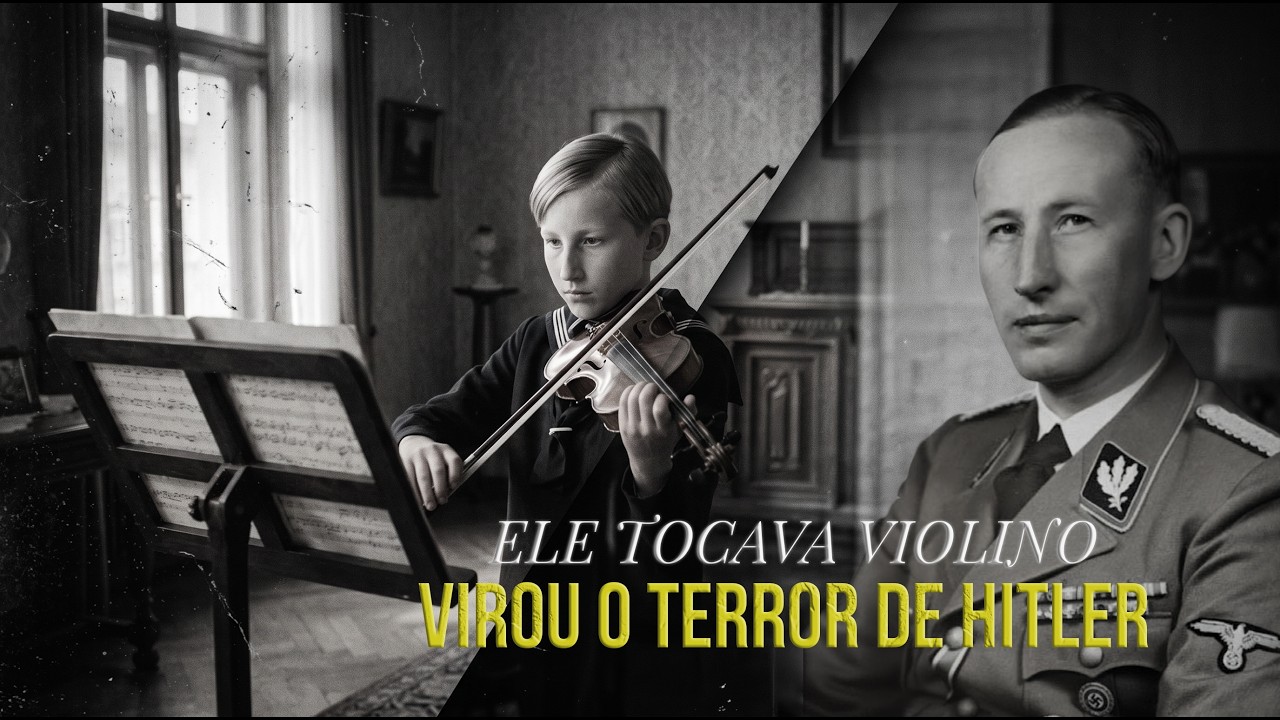
That man was Reinhard Heydrich. And what almost no one knew was that the same hands that now clawed for a weapon had once played Beethoven and Mendelssohn with such sensitivity that adults would stop and listen. How a boy devoted to music became the man Nazi officials themselves feared to meet in a hallway is not a story of a monster born monstrous. It is a story of how a wound, an ambition, and a system of terror turned talent into something far darker.
To understand that moment in Prague, it is necessary to go back to a house in Halle in eastern Germany, where Reinhard Heydrich was born in March 1904. His father, Bruno Heydrich, was an opera composer who ran a music conservatory. His mother, Elisabeth, was a pianist. The household was one of sheet music, rehearsals, and recitals, not soldiers.
Heydrich learned the violin as a child and became exceptionally talented by the account of those who knew him. He also excelled at fencing and won awards. But his childhood was not only applause. He was Catholic in a predominantly Protestant city, and persistent rumors circulated, falsely, that his family had Jewish ancestry because of the surname of his grandmother’s stepfather.
The violin prodigy was also the boy bullied in the schoolyard. He grew up withdrawn and quiet, obsessed with proving his worth, and this obsession would drive everything that followed. In 1918 Germany lost World War I and plunged into chaos. Inflation, hunger, strikes, and street clashes followed.
The Heydrich family lost nearly everything, like millions of others. At fifteen, Heydrich enlisted in a far-right paramilitary militia to help restore order in Halle. Historians consider this his first contact with organized violence and his lasting political awakening. The boy who held a violin in one hand began to handle weapons with the other.
At eighteen he joined the German Navy and thrived, earning excellent evaluations that were praised even by the future Admiral Wilhelm Canaris. He dreamed of becoming an admiral. In 1930 that career collapsed. Heydrich had become involved with the daughter of a shipyard director while already engaged to another woman, Lina von Osten.
A naval court of honor found him guilty of conduct unbecoming an officer and gentleman. The Navy gave him an ultimatum: marry the woman he had gotten pregnant or lose his uniform. Heydrich chose Lina. In 1931, at the age of twenty-seven, he was expelled from the Navy with his career ruined.
It was his fiancée, an enthusiastic member of the Nazi Party, who suggested he try the SS. One day after his discharge, Heydrich joined the party. Six weeks later he met with Heinrich Himmler, who was seeking someone to establish an intelligence service for the SS. Himmler gave him twenty minutes to present a plan.
Heydrich improvised, impressed, and got the job. The man who had once played violin for audiences was handed an empty room, a typewriter, and the mission of building an internal espionage network for the Nazi Party. He did not disappoint. Within a few years the small office grew into the SD, the security service, a machine of dossiers, wiretaps, and blackmail aimed at anyone who could threaten Hitler, including members of the Nazi Party itself.
Heydrich rose quickly, becoming a major in 1931, a colonel in 1932, and an SS general in 1933, all before the age of thirty. He took part in the Night of the Long Knives, personally drawing up the list of targets for execution. He helped orchestrate the Night of Broken Glass in 1938, when synagogues and Jewish businesses were destroyed across Germany and around thirty thousand Jewish men were sent to concentration camps. Hitler, impressed and suspicious at the same time, nicknamed him the Man with the Iron Heart.
But behind that iron heart lay a wound Heydrich spent his life trying to hide. The childhood rumors never disappeared. Even within the SS, suspicion circulated that he had Jewish ancestry on his father’s side. Internal enemies used it against him.
At one point Himmler himself considered expelling him. Hitler intervened after a private meeting and declared that Heydrich was a highly talented but very dangerous man whom the movement should keep close. He survived, but something changed permanently. From then on, every act of cruelty seemed to serve as an answer to the question that had haunted him since childhood: are you pure enough?
The boy who learned the violin in a cultured home gradually became the man who needed to be more ruthless than any other Nazi, so that his loyalty could never be questioned again. In 1939, with the start of the war, Heydrich assumed command of the RSHA, the merger of the Gestapo, the SD, the Criminal Police, and the Foreign Intelligence Service into a single body now considered one of the most efficient repressive structures ever created. He created the Einsatzgruppen, mobile extermination squads that followed the German army through the Soviet Union and shot civilians by the thousands. In January 1942 he convened the Wannsee Conference, and in little more than an hour he presented fifteen senior bureaucrats with the logistics of an industrial genocide: the Final Solution.
The plan called for the elimination of eleven million Jews in Europe. Around six million would be killed by the end of the war. In September 1941 Heydrich was named Acting Protector of Bohemia and Moravia, the de facto ruler of occupied Czechoslovakia, with headquarters in Prague. His strategy had two parts.
On one hand, he offered food and privileges to Czech workers who met production quotas. On the other, he unleashed brutal repression against any sign of resistance. In just five days he ordered the execution of nearly two hundred Czechs. This earned him the name by which he is still known: the Butcher of Prague.
That same arrogance sealed his fate. Confident the region was pacified, Heydrich began traveling around the city without armor and without an escort, just himself and his driver in the convertible. The Czech government-in-exile in London, with British support, planned Operation Anthropoid. Two agents, Jozef Gabčík and Jan Kubiš, were trained and parachuted into Czechoslovakia with a single mission: to kill Heydrich.
After months in hiding in Prague, supported by the local resistance, they found the ideal spot, the sharp turn that forced the car to slow down. On May 27, 1942, Gabčík’s machine gun jammed at the decisive moment, but Kubiš reacted and threw a grenade that exploded near the car, seriously wounding Heydrich in the abdomen and back. He was taken to a hospital, survived the initial surgery, and for a few days seemed to recover, sitting up in bed, eating, and giving orders. Then an infection quickly spread, likely caused by fragments of the car’s upholstery lodged in his body.
On June 4, 1942, eight days after the attack, Reinhard Heydrich died. Nazi retaliation was immediate and disproportionate. More than thirteen thousand Czechs were arrested. The village of Lidice, suspected without concrete proof of sheltering the agents, was surrounded.
All the men were shot on the spot. Women and children were sent to concentration camps, and the entire village was demolished, wiped from the map. The agents responsible for the attack were betrayed by a colleague and surrounded in a church in Prague. After hours of resistance against hundreds of soldiers, out of ammunition and with no way out, they took their own lives to avoid capture.
Accounts from those close to Heydrich say that even during his darkest years in Prague, after signing mass deportation orders and overseeing the logistics of genocide, he still played the violin at home at night, with the same hands. He was given a state funeral in Prague and then in Berlin, with Hitler and the entire Nazi leadership in attendance. He was decorated posthumously. Himmler took over his duties on an interim basis before passing command to Ernst Kaltenbrunner, who continued the extermination machine Heydrich had built.
Decades later, the grave in Berlin was destroyed by occupation forces at the end of the war. The spot where one of the architects of the Holocaust is buried is today marked only by a small stone plaque, almost forgotten. How could the only man Hitler feared have once been a boy who lived to play the violin? There is no simple answer.
Heydrich was not born a monster. He was shaped by childhood humiliations, by a wound that never healed, and by an ambition that found in cruelty the most efficient way to silence all doubt about who he was. The same sensitivity that let him play Beethoven perfectly was the same obsessive discipline he applied to constructing the most organized genocide in history. Talent and monstrosity, in his case, were not opposites.
They came from the same source.