In the autumn of 1871, on a farm in Indiana, a nineteen-year-old woman fell from the hayloft. It was not a dramatic fall. She had come down from that loft a thousand times. But this time her foot missed the rung, the rung gave, or she was simply careless.
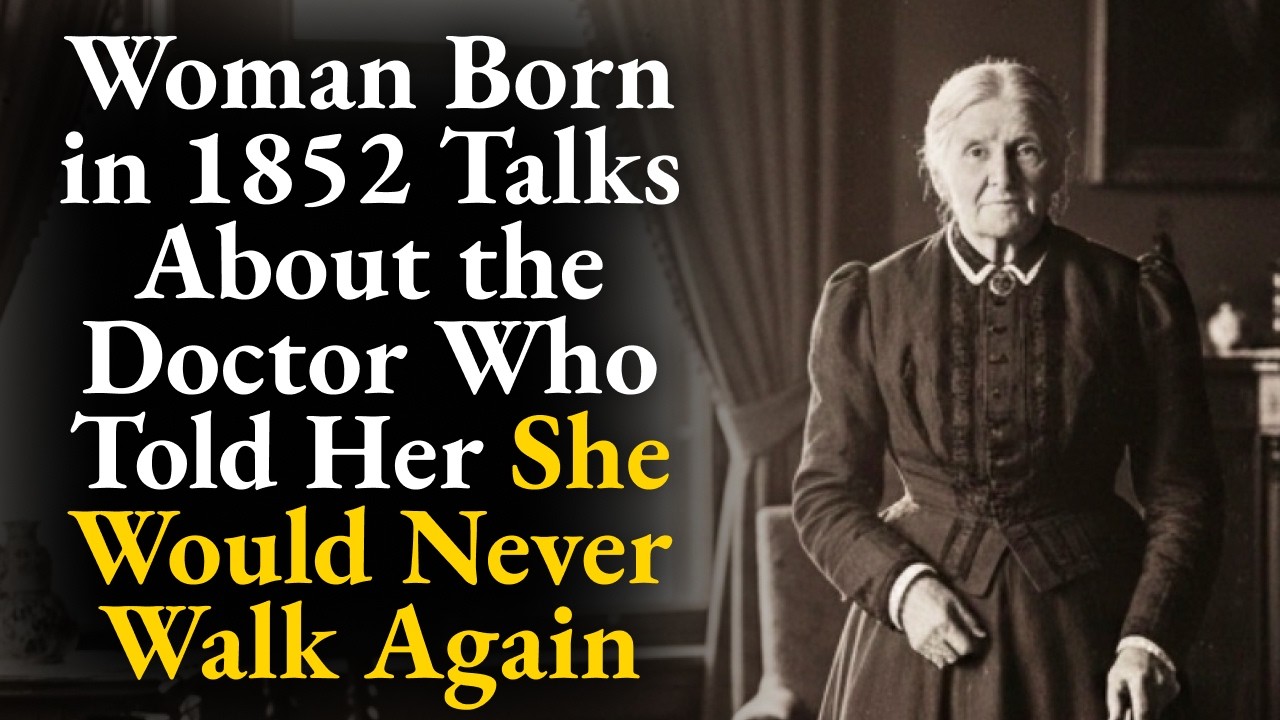
She never knew which. Something in her back and hip gave way with a sound she heard inside her own body. She lay in the hay for a long time before she could call out. Her brother Elias found her and went for their father, and their father went for the doctor.
By the time Dr. Harlo arrived, it was late evening and she was still lying in the hay because no one knew how to move her without making things worse. They carried her into the house on a door plank, moving slowly and carefully. Her mother had already turned down the bed in the downstairs room, the good room kept for company, and put on the good sheets.
That should have told her something. Her mother did not put the good sheets on a bed unless she thought it mattered. Dr. Harlo returned the next morning.
He was a man of about fifty, trained in Cincinnati, competent enough for what the town needed. He were a man who believed in what he knew, and what he knew had a shape to it. Her injury was at the edge of that shape. He examined her carefully, asked where the pain was, pressed along her spine and hip, and asked her to move her foot.
The first time she moved it. The second time she could not be sure if it was moving because she told it to or because of something else. He sent her mother out of the room and then told her what he had found. The nerves running to the legs from the spine had been compressed or torn, possibly both.
He could not tell her which, and in either case the outcome was likely the same. A compression could sometimes heal with time and rest, but a tear was permanent. Based on what he had seen and what she could and could not do, he believed the damage was severe. She should not expect to walk again.
He said he was sorry. He was not cruel. He was simply certain. He left a cane propped against the wall before he went.
A plain wooden cane, straight and smooth with a simple curved handle. He said she would need it in time. She looked at that cane for a long time after he left. The weeks that followed are hard to set in order.
Pain eats time. What she remembers is the shape of the days: the bed, the window, the smell of the house, her mother’s footsteps, the sound of the farm going on without her. That last part was the hardest thing. In the mornings she would hear Elias and her father going out.
Later she would hear the animals and smell whatever her mother was cooking. The whole day moved around her like water around a stone, and she was the stone, fixed in place, not part of it. Her younger sister Ruth came and sat with her in the afternoons, talking to her as if she were still the same person. Her mother brought meals and sat with her while she ate, kind in a way that cost something.
And her mother also began reorganizing the house, shifting the kitchen so Ruth could reach things without help, planning the coming months around the assumption that her daughter would stay in bed and then in a chair. She was not wrong to plan. A farm in autumn does not wait while you decide how sick you are. But the girl lay there and listened to the reorganization happening and felt it like a door closing.
She tried to stand for the first time in early November. Her mother was in the kitchen and the house was quiet. She pushed herself up, got her feet over the edge of the bed, and pushed. She got upright for perhaps four seconds before her left leg went wrong under her.
She went down hard against the side of the bed and sat on the floor with her back against the bed until her mother came in at the noise. Her mother looked at her on the floor, looked at the cane against the wall, and looked back at her. She said, let me help you. She let her.
But she did not take the cane. Not yet. By December she could stand with the bed post and take two or three steps. It did not feel like progress.
It felt like learning a thing that should not need learning. In January she took the cane. She woke on a cold gray morning, looked at it standing there, and something in her that had been holding out against it simply gave way. Not in defeat, more the way you stop arguing with weather.
She picked it up. It was lighter than she expected. With it in her right hand, she could go from the bed to the door and back without stopping. That was the whole room.
The whole room was her victory that January. By February she could reach the kitchen table and sit with the family for meals. Her mother said nothing the first morning. She just turned from the stove, looked at her, and got an extra cup for the coffee.
That was enough. That was the right thing. But at that same table she began to understand how her mother had reshaped herself around the injury. She was explaining to Ruth how to manage the winter preserves, the shelf, the order, how to check the seals, in the same patient, instructional tone she had used to teach her eldest daughter those same things three years before.
She was teaching Ruth what had been hers. Not cruelly, not even consciously. She was just managing what she believed was real. There was a young man.
His name was Daniel Puit. He had been coming around since the summer before the injury, solid and decent and steady in the way that matters more than most qualities in an actual life. He kept coming around after the injury. He sat in the kitchen with her family or in the room with her.
He did not say false things. He did not say she would be fine or the same as before. He said, I am here. And that was what he said every time.
The trouble was not that he left too soon. The trouble was something she did to him that she only understood much later. By spring she could walk to the front door. By early April she could stand on the porch and feel the sun without the cane in her hand, just holding the porch rail.
She knew Dr. Harlo had been wrong. But she also knew what was still not right, what still went wrong under her without warning. And she knew something else, the part she never said out loud.
She knew that what the proving was going to cost would be more than she had paid so far. She just did not know who else would be paying. Through the spring and summer of 1872 she pushed every day past what her body could sustain, into the range where the cost came later at night when the muscles along her hip and lower back would seize and she would lie still and wait for it to pass. She used the cane, and she hated it with a steadiness that surprised her when she examined it.
It was not the cane’s fault. It was what it stood for: what the doctor had expected her to need, the full scope of a smaller life. Daniel was there through all of it. In the long summer evenings they sat on the porch and talked about what they wanted and what they were afraid had changed.
He listened without trying to fix anything. He said she was still the same person, still the person he came around to see. She believed him. She turned his certainty about her into fuel for the proving, which meant she was using him without knowing she was doing it.
His steadiness became something she leaned on the way she leaned on the cane. A thing that held her up while she walked. Not a person in his own right. That fall she walked to the Miller farm.
Two miles there, two miles back. She had the cane and stopped three times each way and was in bed for a day afterward. But she did it. When she walked through the door, her mother went white, then red, then sat down at the kitchen table and asked what she had been thinking.
She could have fallen in the road. She said she didn’t. That was the beginning of something between them that she still was not sure what to call. Not a break, more like a divergence.
Her mother had decided what she could be. She had decided what she was going to be. The two decisions did not go in the same direction. By that winter she walked to the road and back without the cane on good days.
Good days meant the hip was quiet and the left leg was steady and the weather was not too cold, because cold made everything worse. But good days came more often, and she held them like evidence. Dr. Harlo came by in November to check on her.
He said she had made some progress and that the cane was a sensible precaution. He said she should not overexert herself, that the kind of injury she had sustained was not something you push through. He said it like he meant it, like he had learned it from experience and was passing it on as a gift. What she heard was the same thing she had heard the first time.
He said it like it was already done, like the shape of her future was settled. She thanked him and walked him to the door with the cane in her hand. Daniel asked her to marry him in December of that year. He asked simply, the way he did everything, in the kitchen with her father in the next room and her mother at the stove.
He said he wanted to marry her, that he had wanted that before any of this happened and he wanted the same now. She told him she needed to think. What she was thinking was this. She did not want to be married to a man who was with her because she needed him.
She did not want to be a woman whose husband was also her proof of something, her support in both the literal and practical sense. And she was afraid that marrying Daniel meant accepting a limit. Not because he would impose one, but because she would. Something in her knew that if she said yes, the proving would stop, and the proving was what she had left.
In January she told him she was not ready. She told him it was not about him. He was quiet for a moment, and then he said, all right. He stood up and he left.
She watched him go down the path from the window, his coat dark against the snow. She expected to feel free. She felt instead like she had set down something heavy and found that her arm still hurt from carrying it. By spring he was calling on a girl from the other side of the county, and by fall they were engaged.
She was genuinely glad for him. And also, she did not sleep well for a week. By the summer of 1873 she was walking without the cane on most days. Her left leg was not what it had been and never would be.
There is a hitch in her gait even now. But she walked to the Miller farm and back, walked to the church, walked the fence lines in the evening the way she had walked them with her father when she was a girl. The cane came still, in her hand or over her arm, because the left leg would still go wrong without warning. But it was not a verdict anymore.
It was just a thing she carried. One afternoon she passed Dr. Harlo on the road. He stopped his buggy and looked at her walking with an expression she has thought about for sixty years.
It was not quite surprise and not quite admiration. More like a man revising something he had written and not being sure whether the revision was an improvement. He said, Miss Voss, you’re walking well. She said yes.
He said he was glad to see it. She thanked him. That was the last real conversation she ever had with him. He died in 1901.
She did not feel triumph. What she felt was more like the end of a conversation that had already stopped. She left the farm in 1875, not pushed out, but because there was work in Carver, the nearest town of any size, and she was twenty-three and the proving was mostly done. She found work as a seamstress at a dry goods shop.
The owner, a widow in her late forties, hired her after watching her hem a pair of trousers and never asked about her leg. She appreciated that more than she ever told her. In the mornings she could sometimes leave the cane at home and manage the walk from her rented room to the shop without it. Not always.
On bad days, cold days, damp days, the cane came. She had made a kind of peace with that. Not the peace of acceptance so much as the peace of arithmetic. What the leg could do, what it could not, what the cane added to the ledger.
She was in Carver for four years before she met George Wland. He was a carpenter, thirty-one to her twenty-seven, from Ohio, who had come to Indiana to work on a building project and stayed on because there was more work. He had steady hands and a steady nature. He knew about the leg before he knew her well.
There was no hiding it in a town that size. He knew she had been hurt and walked with a cane sometimes and was otherwise able to manage her own affairs. He seemed to find that straightforward rather than complicated. He asked her to walk with him one Sunday evening in May of 1879, and he did not offer his arm or shorten his step for her or make any adjustment at all except to walk at a pace that suited both of them.
She thought, this is a man who has decided what he thinks and does not need to keep deciding. They were married that September. She brought complicated things to that marriage. She brought the leg, the bad days, the cane, the stubbornness she had grown during the proving.
She brought the place in herself where Daniel used to be. Not grief exactly, not regret exactly, but an absence where something had been, a room she had closed and did not reopen. George knew the woman she had become after. He did not know the girl who had fallen from the hayloft or lain in the company bed or sent a good man away in January.
He knew her from 1879 forward. The woman he knew was capable and self-sufficient and not prone to sharing the inside of herself. He may have thought that was simply her nature. She supposes by then it was.
The cane stood in the corner of their first house and in every house after that, moved from corner to corner as they moved, always finding a new corner to stand in. George never asked about it. She thinks he understood without asking that it was not something to ask about. They had three children: Henry, born in 1881; Kora, in 1883; and James, in 1886.
The proving was over finally with the children. Not because she had proven anything to anyone, but because the life that was hers, the full life, the one that was not the diminished version the doctor had sketched out for her, was there. She was inside it. George was a good husband.
He worked steadily, and he was not cruel or careless with the children. When the leg was bad, he did not comment on it, but he also did not pretend he had not noticed. He had a way of arranging the household without saying he was arranging it, moving a chair so she could sit without making a production of it, carrying something heavy past her without being asked. What George did not know, what she never told him, not in thirty-one years of marriage, was how much of herself she had used up in the years before him.
The two years of fighting her own body past what it wanted to do. The things she had done to her mother’s peace of mind, to Daniel, to herself in the course of the proving. She was not sure in those years that she had gotten back everything that mattered. She had the walking.
She had the full life, or what looked like one from the outside. But there was something in her that was quieter than it had been before the injury. Not sadder, exactly. More like a room where the furniture had been rearranged after a repair.
You could see it was the right furniture, but the arrangement was not quite the same, and you kept reaching for things in the wrong place. Kora asked about the cane when she was about four. She had found it in the corner of the bedroom and was using it as a walking stick, thumping around the floor the way children do with anything that looks like a prop. She asked what it was for.
She said it was for walking when her leg hurt. Kora put it back in the corner carefully, with the particular seriousness small children have about things they sense are important to adults. Henry grew up knowing the cane was there the way you know a cracked pane in a window. He never asked about it.
James was different. James watched her from the time he was small. He saw when she was favoring the leg and when she was tired. He did not say anything about these things.
He just noticed them. George died in 1910. He was fifty-nine, which is not old, and the heart went quickly the way they sometimes do. He died in the chair in the parlor on a Tuesday afternoon in March, and she found him when she came in from the yard.
She stood in the doorway for a moment before she went to him. What she thought, the thing she has never said, was that she did not tell him enough. Not the ordinary things. The particular things.
What it had cost to become the woman he had married. What he had been given without knowing what he was given. The quiet and capable woman, without knowing what she had been before and what it had taken to make her. George was not a man who needed explaining, but she had never offered it.
Standing in that doorway, she felt the weight of all the years of not offering, like something physical. At some point in the evening, walking through the house to find the neighbors, she picked up the cane without thinking. She did not realize until later that after thirty years she had reached for it without knowing. She has lived in her current house since 1912, when Henry found it for her and helped her move.
It is a small, sensible house with a yard she keeps up herself and a front porch where she sits in the good months. The town has grown around it, filled in with more houses and more streets. The cane is in the corner of the bedroom upstairs. It is the same cane Dr.
Harlo left against the wall in 1871. She has had it for sixty-four years. She has no good reason for keeping it. It is not a trophy.
She does not take it out and look at it with satisfaction. But she has also never been able to throw it away. When she moved from one house to another, she carried it with her, wrapped in a piece of cloth and packed in the bottom of the trunk before anything else. Her granddaughter Helen asked about it last spring.
She is fourteen, sensible and curious, with blue eyes that startle her sometimes. She came upstairs to help carry down some things and saw it in the corner and asked, Grandma, why do you have a cane? You don’t use a cane. She said she used to.
Helen asked why she still had it. She stood there with that question in the room between them and did not have an answer that was small enough for a fourteen-year-old. She said she was not sure. That was true.
But it stayed with her. The question. Why do you still have it? Part of the answer is that it is the oldest thing she owns.
Her mother’s sewing table is gone. Her father’s Bible is gone. The cane has outlasted almost everything from her childhood. It has outlasted Dr.
Harlo, who gave it to her. It has outlasted Daniel Puit, who died in 1918, of something in his chest that took him slowly. It has outlasted George, who died young. It has outlasted her father, her mother, her brother Elias, her sister Ruth.
Another part of the answer is that she is not sure even now what it means. Whether it means the thing the doctor meant, a tool for a life lived smaller, or the thing she made it mean by refusing it and then taking it up again. It has meant both things at different times. It has been in the corner for sixty years being both things at once, and she has never found a way to separate them.
What the doctor said lives in the cane. What she did to prove him wrong lives in it, too. The price of the proving lives in it. She has kept it because she has not decided yet whether what she did was worth it or simply what was possible.
And until she decides, she cannot let the evidence go. She is eighty-three years old and running out of time to decide. Her left leg is worse this year than it was last year. The mornings are the hardest part.
There is a stretch of time between when she wakes up and when the leg agrees to function as expected. She moves carefully with one hand on the wall. She does not take the cane out of the corner. Her children would say, Mama, just use the cane.
They do not know what it would cost her to take it off that corner now after sixty years and bring it back into service. Not the physical cost. The other kind. She knows this stubbornness is not entirely rational.
She has known that for many years. The stubbornness that got her from the company bed to the fence line, that got her to the Miller farm and back, that sent Daniel Puit down the path in the snow. That stubbornness was the thing that saved her and also the thing that cost her. At eighty-three it is still in her, still telling her the same thing it told her at twenty.
This is not who you are. But she is beginning to wonder if that is the right question. Not who she is. What she has been doing all this time, and whether it was only for herself.
She has been thinking about her children. Kora is fifty-two and is in her own way a version of her mother: capable, self-sufficient, not given to sharing the inside of herself. She watched her daughter keep things to herself all her life with a recognition that is not comfortable. James, who watches, knows something is not right this year.
He has said nothing and done nothing except come by more often than he used to, which is his way. Henry comes every few months from Indianapolis and stays two nights, and they sit on the porch in the evenings and talk about his grandchildren and the state of his business and the weather and the town. He does not ask how she is in any way that requires a real answer. She has always appreciated that.
She is now not sure she should have. There are things she has never told any of her children, not because they are secrets exactly, but because they are hers. She has held what is hers very close for a very long time. That habit started in 1871 on a farm in Indiana and never fully stopped.
She knows what was lost that never came back. She lost the easy version of her own body. Not the bad days with the leg. The simple unconsciousness of before, the way you move through a room without noticing that you are moving, without calculating, without the part of your mind that is always monitoring and adjusting.
She lost that the winter of 1871 and it never came back. She became someone who paid attention to her own body the way you pay attention to a complicated piece of machinery. That attentiveness served her well and also never let her alone. She lost the open version of herself that had existed before she understood what she was capable of in the dark sense.
Before she knew she could push past what her body was telling her and damage both of them in the process. Before she knew what she was willing to do to people who cared about her in order to not need them. She is not sure she lost Daniel Puit. She thinks she gave him up deliberately, for reasons that made sense to her then and make a different kind of sense to her now.
But she lost whatever the life with him would have been. She has lived sixty years inside the life that came instead. The life that came instead was good, genuinely good. And something was lost that she does not have a name for.
Something she made a decision about at twenty without understanding that it was a decision she was making. Henry came last week. He sat on the porch with her in the late afternoon, the sun coming level and warm the way October sun does. He talked about the grandchildren and his business partner who was giving him some trouble, and then he was quiet for a while, and then he said she looked tired.
She said she is eighty-three. He said, I know, but, and then he did not finish the sentence. That was very Henry. She understood what he meant, and he understood that she understood.
They sat together in the late sun with the unfinished sentence between them. She has been thinking about Dr. Harlo more than she has thought about him in years. Not with anger.
The younger version of this story, the version she carried through most of her adulthood, had anger in it. He was wrong. He was wrong and he was certain. And his certainty shaped two years of her life in ways she spent decades working against.
That is not nothing. But here is what she has come to at eighty-three. He was also a man of fifty in a rural county in Indiana in 1871, doing what he knew with the tools he had. What he knew did not include her particular case going the way it went.
He was not wrong about everything. He was not wrong that the injury was serious, that the damage was real, that the road back would be hard and uncertain. He was wrong about the end of it. He was wrong about what she was capable of.
But he did not know that, and she is not sure he could have known it. What he did, and she has had to sit with this for a long time, was take the decision away from her before she had made it. He decided what was possible. And he told her, and because he was the doctor and it was 1871, that deciding was allowed.
The wrong was not in the certainty itself. The wrong was in the fact that it was his certainty about her body, about her life, and he handed it to her as a finished thing. He said it like it was already done. And she spent sixty years answering that.
Two years fighting to walk, which was necessary. Thirty years more carrying the fight inside her even after she had won it, which was something else. Something she built out of the injury and the verdict and the anger that she is not sure she ever fully put down even when she had no more use for it. What did it cost?
She can count it honestly. It cost Daniel Puit the life she might have given him if she had not been in the middle of proving something. She thinks he deserved better than what she gave him, which was someone who used his steadiness for fuel without ever letting it be what he was offering it to be. He found Edna Fowler, and she believes he had a good life, and she is glad for that.
And she is also sorry in the way you are sorry for things you cannot undo. It cost George the full version of his wife, the one who knew how she had gotten to be the woman he married. He got a capable and loyal woman who loved him in her way. She thinks that was enough for him.
And she also thinks he would have been interested in the rest of it if she had trusted him with it. And she never did. It cost her children something she can see in them, particularly in Kora: the not sharing, the holding close, the self-sufficiency that is also a kind of wall. She gave it to them without knowing she was giving it, the way you pass on the way you hold a tool or set a table, without teaching it, just by doing it in front of them every day until it was theirs.
Her left leg gave out on her one morning. Not badly. She caught the door frame in time and the floor did not get her. But it went the way it had been threatening to go all month.
She stood there in the doorway with her hand on the frame and her breath coming a little fast, and she looked down the hallway toward the bedroom, toward the corner where the cane stands. She stood there for a long time. Then she went and got it. She carried it back to the kitchen and made the coffee and stood at the stove with the cane in her free hand, the weight of it familiar in a way that surprised her.
She had used it on bad days over the years, but she had always put it back after. This morning felt different. This morning felt like a different conversation than the one she had been having with it for sixty years. It is lighter than she remembers.
She thought that before, the first time she picked it up in 1872. It is still lighter than it should be for what it has meant. She has been sitting at the kitchen table since breakfast, saying this out loud in her head, the way she has been saying it for months. Helen’s question has stayed with her.
Why do you still have it? And because there are not many October mornings left, she thinks she finally knows what she wants to say. She kept the cane because she could not decide. And she could not decide because she could not answer the question of whether what she did was worth what it cost.
And she could not answer that question because the cost was not only hers. The cost was Elias watching her fall and not knowing how to help. Her mother’s grief that rearranged the kitchen around an absence that did not come to pass. Daniel Puit standing in the snow at the bottom of the path.
George gone in the parlor on a Tuesday in March. Kora, who holds herself close and does not know she is the reason. She walked. She proved the doctor wrong.
She walked to the Miller farm and back, two miles each way, with a cane over her arm and the left leg dragging slightly and the sun on her face. She felt that day something she cannot honestly describe as anything other than joy. Real joy, the kind that does not ask to be justified. And she sent a good man down a snowy path because she was not finished proving something.
And she gave her children a wall instead of a window. And she kept the full account of herself from the man who loved her and deserved it. She does not know whether those were the necessary costs of the joy or the unnecessary ones. She thinks maybe that is the wrong question, too.
She thinks maybe the question she has been asking for sixty years, was it worth it, did I get back what mattered, did I lose the essential thing or only the visible one, does not have an answer the way she wants it to. She thinks the injury and the proving and the life she made out of them are not separable the way a debt and a payment are separable. They are woven. The walking and the cost are the same cloth.
She is eighty-three years old. Her left leg is worse this year. The cane is in her hand. Dr.
Harlo is dead. Daniel Puit is dead. George is dead. Her mother is dead.
Most of the people who knew her young are gone. The ones who are left do not know the young version. They know her from somewhere in the middle, after she had already become what the proving made her. And here she is still standing in a kitchen in Indiana, in a house she has kept for thirteen years, with the autumn light coming through the window and the cane in her hand and the full accounting still unfinished.
She does not know if that is a failure or just the truth about what a life looks like from the inside when you are honest about it. She does not think she will know before she dies. The cane is a piece of wood. It has stood in its corner for sixty years.
She has walked past it ten thousand times, and it has stood there neither accusing her nor congratulating her, just being what it is, plain, exact, patient. She thinks she understands now why she kept it. Not because it represents what she overcame and not because it represents what she lost. She kept it because it is the oldest true thing she has.
It was there at the beginning of the hardest years of her life. It was given to her by a man who was wrong about what she was, and she has carried it ever since through everything. And the carrying is the thing she cannot explain and will not explain away. She is going to sit on the porch this afternoon if the weather holds.
She is going to carry the cane with her and set it beside the chair and look out at the elm going yellow in the yard and the maple going red. She is going to sit there in the October light for as long as it lasts. It is enough. It is enough to have walked and to have paid what she paid and to sit in the light now at the end of it and say, I know what it cost and I know what it gave me, and I am not sure they balance, and I have stopped waiting for them to.
He said it like it was already done. He was wrong about the done part. He was right about the already, the way the injury had already started shaping who she would become before she knew there was a choice in it. Some things are already done before you can see them.
You find out what they are by living through them. She lived through this one. She has the cane to prove it, and the walk, and the full accounting here at the end, honest as she can make it.
That will have to be enough.