November 22, 1963 began as an ordinary Friday at Parkland Memorial Hospital in Dallas. The emergency room was full, as it always was: gunshot wounds from the night before, a car wreck from the highway, a woman in labor who had never seen a doctor during her pregnancy, an elderly man with chest pains who had waited three days because he had no insurance and didn’t think a hospital would take him. Parkland took him. Parkland took all of them.
That was the job. That had always been the job. The hospital had been built for people who had nowhere else to go. In the early 1890s, Dallas was a city sprinting past its own infrastructure.
The railroads had arrived in the 1870s, cotton money poured through, and the population exploded from a few thousand after the Civil War to more than 38,000 by the 1890 census. The growth made Dallas wealthy, but it made the city dangerous for anyone who wasn’t. A laborer injured in a rail yard, a domestic worker with tuberculosis, a child with a raging fever and no money for a doctor—these people had almost no options. Private hospitals expected payment in advance.
Charity care was piecemeal. The city maintained essentially a pest house for infectious disease and not much else. The business community began to recognize that a city without a public hospital would repel the very investment it depended on. Nobody wanted to relocate a factory to a town where a sick worker had nowhere to go.
In 1894, Dallas County purchased a tract of open land south of the downtown commercial core. Roughly seventeen acres of gently rolling, grassy ground dotted with trees. County records described the terrain as Parkland. The name stuck.
The original structure was modest, a wood-frame building with fewer than fifty beds, but it was open, and it accepted patients who couldn’t pay. From the day it opened, it was overwhelmed. Parkland was not born from Dallas’s generosity. It was born from Dallas’s math.
A city growing that fast, with so many people doing dangerous work in rail yards and cotton gins and construction sites, was going to produce injuries. If there was no public hospital, those people would die in alleys and boarding houses, and the city’s carefully marketed image as a progressive commercial center would take damage no advertising campaign could repair. Through the early decades of the twentieth century, Parkland grew grudgingly, incrementally, usually after something had gone visibly wrong. The city’s population passed 90,000 by 1910, 150,000 by 1920, and approached 260,000 by 1930.
Oil money arrived and the downtown skyline pushed upward. New neighborhoods sprawled in every direction, and Parkland absorbed the human cost of it all: construction injuries, factory accidents, tenement fires, tuberculosis, pneumonia, polio. The original wooden structure gave way to larger brick buildings. By the 1920s, Parkland had several hundred beds and was treating tens of thousands of patients a year.
It had become, by default, the largest hospital in Dallas. Not because it was the best funded or best equipped, but because it was the only one that never closed its doors to someone who couldn’t pay. What transformed Parkland came during the Second World War. In 1943, Southwestern Medical College was established in Dallas, eventually becoming the University of Texas Southwestern Medical School.
The school needed a teaching hospital where students could train on real patients in real emergencies at high volume. Parkland was the obvious choice. It was overwhelmingly busy, and it had patients nobody else wanted—the poor, the uninsured, the traumatically injured. The partnership changed the institution’s DNA.
A surgery resident at Parkland in the 1950s might perform more emergency operations in six months than a resident at a prestigious private hospital would perform in three years. The patients were real, not simulated, and the consequences of a wrong decision were immediate and irreversible. If you couldn’t fix it here, it wasn’t getting fixed. By the mid-1950s, the old buildings were failing, and in 1954 a new Parkland Memorial Hospital opened.
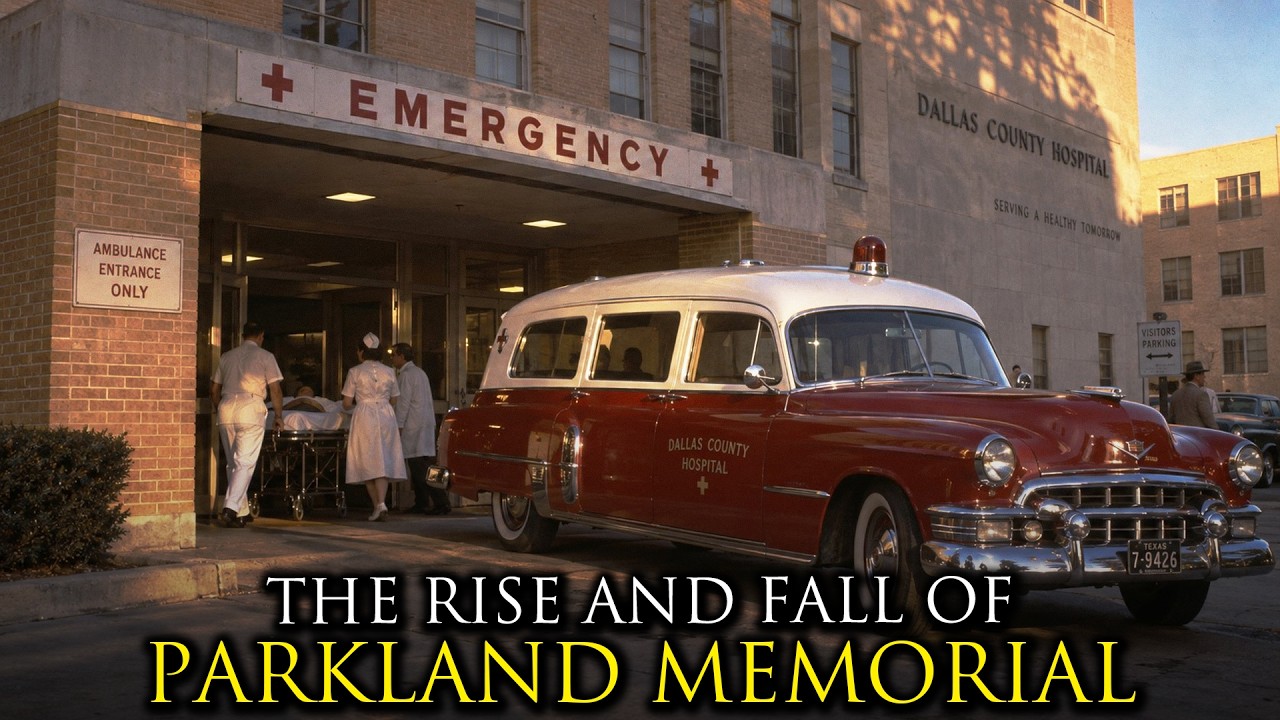
It was large, modern by the standards of the day, and relentlessly institutional: fluorescent lighting, cinder block and tile, designed not for aesthetics but for throughput. The emergency department occupied the ground floor, accessible from a covered entrance where ambulances pulled directly up to the doors. Just off the main emergency corridor were the trauma rooms, compact and intensely equipped. Trauma room 1 was approximately twelve by sixteen feet, with white tile walls, overhead surgical lights, stainless steel instrument trays, oxygen ports, and a drain in the center of the floor—because the work done in that room often produced blood in quantities that needed to be washed away quickly.
For nine years, that room did its anonymous, relentless work on the daily emergencies of a city growing faster than its infrastructure could manage. Then came November 22, 1963. The presidential motorcade left Love Field at approximately 11:50 that morning. The weather was clear and warm, and the Secret Service had removed the limousine’s bubble top so crowds could see President John F.
Kennedy and the first lady clearly. At Parkland, four miles from Dealey Plaza, there were no special preparations. No Secret Service advanced team had staged equipment there. No military medical unit was standing by.
The emergency department was running a normal Friday. The shots were fired at approximately 12:30 p. m. Parkland received no warning call.
The first indication came in fragments: a call from a dispatcher, possibly a bystander. Someone had been shot. It might be the president. The Secret Service made the decision in seconds.
They needed the nearest major emergency facility, and the Stemmons Freeway, which the motorcade was already heading toward, ran directly past Parkland. The distance from Dealey Plaza was roughly four miles. The limousine pulled up to the emergency entrance at approximately 12:38 p. m.
The president was lifted from the back seat and placed on a gurney. Governor John Connally, who had also been struck, was on a second gurney right behind. They were rushed into the trauma area. Dr.
Charles Baxter was one of the first physicians to reach the president. Dr. Malcolm Perry, a young attending surgeon only about thirty-four years old, was called from the cafeteria. Dr.
Robert McClelland arrived shortly after. Dr. Kemp Clark, the hospital’s chief neurosurgeon, was summoned when the nature of the head wound became clear. These were not presidential physicians.
They were the staff of a county hospital, talented and intensely well-trained by the pace of Parkland’s emergency department, accustomed to working on patients who arrived without names, without insurance cards, without anyone in the waiting room who could explain what had happened. The president arrived exactly the same way. The only difference was the number of men with guns standing in the corridor. Perry performed a tracheotomy to secure an airway through the wound in the president’s throat.
Chest tubes were inserted, IV lines were placed, and resuscitative measures were applied with the urgent, practiced precision that Parkland’s trauma teams executed night after night. But the wound to the president’s head was catastrophic. The doctors in that room had seen injuries like it before on shooting victims from Dallas’s roughest neighborhoods. They knew from hard experience that this kind of damage was not survivable.
At 1:00 p. m. , Dr. Kemp Clark officially pronounced John F.
Kennedy dead. What happened next is the part that gets overlooked. While trauma room 1 held the body of the president, while Jacqueline Kennedy sat in a metal folding chair nearby, while Secret Service agents sealed the corridor, the rest of Parkland kept working. The emergency department did not shut down.
The woman in labor on the third floor still needed delivery. The car wreck victim in trauma room 3 still needed surgery. Governor Connally, in an operating room nearby, was undergoing a complex procedure for his own serious wounds. He would survive, in significant part because the surgeons treating him had been trained by the same relentless case load that made Parkland what it was.
The mundane machinery of a public hospital ground forward because it had to. Within the hour, Parkland was surrounded by press, by police, by a city trying to understand what had just happened. The name Parkland entered the global vocabulary that afternoon. It became synonymous with the assassination, with death, with the image of a young president carried into a county hospital and carried out under a sheet.
It would never fully escape that association. But Parkland was not finished with the Kennedy assassination. Two days later, on Sunday, November 24, Lee Harvey Oswald was being transferred from the city jail to the county jail. In the basement of Dallas police headquarters, with television cameras broadcasting live, a nightclub owner named Jack Ruby stepped forward from the crowd and shot Oswald once in the abdomen at point-blank range.
An ambulance brought Oswald to Parkland—same hospital, same emergency entrance, same corridor, into the trauma area just steps from the room where the president had been pronounced dead forty-eight hours earlier. Several of the same physicians who had worked on Kennedy now worked on the man who killed him. Perry was there again. McClelland was there again.
They treated Oswald the way they treated everyone who came through those doors. That was the point of the hospital. Oswald was pronounced dead at 10:07 p. m.
, almost precisely the same time of day Kennedy had been pronounced dead two days before. The story still wasn’t finished. Jack Ruby was arrested, tried, and convicted of murder. While awaiting a new trial—his conviction had been overturned on appeal—Ruby became ill in the Dallas County Jail.
He was diagnosed with lung cancer that had already metastasized aggressively. Because he was a county prisoner, his medical care was the county’s responsibility. He was transferred to Parkland for treatment. On January 3, 1967, Jack Ruby died at Parkland Memorial Hospital.
The president, his assassin, and the man who killed the assassin all died inside the same charity hospital. The president ended up there because in the seconds after the shooting, the nearest facility equipped to handle a critical trauma case was a county hospital for the poor. The assassin ended up there for the same reason. The killer ended up there because county prisoners get their medical care at the county hospital.
After the world’s cameras left Dallas, Parkland went back to doing what it had always done. The emergency room was full the following Monday. The maternity ward was delivering babies. The assassination had given the building a name the world recognized, but it didn’t give it more beds, more nurses, or more money.
What it did make visible was a truth about Parkland that had always been there. The world’s most powerful patient had been treated by young doctors at a county hospital because that was the kind of hospital that was always prepared for the worst. And the reason it was always prepared was because the worst showed up every single day. Through the late 1960s and 1970s, Parkland’s reputation as a trauma center grew into something close to legend.
Dallas had a violent crime problem, with homicide and assault rates among the highest of any major American city, and virtually every serious injury was funneled to Parkland. The experience it produced was undeniable. A resident completing a surgical fellowship at Parkland might have operated on more penetrating trauma injuries than most surgeons in private practice would see in a twenty-year career. When the American College of Surgeons formalized the trauma center verification system in the 1970s and 1980s, Parkland’s designation as a Level One trauma center was practically a formality.
The hospital had been functioning at that level for decades. The phrase “Parkland-trained” became a credential in surgical circles—a reputation that preceded you. A medical technique for managing fluid resuscitation in trauma patients, developed and refined at Parkland through its experience with burn victims and adopted nationally, became known informally as the Parkland formula. And through all of this, the most remarkable thing Parkland did every day was almost never reported on.
By the 1990s and early 2000s, at its peak, the hospital was delivering somewhere in the range of 16,000 babies annually—roughly one birth every thirty to thirty-five minutes, around the clock, every day of the year. The women who came were overwhelmingly without insurance. Many had received little or no prenatal care. They came because Parkland couldn’t refuse them.
And almost none of it was paid for. The uncompensated care tab grew year after year, climbing into the hundreds of millions of dollars annually. Dallas County funded Parkland through property taxes, and every year the county commissioners debated how much to allocate. It was the same argument Dallas had been having since 1894: Is this hospital a moral obligation or an expense the county can’t justify?
By the early 2000s, the 1954 building was failing. The electrical systems couldn’t support modern diagnostic equipment. The emergency department built for a city of a few hundred thousand was now absorbing the emergency load of a metropolitan area approaching five million. The question of replacing the building had been discussed for years, but building a new public hospital is a political decision.
It required a bond election. In 2008, Dallas County voters approved a bond package for a new Parkland Memorial Hospital. The final cost ran to approximately $1. 3 billion, making it one of the most expensive public hospital construction projects in American history.
The new Parkland opened in August 2015, a massive complex of roughly 2. 8 million square feet on the same campus as the old building. It had a new emergency department with more than twice the capacity, a new trauma center, a new maternity ward with private rooms, new intensive care units, new imaging technology. The old building—the corridors where a president’s gurney had been rushed at a run, the trauma area where an assassin had died, the maternity floors where tens of thousands of Dallas residents had taken their first breath—was gradually emptied, decommissioned, and partially demolished.
The core function of the new hospital is identical to what it was the day the first wooden structure opened its doors. It is still the hospital for people who have nowhere else to go. It is still funded by Dallas County taxpayers. It still delivers thousands of babies every year to mothers without insurance.
It still runs one of the busiest Level One trauma centers in the nation. It still trains residents who scatter across the country carrying what they learned. And it still faces the same financial tension it has faced for 130 years: a hospital that can never say no, funded by a community that can never quite agree on how much it’s willing to spend on saying yes. The story the world remembers about Parkland is twenty-two minutes long.
That story is real, and it belongs to the hospital the way a scar belongs to a body. But twenty-two minutes out of 130 years is a fraction so small it rounds to zero. Before the motorcade pulled up, the hospital had already been open for sixty-nine years. After the cameras left and the world moved on, Parkland kept doing what it had done every day before: taking in the people nobody else wanted.
The woman hemorrhaging in a parking lot because she couldn’t afford prenatal care. The teenager shot through the lung over a pair of shoes. The elderly man whose diabetes had taken both his legs because he’d gone fifteen years without seeing a doctor. The president was one patient.
The most famous, the most consequential by any measure of how the world keeps score. But he arrived the same way everyone else arrived: without warning, without an appointment, carried through the door of the nearest hospital that would take him, without asking a single question first. That hospital was a charity hospital built on open land at the edge of a young and ruthless city, funded by property taxes, staffed by the overworked and underpaid, filled every single day with the people a booming American metropolis preferred not to see—until one of them was the president, and there was nowhere else to look. The door was the point.
The door was always the point.