On June 25, 1876, a combined force of Lakota, Northern Cheyenne, and Arapaho warriors under Sitting Bull and Crazy Horse annihilated a battalion of the U. S. Seventh Cavalry led by Lieutenant Colonel George Armstrong Custer. The Battle of the Little Bighorn stunned the nation and became one of the most fiercely debated engagements in American history.
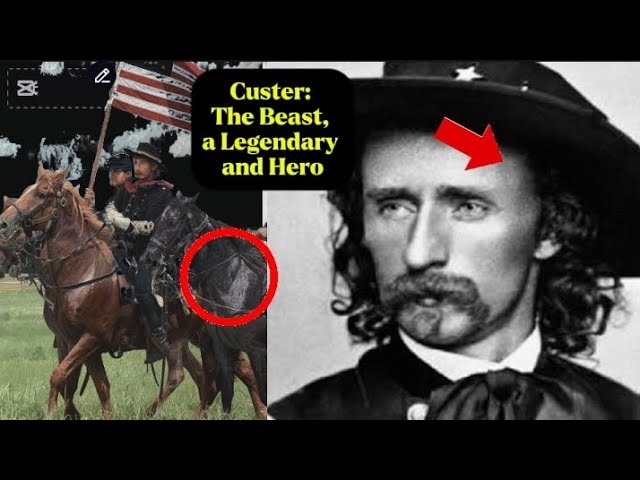
Custer’s death, along with the destruction of his immediate command, transformed a reckless military disaster into a martyr’s legend, one that would be used to justify a brutal campaign of conquest against Native peoples for decades to come. The tragedy of that campaign reached its grim conclusion in 1890 at Wounded Knee, where roughly three hundred Native Americans, many of them women and children, were killed by Hotchkiss guns manned by soldiers of the very regiment Custer had led. Custer was not merely a cavalry officer. He was one of the most celebrated and self-consciously theatrical figures of his era.
Born in New Rumley, Ohio, he grew up in a family steeped in politics and competitive banter. A moment from his childhood reveals the man he would become. At age four, he needed a tooth extracted, and his father took him to the dentist late at night. Terrified of blood, the boy was urged by his father to be a brave soldier and get through it together.
Custer endured the extraction without a sound, then turned to his father and announced that the two of them could defeat every Democrat in Ohio. He graduated last in his class at West Point, but not for lack of intelligence. He deliberately cultivated the persona of the rebellious cadet, walking a fine line between defiance and expulsion. He survived, graduated, and was well liked by many of his peers.
During the Civil War, he emerged as one of the Union army’s most daring cavalry commanders. Promoted to brigadier general at twenty-three, he became one of the youngest generals in the Union forces. He wore velvet uniforms and let his blond hair grow long, cultivating an image as much as a command. At Gettysburg, he helped blunt J.
E. B. Stuart’s cavalry attacks. He was present at Appomattox, where Sheridan presented the peace treaty table to Custer’s wife, Libby, who served throughout his career as his media agent and image-maker.
When the Civil War ended, Custer’s path led west. But the conflict he found there was unlike anything he had fought before. The army had been drastically reduced in size, and desirable positions were scarce. Many soldiers who fought in the western campaigns were recent immigrants, often Germans, serving in what amounted to a mercenary capacity.
The nature of the fighting was also profoundly different. Sheridan issued orders, carried out by Custer in other locations, that all able-bodied Native men were to be killed. Captured men were eliminated. This was not a war of maneuver between uniformed armies; it was, in many respects, a war of extermination.
The goal was to remove obstacles to Manifest Destiny, and the violence was justified by framing it as a sacred mission to bring civilization to supposedly primitive peoples. Custer, with his flair for publicity and his talent for memorable statements, was perfectly suited to this role. His wife Libby, a gifted writer, helped polish his public image. Together they turned brutal campaigns into romantic stories of empire.
One of the most appalling episodes was the attack on the Washita, a savage assault on a Cheyenne village that was largely peaceful. Custer’s account made it sound as though a small force faced overwhelming numbers of Native warriors, but the reality was far more complex and far less heroic. He also took an eighteen-year-old Native woman named Monahseetah as a concubine, while presenting his marriage to Libby as an ideal. The hypocrisy extended to his family: his brother Tom, a two-time Medal of Honor recipient from the Civil War, stood beside him through these events.
Historians have speculated that Custer may have been sterile due to an earlier case of gonorrhea, raising questions about whether Tom, not George, fathered a child with Monahseetah. Custer’s expedition to the Black Hills in 1874 had revealed gold, igniting a rush that drew settlers into lands guaranteed to Native peoples by treaty. The United States had repeatedly broken its formal agreements, seizing territory that had been promised to Native Americans indefinitely. The buffalo herds, vital to the survival of the nomadic tribes, were being decimated by white hunters.
Custer, meanwhile, returned to the media spotlight, and talk of a possible presidential run began to circulate. His political judgment, however, was poor. He made unwise public statements and eventually accused President Grant’s brother Orvil of corruption in the administration of Indian reservations. Grant, who despised Custer, stripped him of command briefly before allowing him to return, tensions simmering as the nation prepared to celebrate its centennial.
In late June 1876, Custer was advancing toward a vast encampment of Native peoples gathered along the Little Bighorn River. The camp was enormous, housing eight to ten thousand people, including warriors, women, children, and the elderly. Custer’s intelligence was dangerously incomplete. He knew the camp was there, but the terrain concealed its true scale.
He had been told he was pursuing a smaller force, and he acted accordingly. He made the fateful decision to divide his roughly six hundred men into three separate battalions, a maneuver suited to pursuing a fleeing enemy, not to attacking a large, entrenched one. His plan, consistent with his conduct at the Washita, was to seize women and children as hostages and use them as human shields. He understood that Native warriors would hesitate to attack while their families were in danger.
In his book on the Washita, he described exactly this tactic. At the Little Bighorn, he intended to do the same. The evidence suggests he nearly succeeded before everything collapsed. But separated from the main body of his force, he was cut off by the Cheyenne and Lakota warriors before he could execute his desperate strategy.
His command was isolated and destroyed. Custer was accompanied by two of his brothers and his brother-in-law. They died alongside him in what came to be known as his last stand. The battle itself remains clouded in mystery, largely because the men who died with Custer could not tell their side of the story.
What is known comes from Crow scouts who were near him and from the accounts of those who survived the regiment’s other battalions. The evidence suggests that Custer, surrounded and cut off, was overrun before he could use the hostages he had hoped to seize. The disaster was not merely a military catastrophe; it was also a family tragedy. But the blame did not fall solely on the enemy.
Two of Custer’s battalion commanders, Major Marcus Reno and Captain Frederick Benteen, were separated from Custer’s column when he advanced. Neither man moved quickly to support him. Both had deep personal reasons to distrust Custer. Custer had publicly humiliated Reno, isolating him and mocking him before his inner circle.
Benteen, a sardonic and talented officer who had served with Custer long enough to recognize his manipulative tactics, harbored his own contempt. When the moment came to ride to Custer’s aid, neither believed he was in genuine danger, and both harbored resentment over what they considered his abandonment of another officer and his men who had been killed. The regiment was deeply dysfunctional, split by feuds and distrust. Reno’s command, under heavy attack, was nearly annihilated.
Reno himself, often drunk, was largely unaware of the situation around him. It was Benteen who took effective command and organized a defensive position that held for several days until General Terry arrived with reinforcements. The men fought convinced that Custer had abandoned them. When Benteen finally reached the battlefield, he insisted that Custer could not be dead, suggesting instead that he was merely watering his horses.
In fact, Custer was already dead. The situation unfolded like a Shakespearean tragedy, driven by Custer’s own conduct, which had alienated the very officers who might have saved him. The battle occurred in 1876, a year when the nation was preparing to celebrate its centennial and a presidential election was approaching. Some had speculated about Custer as a possible candidate.
Had he returned as a conquering hero, history might have taken a different path. Instead, he returned dead, and the story of the battle began to be shaped even as it was still being fought. Those who survived told their own versions of events, and the legend of the last stand was born. The popular image of Custer as the last soldier standing was an invention, lacking any proof.
It was a narrative nurtured by his grieving widow Libby, who transformed her husband into a martyr for American empire. The Battle of the Little Bighorn was not the first conflict of its kind, but it established a mythological narrative that has echoed ever since. The language of conquest persisted into modern conflicts: American troops in Vietnam and Iraq still referred to hostile territory as Indian country. The tactics of those later wars, including attempts to turn soldiers against their comrades, echoed the brutal methods of the Indian Wars.
The transition from subjugating Native peoples within the continent to projecting power abroad represented a continuity in American military discourse. Canada, notably, took a different approach. Many historians argue that there was no need to engage Native populations militarily at all. The destruction of the buffalo herds and the seizure of waterways left the nomadic tribes unable to sustain themselves.
The conflict was avoidable. The United States, however, chose a different path. The wars ensured that the story of American expansion would be written in blood rather than gradual and humane development. The Battle of the Little Bighorn ended with Custer’s command wiped out and the Seventh Cavalry shattered.
The immediate consequence was a massive military campaign against Native peoples, culminating in the massacre at Wounded Knee in 1890. The survivors of the defeated tribes were forcibly moved to prisoner-of-war camps that became reservations. The myth of Custer’s last stand, promoted by his widow and embraced by a nation in search of heroes, persisted for generations.
The reality behind the legend was a brutal, ugly war that left no one with any sense of pride.