The announcement came on a Wednesday morning in November 1944. The camp interpreter walked into the barracks at Camp Hearne, Texas, and told the men to listen. Tomorrow, he said, the Americans would be serving a holiday dinner, something called Thanksgiving. Turkey, mashed potatoes, pie.
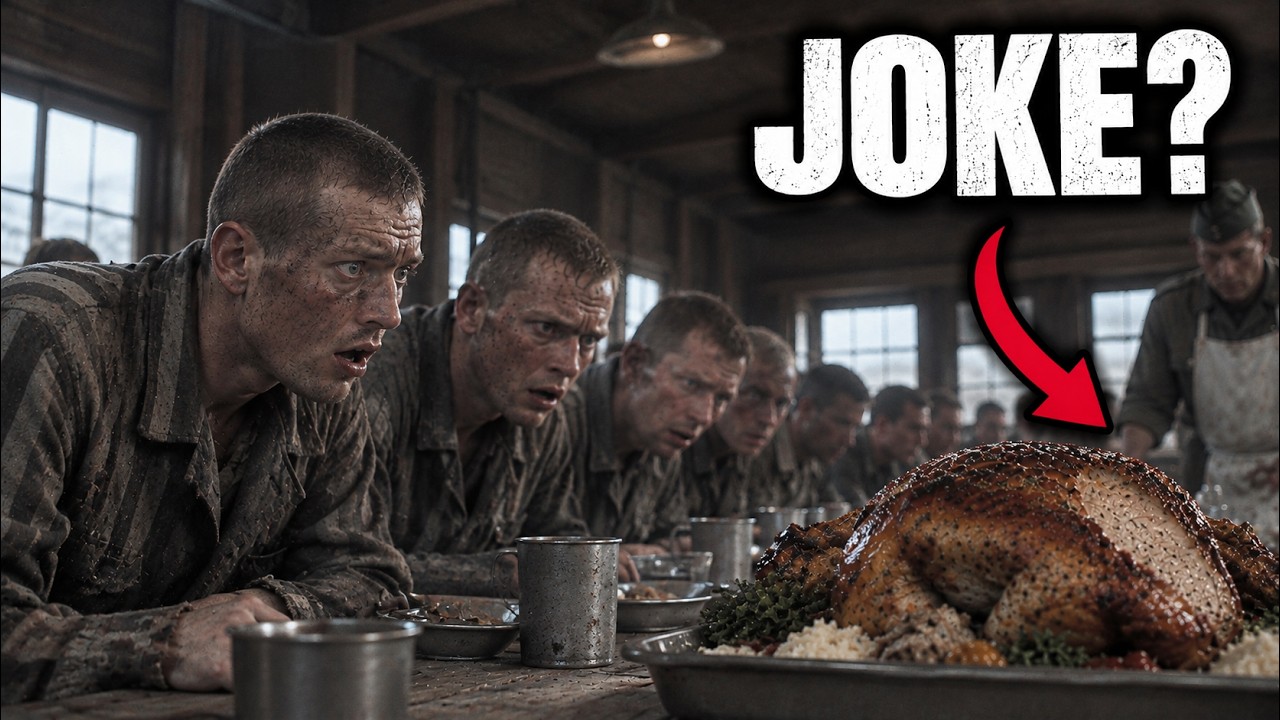
The barracks went quiet. Then somebody laughed. Then the arguing started. Camp Hearne sits in the flat middle of Texas, in Robertson County, roughly halfway between Dallas and Houston.
In the autumn of 1944, it held about 4,800 German prisoners of war behind two ten-foot fences of barbed wire, most of them men from the Afrika Korps. That army had surrendered in Tunisia in May 1943, when 275,000 men laid down their arms in a single week, one of the largest surrenders in German military history. It happened so fast that many of the men still could not quite believe it. One of them was Heino Eriksson.
He was eighteen when he was captured. He had grown up in Germany as the Nazi party built its picture of the world, a picture that left little room for doubt. He had been a member of the Hitler Youth’s junior wing as a boy, and when war came he joined the 22nd Panzer Grenadiers. He was sent to Africa, got dysentery, surrendered, and found himself on a ship crossing the Atlantic to a country he had been taught carefully to despise.
When the train from Ellis Island stopped in the fall of 1943, he stepped out onto Texas soil and looked around. He would later write about what he found at Camp Hearne. Hot showers, good food, soccer facilities. The camp, in his words, was standard.
He used that word carefully, because the Germany he had left behind was not standard anymore. Back home in November 1944, the ordinary German family lived on a ration card. Bread, fat, meat, and sugar were all rationed. The meat allowance by late 1944 had been cut to about 250 grams per person per week, less than a quarter pound.
The fat allowance, including butter and cooking oil, was about 60 grams per week. Ersatz coffee made from roasted grain, ersatz soap made from clay, ersatz bread stretched with potato flour and wood pulp. Every letter home said the same careful words: We are managing. We have enough.
And every man in the barracks knew what that really meant. So when the interpreter said turkey, the men did not think about Thanksgiving. They thought about home, about what their mothers were eating, about what a quarter pound of meat per week actually looks like on a plate. Then the argument started, because Camp Hearne had a problem that went beyond turkey.
The camp had Nazis. Not every prisoner who arrived was willing to accept that Germany had lost the war, or was losing it, or might lose it. Some of the men who came in from Tunisia were hardline party members. They believed in victory, they believed in Germany, and they believed the best weapon against American influence was resistance.
Eat nothing, accept nothing. Any man who seemed grateful, who enjoyed his food, who stopped hating, was a traitor. This was not informal pressure. It was organized.
The Nazis inside Camp Hearne ran a system. They assigned men to watch other men. They reported to their own internal leadership. Anyone considered disloyal could be beaten, and the beatings happened.
Eriksson described his greatest fear in the camp as not the American guards but the Nazis who controlled things from the inside. On the Wednesday night before Thanksgiving 1944, the internal Nazi leadership had an answer to the interpreter’s announcement. Do not eat. A German soldier does not take gifts from the enemy.
Whether the turkey was a propaganda trick, a way to take photographs and show the world how kind America was, or simply a bribe to soften their will, the answer was the same. Do not eat. Some men agreed. Some were afraid not to agree.
Some did not know what to think. And some, like Eriksson, were tired in the deep way that comes from years of being told what to believe about a world that kept turning out to be different. They lay on their bunks that night and waited for Thursday. Here is the part nobody in the barracks knew.
The Thanksgiving dinner at Camp Hearne was not a gift. It was not propaganda. It was not even technically generosity. It was the law.
Article 11 of the Geneva Convention of 1929 required that food given to prisoners of war must be equal in quantity and quality to the food given to troops at base depots. Base depot soldiers were garrison troops, not frontline combat men, but they were soldiers. And on Thanksgiving Day, American soldiers ate turkey. The army did not make an exception for prisoners, because making an exception would undermine the entire system.
The reasoning was practical and stated clearly in wartime documents. Every German prisoner treated fairly in the United States made it more likely that American prisoners in Germany would be treated fairly. A broken rule anywhere in the chain weakened every other link. The turkey was not a gesture.
It was a line item in the budget, and the budget was the same for the men inside the wire and the men outside it. The cooks at Camp Hearne did not need to invent a menu. They used the standard Thanksgiving ration. Turkey and dressing, mashed potatoes with gravy, cranberry sauce, sweet potatoes, corn, bread, butter, and pie.
The army had been planning it for weeks. Getting enough turkey to soldiers in Europe in 1944 had required a single ship, the SS Great Republic, to carry 1,600 tons of frozen birds across the Atlantic, just for the men in France and Germany. Inside Camp Hearne, the cooks had been working since before dawn. The smell reached the barracks before the men were called to the mess hall.
There is something about the smell of roasting meat when you have not had it properly in a long time. It does not wait for you to think about it. It simply arrives. It drifted under the door on Thanksgiving morning while the hardliners watched each other’s faces and the other men stared at the ceiling.
The call came at noon. Eriksson stood in line with his metal tray and moved forward with the others. The cooks wore white aprons. There was no photographer that anyone could see, no officer standing with a notebook.
There was only the smell and the steam rising off the food and the sound of the ladle. He took his tray and sat down. Across from him, other men were doing what he was doing, looking at the food, looking at each other. Some picked up their forks.
One man did not. He sat with his arms crossed and his tray pushed away, staring at the wall. He was not alone. A few hardliners had come to the mess hall and refused to eat, sitting in silence with untouched plates as a statement, as a signal, as a warning to anyone watching.
But the smell was still there, and the food was getting cold. One by one, quietly, the men at Eriksson’s table began to eat. Later, in his memoir, Eriksson described the camp food simply. Good food, he said, regular meals.
These were not the words of a man writing propaganda for America. They were the words of a man who had learned by comparison. The comparison was everything. Because at the same moment Eriksson was eating turkey at Camp Hearne, the men at home were eating a quarter pound of meat for the entire week.
The letters Eriksson and the other men wrote home in the days that followed had to pass through censors. They knew it. They wrote carefully. They wrote that they were well, that the work was fair, that they had been given a holiday meal.
Almost none of them wrote what the meal actually was. To write it honestly, to say turkey and mashed potatoes and cranberry sauce and pie, was to describe a feast to a family that had not seen one in years. The censors would read every word, and the family would read the letter in a cold kitchen with ration cards in a drawer. They would not believe it.
And if they believed it, they would not forgive it. So the men wrote the safe sentences and kept the turkey to themselves. The hardliners who refused to eat said nothing about what they had done. The men who ate said nothing about what they had done.
That night, a strange quiet settled over the camp. It was not the quiet of agreement. It was the quiet of men who had each privately arrived at a question nobody wanted to say out loud. If the food was a trick, why did the guards eat the same thing?
The Thanksgiving ration was the same on both sides of the wire. The men could see the guards’ mess hall from the yard. They could smell the same smells coming from the same direction. No photographer had appeared.
No officer had tried to document gratitude. The food arrived, was served, and was cleared away. The cooks went back to the kitchen. The guards went back to their posts.
It was just Thursday in America. The hardliners could not quite explain that. They could explain a gift, because a gift had motives. They could explain a trick, because a trick had a purpose.
But a rule that applied equally to the enemy and to the guard because it was the rule, because nobody was trying to make a point, that was harder to explain in the language of propaganda and betrayal. Some of them came back for the pie. After the war, Heino Eriksson was sent back to Europe, not immediately to Germany but to Scotland, where he spent two years working on farms as part of Germany’s labor reparations. He returned to what was left of his hometown.
What he found was rubble and cold and the kind of hunger that ration cards had been quietly predicting for years. And he could not stop thinking about Texas. In 1953, eight years after the war ended, Heino Eriksson returned to the United States. He became an American citizen in 1958.
He settled in Texas, about an hour and a half from Hearne. In 2010, he drove back to the camp site for the opening of the Camp Hearne exhibit and visitor center. He was eighty-six years old. He stood in the field where the barracks had been and looked at what was left, mostly foundation outlines and a water tower and the memory of two ten-foot fences.
He had written his memoir by then. It was called The Reluctant Warrior. In it, describing the camp, he used a sentence that seemed small until you thought about it. I learned the meaning of freedom in a prison camp.
Not on the battlefield, not in Africa where he had fought or in Scotland where he had worked. In a prison camp in Central Texas, where the guards and the prisoners ate the same Thanksgiving dinner for no reason except that it was the rule. The hardliners who refused the meal never changed their minds publicly. Some went home still believing.
Some privately did not. What changed was not always visible and was not dramatic. It happened quietly in the years after, when a man sat down at a table and tried to explain to his family what America had actually been like. The turkey was not the point.
The point was that nobody had to give it. The rule required it, and the rule was followed. For a man who had grown up in a country where rules meant whatever the powerful decided they meant that week, that was a harder thing to argue with than any speech or film or propaganda pamphlet ever produced. It was just Thursday.
And everybody ate.