In May 1945, with the Third Reich in collapse, American soldiers sweeping through Bavaria and Austria seized documents and interrogated prisoners, racing to capture anything of intelligence value before it vanished. At Schloss Fischhorn, a castle near Salzburg that had served as an SS facility, agents from the US Army’s Counter Intelligence Corps discovered a hidden cache behind a false wall in a tool shed. Inside were photo albums, reels of home movies, monogrammed silverware, clothing, and a handwritten diary. The diary belonged to Eva Braun, Adolf Hitler’s secret mistress.
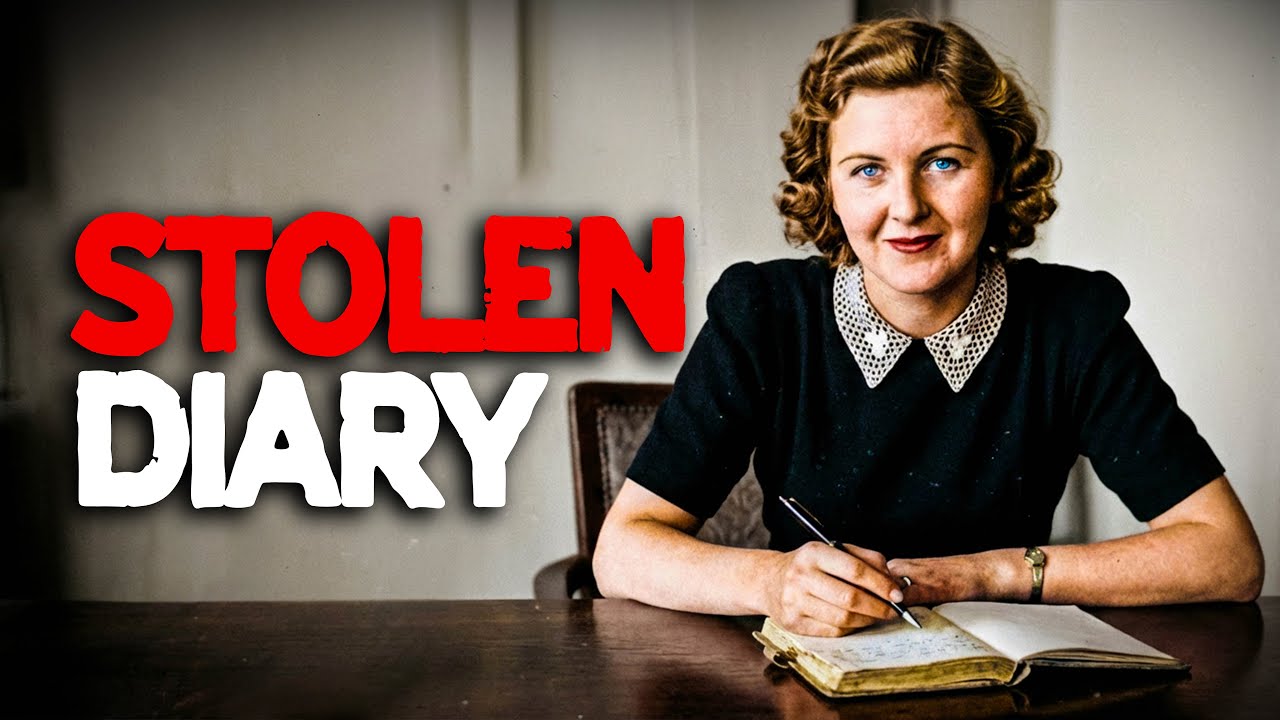
What followed involved forgery, theft, cover-ups, and a mystery that remains unsolved eight decades later. Eva Braun had been Hitler’s companion for sixteen years, though the German public never knew she existed. She met him in 1929 while working as an assistant at the photography shop of Heinrich Hoffmann, Hitler’s official photographer. Their relationship was kept completely secret.
Hitler believed his political image required him to appear married only to Germany. Eva lived a gilded but isolated life, first in a Munich villa Hitler provided, then at his mountain retreat, the Berghof near Berchtesgaden. She was forbidden from appearing at his side in public. She filled her days with photography, amateur filmmaking, and, for a brief period in 1935, keeping a diary.
That diary, along with her letters to Hitler and her home movies, would become some of the most sought-after documents of the Nazi era. The diary Eva kept in 1935 was born of frustration and loneliness. She began writing on February 6th, her twenty-third birthday, documenting her feelings about a relationship in which she was constantly waiting, waiting for phone calls, waiting for visits, waiting to be acknowledged. The entries reveal a young woman who felt neglected and ignored, who worried that Hitler was seeing other women, and who oscillated between hope and despair.
The final entry is dated May 28th, 1935. That night, or the following morning, Eva took an overdose of sleeping pills in what appeared to be a suicide attempt, her second in three years. Her older sister, Ilse, discovered her unconscious. More importantly for the fate of the diary, Ilse also found the open diary beside her sister, its pages revealing Eva’s troubled state of mind.
Ilse Braun made a decision that would shape history. Fearing that Hitler might end the relationship if he learned of the suicide attempt and read Eva’s complaints about his neglect, Ilse tore twenty-two pages from the diary. She hid them, intending to return them once the crisis passed. The pages were eventually given back to Eva, who kept them with her other personal effects.
Those torn pages, fragmentary, emotional, deeply personal, would survive the war intact. But where were they when the Reich collapsed, and how did American intelligence find them? The story of the diary’s postwar journey begins on April 2nd, 1945, eight days before Hitler’s suicide. With Soviet forces closing in on Berlin and the Third Reich crumbling, Hitler issued an order to SS Oberführer Johannes Göhler to destroy all personal effects belonging to himself and Eva Braun.
Hitler was determined that nothing intimate should fall into enemy hands. The materials in question had been moved from the Berghof to Schloss Fischhorn, a castle near Salzburg that served as an SS horse breeding facility. The castle was under the command of SS Gruppenführer Hermann Fegelein, Eva Braun’s brother-in-law, who had married her younger sister, Gretl, in June 1944. Fegelein would be shot for desertion on April 28th, just two days before Hitler’s own death.
But the personal effects remained at Fischhorn. Göhler passed Hitler’s destruction order to SS Hauptsturmführer Franz Conrad at Fischhorn. According to Göhler’s later testimony to American interrogators, Conrad confirmed that he had carried out the order. The materials supposedly destroyed included two tin trunks containing hundreds of letters exchanged between Hitler and Eva over more than a decade, along with photo albums, eight reels of home movies, silverware monogrammed with Eva’s initials, clothing, gold watches, and other personal items.
If Conrad truly destroyed everything, the letters between Hitler and Eva, potentially one of the most revealing collections of Nazi-era documents, were lost forever. But Conrad did not destroy everything. When American forces reached Schloss Fischhorn in May 1945, they captured Göhler and began interrogating him about Hitler’s final days and the disposition of Nazi assets. Meanwhile, agents from the US Army’s Counter Intelligence Corps conducted their own search of the castle grounds.
One of these agents was a man named José Antonio Robert A. Gutierrez, who would rise to the rank of lieutenant colonel by the war’s end. According to his official report, Gutierrez discovered a cache of personal effects hidden behind a freshly constructed false wall in a tool shed on the Fischhorn property. Someone, presumably Conrad or another SS officer, had concealed the items rather than burning them as ordered.
What Gutierrez found was remarkable. The hidden cache contained Eva Braun’s photo albums documenting her life and her relationship with Hitler through hundreds of photographs. There were eight reels of 16mm home movies that Eva had filmed at the Berghof between 1938 and 1944, capturing candid footage of Hitler relaxing with guests, playing with his dog Blondi, and entertaining visitors. There was silverware monogrammed with Eva’s initials, clothing, and personal items.
And there was the 1935 diary, the twenty-two handwritten pages that Ilse Braun had torn from Eva’s journal a decade earlier. Gutierrez turned most of what he found over to the headquarters of the US Seventh Army. But the two tin trunks supposedly containing the Hitler-Braun correspondence were not among the items he reported recovering. The materials Gutierrez officially turned over began their journey to the United States.
The photo albums, home movies, and diary were transferred to the War Department’s intelligence division for examination. American intelligence officers were eager to learn anything they could about Hitler’s private life and inner circle. Eva Braun had been virtually unknown to the world before the war’s end. The German public had no idea she existed, and her personal documents offered unprecedented insight into the Führer’s domestic arrangements.
The diary was examined, translated into English, and authenticated. Intelligence analysts noted that the entries revealed an immature young woman desperate for attention from a man who treated her as an afterthought. By November 1945, news of Eva Braun’s diary had reached the press. A report from Frankfurt announced that American intelligence officers were examining a diary in which Eva Braun admitted to being Hitler’s mistress as far back as May 1935.
The story generated international interest. Here was primary-source evidence about one of history’s greatest monsters, not his military campaigns or political machinations, but his private romantic life. The diary’s contents were subsequently published in various forms, appearing in newspapers and magazines throughout the late 1940s and 1950s, but the original document, the twenty-two handwritten pages in Eva’s own script, remained in American government custody. Today, Eva Braun’s 1935 diary is held at the National Archives at College Park, Maryland.
It is cataloged as part of Record Group 242, officially designated the National Archives Collection of Foreign Records Seized. This collection, comprising more than 680 unique series, houses documents captured from Nazi Germany, Fascist Italy, the Soviet Union, the Japanese Empire, and other foreign governments during and after World War II. The diary sits alongside other captured German documents, including the records of the German Foreign Ministry, military operational files, and remarkably, Adolf Hitler’s last will and political testament signed in the bunker on April 29th, 1945. The National Archives catalog entry for the diary describes it as the diary of Eva Braun with entries from February 6th, 1935 to May 28th, 1935.
The collection includes both the original German manuscript in Eva’s handwriting and an English typescript translation prepared by the War Department’s intelligence division. Eva’s home movies traveled a similar path to the diary but have achieved even wider distribution. The eight reels Gutierrez recovered from Fischhorn were part of a larger collection. Eva had originally shot twenty-eight reels of footage between 1938 and 1944.
The US Army compiled the surviving footage and transferred it to the National Archives in 1947. Today, the collection is cataloged under the title Private Motion Pictures of Adolf Hitler and Eva Braun and comprises nine surviving reels of 16mm silent film in both color and black and white. The footage first appeared in American newsreels in 1947 and has since been used in countless documentaries about Hitler and the Nazi era. In 2012, the National Archives began a digital restoration project for Eva Braun’s home movies, working from existing negative copies to preserve and enhance the footage for future generations.
The films are now widely available, with complete DVD sets released in 2004 and much of the footage viewable online. Eva Braun’s photo albums also reside at the National Archives, cataloged as a distinct series within Record Group 242. The collection spans from approximately 1913 to 1944, documenting Eva’s childhood, her years working for Heinrich Hoffmann, and her life as Hitler’s secret companion. The photographs include formal portraits, candid snapshots, and images of Nazi leaders at leisure, a visual record that historians have mined extensively for insights into the Third Reich’s inner circle.
The fate of the Hitler-Braun correspondence remains one of the enduring mysteries of World War II. According to Johannes Göhler’s testimony to American interrogators, two tin trunks at Fischhorn contained hundreds of letters exchanged between Hitler and Eva over their sixteen-year relationship. Because Hitler insisted that Eva remain at the Berghof while he traveled to Berlin and various military headquarters, they communicated extensively by mail. These letters, if they survived, would offer unprecedented insight into Hitler’s private thoughts and the dynamics of his most intimate relationship.
But the letters were not among the materials Gutierrez officially recovered and turned over to the Seventh Army. For decades, investigators assumed that Franz Conrad had indeed burned the correspondence as ordered. Conrad himself could not confirm or deny this. He was extradited to Poland after the war, tried as a war criminal, and executed.
The mystery might have ended there, except for a revelation that emerged twenty years later. In 1965, British journalist and historian David Irving interviewed Ursula Göhler, the ex-wife of Johannes Göhler. She told Irving a remarkable story. After the war, while her husband was interned by the Americans, she had been employed by the US Army’s 307th Counter Intelligence Corps unit near Stuttgart.
The commander of that unit was Lieutenant Colonel Gutierrez, the same agent who had discovered the hidden cache at Fischhorn. According to Ursula Göhler, she developed a close personal relationship with Gutierrez during her employment with his unit. In his quarters, she claimed, she found the two tin trunks containing the Hitler-Braun correspondence. She told Irving that she had spent many days reading through the letters.
When Gutierrez prepared to return to the United States at the end of his tour, he took the trunks with him. If Ursula Göhler’s account is accurate, the letters were never destroyed. They were taken by an American intelligence officer as war souvenirs, removed from the official chain of custody, and transported to the United States in private hands. David Irving tracked down Gutierrez, who by then had settled in New Mexico and become a prominent local figure.
Irving’s investigation established that Gutierrez had indeed kept at least some of Eva Braun’s personal effects as souvenirs. Previous investigators had documented that he possessed Eva’s monogrammed silverware and at least one of her dresses. But when Irving asked about the letters, Gutierrez was evasive. He claimed to have become a born-again Christian and said that he had destroyed the correspondence because he did not want to humanize Hitler.
Irving came to believe that Gutierrez had either destroyed the letters as he claimed or alternatively sold them to private collectors over the years. Irving’s conclusion was blunt. If the letters still existed, they were worth millions of dollars and were probably in the hands of some wealthy private collector, unlikely to surface for a hundred years. The mystery of the missing letters attracted renewed attention in 1993 when a team of investigators converged on Gutierrez’s home in Albuquerque, New Mexico.
The group included Michael Walsh, a writer for Time and Life magazines; Marian Ernst, a London specialist in the authentication of artworks and documents; Norman Scott, a Florida treasure hunter who had turned his attention to Nazi loot; and Kenneth D. Alford, a Virginia banker and amateur World War II historian who had spent years researching the case. Alford had compiled 642 pages of US Army documents relating to the Fischhorn discovery. The team approached Gutierrez, now seventy-eight years old, and made him an offer for the letters.
They were well aware of the risks. In April 1983, the German magazine Stern had paid more than three million dollars for sixty volumes purporting to be Hitler’s personal diaries, which were later exposed as crude forgeries created by a Stuttgart dealer named Konrad Kujau. The Hitler diary hoax had made everyone more cautious about Nazi-era documents, but it had also demonstrated the enormous sums that authentic materials could command. The meeting with Gutierrez dragged on for three days.
At the end, Gutierrez remained as ambiguous about the Hitler-Braun correspondence as he had been at the start. He neither confirmed nor denied possessing the letters. The team left empty-handed. Alford’s research had also uncovered another tantalizing lead.
Among the documents he found was an undated letter from Franz Conrad, the SS officer who had supposedly burned the correspondence, to his mother in Schladming, Austria. The letter instructed her to turn over the letters from Hitler and Eva Braun to the American officer who presented her with the letter. Gutierrez was not mentioned by name, but Alford concluded that he had likely been the officer in question since he had spent many hours interrogating Conrad. When Alford confronted Gutierrez about this, Gutierrez initially denied having any of the Hitler-Braun effects in his possession, but then gave Alford thirty pieces of sterling silver flatware monogrammed EB and a silk gown that had belonged to Eva Braun.
Gutierrez died without ever definitively confirming or denying what he knew. While the authentic diary made its way to Washington, a second diary emerged that would muddy the historical waters for decades. In December 1945, just months after the war ended, Austrian filmmaker and mountaineer Luis Trenker appeared before a notary public with a sealed package. According to Trenker, Eva Braun had entrusted him with the package during the winter of 1944–1945 at the Kitzbühel ski resort, with instructions not to open it until after her death.
Inside the package was an unsigned typescript manuscript purporting to be Eva Braun’s diary, covering the period from late 1937 to July 1944, years for which no authenticated diary existed. The manuscript included intimate details about life in Hitler’s inner circle, gossip about Nazi leaders, and claims that implicated prominent figures in embarrassing situations. Most notably, the diary suggested that filmmaker Leni Riefenstahl, Trenker’s former lover and professional rival, had been romantically involved with Hitler. Riefenstahl, who was trying to rehabilitate her reputation in the postwar years, was outraged.
She filed suit to have the diary’s authenticity investigated. The legal proceedings that followed exposed Trenker’s document as an elaborate fraud. American and Austrian military government investigators examined the manuscript and concluded that it was a gross fabrication and a pornographic concoction. Researchers discovered that entire passages had been lifted verbatim from a book published in 1913, the memoirs of Countess Larisch Wallersee about the tragic love affair between Archduke Rudolf of Habsburg and Baroness Maria Vetsera.
The forger had simply copied the text and changed the names. Archduke Rudolf became Hitler, Maria became Eva Braun, Archduke Otto was transposed to Julius Streicher, and Metternich became Joachim von Ribbentrop. The plagiarism was so blatant that once experts compared the two texts, the deception was obvious. In October 1948, the Munich courts officially declared Trenker’s diary a forgery.
But the ruling did not prevent the document from circulating. A London publisher had already brought out an edition in 1949, and the forged diary was reprinted in 1979 and again in 2000, sometimes with disclaimers acknowledging the fraud, sometimes without. Luis Trenker himself showed no apparent remorse for his role in the affair. Whether he created the forgery himself or merely served as the frontman for someone else’s fabrication has never been definitively established.
The existence of the Trenker forgery inevitably raised questions about the authenticity of the 1935 diary held by the National Archives. Could that document also be a fake? The evidence strongly suggests it is genuine. The diary was recovered directly from the Fischhorn cache by American intelligence agents, establishing a clear chain of custody.
The War Department’s intelligence division examined and translated it in 1945 and 1946 and found it consistent with other known facts about Eva Braun’s life. Most importantly, Ilse Braun, Eva’s surviving older sister, authenticated the handwriting and confirmed the circumstances under which the pages had been removed from Eva’s journal after the 1935 suicide attempt. Some historians have raised minor questions, suggesting discrepancies in writing style or speculating that Eva might have fabricated or embellished the diary entries herself as a deliberate performance intended to manipulate Hitler’s emotions after her suicide attempt. But these revisionist arguments have not gained wide acceptance.
The consensus among historians remains that the 1935 diary is authentic, even if some individual entries may have been written or revised after the fact. The question of Nazi document authenticity reached its peak in 1983 when the German magazine Stern announced the discovery of Adolf Hitler’s personal diaries, sixty handwritten volumes covering the years 1932 to 1945. The announcement caused a worldwide sensation. If genuine, the diaries would be one of the most important historical discoveries of the century.
Stern had paid more than three million dollars for the documents, and major media organizations around the world scrambled to secure publication rights. The sensation quickly turned to embarrassment. Within weeks of the initial announcement, forensic tests revealed that the diaries were crude forgeries. The paper contained chemical whiteners that had not been used until after World War II.
The ink was modern. The bindings were of postwar manufacture. The forger was identified as Konrad Kujau, a Stuttgart dealer in Nazi memorabilia who had been producing fake Hitler artifacts for years. The scandal destroyed careers and permanently damaged public trust in Nazi-era document discoveries.
The Hitler diary hoax cast a long shadow over all claims involving Nazi personal documents, including Eva Braun’s diary. Any assertion that new materials had been found was now met with extreme skepticism. This skepticism extended to the persistent rumors about the missing Hitler-Braun correspondence. If the letters ever surfaced in Gutierrez’s possession or elsewhere, they would face intense scrutiny.
The combination of enormous potential value and the difficulty of authentication has created conditions where the letters, even if genuine, might never be accepted as such. So what happened to Eva Braun’s diaries after World War II? The answer depends on which diary we mean. The authentic 1935 diary, twenty-two handwritten pages documenting a few months of emotional turmoil in the life of Hitler’s secret mistress, was recovered by American intelligence agents from a hidden cache at Schloss Fischhorn in Austria.
It was examined by the War Department, authenticated by Eva’s sister Ilse, and eventually transferred to the National Archives in Washington, where it remains today as part of Record Group 242. The forged Trenker diary, a fabrication cobbled together from plagiarized nineteenth-century memoirs, was exposed in Munich court proceedings in 1948 but continues to circulate in various published editions. Eva Braun’s home movies, recovered from Fischhorn and compiled into nine surviving reels from an original twenty-eight, are also held by the National Archives and have been widely distributed on DVD and online. Her photo albums reside at the same facility.
The Hitler-Braun correspondence, hundreds of letters exchanged over sixteen years, has never been found. The two tin trunks that supposedly contained them may have been burned by Franz Conrad as ordered, may have been taken by CIC agent Gutierrez and later destroyed or sold, or may still exist in private hands waiting to surface. The letters remain one of the great lost documents of World War II, a collection that would transform our understanding of Hitler’s private life if it could be found and authenticated. Today, the twenty-two pages of Eva Braun’s 1935 diary rest in the National Archives at College Park, Maryland, preserved as part of Record Group 242, the collection of foreign records seized by the United States during and after World War II.
The diary shares space with Hitler’s will, captured German military files, and countless other documents from history’s darkest chapter. Researchers can examine it by appointment. The home movies can be viewed online. The photo albums can be studied by scholars.
But the letters, the correspondence that would reveal how Hitler communicated with the woman who shared his life for sixteen years, remain missing. Their fate unknown. They may have burned at Fischhorn in 1945. They may have traveled to New Mexico with a CIC agent who took his secrets to the grave.
Or they may still exist somewhere waiting to be found. The last great document mystery of the Nazi era.