Nathanael Greene was handed command of an army that had just suffered one of the worst defeats in American history. His soldiers were starving, shoeless, and half of them had already deserted. The British controlled nearly every major city and fort across the Carolinas, and Congress had almost nothing left to send him. Over the next two years, he fought battle after battle, and he lost nearly all of them.
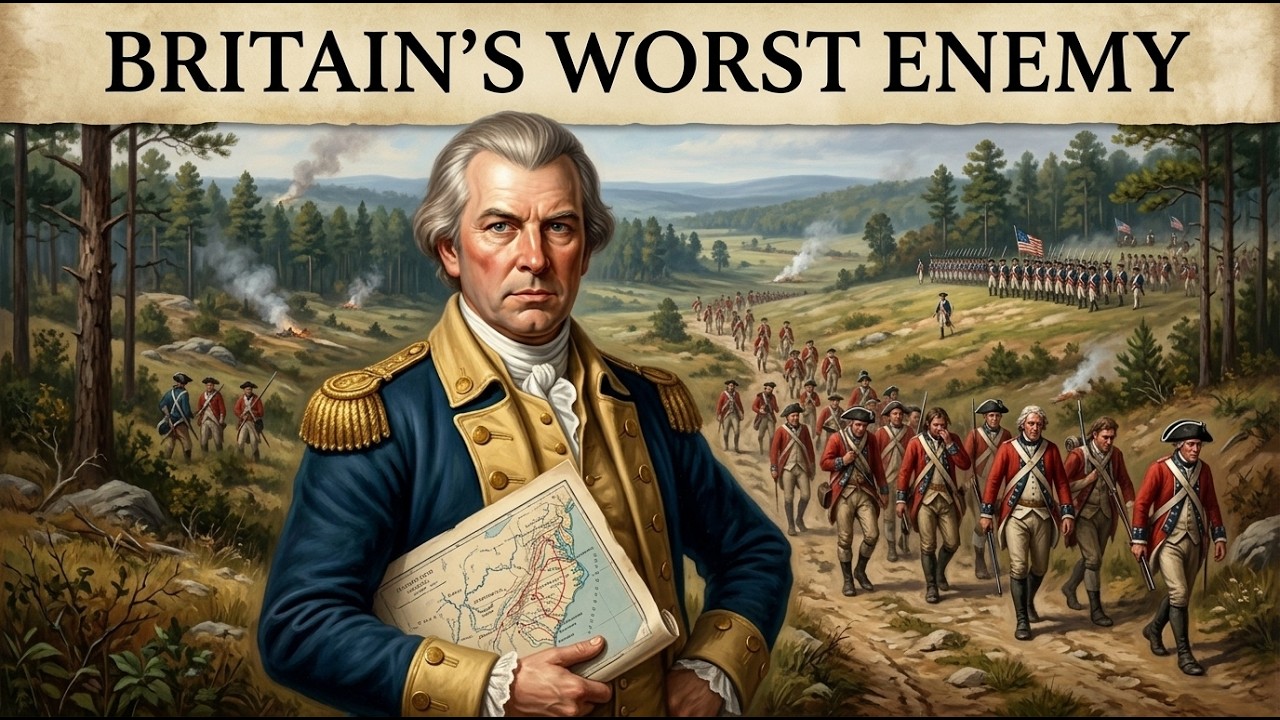
And yet, when the treaties were signed, he was the one who had won the war. He never won a single major engagement. That is what makes his campaign between 1780 and 1782 one of the most brilliant in military history. Greene understood something that most commanders never grasped: you do not need to win battles to win a war.
Greene was born in 1742 in Potowomut, a small settlement along the coast of Rhode Island, where his family ran a forge and an anchor foundry. He was the son of a prosperous Quaker merchant and preacher. The Quakers were pacifists. They rejected violence and condemned the study of war.
But young Nathanael could not stop reading about it. He traded for books on tactics and fortification, smuggled them into the family home, and studied the campaigns of Julius Caesar and Frederick the Great by candlelight while his father assumed he was reading scripture. He taught himself geometry because he knew it was essential for understanding fortifications and artillery placement. By the time the first shots were fired at Lexington and Concord, Greene had absorbed more military theory than most serving officers in the British Army.
He had never commanded a soldier, never heard a cannon fired in anger, and never stood on a battlefield. He also walked with a pronounced limp. The exact cause is debated; some say a stiff knee from birth, others an old injury from the forge. In an era when officers were expected to cut imposing figures on horseback, Greene did not look the part.
His own church expelled him for attending a military parade. He was a limping, self-taught Quaker bookworm, the furthest thing from a natural soldier. When war broke out in 1775, Greene helped organize the Kentish Guards, a local militia unit, and he enlisted as a private. Within months, the Rhode Island General Assembly promoted him to Brigadier General and gave him command of the Rhode Island Army of Observation, roughly 1,500 men tasked with joining the siege of Boston.
He went from private to general in the blink of an eye. Outside Boston, he caught the attention of the one person whose opinion mattered most: George Washington. The Rhode Island troops were among the best organized and best disciplined units in the ragtag Continental camp. While other militia commanders struggled to keep their men from wandering off, Greene ran a tight operation.
His camps were clean, his soldiers drilled regularly, and his supply chains actually functioned. Washington recognized a man who understood the full picture of keeping an army alive, not just the glamorous parts of leading charges. Over the following months, the two developed the most important military partnership of the revolution. Greene fought at Trenton on the freezing night of December 26, 1776, commanding one of the two main columns in the assault through a blinding snowstorm.
He fought at Princeton days later, then at Brandywine and Germantown. He made mistakes, including a costly one at Fort Washington in New York, where he advised holding a position that was overrun by the British with heavy American losses. But what set him apart was how he responded to failure. He did not make excuses.
He studied what went wrong, adjusted, and came back sharper. Then came the job nobody wanted. In the winter of 1778, the Continental Army camped at Valley Forge was falling apart. Soldiers starved, froze, and died of disease.
Men wrapped their feet in rags because they had no boots, and bloody footprints marked the paths between the log huts. The supply system had collapsed. Washington needed a new Quartermaster General, the officer responsible for feeding, clothing, equipping, and moving the entire army. It was the least glamorous job in the military.
Greene did not want it, and he told Washington as much. But Washington asked directly, and Greene accepted because he understood that an army that cannot eat cannot fight. He reorganized the supply chain from the ground up, established a network of depots, haggled with merchants, and personally tracked down everything from horseshoes to cartridge boxes. The army survived Valley Forge in large part because of what he built during those miserable months.
By 1780, the war in the South had turned into a catastrophe. The British captured Charleston in May, taking an entire American army prisoner. Congress sent Horatio Gates, the so-called hero of Saratoga, to fix the situation. At the Battle of Camden in August, Gates marched his army straight into Cornwallis and was utterly destroyed.
Gates himself fled the battlefield on horseback, riding over 160 miles in three days. His reputation was finished. The southern states were on the verge of being lost entirely. Washington sent Greene.
When Greene arrived at the remnants of the southern army in Charlotte in December 1780, he found roughly 1,400 men fit for duty, poorly armed and barely clothed. They were starving, unpaid, and deserting daily. The countryside had been ravaged by years of brutal partisan warfare between patriot and loyalist militias, a civil war that had turned neighbor against neighbor. Greene wrote that the appearance of his troops was wretched beyond description.
He did not panic, and he did not rush into battle the way Gates had. Instead, he did something that violated every conventional rule of 18th century warfare. He split his army, sending roughly 600 men under Daniel Morgan west while he took the rest east. Military orthodoxy said never divide a smaller army in the face of a larger one.
But by splitting his forces, Greene forced Cornwallis to split his own to counter both threats. Cornwallis sent his most feared cavalry commander, Colonel Banastre Tarleton, after Morgan with roughly 1,100 troops. On January 17, 1781, at a place called Cowpens in upcountry South Carolina, Morgan turned and fought. He placed his least reliable militia in the front line and told them to fire just two volleys, then retreat.
When Tarleton’s infantry charged and the militia broke, the British assumed the battle was won. They surged ahead into the disciplined fire of the Continental regulars, and Morgan’s cavalry swung around to hit their flanks. In less than an hour, Tarleton’s force was virtually annihilated, with over 800 killed, wounded, or captured. Tarleton barely escaped.
Cowpens shattered the myth of British invincibility in the South. Cornwallis was furious. Now he made a decision that would cost him everything. He decided to chase Greene across the Carolinas and destroy the American army once and for all.
To move faster, he ordered his own army to burn its supply wagons and baggage. Greene had anticipated this. He had already gathered boats along the Dan River, and he appointed a rear guard to slow the British pursuit while the main army raced ahead. Greene marched his exhausted army north through freezing winter rain, racing nearly 200 miles across North Carolina.
His men crossed the Dan River into Virginia on February 14, 1781, with Cornwallis arriving at the empty riverbank just hours too late. The British general had burned his supplies, exhausted his army, and had nothing to show for it. Then Greene went back. He recrossed the Dan, marched into North Carolina, and by mid-March had assembled roughly 4,400 men.
On March 15, 1781, at Guilford Courthouse, Cornwallis attacked with about 1,900 British regulars. Greene arranged his forces in three lines. The North Carolina militia fired a single volley and ran. The Virginia militia held longer.
The battle reached the Continental regulars, and fighting became hand-to-hand in the woods. Cornwallis, in desperation, ordered his own artillery to fire grapeshot into the melee, hitting his own men along with the Americans. Greene ordered a retreat. Cornwallis held the field, but the cost was staggering: over 500 British killed and wounded, more than a quarter of his entire force, and these were irreplaceable regulars.
Greene lost around 1,300, but most were militia who would return within weeks. British MP Charles James Fox reportedly said that another such victory would ruin the British Army. Cornwallis abandoned the Carolinas entirely and marched to the coast, then north into Virginia. That march would eventually lead him to a small tobacco port called Yorktown.
But Greene did not follow him. That was not his job. Instead, he turned back to South Carolina to dismantle the British network of outposts and forts across the interior. He worked alongside partisan leaders who had been fighting in the swamps for months: Francis Marion, the Swamp Fox, Thomas Sumter, and Andrew Pickens.
Greene fought the main British forces while the partisans cut supply lines and picked off isolated garrisons. Over the next several months, Greene lost again at Hobkirk’s Hill in April 1781. He besieged the fortified post at Ninety Six in June and was forced to withdraw. In September, at Eutaw Springs, his troops pushed the British back through their own camp before losing cohesion and retreating.
Every time he lost a battle, he retreated in good order, preserved the core of his army, and came back stronger. Every time the British won, they suffered casualties they could never replace and found themselves holding more hostile territory with a smaller army. Greene was trading space for time and battles for attrition. After Eutaw Springs, the British pulled back to Charleston and never came out again.
Greene had liberated the entire interior of South Carolina and Georgia without winning a single pitched battle. Meanwhile, Cornwallis sat trapped at Yorktown, surrounded by Washington’s combined American and French forces. The siege ended in October 1781 with the British surrender that effectively concluded the war. Washington and the French received the glory, but Cornwallis would never have been at Yorktown if Greene had not driven him out of the Carolinas.
Greene had closed every other door. Greene had spent enormous amounts of his own fortune to feed his soldiers, personally guaranteeing loans when Congress sent nothing but excuses. After the war, he was deep in debt. Georgia gave him a confiscated loyalist rice plantation called Mulberry Grove near Savannah, and he moved his family there in 1785 to rebuild his fortunes.
On June 19, 1786, Nathanael Greene died at Mulberry Grove. He was 43 years old, likely from heatstroke complicated by exhaustion. His wife was left with debts that took years to resolve. Many years later, a young Yale graduate named Eli Whitney, staying at Mulberry Grove as Catherine Greene’s guest, would invent the cotton gin on that same property.
Greene never had a famous last stand or a signature victory with his name on it. He died young and broke, and history gradually moved on. But the officers who served with him knew. Washington knew.
His Southern Campaign is studied at military academies around the world as one of the finest examples of strategic attrition in the history of warfare. He proved that war is not won by the general who holds the most battlefields, but by the general who understands what the war is actually about and refuses to lose the thing that matters most: the army itself. The limping Quaker who taught himself war from stolen books never won a battle.
He won the war.