On January 1, 1953, Hank Williams was found dead in the backseat of his Cadillac on the way to a concert in Canton, Ohio. He was twenty-nine years old. The singer who had defined heartbreak for a generation left behind a catalog of songs that would outlive him, a widow, a three-and-a-half-year-old son, and a secret that would not surface for three decades. Days after his death, in Montgomery, Alabama, a daughter was born to a Nashville secretary named Bobby Jett, a child whose existence the Williams family would bury, deny, and fight against for years.
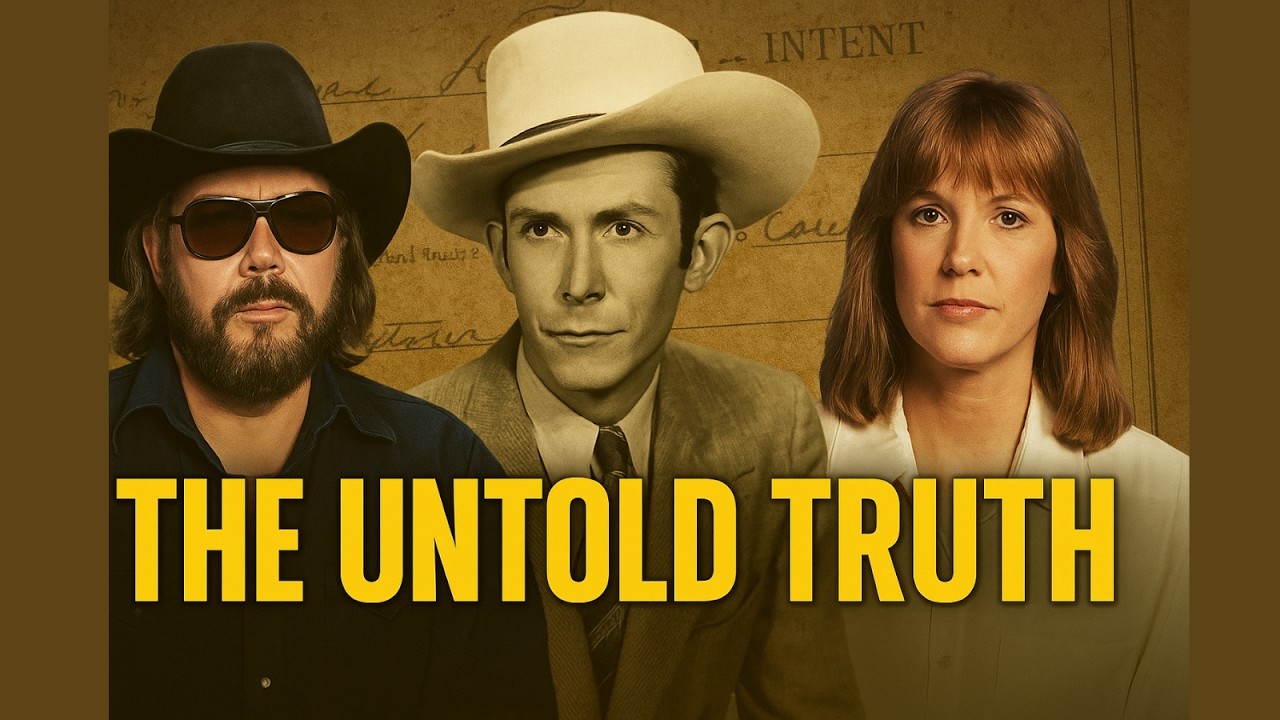
Randall Hank Williams was born on May 26, 1949, in Shreveport, Louisiana, at the very height of his father’s career. Hank Williams Sr. was the undisputed king of country music, turning out hits like “Lovesick Blues,” “Your Cheatin’ Heart,” and “I’m So Lonesome I Could Cry. ” His marriage to Hank Jr.
‘s mother, Audrey, was famously stormy, fueled by ambition, alcohol, and professional jealousy. The young boy’s earliest years were spent in the middle of that chaos, watching his father’s meteoric rise and equally rapid decline into alcohol and prescription drug abuse. When Hank Sr. died, Audrey Williams recognized the commercial potential of the name she had married.
Before Hank Jr. was even ten years old, she had him learning his father’s songs, wearing miniature versions of Hank Sr. ‘s flashy Nudie suits, and performing on stage. He made his Grand Ole Opry debut at eleven, singing his father’s hits.
Throughout his teenage years, he toured relentlessly, marketed explicitly as Hank Williams Jr. , the living echo of the lost icon. He signed a record deal, found significant success singing his father’s material, and even provided the voice for his father in the 1964 biopic Your Cheatin’ Heart. The work was lucrative but psychologically damaging.
Hank Jr. later described feeling like a puppet, a museum piece forced to imitate a ghost rather than develop his own identity. He grew increasingly resentful of his mother’s control and the suffocating expectations. His personal life began to mirror his father’s, marked by drinking, drugs, and turbulent relationships.
By the early 1970s, he was creatively stifled and personally adrift, desperate to break free from the persona his mother had built for him. He moved to Alabama, experimenting with rock and blues influences, searching for his own voice. On August 8, 1975, while hiking with friends on Ajax Peak in southwestern Montana, Hank Williams Jr. slipped and fell nearly five hundred feet down a rocky slope.
His injuries were catastrophic: multiple skull fractures, a crushed face, and a brain exposed. He required emergency surgery and multiple reconstructive procedures over the following two years. Doctors initially doubted he would survive, let alone perform again. The accident left him with significant facial scarring, which he would thereafter almost always hide behind a beard, sunglasses, and a cowboy hat.
The recovery forced him to re-evaluate his life and his music. He emerged not as the polished imitator his mother had groomed, but as a grizzled survivor with a new sound and a new attitude. He fully embraced the rock and southern blues influences he had been exploring, creating a hard-hitting blend of country rock that was entirely his own. Albums like The New South in 1977 and the platinum-selling Whiskey Bent and Hell Bound in 1979 announced the arrival of a major new force in country music.
The 1980s became his decade. He dominated the charts with hits like “Family Tradition,” a song that explicitly addressed his legacy, and “A Country Boy Can Survive. ” He won multiple Entertainer of the Year awards and became famous for his electrifying concerts, his rebellious attitude, and his outspoken, often politically charged lyrics. He adopted the nickname Bocephus, which his father had given him as a child, and built a persona even larger than the shadow he had been born under.
His revamped version of “All My Rowdy Friends” became the theme song for Monday Night Football for two decades. His career remained marked by controversy, most notably in 2011 when ESPN pulled his Monday Night Football theme song after he made inflammatory remarks comparing President Barack Obama to Adolf Hitler on Fox News. He faced criticism for lyrics and statements perceived as racially insensitive. His personal life continued to see ups and downs, including battles with addiction that echoed his father’s, though he eventually achieved sobriety.
In 2020, he suffered the tragic death of his daughter Katherine Williams-Dunning in a car accident. While Hank Jr. lived his life under the constant glare of his father’s name, another child had entered the world in the days after the legend’s death. Born January 6, 1953, in Montgomery, Alabama, the infant was named Antha Belle Jett.
Her mother, Bobby Jett, had carried on a brief, intense affair with Hank Williams during the final turbulent months of his life, after his divorce from Audrey and during his chaotic marriage to his second wife. Hank was reportedly aware of the pregnancy, and some documents suggested he had acknowledged paternity and made informal arrangements for the child’s care, possibly involving his mother, Lillian Stone. His sudden death left everything unresolved. Bobby Jett, an unmarried woman in the conservative South of the 1950s, faced immense social stigma.
Days after giving birth, she agreed to give the infant into the temporary custody of Hank Williams’ mother, Lillian Stone. Lillian cared for her granddaughter for about two years, but her health was failing, and she died in 1955. Before her death, she arranged for the adoption of the little girl, who was now known as Kathy Stone. The adoption was handled quietly.
Kathy was raised by adoptive parents, Louise and Wayne Deupree, in Alabama. They were told very little about her origins, only that she was the daughter of a deceased famous country singer, and were instructed to keep her past a secret. Kathy grew up in a loving adoptive home, completely unaware of her connection to Hank Williams. She knew she was adopted but had no inkling of her true parentage.
She lived a normal life, went to college, married, and had children of her own. The secret remained buried for decades. In the late 1970s or early 1980s, prompted perhaps by the birth of her own children or simple curiosity about her origins, Kathy began searching for her biological parents. Her adoptive parents, honoring their promise, initially provided little information.
Through persistent investigation, navigating sealed adoption records and reluctant sources, she uncovered fragments of the story. The breakthrough came when she discovered her original birth certificate bearing the name Antha Belle Jett, and through further investigation, connected Bobby Jett to Hank Williams. In 1984, armed with evidence including affidavits and documents allegedly signed by Hank Williams acknowledging paternity and promising support shortly before his death, Kathy petitioned the Alabama courts to be legally recognized as his daughter and rightful heir. The petition was fiercely contested by the administrators of the Hank Williams estate, primarily Hank Williams Jr.
and the estate’s managers. The legal battles spanned years and involved multiple court cases, appeals, and intense media scrutiny. The estate argued that too much time had passed, that the evidence was insufficient, and that recognizing another heir would dilute the inheritance and complicate the management of Hank Sr. ‘s lucrative musical legacy.
In 1985, an Alabama circuit court judge ruled in Kathy’s favor, declaring her the biological daughter of Hank Williams Sr. The fight for inheritance rights continued. The crucial victory came in 1989, when the Alabama Supreme Court upheld the lower court’s ruling and significantly determined that she had been intentionally defrauded of her rightful share of the family inheritance and copyrights by the estate’s administrators. The landmark decision granted her legal recognition, the right to use the Williams name, and a share of the substantial royalties from her father’s music.
She chose the name Jett Williams, honoring both her birth mother and her biological father. Since winning her legal battles, Jett Williams embraced her heritage. She launched her own country music career, performing her father’s songs and her own material, often accompanied by surviving members of Hank Sr. ‘s band, the Drifting Cowboys.
In 1990, she co-authored her autobiography, Ain’t Nothin’ as Sweet as My Baby: The Story of Hank Williams’s Lost Daughter, detailing her journey of discovery and her fight for recognition. The son who wrestled the ghost and the daughter who fought for her name took entirely different paths, yet both were shaped by the same impossible inheritance. Hank Williams Jr. spent his life publicly battling his father’s legacy, ultimately forging his own legendary and controversial identity.
Jett Williams spent decades fighting simply to stand in the light of a name that was rightfully hers. Their stories, taken together, reveal the profound weight of inheriting genius, addiction, and family secrets in the spotlight of American music.