For seventy years, the story of Princess Margaret and Group Captain Peter Townsend has been told as a tragedy of forbidden love: a princess forced by the crown to give up the war hero she adored. The calendar suggests a colder, more deliberate story. She was handed a choice, and she made it. The version most people know runs like this: a princess fell in love, the crown intervened, the church objected, and the machinery of state crushed them both.
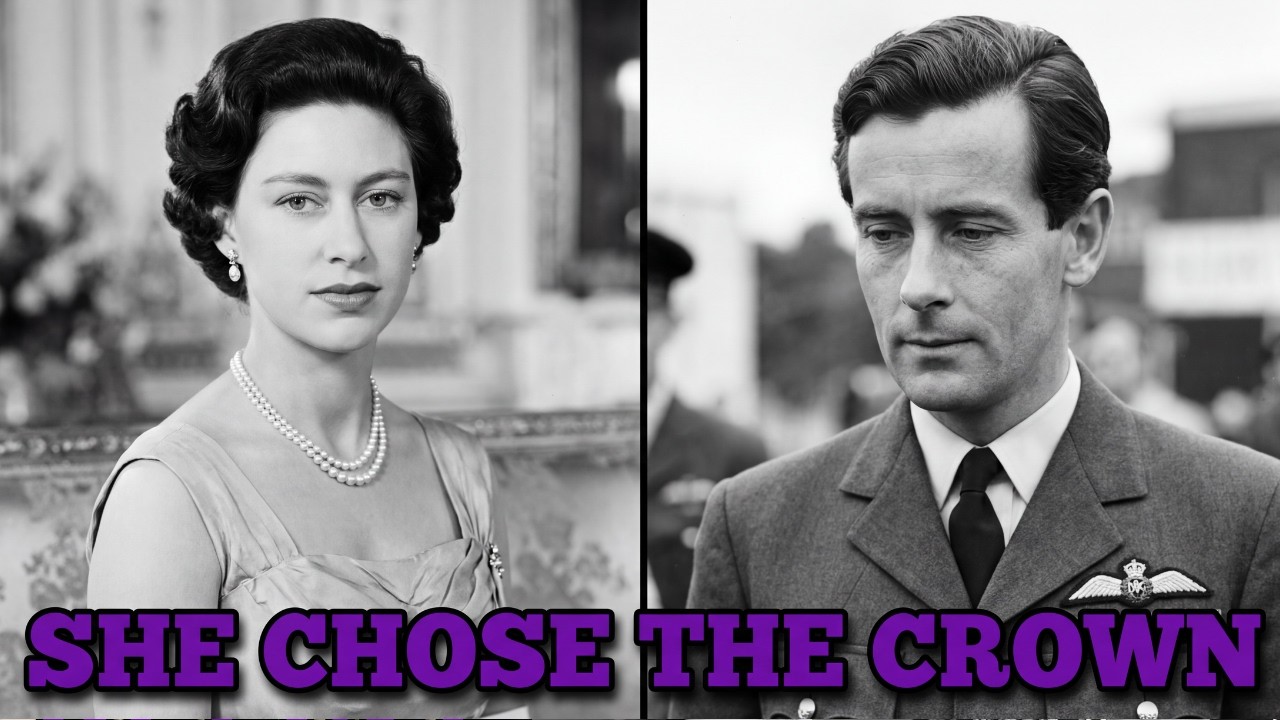
On the last day of October 1955, her statement went out over BBC radio. A royal tragedy, confirmed by the crown and endorsed by decades of documentaries. But look closely at the sequence of dates, and a different picture emerges. This was not a helpless woman destroyed by forces she could not resist.
It was a deliberating one, who took thirty-two months from the moment her family learned of the romance to the moment she ended it publicly. The roots of the crisis reach back to December 10, 1936, when King Edward VIII signed the instrument of abdication at Fort Belvedere. He had chosen Wallis Simpson, an American divorcée whose second husband was still living. The Church of England would not accept her as queen, the Dominion governments would not accept her, and Prime Minister Stanley Baldwin had told the king directly that the government could not support the marriage.
Edward chose the woman over the crown. His brother Albert became King George VI the following morning, a man who had never sought the job and was not prepared for it. His elder daughter, Elizabeth, then ten, suddenly became heir presumptive. Margaret was six.
Margaret grew up inside the immediate aftermath of that event, watching her father struggle with a role that shortened his life and understanding at a young age what it cost a royal who chose a divorced person over the throne. The abdication was not just family history. It was the soil everything around her grew in. Townsend was born in Rangoon in 1914 and joined the Royal Air Force in 1933.
During the Battle of Britain he commanded Number 85 Squadron, flying Hurricanes. He destroyed nine enemy aircraft, earned the Distinguished Flying Cross and Bar, and was shot down on August 31, 1940, when a cannon shell exploded in his cockpit. He bailed out, lost a toe to surgeons, and was back on operational flying within three weeks. In 1944 he was appointed equerry to King George VI, a three-month RAF secondment that became nine years of royal service.
The king came to regard him as the son he never had. Margaret was thirteen when Townsend arrived at Buckingham Palace. He was twenty-nine, already married, already a father. By 1947, during the South Africa tour, Margaret later told friends she fell in love with him.
Townsend’s marriage had been deteriorating for years; his wife committed adultery in 1951, and he filed for divorce in November 1952. He was the innocent party. The decree nisi was granted on December 20, 1952. That designation did not help.
The Church of England’s doctrinal position was firm and absolute: it would not solemnize the marriage of a divorced person whose former spouse was still living, regardless of fault. In February 1953, the people immediately around Margaret already knew of her intention to marry Townsend. The queen mother refused to speak to Margaret about it. The queen was sympathetic but asked them to wait a year.
In April 1953, Townsend proposed formally. The public moment came on June 2, 1953, coronation day, when Margaret was photographed brushing a small piece of lint from Townsend’s uniform jacket. In the 1950s, that gesture was a visible sign of a private life that had no business being visible in public. Fleet Street had the story within about two weeks.
Queen Elizabeth’s private secretary, Sir Alan Lascelles, gave Townsend a verdict rather than guidance: either you’re mad or bad. No third option. Within a month, Lascelles had persuaded Winston Churchill to post Townsend to Brussels as air attaché to the British embassy. On July 15, 1953, Townsend was informed of his start date.
The exile was designed to kill the story by removing its male lead. What it actually did was give Margaret an extraordinarily long and undisturbed period to calculate. The machinery designed to suppress the romance was handing her time. On August 21, 1955, Margaret turned twenty-five.
Under the Royal Marriages Act of 1772, descendants of George II under twenty-five needed the sovereign’s direct consent to marry. After twenty-five, a different mechanism applied: twelve months’ formal notice to the Privy Council, during which either house of parliament could block the marriage with a disapproving address. That disapproval was not automatic, and parliament was not required to act. The outcome was no longer solely within the queen’s gift.
That same month, Margaret wrote directly to Prime Minister Anthony Eden from Balmoral. The letter, recovered from the National Archives in 2004, was called by Margaret’s official biographer Christopher Warwick a significant historical document which put a completely different complexion on the accepted version of events. Margaret told Eden she wouldn’t see Townsend during August or September, but that he would return to London on leave in October and she intended to see him then. She wrote: “But it’s only by seeing him in this way that I feel I can properly decide whether I can marry him or not.
” She hoped by late October or early November to tell Eden what she intended to do. This is not the letter of a woman who has already decided. The letter also carried a quiet detail: only the queen knew she was writing. The popular account rests on the claim that marrying Townsend meant giving up everything: her title, her civil list income, her status as a working princess, her Kensington Palace apartment with its thirty-five rooms.
The National Archives released the relevant cabinet papers in January 2004. The actual documented plan looked nothing like that. Eden had drawn up terms under which Margaret could marry Townsend while retaining her royal title. She would retain her existing civil list allowance of £6,000 per year, and the Civil List Act of 1952 specified that in the event of her marriage, an additional £9,000 per year would be paid to her during her life.
Under Eden’s plan, marrying Townsend would have made Margaret £15,000 per year. She apparently believed otherwise. Margaret thought losing her civil list income would ruin her, and she was not informed of the proposed additional allowance. The one concrete price in the documented plan was renouncing her rights of succession, and Margaret’s own statement names it.
She was third in line behind Prince Charles and Princess Anne. The actual documented cost was a notional succession right behind two small children. The final October unfolded with precision. On October 1, Eden flew to Balmoral to present the terms directly to the queen and to Margaret.
On October 12, Townsend returned to London and reunited with Margaret at Clarence House. From October 13 through 19, they spent time together, including a goodbye weekend at Ufield House in Sussex. On October 19, the Archbishop of Canterbury, Geoffrey Fisher, met Margaret at dinner and counselled her not to proceed with the marriage. The specific language of her eventual statement, “mindful of the church’s teaching that Christian marriage is indissoluble,” shows the impression that dinner made.
On October 27, Margaret visited Fisher again at Lambeth Palace. According to one account, she told him she had already decided. On October 28, she met Townsend one final time at Clarence House. On October 31, 1955, at seven in the evening, BBC radio interrupted its scheduled programming to broadcast Margaret’s statement.
She said: “I would like it to be known that I have decided not to marry Group Captain Peter Townsend. ” The statement does not say she was prevented, forbidden, or barred. It says she decided. She acknowledged the civil route existed: “I have been aware that, subject to my renouncing my rights of succession, it might have been possible for me to contract a civil marriage.
” Then: “But, mindful of the church’s teaching that Christian marriage is indissoluble, and conscious of my duty to the Commonwealth, I have resolved to put these considerations before any others. ” And finally: “I have reached this decision entirely alone. ” Townsend had drafted the statement himself, shown it to her at their final meeting, and she had said: “That’s exactly how I feel. ” On the day it went out, he left London before it was broadcast.
The Daily Mirror devoted its entire front page to the news. Of the 70,000 readers who wrote in, 67,765 said she should have been allowed to marry Townsend. The public believed in the tragedy version. But the documented record tells a different story.
Parliament never voted. No civil marriage was attempted. No formal disapproving address was ever issued because the bill that would have triggered the parliamentary process was never introduced. The machinery set the price.
She decided not to pay it. Four years later, on October 10, 1959, Townsend announced his engagement to Marie-Luce Jamagne, the daughter of a Belgian family in Brasschaat who had been his refuge since 1954. The publicly documented relationship began in 1958, when she accompanied him on a two-year world journey as his photographer. They married in late 1959 and had three children.
He settled in France. His obituary noted that he developed a perceptible sense of relief that things turned out the way they did. Margaret announced her engagement to photographer Antony Armstrong-Jones in 1960. Biographers describe a woman who in the years that followed understood herself as the one who had sacrificed.
The tragedy was real. Two people who had genuinely loved each other did not end up together. But the crown did not take Peter Townsend from Princess Margaret. Margaret chose the crown over Peter Townsend.
Her statement says she reached that decision entirely alone, and seventy years of calendar entries have been quietly confirming it ever since.