By the late 1980s, Hollywood had spent more than a century filming the Civil War without once putting the 54th Massachusetts at the center of the frame. The first all-black regiment of the North marched into history in 1863 and then somehow out of it. Most Americans had never heard the name. That changed when a four-year studio fight and a young director with a single feature behind him pushed Glory into theaters in December 1989.
It won three Academy Awards, and a few months ago the Library of Congress entered it into the National Film Registry. Behind the polished surface sits a stranger story. The film began with a statue. On Boston Common, a bronze relief by sculptor Augustus Saint-Gaudens shows a column of black infantrymen marching beside a mounted officer, each face modeled as an individual at a time when convention would have rendered them as a single anonymous mass.
A screenwriter named Kevin Jarre stopped in front of it and felt the gap open under him. He could name the officer on the horse. He could not name one of the men marching beside him, and he had loved the Civil War his whole life. That gap became the reason the film exists.
Jarre sought out Lincoln Kirstein, the writer and impresario who had championed the memorial for decades, and met with him in Saratoga in 1986. He read whatever he could find about Colonel Robert Gould Shaw and the 54th Massachusetts, the first black regiment raised in the free North, until the story had taken hold of him completely. Then he sat down in room 421 of the Gramercy Park Hotel and wrote the spec script in roughly four weeks. The film took far longer to reach a screen than the script took to write.
Every studio in town agreed on one thing about the script: a Civil War drama whose heroes were black soldiers carried two commercial fears at once, the expensive period picture and the subject matter executives privately judged unmarketable. Proving them wrong took the better part of four years. The Australian director Bruce Beresford signed on first and brought producer Freddie Fields with him, setting the project up at Columbia Pictures. Then the studio’s head, David Puttnam, was forced out in 1987, and the picture fell apart in the wreckage.
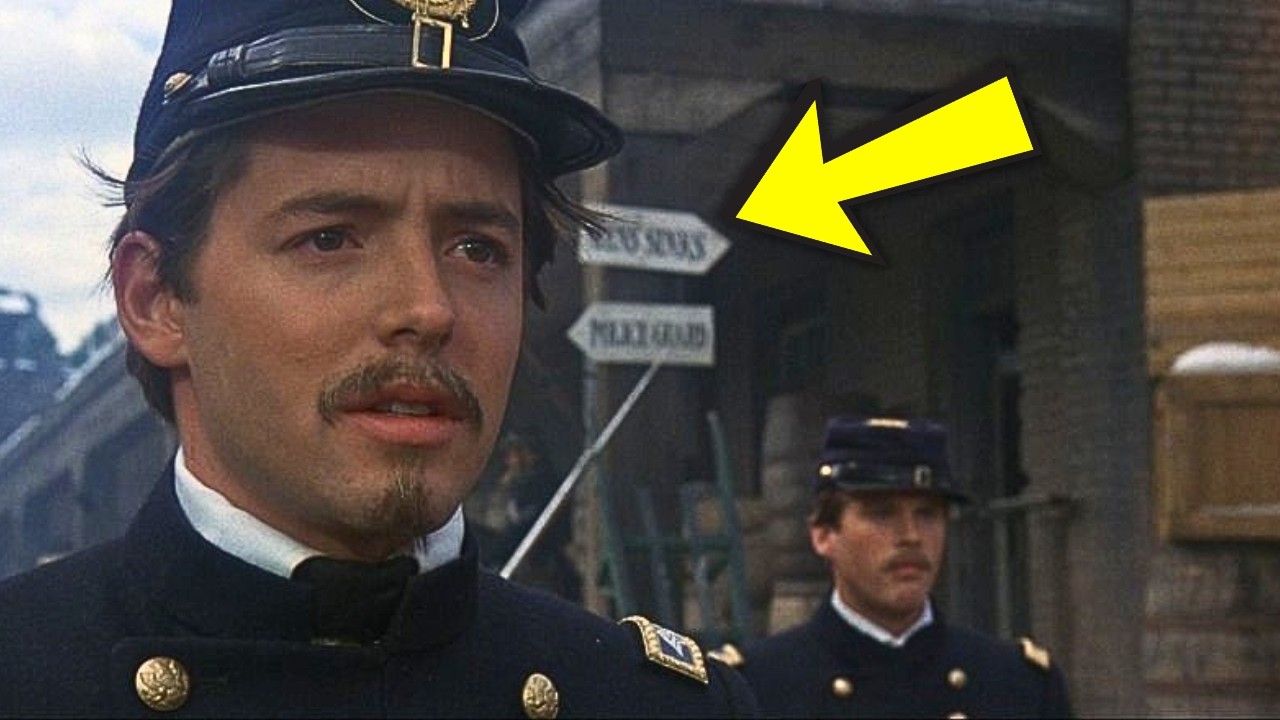
Beresford walked away. Fields refused to let it die. He carried the screenplay over to TriStar, and according to Edward Zwick’s 2024 memoir, Hits, Flops, and Other Illusions, the studio would commit only once Matthew Broderick agreed to star. A bankable teen comedy lead was the lever that finally turned the green light.
The film about the men no one would finance got made on the strength of the one name the executives were willing to trust. The lines that move audiences most came straight from Robert Gould Shaw’s own letters, which he wrote home in 1863 never imagining they would survive in Harvard’s Houghton Library or appear word for word on the film’s title cards more than a century later. Zwick built the whole screenplay on three texts: Shaw’s letters, Peter Burchard’s 1965 history One Gallant Rush, and Lincoln Kirstein’s 1973 photographic study of the Saint-Gaudens memorial. Kirstein guarded that material fiercely.
Years before Jarre arrived, he had turned James Ivory of Merchant Ivory away rather than let the story be rewritten into something more genteel. Years before the cameras rolled, Zwick had already cast the part of Trip, the runaway who becomes the film’s fiercest conscience, in his head. He had watched a young actor take command of the screen in A Soldier’s Story in 1984 and again in Cry Freedom in 1987. Wanting him and affording him turned out to be two very different problems.
The budget would not stretch, so producer Freddie Fields put up part of his own producer’s fee, a private bet on a performer the studio was not eager to pay for. Denzel Washington needed convincing of his own, but the gamble paid off in full. The role carried Washington from a respected working actor to a genuine star. Morgan Freeman had a genuinely strange stretch in the middle of December 1989.
Within a day of each other, two films carrying his name reached theaters in limited release, Driving Miss Daisy and this one, and both were headed straight for acclaim and awards. Freeman brought real military bearing to the role of John Rawlins, drawn straight from his own years in the US Air Force before acting. The actor cast as Thomas Searles had almost no experience in front of a camera. Andre Braugher had finished at Juilliard’s drama division a year earlier, where the faculty singled him out as the program’s most outstanding student.
He struggled at the start with the small mechanics that stage acting never demands, hitting his marks and delivering the same performance take after take. The trouble passed quickly. Within days he had become one of the production’s revelations. Braugher went on to anchor Homicide: Life on the Street and later to win a fresh generation of fans on Brooklyn Nine-Nine.
He died in December 2023. The authenticity did not stop at the director’s reading list. It ran all the way down into the ranks. Roughly 10,000 men gathered in a Pennsylvania field for one of the largest Civil War reenactments anyone had staged in a generation, the 125th anniversary at Gettysburg in June 1988, and the film’s opening Antietam sequence drew directly on footage shot among that enormous crowd.
Most of those men cost the production almost nothing. They were reenactors who supplied their own period correct uniforms and equipment and asked for no pay at all. For two solid weeks before principal photography began, the lead actors sweated their way through a real Civil War boot camp in the Georgia heat, learning to stand, march, and handle a period rifle the way a soldier of 1863 actually would have. The man running them through it was a hard Irish-American instructor who showed his famous pupils very little mercy.
It shows on screen in a way that can’t be coached in an afternoon. Watch the climactic charge closely, and the ocean sits on the wrong side of the screen. In the real assault, the soldiers of the 54th attacked northward along the beach with the Atlantic on their right. In the film, they surged the other way entirely, southward, with the water on their left.
The production shot the attack on Fort Wagner at Jekyll Island, Georgia, where the lay of the coastline simply ran the opposite direction, so Zwick flipped the charge to match the beach he actually had. The stretch of Jekyll Island where the regiment made its doomed reversed run carries a different name today. The locals call it Glory Beach. A few short blocks from the Savannah docks where enslaved people had once been bought and sold, the cameras rolled on the hardest scene in the entire film.
Trip is bound to a post and flogged in front of the assembled regiment as punishment for trying to leave. Zwick wanted it raw and unbroken. He told John Finn, the actor swinging the lash, to keep going and not stop no matter what, and he loaded the camera with extra film so nothing would force a cut. The instrument itself was a felt prop soaked through with water so it would read on camera.
In a later interview, Washington said the blow caught him for real all the same. The single tear that slides down his cheek in the finished shot was real, even though by his own account he was not crying. Washington has always said the scene reached past anything he could call performance. He knelt before the take and tried to commune with the spirits of the people who had been enslaved on ground that still seemed to hold their memory.
On the night before the regiment’s final fatal battle, the men of the 54th draw in close around the firelight and begin to speak one after another in something that hangs between prayer and testimony. The cameras were running through all of it, and yet there were almost no written lines for the actors to say. Zwick had deliberately handed the moment over to his cast and asked them to find their own way into it. What they reached for came straight out of a real and very old tradition, the call and response testimony of the African American shout, a form of communal worship that black Americans carried up out of slavery.
There is a documented account of United States Colored Troops doing very nearly this same thing on the night before the Battle of the Crater in 1864. Three of the night’s Academy Awards went to a single film on the evening of March 26th, 1990. The win that startled the room belonged to a 35-year-old supporting actor who took the category over a field that included Marlon Brando himself. Denzel Washington won Best Supporting Actor.
Freddie Francis took the award for his cinematography, and Russell Williams won for sound, the first of two Oscars he would collect. Washington kept his acceptance brief and turned it deliberately back toward the past. He thanked his director, his manager, and his wife, and then he turned to honor the men the entire film had been built around: the 54th, the black soldiers who helped to make this country free. Wounded and bleeding on the sand wall of Fort Wagner, a single soldier of the 54th refused to let go of what he carried.
Sergeant William Harvey Carney had snatched up the regiment’s standard the instant the man holding it went down, and he hauled it up the slope of the parapet through a storm of gunfire on July 18th, 1863, taking wound after wound and never once letting it touch the ground. Carney survived the day. His medal did not reach him until 1900, nearly four decades after the battle. His stand at Fort Wagner is the earliest action by an African-American ever recognized with the Medal of Honor.
Bleeding from several wounds, he told the men who reached him to take the standard back and added the line that history kept: “Boys, the old flag never touched the ground. ”
Almost no one actually saw the film on its opening weekend, and it still posted the best single number in the entire country. It premiered in just three theaters in the middle of December 1989, taking in only around $63,000 across the whole run, but spread over so few screens that worked out to better than $21,000 per screen, the highest such average of any film playing anywhere that weekend. The wide release came that February, and a slow build of word of mouth and steady Oscar buzz carried the picture to a final domestic gross of $26.
8 million against an $18 million budget. Eastman Kodak put up something like $2 million to send home video teaching kits out to schools across the country, which is how an entire generation of students first came to meet the men of the 54th. Long before the film ever existed, the men of the 54th already had their monument. The bronze relief on Boston Common, the same one that had sent Kevin Jarre off searching for a story he had never been taught, was unveiled on May 31st, 1897, 14 long years in the making, the first major civic monument anywhere in America raised to honor black soldiers.
Frederick Douglass appears briefly in Glory, and the real Frederick Douglass had personally sent two of his own sons into the 54th Massachusetts. Lewis Henry Douglass rose to the rank of sergeant major, the highest rank a black soldier was permitted to hold at the time, and he was wounded in the assault on Fort Wagner. Two days after the assault, Lewis sat down and wrote home to the young woman he meant to marry. The words he found for it were as bare as grief gets.
“The splendid 54th is cut to pieces. ”
For 100 years, the nation had mostly looked away from them. The film’s achievement was to make it want to look again. Glory opened in three theaters and grew slowly into something most blockbusters never become.
It made Denzel Washington a star, and it made the 54th Massachusetts impossible to forget. The criticisms are fair to keep in view. The story does lean on Shaw’s perspective, and it takes real liberties with the history. Its lasting achievement was to force a conversation the country had spent a century avoiding into classrooms and living rooms that had never heard these names.
On January 28th, 2026, held back from its usual December slot by the federal shutdown the autumn before, the Library of Congress entered the film into the National Film Registry, making official what audiences had long since decided. The monument on Boston Common, the soldiers’ real names, the letters waiting at Harvard, all of it stood there long before the cameras arrived. The film’s gift was to make millions of people finally want to know them.