The sun burned down on the rolling hills beside the Little Bighorn River in late June 1876, turning the air thick with dust and gunpowder. For more than 150 years, the public has been told a clean, almost romantic version of what happened there: George Armstrong Custer, the golden-haired boy general, standing firm on a lonely ridge with his revolver blazing, his men in a tight defiant circle holding off wave after wave until the last bullet was spent. Textbooks called it a noble tragedy. Paintings turned it into a frozen tableau of heroism.
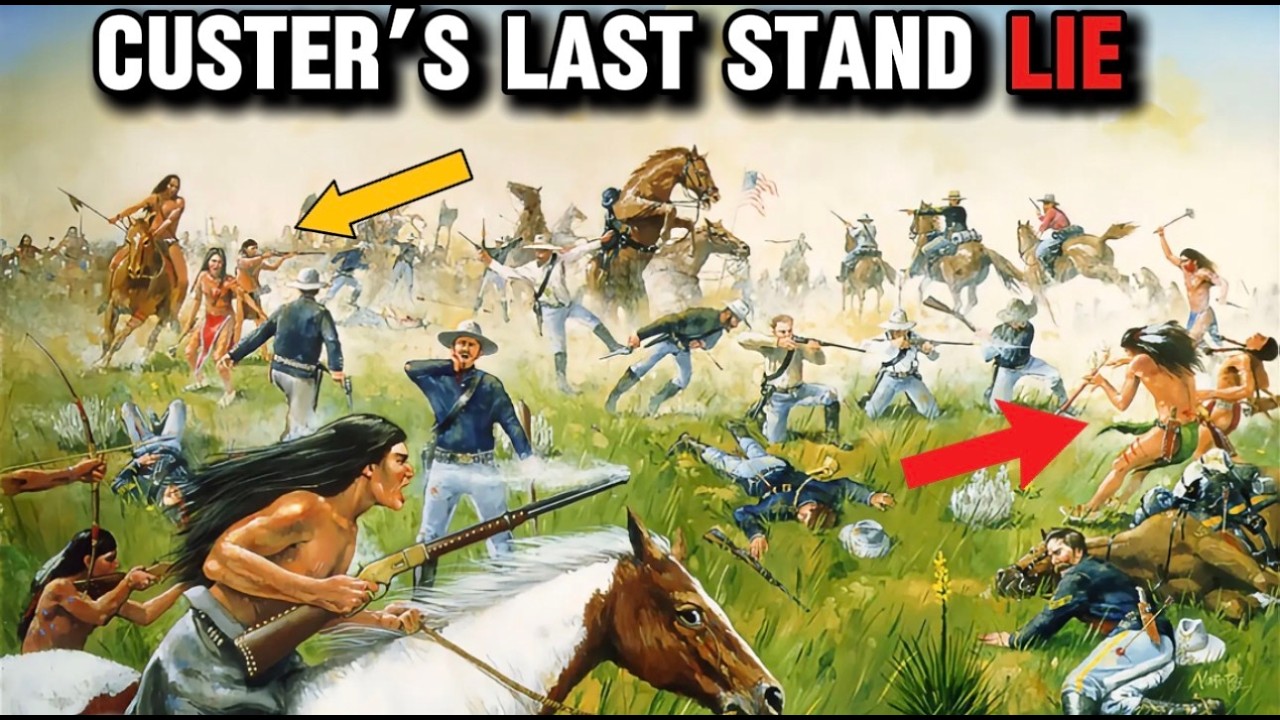
But the accounts of the Lakota, Cheyenne, and Arapaho people who fought for their families tell a different story. Those final hours were not a stand. They were a collapse, a desperate scramble, a command that unraveled under its own weight. Overconfidence met unbreakable determination, and the battlefield itself records the difference.
Custer was not a flawless military genius. Born in 1839 in New Rumley, Ohio, the son of a blacksmith, he was loud, restless, and ambitious. He scraped through West Point dead last in his class, racking up demerits for pranks and tardiness. The Civil War saved him from obscurity.
By age 23, he was a brevet brigadier general leading the Michigan Cavalry Brigade, earning a reputation for bold charges that sometimes bordered on suicidal. His men called him lucky. Peace did not suit him. After the war, he was reduced to lieutenant colonel in the new 7th Cavalry, chasing scattered bands and enforcing treaties that Washington kept rewriting.
He cultivated a public image with his trademark buckskin jacket and long curls, and his wife, Libby, spent the rest of her long life polishing every rough edge of his legend. But Custer had flaws no memoir could hide. He was court-martialed for going AWOL to see her. He tangled in scandals and political feuds.
He repeatedly underestimated Native fighters, seeing them as obstacles rather than nations with their own strategies and grievances. The forces pulling everyone toward the Little Bighorn ran deeper than one man’s ambition. The Fort Laramie Treaty of 1868 had promised the Lakota, Northern Cheyenne, and Arapaho the Black Hills as their own, along with hunting rights across the plains. Then gold turned up in those hills in 1874, and Custer himself led the expedition that confirmed it, practically advertising the find.
Miners poured in by the thousands. The government issued an ultimatum: all Indians had to report to reservations by January 1876 or be considered hostile. Most would not comply, especially the bands following Sitting Bull and Crazy Horse. By June, thousands had gathered along the Greasy Grass, as the Lakota called the Little Bighorn.
Estimates put the village at six to seven thousand people, with perhaps fifteen hundred to twenty-five hundred fighting men. It was not a war party. It was families, elders, children playing, women tending lodges. Sitting Bull, the Hunkpapa leader, had a vision during the Sun Dance that spring: soldiers tumbling into camp upside down, like grasshoppers falling from the sky.
The people took it as a sign their stand would hold. Custer’s column left Fort Abraham Lincoln in May as part of a larger campaign under General Alfred Terry. The plan was coordination: Terry and Colonel Gibbon coming from the east and north, Custer’s 7th as the fast hammer to drive the villages into them. But Custer pushed ahead hard.
He left behind the Gatling guns because they slowed the march. His Crow and Arikara scouts warned him the camp was enormous. One scout reportedly said it would take a week to ride around it. Custer brushed it aside, telling them they had enough to whip anything that rode.
On June 24th, his scouts spotted the massive pony herd. Instead of waiting for Terry or confirming the numbers, he ordered an immediate attack. The next morning, June 25th, he split his roughly 650 men into three battalions. Major Marcus Reno took three companies south to hit the lower end of the village.
Captain Frederick Benteen led three more west to scout for escape routes. Custer kept five companies, about 210 men, including his brothers Tom and Boston, his nephew, and his brother-in-law, for the main thrust along the ridges to the north. Reno crossed the river first around noon. Warriors grabbed whatever weapons were at hand and poured out.
Women scooped up children and ran for ravines. Reno’s men dismounted and formed a skirmish line, but the volume of fire forced them back across the river in disorder. They scrambled onto a bluff and dug in under siege. Benteen, finding nothing to the south, joined Reno.
By then, Custer was committed elsewhere. Custer’s men moved down Medicine Tail Coulee, a dry wash, aiming toward the river. Native accounts differ on how far they got, but most agree they never crossed in force to strike the heart of the camp. Warriors on fast ponies began circling, firing from cover.
The soldiers pushed north along the bluffs, but the response was already overwhelming. Red Horse, a Miniconjou Lakota chief who fought that day and later drew detailed pictographs for the Smithsonian, left one of the clearest records. He described being a short distance from camp digging wild turnips when he saw a cloud of dust rising. He soon saw the soldiers charging the camp.
After driving Reno’s men back, the warriors turned on Custer’s group. Red Horse said the soldiers discharged their guns but little, that they became foolish, many throwing away their guns and raising their hands, asking to be taken prisoner. The Sioux did not take a single prisoner. They killed them all.
Two Moon, the Northern Cheyenne chief, fought both Reno and Custer and described the whirlwind in an interview years later. He had ridden into camp warning people not to run, telling them to stay and fight even if they were to be killed. He saw Custer’s men forming lines, bugles sounding, soldiers dismounting. The Indians swirled around them like water around a stone.
Soldiers used single-shot Springfields while many warriors carried repeaters. Two Moon watched the soldiers make several stands, each one crumbling. At last, about 100 men and five horsemen stood on the hill, all bunched together. Then a chief was killed, and a desperate breakout started toward the river with the circle closing around it.
Gall’s fury fueled much of the northern fight. Reno’s initial charge had killed his two wives and three children. It made his heart bad, he later said. After that, he killed all his enemies with the hatchet.
Crazy Horse coordinated from the ridges, exploiting every draw for cover. Standing Bear, a young Lakota warrior of 17, remembered the frenzy in a letter dictated decades later. He heard a man shouting that the soldiers were coming, that they had shot a boy on his way to get their horses. He sprang onto a horse with only his shirt, no shoes, riding half-naked toward the sound of guns.
The accounts of Custer himself swirl in the dust. Some Lakota oral histories say he was wounded early, perhaps in the chest, and took a temple shot to avoid capture. Others credit specific warriors. Gall insisted Custer never reached the ford in strength.
His final spot was on the ridge now called Custer Hill, where about 40 men and a few horses made a last cluster. Archaeology found minimal evidence of a prolonged stand, no massive breastworks of dead horses held long. Custer’s body was discovered two days later by Terry’s relief column, relatively intact compared to others, with two wounds, no scalping. His brothers lay nearby.
When the shooting stopped, the warriors did not linger in celebration. They had defended their homes. Red Horse took guns and belts from the dead, many with full ammunition still in them. The focus quickly shifted back to protecting the village.
Reno and Benteen held their bluff overnight, hearing distant fire but unable to break through. The next day, the warriors slipped away as Terry approached. Relief troops on June 27th found 210 bodies scattered across the ridges, bloating in the June heat. Quick, shallow burials followed.
The immediate army reports focused on heroism to rally support for continued campaigns. Libbie Custer’s books turned every flaw into virtue. Frederick Whittaker’s quick biography cemented the martyr image. Paintings hung in saloons across the country showing a defiant circle against impossible odds.
Hollywood picked it up, glossing over mistakes and making Custer a tragic romantic lead. Native accounts, collected in interviews and pictographs, sat in archives or were dismissed as unreliable exaggerations from the vanquished. Archaeology changed everything. Cartridge distributions proved warriors used the terrain for enfilading fire.
Soldiers fought from the high ground as trained, but numbers and mobility overwhelmed them. No evidence supported mass suicide. The variety of Indian firearms showed trade networks had armed them well, but coordination mattered more than technology. The battlefield today, preserved as a national monument, holds markers for both sides.
An Indian memorial added in 2003 honors the warriors who protected their people. The truth does not erase courage on either side. The troopers who charged into unknown odds showed grit, even if leadership failed them. The warriors circling that hill fought for survival with everything they had left.
Archaeology and oral histories now let us see the messy reality: not a glorious last stand, but a brutal clash where arrogance met resolve. History recorded what it needed to believe. The ground and the voices that survived tell us something else entirely, a story of overreach, of defense, of lives cut short in the heat of a single afternoon.
The dust has long settled, but the questions refuse to stay buried.