Early in the war, a Union soldier in the upper South thought he had found the perfect solution to a cold night: a single wooden fence rail from a nearby farm. Dry, portable, easy to burn. He pried it loose, carried it back to camp, and lit a fire. His commanding officer found out and ordered formal punishment.
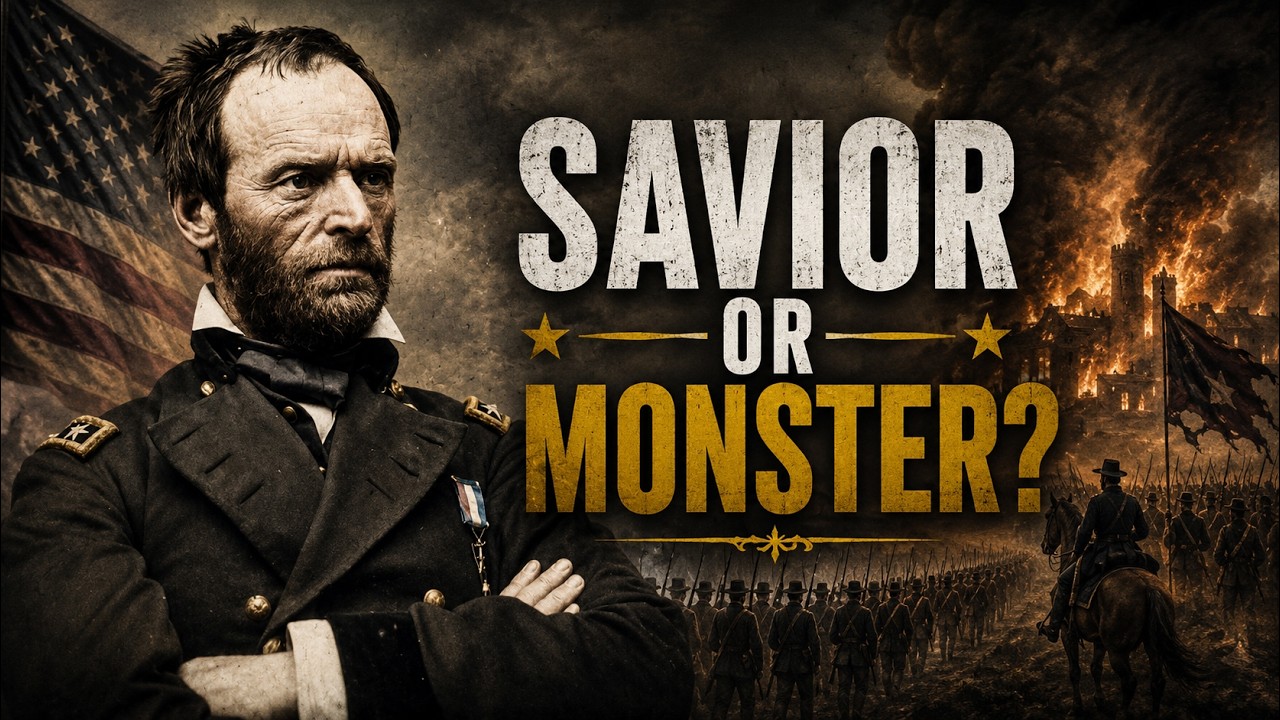
One wooden rail from a civilian fence went into the record as a serious breach of military conduct. That officer had standing orders forbidding the seizure of civilian property, even from men who had voted for secession, and he enforced those orders as if the Republic depended on them. For him, the line between a professional army and a mob began exactly there, at the boundary between what a soldier was ordered to do and what he decided on his own to take. The officer’s name was William Tecumseh Sherman.
Three years later, that same man ordered the systematic destruction of roughly 285 miles of Georgia’s economic infrastructure. He watched Atlanta’s rail yards, machine shops, and depots go up in flames. He marched about 62,000 soldiers through the heart of the Confederacy with orders to live off the land, wreck every railroad they crossed, and leave no military asset usable behind them. Then he turned north into South Carolina, the state he blamed more than any other for starting the war, and let it burn with even less restraint.
The gap between those figures, the brigadier who disciplined a man over a stolen fence rail and the general watching whole rail junctions glow, is not a question of whether the change happened. It is a question of how it happened. The answer is not buried in psychology. It is not just about anger, grief, or numbness.
The engine was colder and more methodical. It was a man watching a strategy fail battle after battle and year after year. Sherman did not stop caring what war cost. He calculated what losing would cost instead.
Every serious American officer in 1861 had read Antoine-Henri Jomini. His summary of the Art of War and his analysis of Napoleon’s campaigns had been the backbone of West Point’s curriculum for decades. Jomini’s core idea was simple. War is a contest between professional armies.
Civilians stand outside it by definition. A well-conducted war is one in which forces maneuver for position, mass at decisive points, and fight battles that produce clear military outcomes. Political leaders then accept those outcomes and negotiate a settlement, while populations watch from the sidelines. Sherman absorbed this not just as a tactical preference, but as a moral conviction.
A war confined to armies was both strategically sound and humane. When he punished a soldier for stealing that fence rail, it was Jomini’s framework enforced at the smallest possible scale. In 1861, Lincoln’s administration gave this military theory a political name, conciliation. The premise was that Confederate governments were illegal structures sitting on top of basically loyal populations.
Win a few clean victories, treat Southern farms and families with strict respect, and those populations would drift back toward the Union. The problem was that almost everything in the field suggested the opposite. Grant and Sherman took Fort Henry and Donelson in February 1862, fought the bloody field of Shiloh in April, and pushed onto Corinth. By that summer, Union forces controlled major rail junctions in the West and the Mississippi north of Vicksburg.
The Confederate armies were battered, but still in the field. In the shadows of that conventional war, Confederate guerrillas flourished in Tennessee, Kentucky, and Mississippi. They burned bridges, derailed trains, fired on riverboats, ambushed foraging parties, and then vanished back into a countryside that was officially under protection. Sherman’s view of that theory cracked in Memphis.
In July 1862, guerrillas attacked a Union forage train near LaGrange, Tennessee. Sherman believed the attackers were local civilians, so he ordered the arrest of 25 of the most prominent men in the area and sent them off as prisoners. In his report, he wrote, “I am satisfied we have no other remedy for this ambush firing than to hold the neighborhood fully responsible, though the punishment may fall on the wrong parties. ” He was not confused about the ethics.
In the same line that defended the move, he admitted that innocent people might pay. He had decided the alternative, doing nothing and watching guerrillas keep operating at no cost to anyone around them, was worse. By September, guerrilla attacks on the Mississippi had escalated. Partisans fired on Union supply boats near Randolph, Tennessee.
Sherman ordered Colonel Charles Walcutt to march on Randolph and burn it, leaving almost nothing but a marker to show a town had once been there. He warned that if attacks continued, he might load riverboats with captured guerrillas, so any future ambush would slaughter Confederate prisoners as well as Union crews. He was describing a lever. If civilians who harbored and supplied irregulars paid no price, they would keep doing it.
If they paid a price, some would stop. What he was discovering on the ground was that Jomini had described a kind of war the South was not actually fighting. The Confederacy was not a professional army on a neat map with a neutral population behind it. It was a society in arms, farms turning out food for Confederate depots, railroads moving that food, families sending sons to the ranks and intelligence back with them on furlough.
The army and the home front were welded together. Sherman was beginning to understand that he would eventually have to decide whether to respond in kind. The next step in his education came in Mississippi, in the town he would leave so thoroughly wrecked that every previous Union operation would look like the fence rail policy with better paperwork. By the winter of 1863, Sherman had been thinking about Meridian for months.
It sat where the Mobile and Ohio Railroad crossed the Southern Railroad, a crossroads connecting what was left of Confederate operations west of the Appalachians to the Eastern armies. Meridian held warehouses, armories, hospitals, headquarters, and the depot that fed irregular forces across the lower Mississippi Valley. Destroy Meridian and you rip out a section of the Confederacy’s supply network. Before he marched, he did something that went beyond a field order.
In January 1864, he wrote a long letter to Major R. M. Sawyer in Huntsville, Alabama, explicitly intended to be read aloud to civilians. In it he spelled out the Union’s view of its rights in the war.
The government could, if necessary, take their lives, their homes, their lands, their everything from those who persisted in rebellion. He warned that anyone who communicated with or aided guerrillas would be arrested and banished from Union lines. On February 3rd, 1864, Sherman left Vicksburg with roughly 20,000 to 25,000 men, light wagons, and no tents. Speed was the weapon.
His men carried a few days of rations and were expected to forage the rest. They reached Meridian on February 14th. Confederate forces under Leonidas Polk fell back rather than risk a pitched battle. For about five days, Sherman’s men dismantled the town.
More than 100 miles of track were torn up, rails stacked on burning ties and twisted into useless loops. Dozens of bridges and trestles burned. Depots, warehouses, arsenals, hospitals, and barracks were gutted or destroyed. Sherman summed it up with his famous line: “Meridian, with its depots, storehouses, arsenals, hospitals, offices, hotels, and cantonments no longer exists.
” Private homes were mostly spared. The target had been the town’s ability to support war. Union casualties for the whole operation were under 200. He had penetrated deep into Confederate territory, lived off the land for nearly a month, wrecked a major logistics hub, and returned with his men in better shape than when they left.
That last point changed everything. The assumption behind every big Union push in the West had been that an army required a secure supply line of rails, guarded depots, and regular deliveries. Meridian overturned that. A moving army that foraged could be faster and in some ways stronger than a static army tied to a railhead.
Sherman went back to Vicksburg and wrote his conclusions to Grant. Within months, Grant signed off on the operational concept for a much larger experiment: the Georgia campaign, the march to the sea. Cut loose from supply lines, live off hostile territory, destroy everything of military value in the path, and move too fast to stop. That had already been test flown at Meridian.
The dress rehearsal was over. What remained was a change of scale. What separates Sherman from almost every other general of his generation is not just what he did, but what he wrote before he did it. From 1863 through 1865, he wrote to Grant, Halleck, his brother John, and his wife Ellen, working out in real time the moral and strategic logic of what we now call hard war.
In September 1863, he told Halleck, “I would make this war as severe as possible and show no symptoms of tiring till the South begs for mercy. ” In the same letter, he laid out his key legal move: “Every member of the nation is bound by natural and constitutional law to maintain and defend the government against all its opposers. If they fail to do it, they are derelict and can be punished or deprived of all advantages arising from the labors of those who do. ”
Before leaving Atlanta in November 1864, he put that doctrine into plainer language.
To one associate he wrote that he intended to make war and individual ruin synonymous terms for those sustaining the rebellion. To another he said of his coming march, “I am going into the very bowels of the Confederacy and will leave a trail that will be recognized 50 years hence. ” The fullest version of his theory appears in his December 24th, 1864 letter to Halleck from Savannah, written after the march while he was still processing what it had done. “We are not only fighting hostile armies, but a hostile people and must make old and young, rich and poor feel the hard hand of war as well as their organized armies.
I know that this recent movement of mine through Georgia has had a wonderful effect in this respect. Thousands who had been deceived by their lying papers into the belief that we were being whipped all the time realized the truth and have no appetite for a repetition of the same experience. ”
Hostile people was the precise point where Sherman stepped away from Jomini and conciliation. Destroying armies alone had not ended the war.
Destroying the foundation under them might. Sherman kept coming back to the same grim equation. A shorter, harsher war is more humane than a longer, gentler one. Every month conciliation failed to end the conflict, more soldiers died in the Wilderness, at Spotsylvania, and in front of Petersburg, casualties that dwarf the noncombatant suffering caused by three weeks of railroad wrecking in Georgia.
“War is cruelty and you cannot refine it,” he told the mayor of Atlanta. Decades after the war, historians started asking whether Sherman’s theory worked. One line of evidence came from Confederate morale. Later analysis of muster records and correspondence suggests that as Sherman’s army moved through Georgia in late 1864, desertion rates in the Army of Tennessee and among Confederate troops drawn from those regions rose noticeably.
Letters from home described smoke houses emptied, corn taken, and rail lines ruined. A man who could stand in the trenches when he believed his farm was safe was a different man once that farm was gone. Another line of evidence came from logistics. Every previous Union offensive in the West had left behind a long chain of garrisons, men stuck guarding bridges, depots, and telegraph stations along the supply line.
Sherman’s answer was brutally simple. Don’t have a supply line. By living off Georgia, his roughly 62,000-man force stayed concentrated at the front. There was no rear to defend, no rails that had to be kept intact.
Wade Hampton, one of the Confederacy’s most aggressive cavalry commanders, chased Sherman through the Carolinas and later wrote that it was impossible to explain the extent of the demoralization Sherman’s passage produced. Within five months of Sherman’s army reaching Savannah, the war was over. Lee surrendered at Appomattox on April 9th, 1865. Johnston surrendered to Sherman at Bennett Place on April 26th in what remains the single largest surrender of Confederate troops, about 89,000 men, of the entire war.
By early June, every remaining organized Confederate force had laid down its arms. Sherman believed he was making war more humane by making it shorter. In cold arithmetic, he was probably right. But that is not what it felt like if you were standing in front of your house when the blue columns came.
He knew from the start that the arithmetic of attrition was not the only measure. That is why before leaving Atlanta, he tried to build guardrails into Special Field Orders No. 120, the directive he issued on November 9th, 1864 to govern the march. Foraging parties had to be organized, limited in size, and led by commissioned officers.
No soldier was to enter a private dwelling without explicit authorization. No building was to be burned without a core commander’s approval. The bummers were what happened in the gaps. They worked ahead and alongside the main columns, foraging aggressively and often beyond orders.
Some stayed within the rules, others did not. They went into houses, took family property that had no military value, and crossed the line from sanctioned destruction into something more like personal revenge or opportunism. After the war, Sherman admitted the bummers represented a failure in execution. He never accepted that they invalidated the policy itself.
And then there was Ebenezer Creek, which was not just a failure of supervision, but a conscious decision. As Sherman’s army moved, thousands of formerly enslaved people followed, men, women, and children who correctly saw the column as their best path toward freedom. At Ebenezer Creek in December 1864, Union General Jefferson C. Davis, one of Sherman’s core commanders, ordered the pontoon bridge taken up before the freed people trailing his column could cross.
Several hundred people were left on the far bank of a flooded creek with Confederate cavalry closing in. Some drowned trying to swim. Others were captured or murdered. No one has ever produced an exact number.
In early 1865, writing to Ellen from the Carolinas after months of being the instrument of destruction he had sketched on paper, Sherman confessed that he had begun to regard the death and mangling of a couple of thousand men as a small affair, a kind of morning dash, and added that it was only familiarity with death that makes this so. He was not boasting. He was diagnosing what his work had done to him. He thought the transformation was necessary.
He knew it had a price. Those two facts sat side by side inside him, unresolved, for the rest of his life. Sherman never apologized for the strategy. What he did say over and over was that if you truly understand what war was, you do almost anything to avoid it.
In 1879, speaking to cadets at the Michigan Military Academy, he looked out at a crowd of boys thrilled by uniforms and glory and told them, “There is many a boy here today who looks on war as all glory, but boys, it is all hell. ” He added that it was those who had never fired a shot or heard the screams and groans of the wounded who were always clamorous for more blood. The family that owned that fence in Tennessee in 1861 would have seen both versions of him. First, the young brigadier who punished a soldier for stealing a single rail because civilian property was supposed to be off-limits.
Three years later, men in his uniform came through farms just like it and took everything that fence had been built to protect. Sherman understood that distance better than anyone who has ever written about him. He had not stopped caring. He had decided that caring by itself did not end wars.
In his mind, the mercy he had practiced in 1861 had simply stretched the killing out month after month, grave after grave. So he chose effectiveness over the kind of mercy that made him feel better but did not change the result. Whether he was right about that is a question without a clean answer. It did not have one then.
It does not have one now.