The war in Europe was over, and in occupied Austria the victorious allies were celebrating. In a banquet hall in Linz, tables groaned under food, vodka flowed without pause, and American and Soviet officers laughed together, toasting their shared victory. But at one table the temperature was freezing. General George S.
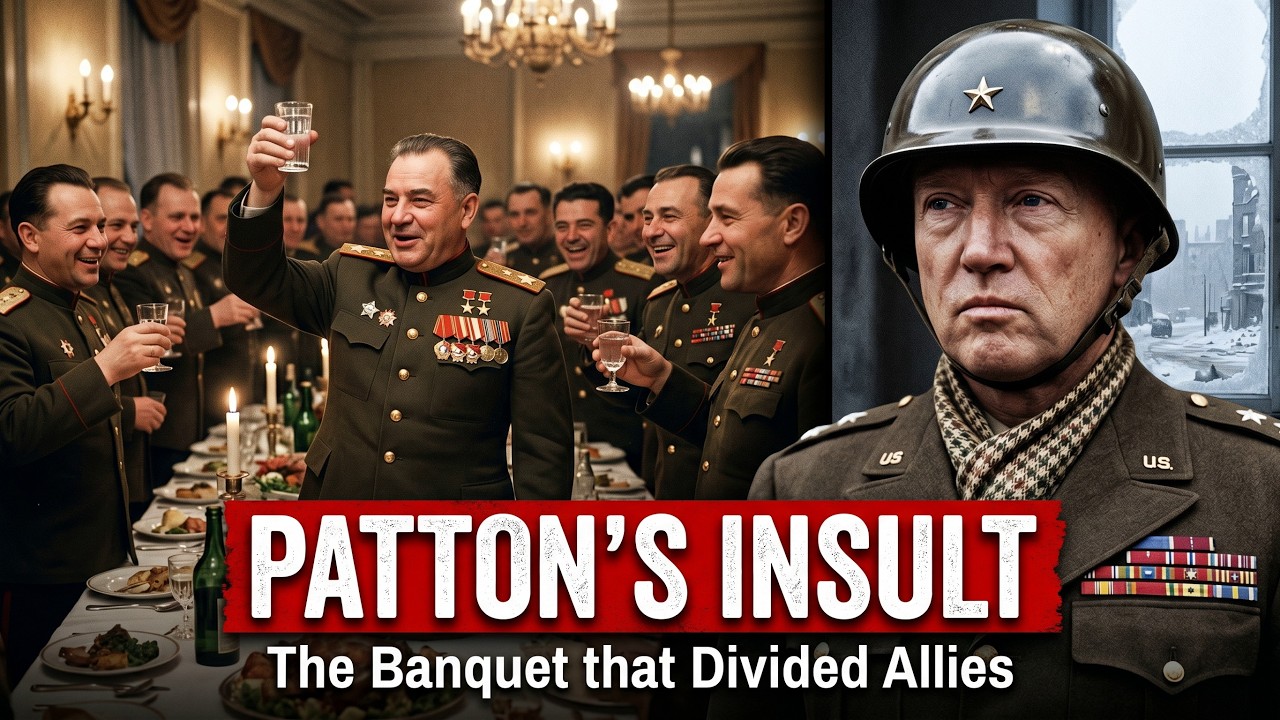
Patton, commander of the American Third Army, sat with his jaw clenched, glaring at the Soviet officers across from him with undisguised contempt. The moment that nearly ignited a new war came when a senior Soviet general rose, raised his glass of vodka, and through an interpreter proposed a personal toast to Patton, honoring his brilliance as a commander and the friendship between their nations. It was a diplomatic gesture, a moment meant for polite reciprocity. Patton stood slowly.
He did not touch his glass. His high-pitched voice cut through the room: “Tell that Russian son of a bitch that from the way they’re acting here, I regard them as enemies, and I refuse to drink with him or any other Russian son of a bitch. ”
The young American translator went pale. He looked from Patton to the Soviet general, surrounded by his own armed officers.
“General Patton, sir,” he stammered, “I can’t translate that. It would cause a major diplomatic incident. ” Patton slammed his hand on the table. “Translate it exactly as I said it, dammit.
That is an order. ” Trembling, the translator turned and delivered Patton’s exact words in Russian. The Soviet officers tensed, hands moving toward side arms. The room went dead silent.
To understand why Patton behaved so recklessly, one must understand his mindset in the spring of 1945. While Washington and London maneuvered to build a postwar order with Joseph Stalin, Patton saw a different picture. He was a student of history who had studied the Russian Empire and communist ideology, and he had watched the Red Army sweep across Eastern Europe. He reached a chilling conclusion: America had defeated one monster only to invite a greater one to the table.
“We have destroyed what could have been a good race,” he wrote in his diary of the Germans, “and we are about to replace them with Mongolian savages. ”
Patton did not care about politics. He cared about winning, and in his mind the war was not finished. He believed the Soviet Union was the next great threat to Western civilization, and he wanted to fight immediately.
His Third Army was at the height of its power, with tanks, men, and momentum. He begged his superiors: “Give me the word, and I will push the Russians back across the Vistula River. We have to fight them eventually. We might as well do it now while our army is fully mobilized.
”
Dwight D. Eisenhower, the Supreme Allied Commander, was horrified by such talk. He was trying to hold the delicate alliance together. He ordered Patton to halt his advance, forbade him from taking Berlin, and directed him to stop outside Prague so the Red Army could capture those cities.
Patton was furious, convinced that the politicians were handing half of Europe to a brutal dictatorship. That burning resentment was still inside him when the fighting stopped in May 1945. A new kind of warfare began: the war of diplomacy and banquets. American, British, and Soviet commanders were required to meet, exchange medals, and host massive, alcohol-fueled celebrations.
For Soviet generals, these banquets were a display of strength. They brought cases of vodka and cognac with the intention of drinking Western officers under the table; in their view, holding your liquor while remaining standing was a test of manhood. For Patton, these events were torture. He despised Soviet military culture.
He looked at Red Army soldiers who had survived Stalingrad and Kursk and saw a chaotic, undisciplined horde. He hated their uniforms and their politics, and above all he hated the way the American government seemed to be deferring to them. But orders were orders. In the weeks after the German surrender, Patton was forced to attend several of these joint celebrations, including the most famous one in Linz, where American and Soviet forces had linked up.
The Soviet delegation was led by a hardened, battle-scarred general, a survivor of the Eastern Front who had lost millions of comrades and had no patience for Western arrogance. He had heard the legends of “Old Blood and Guts” and wanted to see the famous American tank commander face to face. The banquet hall was loud, the toasts endless. Russian custom demanded that each glass be drained completely, bottom up.
To Stalin, drink. To Roosevelt, drink. To the Red Army, drink. Patton was not a heavy drinker and preferred to keep his wits about him.
As the night wore on, his patience wore thin. He sat stiffly in his tailored uniform, his polished helmet and ivory-handled revolvers a stark contrast to the rugged wool tunics of the Soviet officers. Then the Soviet general noticed Patton’s mood and decided to break the ice. He stood, poured a massive glass of vodka, and turned directly to Patton, speaking in Russian.
The translator relayed his words: a personal toast to Patton’s brilliance and to the friendship between their nations. Everyone at the table stopped talking. The Americans held their breath. They knew Patton’s temper.
The insult came, the room froze, and the Soviet general stood absolutely still, eyes locked on Patton. The silence stretched for what felt like an eternity. Then the Soviet general smiled. He did not yell and did not reach for his gun.
He looked at the young translator and fired back a rapid response. The translator turned to Patton. “Sir, the general says, ‘Tell General Patton that he is a son of a bitch too. ’”
Nobody moved.
Patton processed the words, looking at the Soviet general, who still stood holding his glass with a defiant smirk. The Soviet had not backed down. He had taken Patton’s best insult and thrown it back. He had acted like a soldier, not a politician.
Patton’s face broke into a wide grin. He threw his head back and laughed, loud and genuine. “All right,” he shouted, “tell the old bastard that I’ll drink to that. I’ll drink with him as one son of a bitch to another.
” The two men raised their glasses, clinked them, and downed the vodka in one gulp. The tension vanished. Both sides cheered, and the banquet resumed, louder and rowdier than before. For one moment, the American bulldog and the Soviet bear had found a language they both understood, the language of warriors.
The story of the “son of a bitch toast” spread quickly through both armies and became legendary. It showed exactly who George S. Patton was: a man incapable of diplomacy, who spoke his mind no matter the consequences. But the shared laugh and clinking glasses changed nothing.
In the months that followed, Patton grew increasingly vocal about the need to prepare for war with Russia. He told anyone who would listen that the job had been left half finished. “The difficulty in understanding the Russian,” he wrote shortly after the banquet, “is that we do not take cognizance of the fact that he is not a European, but an Asiatic, and therefore thinks deviously. We can no more understand a Russian than a Chinaman or a Japanese.
”
His outspoken views, constant criticism of Soviet policy, and reckless statements to the press finally became too much for the American government. In October 1945, Eisenhower relieved Patton of command of his beloved Third Army. It broke his heart. Just two months later, in December 1945, Patton was paralyzed in a bizarre low-speed car crash in Germany and died in a military hospital twelve days later.
Because of his open hatred for the Soviets, conspiracy theories immediately swirled. Some claimed Stalin’s secret police, the NKVD, had arranged the crash. Others whispered that the American OSS, the precursor to the CIA, had silenced him before he could start World War III. Historians agree it was a tragic accident, but the rumors persist.
George S. Patton was a man out of time, a pure warrior trapped in a world that suddenly demanded politicians and peacemakers. He did not know how to smile for the cameras or hide his hatred. When that Soviet general offered him a drink, a normal commander would have politely accepted and complained later.
Patton instead looked the enemy in the eye and told him exactly what he thought. And ironically, by dropping the political theater and speaking the harsh, blunt language of a soldier, he earned from the Soviets the one thing diplomats never could: their respect. In the end, he was right about one thing. The war was not truly over.
The smiles and toasts at those banquets faded, replaced by the Iron Curtain, nuclear standoffs, and a Cold War that would last forty-five years. Patton saw it coming before almost anyone else, and he warned them right to their faces.