On February 1, 1943, a B-17 Flying Fortress of an American bombardment group was pulling away from its target high above the Tunisian coast when a German fighter, hit by defensive fire and out of control, sliced through the formation and struck the bomber. The collision tore through the rear fuselage, ripping away a large portion of the horizontal stabilizer on one side. So little of the original airframe remained connected that the tail visibly twisted against the fuselage in flight, captured in photographs taken from another bomber in the formation. By every calculation the German air force had made about four-engine bombers, the aircraft was finished.
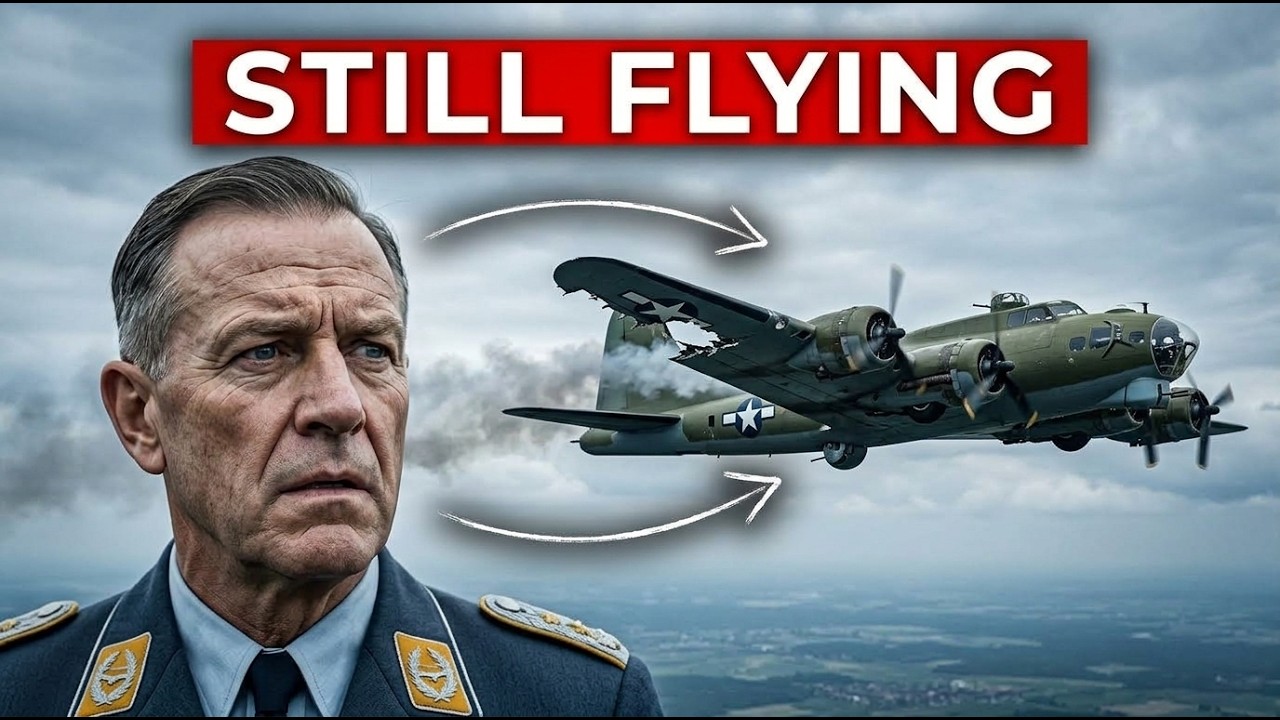
The tail should have separated within seconds. It did not. The bomber kept flying for roughly an hour and a half. It stayed with the formation, crossed the Mediterranean, and reached its base.
The crew climbed out, and only after the aircraft settled on the runway did the structure finally collapse. Everyone aboard survived. Stories like this are often treated as folklore rather than engineering. That is a mistake, because the German air force treated it as neither folklore nor mystery.
They treated it as a technical problem, studied it deeply, ran ballistics calculations, redesigned their weapons around it two times, then a third, and by the end of the war they were authorizing near-suicidal operations because the equation would not produce the results they needed. The question they were trying to answer was not romantic. It was arithmetical. How much damage does it take to destroy an American heavy bomber before it stops flying?
And the answer they kept arriving at, which shaped the development of German fighters from 1942 until the end, was far greater than anyone believed and far more than a fighter pilot had time to deliver. The first part of that answer was the mathematics of bringing a bomber down. The Luftwaffe calculated the number of hits required, on average, for each weapon type to destroy a four-engine bomber. With the standard 20 mm cannon fitted to most German fighters, the number was roughly twenty hits.
Twenty separate 20 mm shells striking the aircraft in the generally correct regions to bring it down with confidence. Twenty hits in two seconds from a moving platform, against a maneuvering target, while the bomber’s gunners and every other bomber in the formation were firing back. That was a nearly impossible standard, and the Germans knew it. By late 1942 they were already changing tactics because of it.
The frontal assault, developed in the West against American formations and most associated with Egon Mayer and the pilots of Jagdgeschwader 2, existed because attacking from directly ahead put your shells into the cockpit and the inboard engines, the parts that could be destroyed quickly, and because the forward defensive armament of early B-17s was its weakest sector. It was a clever solution to a terrible problem. It also required flying head-on into a formation of bombers at high closing speeds, where a half-second error meant death, and it left the pilot even less time to fire than an attack from the rear. The second part of the story is the bomber itself.
The Boeing B-17 was designed in 1934 and 1935 for a peacetime air corps competition, by a company whose previous experience was building passenger aircraft. Its engineers approached the structure the way engineers do when they expect passengers to sit inside it. The result was an aircraft that was not very good by the standards of what a bomber was supposed to do. The B-17 carried a smaller bomb load than the B-24 Liberator flying beside it.
It was slower. It had a shorter range. In every specification that bombing command actually cared about, the newer aircraft was superior. By any rational purchasing logic, the B-17 was an inferior machine.
Yet the army bought thousands of both. The reason it survived was the same reason it looked mediocre on paper. Its structure was heavy and incorporated redundancy in its parts, and that redundancy cost payload. The wing was built around multiple spars, with a dense structure of ribs and struts, and the skin carried part of the load distribution rather than being a cover stretched over a skeleton.
This is what semi-monocoque construction means. When you puncture such a structure, the load does not follow a single path, and it does not all concentrate through the part you have just destroyed. It redistributes. Stress flows around the hole into the members on either side, and into the skin above and below.
If the surrounding structure has a safety margin, and this structure had a large one because it was designed conservatively by people thinking about fatigue life and passenger safety rather than minimum weight, the aircraft keeps flying with a hole in it. Other decisions compounded that advantage. Four engines on separate mounts, with separate fuel feeds and separate electrical and hydraulic runs, distributed across the wing. Knock out one and you lose a quarter of your power, but you do not lose the ability to fly.
Knock out two on the same side, and a good pilot with an alert crew could often make it home, slowly, at low altitude, but make it home. Self-sealing fuel tanks had a lining that swelled on contact with fuel to close the hole a bullet had made, so a hit in the wing did not automatically mean fire. Control runs were duplicated where duplication was cheap. Armor plates protected crew positions.
Electrical systems could be isolated. None of this was genius. There is not a single brilliant idea in the B-17 structure. It is a catalog of conservative choices made by engineers who had a safety margin to spend and spent it, and who were designing in the mid-1930s for requirements no one expected to be tested by German 20 mm cannons at 25,000 feet.
The aircraft was overbuilt for its assigned mission, which turned out to mean it was built correctly for the mission it actually flew. The third part of the story is the half that never appears in the famous photographs, and it mattered more than the airframe itself. A bomber that returned to base with a hole was not something that had survived. It had been delivered to a hardstand in East Anglia under the cover of darkness, where a different group of men took over.
Every American bombardment group in England had maintenance and repair personnel who devoted their entire war to fixing battle damage. Sheet metal workers, riveters, welders, electricians, engine specialists. Sub-depots capable of work beyond a group’s capacity, and depot-level facilities capable of rebuilding what the sub-depots could not. The routine, repeated thousands of times, went like this.
The aircraft came back with holes, sometimes hundreds of them. Damage was assessed the same day. Skin panels were cut out and replaced. Structural struts were spliced.
Control cables were renewed. Engines were changed as complete units. So an aircraft that landed at four in the afternoon looking like a sieve was ready for a mission two or three days later. There is a phrase that appears constantly in group records for aircraft that spent long periods in the hands of the maintenance men.
Hangar queen. An aircraft too badly damaged to fly, but too valuable to strike off, sitting on its hardstand for weeks, slowly giving up its parts to keep the rest of the squadron in the air, and sometimes eventually flying again. When an airframe was damaged beyond even that, it was not discarded. It was stripped.
Engines, instruments, turrets, guns, radios, landing gear components, and long sections of usable structure were pulled from it and grafted onto aircraft that could be saved. That is the multiplier. The German ballistics study asked how many hits it took to bring down a bomber. That was the right question for a fighter pilot.
It was the wrong question for the war. Because the question at the level of the war is how many hits it takes to keep a bomber out of service permanently. And the answer to that question included a very large number of men in England with rivet guns whom the Luftwaffe never saw and could not attack. There are two uglier realities that also belong in this assessment, because the story that claims the sturdy bomber always makes it home is a lie.
The first is that the toughness of the aircraft did not extend to the men inside it. At 25,000 feet, the air temperature is far below freezing. The aircraft was not pressurized. A hole in the fuselage, the kind the structure ignored structurally, turned the interior into a wind tunnel at fifty below zero.
Heated electric suits failed constantly. Frostbite casualties in the Eighth Air Force numbered in the thousands, sometimes exceeding casualties from enemy fire. A gunner could lose fingers to the cold in an aircraft that landed with hardly any structural damage. The second is that the bomber’s ability to absorb damage did not save the air campaign in 1943.
It could not. In the autumn of that year, during deep unescorted missions inside Germany, the Eighth Air Force took losses no structural margin could offset. In the second raid on Schweinfurt in October 1943, sixty B-17s failed to return from a single mission. The men called it Black Thursday, and they were right to.
Extra structure gives you survival at the margins. It does not win a military campaign. What won the campaign was long-range fighter escort, which did not arrive in sufficient numbers until 1944. The men who repaired those aircraft through the night, the sheet metal workers and riveters who never left an airfield in Suffolk, are not in any of the photographs of bombers with their tails torn off.
The fourth part of the argument is the cleanest one, because it does not require taking American sources at their word about how hard these aircraft were to bring down. The German weapons development program is the evidence. Read it as a document, and it says the same thing over and over with rising panic. Stage one.
The standard 20 mm cannon needs about twenty hits. Stage two. Put more of them on the aircraft. Fighters were fitted with underwing gun pods carrying additional cannons, increasing weight and drag and making the fighter far worse in air combat, a cost the Germans accepted specifically to reduce the firing time required against bombers, and one they were punished for severely once the American escort arrived.
Stage three. Rockets. Large-caliber mortar shells fired from tubes under the wings, thrown not at individual aircraft but into bomber formations to break them apart so fighters could attack isolated bombers. The weapon existed because the formation itself, the box of mutually supporting defensive fire, was as much a problem as the airframe.
Stage four. A larger cannon. The MK 108, a 30 mm weapon with a short barrel, low velocity, and a shell carrying an enormous high-explosive charge. Against a heavy bomber, the requirement dropped from about twenty hits to roughly three or four.
That was the entire design brief. Reduce the number of hits required to something a pilot could actually achieve in two seconds. Stage five. Armoring the fighter and shortening the engagement range.
Sturmbock units, heavily armored Focke-Wulfs with bulletproof glass and steel plate around the cockpit, flew straight at the rear of a bomber through defensive fire, closing to point-blank range because even a mediocre gunner could hit the target with the necessary 30 mm shells at that distance. The pilots of those units flew attack aircraft against formations of gunners, accepting losses no conventional fighter unit could bear. Stage six, in the final weeks of the war, was ramming. A volunteer force was assembled in the spring of 1945 to fly unarmed fighters into American bombers deliberately, not under the pretense of a conventional attack, but to bring the aircraft down through collision, with pilots instructed to bail out if they could.
That sequence tells you exactly what the German air force concluded. More guns, bigger guns, rockets, armor. Then, finally, the German fighter airframe itself used as a projectile, because everything that could be mounted inside it was not enough. That is not folklore.
That is a procurement record showing what the German air force actually believed about how difficult it was to destroy an American heavy bomber. The final judgment is that the B-17 was not a better bomber than its competitors. It was a better aircraft to be inside. Every standard planners used to choose an aircraft, bomb load, range, cruising speed, cost per ton, favored other designs.
By the numbers that caused aircraft to be ordered, the B-17 was the second choice. By the number no one put in the specification, it was the best aircraft of the war. The probability that an airframe hit by cannon fire at 25,000 feet would return to England with a living crew and be repairable. That property was not intentional.
No one sat down at Boeing in 1935 to design an aircraft that could absorb 20 mm cannon hits, because in 1935 that threat did not exist in that form. What they did was design conservatively. Multiple load paths, generous safety margins, distributed systems, four engines. Because that was how companies built passenger aircraft.
The Luftwaffe’s error was to keep asking the question that made sense from inside a fighter cockpit. How many hits do you need? They answered it correctly, and answered it again every time they mounted a larger weapon. And every correct answer led them further into a fight they could not win.
Because the bomber’s real defense was not the airframe alone. It was the airframe, the combat box, the men with rivet guns in England, the industrial capacity to keep sending aircraft, and, decisively from early 1944, a fighter capable of escorting them all the way and destroying interceptors before they reached the bomber stream. Against that arsenal, a heavier cannon could never be the solution. But the heavier cannon was the only kind of solution the fighter force knew how to produce.
So they kept producing it, all the way to the point of asking men to fly directly into their targets. The bomber that came home over the Mediterranean in February 1943 with its tail nearly detached was not a miracle. It was the product of conservative structural design from a mid-1930s airline company, faced with a threat that had not been accounted for, and it held together for ninety minutes, which was exactly as long as it needed to. The crews were fully aware of what they were sitting inside.
They had all seen aircraft fall burning, and they knew the odds of survival in 1943 were worse than anything a young man should have been asked to accept. They flew anyway, and many did not come back. Those who did came back inside an aircraft whose main virtue was that it had been built heavier than necessary.