In the mountains above Medellín, the Colombian government built a facility for one of the most dangerous criminals on Earth. But the man being imprisoned had more say in its design than the state did. The guards who worked there did not call it a prison, and neither did the Colombian public. They called it Hotel Escobar.
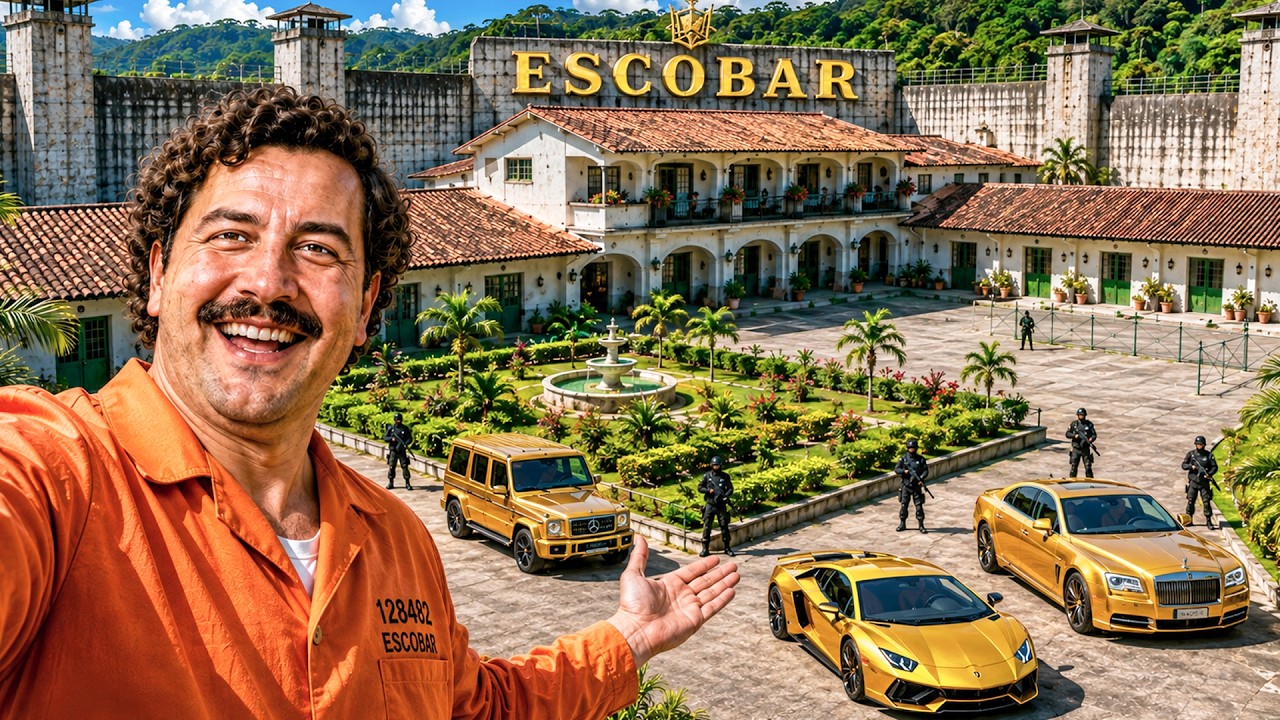
They called it Club Medellín. Those nicknames made perfect sense, because that compound on the mountain was never really built to hold Pablo Escobar. It was built around him. Pablo Emilio Escobar Gaviria was born on December 1, 1949, in Rionegro, Colombia, to a farmer father and a schoolteacher mother.
He came from nothing, and by his teenage years he was already climbing through crime: stolen cars, fake diplomas, contraband. By the early 1980s, he had transformed himself into the leader of the Medellín Cartel, the most powerful cocaine trafficking organization the world had ever seen. At his peak, Escobar and his cartel were responsible for supplying roughly 80 percent of the cocaine entering the United States. He was worth an estimated $30 billion, listed by Forbes as one of the wealthiest people on the planet, and he had turned the city of Medellín into something that felt at times like an active war zone.
The violence connected to Escobar and the Medellín Cartel was staggering in scale and brutality. Escobar employed sicarios, hired assassins, many of them teenagers from Medellín’s poorest neighborhoods, to carry out targeted killings on his behalf. He had judges assassinated. He had police officers murdered in the streets.
He had a presidential candidate, Luis Carlos Galán, shot dead at a political rally in 1989. He bombed a commercial airliner, Avianca Flight 203, killing all 107 people on board. He bombed the headquarters of the Colombian secret police, killing over 50 people and wounding hundreds more. He ordered the killings of so many police officers that he reportedly paid his own men a bounty for each one they killed.
That bounty system produced results. Hundreds of police officers died during this period. Escobar’s strategy was brutally simple: plata o plomo, silver or lead. Take the bribe or take the bullet.
The strategy worked. It corrupted judges, politicians, military commanders, and law enforcement figures at every level of Colombian society. By the early 1990s, the Colombian government under President César Gaviria was facing a situation that had no clean solution. The extradition of Colombian nationals to the United States had become one of the most explosive political questions in the country.
Escobar hated extradition above all else. He feared being tried in an American federal court more than almost anything. In Colombia, his money and his threats could reach almost anyone. In a United States federal prison, that leverage largely disappeared.
So Escobar had spent years waging a campaign to abolish extradition, bribing politicians, threatening judges, killing anyone who got in the way. In 1991, when Colombia was drafting a new constitution, extradition of Colombian citizens to the United States was banned. Many observers at the time suspected that Escobar had used money and intimidation to influence members of the constituent assembly. Whether or not that was proven, the result was clear.
When the new Colombian Constitution of 1991 took effect, extradition was prohibited. That change created the opening for a deal. Escobar was willing to surrender. He was willing to serve a prison sentence in Colombia.
He was willing to stop the bombings, stop the assassinations, publicly declare an end to the violence that had terrorized the country. In exchange, he had two core demands. First, no extradition. Second, he would serve his sentence in Colombia in a facility that met his own specifications.
The Colombian government, desperate to reduce the carnage and facing enormous domestic and international pressure, accepted. Escobar surrendered on June 19, 1991, and was transported by helicopter that same day to his newly constructed prison. The location Escobar chose told you everything about how he understood the arrangement. He selected a hillside above the municipality of Envigado, looking out over the Medellín Valley.
The elevation was extraordinary. The compound sat high enough that from its vantage point, you could observe movement across a significant portion of the city below. Escobar reportedly kept telescopes on the grounds for exactly that purpose. If anyone was coming for him, he wanted to see them first.
The steep mountain terrain made it extraordinarily difficult to approach by land without being noticed, and at that altitude the valley regularly filled with heavy fog, a natural blind spot that made aerial surveillance and air raids against the compound nearly impossible. The Colombian military, as part of the surrender arrangement, was restricted from approaching within a designated distance of the compound. The exclusion zone meant that even if authorities had wanted to conduct a surprise inspection, they were legally constrained from simply showing up. Escobar had effectively designed a security perimeter before a single wall had been built.
What Escobar actually built on that hillside sounded like fiction until you looked at the photographs. La Catedral was not a prison. It was a compound, a private estate, a fortress that happened to have a warden’s house and seven guard towers attached to it. The compound contained comfortable bedrooms designed around Escobar’s personal preferences rather than standard cells.
His personal suite, according to multiple accounts, featured a rotating bed in a jacuzzi-equipped room inside a facility the Colombian government had officially classified as a maximum security prison. There was a bar, a billiards room, a sauna, a gym, a disco, and a waterfall on the property. The compound had a full-size football pitch where Escobar organized matches, invited professional players down from Medellín, and spent his afternoons exactly the way he wanted. There was also a dollhouse inside the compound, kept there for his daughter, who visited often along with Escobar’s wife, family members, associates, and according to numerous reports, sex workers brought in from the city below.
Food was reportedly brought in from restaurants in Medellín. Escobar received guests on his own schedule and set the rules for who came and went. Some accounts estimate that over 300 unauthorized visitors passed through the compound during the 13 months he lived there. The most important thing about La Catedral was not the football pitch or the rotating bed.
It was the communications infrastructure. The compound was equipped with telephone lines, fax machines, radio transmitters, and cell phones. Those communication systems meant that Escobar’s physical location inside a prison compound did not significantly interrupt his ability to run a billion-dollar criminal organization. Instructions moved in and out.
Information flowed. Decisions were made. The Medellín Cartel continued to operate while its leader was technically serving a prison sentence. The Colombian government had publicly declared Escobar’s surrender a victory, but what it could not easily explain was how a man who was supposedly locked away was apparently able to continue making decisions that affected criminal operations across Colombia and beyond.
The luxury was real, and the luxury mattered to him. But Escobar had not surrendered to rest. He had surrendered to survive extradition and to buy himself a situation in which he retained power. The bars on the windows and the guard towers outside were theater.
The phones and the radio transmitters were the actual prison business. The nickname Hotel Escobar did not arise from journalists or foreign observers. It came from Colombians themselves, from a public that watched the news coverage and drew the obvious conclusions. Those nicknames were genuinely damaging to the Gaviria administration because they captured in two words what the opposition had been arguing for months: the government had not imprisoned one of its most dangerous criminals.
It had housed him. The military exclusion zone made the symbolic contradiction even worse in practical terms. The government’s ability to monitor, inspect, or exercise any meaningful oversight over the facility was deliberately constrained by the same agreement that had supposedly put Escobar in custody. What happened inside that compound in 1992 turned the story into something far more serious.
The Moncada and Galeano families were among the most powerful within the Medellín Cartel. Fernando Galeano and Gerardo Moncada, known as Kiko, were senior figures who had taken on increased operational responsibilities while Escobar was managing his surrender. In 1992, one of Escobar’s lieutenants discovered what appeared to be a cache of cash on property connected to Galeano and Moncada in Rionegro, money that Escobar believed should have been accounted for as part of the cartel’s war tax funds. Escobar concluded that his own lieutenants had been stealing from him.
He summoned Galeano and Moncada to the compound. They came, and they were killed there. According to historical accounts, including reports from investigators, Escobar beat Galeano to death with a pool cue and had Moncada killed, dismembered, and burned on the prison grounds. These were major cartel lieutenants killed inside a facility that was supposed to be a government-controlled prison, by the prisoner himself, using the prisoner’s own guards.
The compound was not just a luxury retreat. It was the headquarters of a criminal organization that still operated by its most brutal principles. The widows of the murdered men went to the press. The story leaked, and when news of the murders reached President Gaviria’s government, it created a political crisis that could not be managed with public relations.
The government made a decision: Escobar would be transferred out of La Catedral and moved to a conventional military facility where the state could actually exercise control. Moving him meant stripping away every protection and privilege he had bargained for. Escobar found out about the transfer plans before they could be executed. On July 22, 1992, one year and one month after Escobar had moved into La Catedral, the Colombian Vice Minister of Justice, Eduardo Mendoza, arrived at the compound to inform Escobar of the transfer.
Escobar’s response was immediate and violent. He took Mendoza and another government official hostage. President Gaviria ordered the Colombian National Army to surround La Catedral. A firefight broke out between military forces and Escobar’s guards.
In the chaos, on the grounds of an official government prison, Pablo Escobar walked out. He used an escape route that, according to investigators and historical accounts, had been built into the facility’s design during its original construction. He had planned for this. The prison had always had a way out.
Joe Toft, a retired agent from the United States Drug Enforcement Administration, later summarized the entire situation: escape was not the correct word. Escobar walked out of that prison. The Colombian government launched a manhunt immediately, but the damage was done. Colombia turned to the United States for assistance, and the American response was significant.
Delta Force operatives joined the Colombian National Police’s newly formed search bloc just four days after the escape, on July 26, 1992. The search bloc was a specialized 600-man unit commanded by Colonel Hugo Martínez, trained partly by American advisers and dedicated exclusively to finding Pablo Escobar. The CIA provided intelligence. Surveillance technology was deployed.
Finding Escobar would take 16 months. During those 16 months, the violence his surrender had briefly suppressed returned with brutal intensity. Escobar reportedly paid bounties to his sicarios for every search bloc member they killed, and over 600 police officers were reported dead during the manhunt period. Out of that chaos emerged Los Pepes, the people persecuted by Pablo Escobar, a violent paramilitary organization whose membership included figures connected to the Cali Cartel, paramilitary networks, families of Escobar’s victims, and former associates whose relationships with him had collapsed following the Moncada and Galeano murders.
Escobar’s escape changed his position in ways that ultimately contributed to his death. Inside La Catedral, Escobar had been untouchable in practical terms. He had the high ground, literally and figuratively. He had his own security.
He had communications. He had political arrangements that constrained the government’s ability to move against him. As a fugitive, all of that disappeared. He was now trying to survive on the same streets he had once controlled, and the pressure was constant and accumulating.
By late 1993, authorities were closing in. The search bloc had developed techniques for tracing communications, identifying Escobar’s location through the signals from his phone calls and radio transmissions. Escobar had maintained communication with his family throughout the manhunt, and those communications ultimately gave him away. On December 2, 1993, the day after his 44th birthday, Colombian authorities located Escobar in a middle-class Medellín neighborhood called Los Olivos.
A confrontation ensued. Escobar and a single bodyguard attempted to escape across clay tiled rooftops. He was struck by three bullets, in the torso, the leg, and a fatal shot through the right ear. The search bloc officially credited the shooting to their officers.
Escobar’s family has maintained for years that he may have taken his own life rather than allow himself to be captured, pointing to a declaration he had made repeatedly throughout his life that he would rather have a grave in Colombia than a jail cell in the United States. That claim has never been definitively confirmed or conclusively refuted. The exact circumstances of the final shot remain a matter of dispute. What happened to La Catedral after Escobar’s escape told its own story.
The compound was abandoned immediately following the July 1992 chaos, and then it was stripped. Treasure hunters came looking for hidden money, secret rooms, buried wealth. The compound sat deteriorating for years. The property eventually passed into the hands of the municipality of Envigado.
Then, in 2007, a group of Benedictine monks took over the site. They did not demolish it. They transformed it. They built a chapel on the grounds, a library, and living quarters and accommodation for elderly and impoverished people from Envigado.
The city ceded the entire land to the monks. They built essentially a place of care and remembrance where a private criminal fortress once stood. A memorial at the site honors the victims of the violence associated with Pablo Escobar and the Medellín Cartel. The exact construction costs of La Catedral are difficult to verify with precision.
There is no documented invoice, no official government audit, no single verified number. What one account notes is that Colombian taxpayers, not Escobar himself, may have funded significant portions of the construction, that the government in its desperation to end the violence was prepared to cover costs as part of making the deal work. Whether that is accurate in full or in part is something historians continue to debate. What is not in dispute is that the compound was extraordinary in scale, that it was designed around the preferences of a man who was supposed to be a prisoner, and that the true cost of La Catedral was never measured in construction dollars.
It was measured in what the Colombian government gave away when it agreed to let a criminal leader set the terms of his own imprisonment. The government surrendered the most fundamental principle of incarceration: that the state, not the prisoner, determines the conditions of confinement. Once you have agreed that the prisoner can choose the location, control part of the security, limit military access, and maintain communications with the outside world, the football pitch and the jacuzzi are almost beside the point. For 13 months, one of the most dangerous criminals in modern history was technically behind bars while living by rules that looked remarkably like his own.
When those rules were finally challenged, he simply walked away. The compound that was designed around one man’s comfort now serves communities of people who never had comfort to begin with. The walls of La Catedral tell two very different stories. The first is about the extraordinary power Pablo Escobar possessed, the kind of power that could convince a national government to build a prison according to his specifications and then restrict its own military from approaching it.
The second story is the one the memorial is there to tell. Behind every comfortable room, every piece of communications equipment, every visitor allowed past the gates was a consequence paid by someone else. A judge who would not take a bribe and was shot dead. A police officer killed for a bounty.
A family destroyed by a bombing. A country terrorized into making a deal that no government should ever have to make. The walls of La Catedral do not just tell the story of Pablo Escobar’s power. They tell the story of what that power cost, and who paid the price.
Not Pablo Escobar. Everyone else.