In 1927, on a train crossing Canada, the most trusted servant of the British crown leaned toward the prime minister and said the heir to the throne would be better off dead. His name was Tommy Lascelles, assistant private secretary to the Prince of Wales, and he had watched the charming young prince at close range for seven years. Sometimes, he said, while he waited to hear whether the prince had broken his neck in a country race, he could not help thinking a broken neck would be the best thing for the man and for the country. The prime minister answered that he had often thought the same.
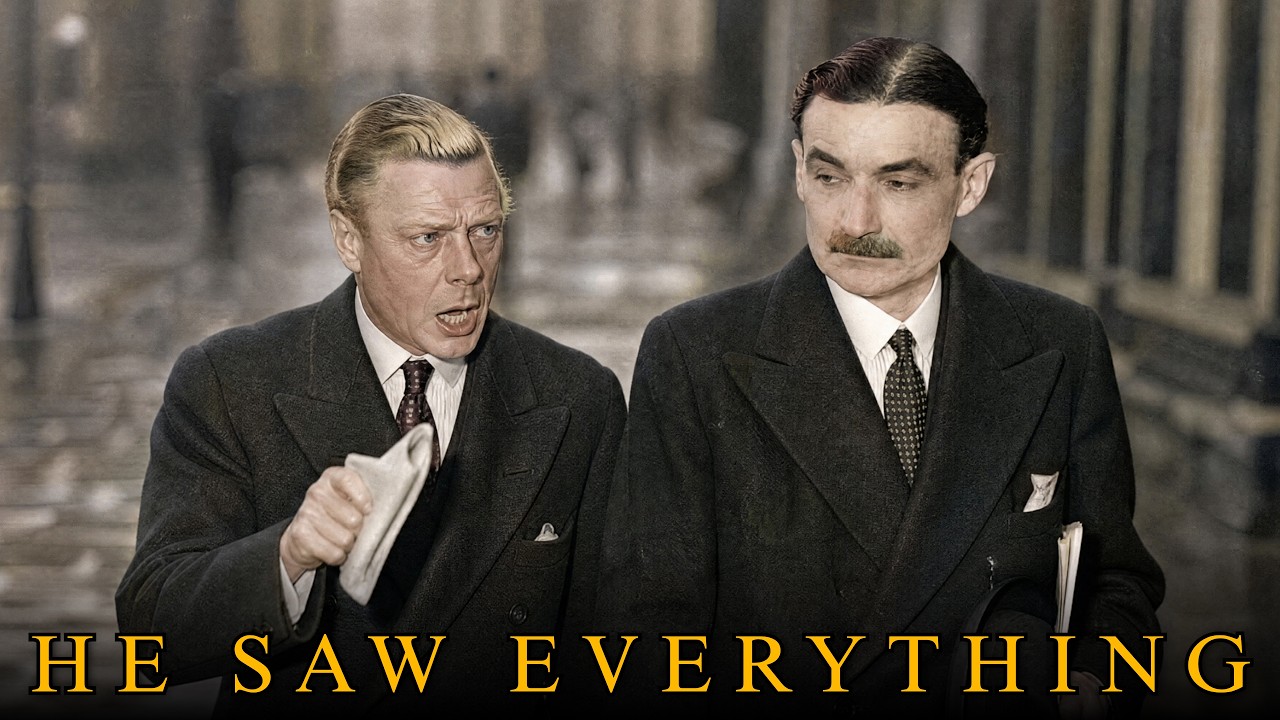
It was no threat, and it was no joke. It was the cold verdict of the one man who knew the future king best. Alan Frederick Lascelles was born in 1887 in the Dorset parish of Sutton Waldron, the only surviving son among six children. Known all his life as Tommy, he was born inside the outer ring of the royal world, near enough to be trusted with everything, far enough that he would always be a servant of it and never its master.
He was educated at Marlborough College and Trinity College, Oxford, where he read the classics. Those who knew him remarked on his coolness of manner, his cutting wit, and a moral seriousness that never relaxed. He was not built for warmth; he was built for judgment. The war took his generation and remade the survivors.
Lascelles went to France with the Bedfordshire Yeomanry and came back a captain with the Military Cross and a changed man underneath. He had watched friends die and waste on a scale that no sermon about duty could match, and it left in him a permanent impatience with anyone who treated life or privilege as a thing to be idled away. His marriage in 1920 to Joan Thesiger, daughter of Lord Chelmsford, the Viceroy of India, tied him tighter still to the governing class of the empire. He tried journalism and stockbroking, and neither took, and he lost money in the trying.
He was a serious man in search of a serious task. The task that found him was the strangest calling in the kingdom. The private secretary to a member of the royal family is not a typist and not a butler. He is the hinge on which the monarchy turns.
He decides who reaches the royal person and who is kept away, drafts the words spoken in public and many spoken in private, negotiates with the government, manages the newspapers, and absorbs in silence every private disaster the family produces. It is a role with almost no formal power and almost unlimited real power. One rule governed the whole of Lascelles’s career: he served the crown, not the man who wore it. He did not love kings.
He loved the institution, and he judged every monarch by one measure only, whether they strengthened that idea or weakened it. In 1920, he entered the household of the most adored young man in the world. Edward, Prince of Wales, was in his middle twenties, slight, fair, and restless, with a boyish charm that reached through the newspaper page and the newsreel screen. He had toured the empire and been mobbed wherever he went.
Lascelles shared the general enthusiasm without reserve and once described him as the most attractive man he had ever met. The household ran out of York House, a place of constant motion, with correspondence running to many thousands of letters and tours to plan months in advance. Lascelles made himself essential, the careful mind behind the glamorous surface. But a private secretary sees his master as no one else does, tired, bored, drunk, in love, and afraid.
Across the early 1920s, what Lascelles saw stopped being small. The charm remained dazzling in public, but behind it lay a restlessness that curdled into petulance. The prince would work when it amused him and vanish when it did not. The drinking and gambling troubled Lascelles, but what could not be forgiven was the attitude beneath them.
The prince did not seem to feel the weight of what he would one day carry. He treated the throne as an inconvenience rather than a trust. To a man who had watched friends die in France for far less than a crown, that carelessness was close to blasphemy. Then there were the women.
The prince moved through a series of affairs, the most enduring being with Freda Dudley Ward, a married woman. Lascelles was no prude, but the scandal to him was the way the prince let a woman govern his moods and movements, cancelling duties and arranging his whole life around a private passion while the public work of the monarchy waited. Lascelles saw the pattern clearly a full ten years before the world would learn its final and most famous name. By the middle of the decade, he was beginning to believe that the most beloved man in the world was not fit to be king.
The prince’s own father, King George V, had reached a similar verdict. The old king is said to have delivered a prophecy of his own, that after he was dead, the boy would ruin himself within twelve months. It matched almost exactly the fear forming in the mind of the father’s most trusted servant. Two men who loved the crown had looked at the heir and seen the same disaster coming.
Lascelles had given the better part of a decade to the closest possible study of one man. By 1927, the picture had settled into a single unbearable conclusion: the throne was going to pass to a man who would not carry it, and nothing anyone could do would change him. On the train crossing Canada with Stanley Baldwin, Lascelles finally let it out. He told the prime minister that sometimes, when waiting to hear the result of a point-to-point race in which the prince was riding recklessly, he could not help thinking that the best thing for the heir and for the country would be for him to break his neck.
Baldwin did not recoil. Instead, he agreed. God forgive me, the prime minister replied, I have said the same thing often. There it was, spoken aloud between two of the most responsible men in the empire, the quiet shared wish that the future king might die before he could reign.
A year later, in 1928, Lascelles was in East Africa with the prince on a safari through Kenya and Uganda when a telegram arrived that King George V had fallen gravely ill. For any son, and above all for the son next in line to a crown, there was only one possible response: cut the tour short and go home. The prince did not do it. In Lascelles’s account, the young man reacted to the news of his father’s possible death with an indifference the secretary found almost impossible to believe.
He did not want to cut short his pleasures. He treated the telegram as an interruption rather than a summons, and he had to be pressed toward the plain duty that should have needed no pressing at all. The old king recovered, but something in Lascelles did not. He decided he could not go on, and in 1929 he asked to see the prince alone.
A private secretary does not lecture the heir to the throne, but Lascelles broke all of it. He laid out the neglect, the selfishness, the waste of great gifts, and then he told the prince to his face that he was going the way that would cost him the throne of England. The prince’s response was the most chilling part. He did not rage.
He took the whole devastating verdict with a mild and almost cheerful good humor, as though a man telling him he would lose his throne were making a slightly tedious point about the weather. To Lascelles, that reaction was more damning than fury. Anger would have meant the words had reached him. The mildness meant that nothing reached him at all.
Lascelles left with no promise of another post, having thrown away nine years of the most privileged service in the kingdom. For two years he drifted through minor work until 1931, when he was appointed secretary to the Governor General of Canada. The Canadian years proved that his walking out had not destroyed him, and late in 1935 he was called home as assistant private secretary to King George V himself. The old king died in January 1936, and with his death, the thing Lascelles had dreaded for the better part of ten years came to pass.
The Prince of Wales, the man he had wished dead on a Canada train, became King Edward VIII. Within a year, the thing Lascelles had foreseen came for the throne itself. By the autumn of 1936, it was clear to everyone inside the palace that the king meant to marry Wallis Simpson, an American woman with two living former husbands. For a king who was also the head of the Church of England, a church that did not permit the remarriage of divorced people, it was impossible.
He could have the throne or he could have her. On the 11th of December 1936, after a reign of less than a year, he abdicated. Lascelles had been proved right utterly and publicly. He felt no triumph.
On the night the abdication was settled, he walked alone round and round St. James’s Park in the dark, thinking of King James II and turning over the enormity of what had happened. He described Edward as being like a child in the fairy stories who had been given every gift except a soul. The brother who took the throne was everything the elder had refused to be.
George VI was shy, dutiful, and solid, a man who had never wanted the crown and carried a stammer that made public speaking an ordeal. In that quality, Lascelles found at last a king he could serve with his whole heart. He gave him sixteen years of unbroken loyalty. As the king’s assistant private secretary and from 1943 as his private secretary, he sat at one of the best-informed desks in Britain.
He saw the most secret papers of the state and knew of the existence of the atomic bomb months before it was dropped on Hiroshima. He also managed the relationship between the cautious king and the headstrong prime minister, Winston Churchill, smoothing the friction between them through the war. The same certainty that let him denounce a prince also let him remove a rival. In 1943, he was instrumental in the maneuver that eased Sir Alec Hardinge out of the post of private secretary and put himself in.
He held that summit of courtly power for the next ten years. In 1950, he wrote a letter to a national newspaper signed with the Latin pen name Senex, setting out the exact conditions under which a constitutional monarch might properly refuse a request from a prime minister to dissolve parliament. Those conditions became known as the Lascelles Principles and are still cited today across the Commonwealth. When King George VI died in February 1952, Lascelles carried his loyalty forward to the young Queen Elizabeth II.
He guided her through the accession councils and the vast machinery of the coronation, set for June 1953. But the new reign carried within it the seeds of one more crisis. The queen had a younger sister, Princess Margaret, and Princess Margaret had fallen in love with Group Captain Peter Townsend, a decorated wartime pilot who was divorced. The church did not allow the remarriage of a divorced person, and the sovereign held a veto over the marriages of the royal family.
To Lascelles, the matter was a constitutional problem and nothing softer. When Townsend spoke to him of the relationship, he told the war hero, You must be either mad or bad to imagine that such a marriage could be allowed. Townsend was posted abroad and kept apart from the princess for two years. In October 1955, Princess Margaret gave up the man she loved in a public statement mindful of the church’s teaching and her duty to the Commonwealth.
Lascelles retired on the last day of 1953 at the age of 66, loaded with honors. He was offered a hereditary peerage and turned it down twice, holding that the honor he already had rated higher. The crown gave him a grace and favor residence at Kensington Palace, and there he lived out the rest of his long life, a few doors from Princess Margaret herself. Between them there was only silence.
He died at Kensington Palace in August 1981 at the age of 94, taking to his grave, or so the world assumed, the vast horde of royal secrets he had guarded for a lifetime. That assumption was wrong. Lascelles had never really stopped recording things. Night after night, in a hand of exceptional clarity, he had written down what he saw: the conversations, the judgments, the contempt, and sometimes the fear.
After his death, his friend Duff Hart-Davis took up the private record and edited it for publication, three volumes appearing across two decades from 1986 to 2006. The wish on the Canada train was in there, printed at last for anyone to read. The verdicts on Edward were in there, and the grief of the abdication, and the cold machinery of a courtier’s judgment across thirty years. The man whose entire creed had been discretion became through his own pen one of the great witnesses against the masters he had served.
In 2016, a television drama brought him back to life for an audience of millions, playing the cold and correct Lascelles as the very image of the establishment. The man who built a career on being unseen became, in the end, one of the most recognizable courtiers in history. He served the crown, not the man who wore it, from the first day to the last. He was right about Edward.
The diaries prove it, and the abdication proved it before them. Whether he was right about Margaret is a harder question, and it is the one the story leaves open. He kept the throne steady. He also kept the receipts.
And in the end, on a train crossing Canada in 1927, a devoted servant of the crown had looked at the man who would be king, wished him gone for the good of them all, and then spent the rest of his life and the whole of his silent pen proving how right and how terrible that wish had been.