During America’s Gilded Age, from the 1870s through the early 1900s, industrialization created a new aristocracy. Men like Cornelius Vanderbilt and John D. Rockefeller amassed fortunes that dwarfed European royalty.
By 1890, the top one percent of Americans owned more wealth than the bottom ninety percent combined.
For the daughters of these dynasties, weddings were never about love. They were business mergers. A daughter’s body was the signature on the contract.
Families spent years planning strategic unions to cement alliances and secure social standing. Mothers tracked eligible bachelors like horse breeders, valuing pedigree above all else.
Young women were groomed from childhood for a single purpose. They attended finishing schools where they learned French, piano, and polite conversation. Their corsets were cinched to eighteen inches, making breathing difficult.
Chaperones accompanied them everywhere. Privacy did not exist. Their reading material was monitored, and novels depicting passion or independence were forbidden.
The pressure intensified when a daughter reached her late teens. Mothers hosted elaborate balls costing tens of thousands of dollars. The season had one goal: secure a husband, preferably a titled European aristocrat.
American money marrying Old World prestige created the perfect alliance. Everyone won except the bride.
Consider Consuelo Vanderbilt. Her mother Alva wanted her to marry the Duke of Marlborough. Consuelo was eighteen and in love with a young American named Winthrop Rutherford.
Her mother forbade the relationship. When Consuelo protested, Alva took to her bed, claiming heart troubles, and told her daughter that refusing the Duke would kill her.
On November 6, 1895, Consuelo wore a gown weighing over twenty pounds and a veil stretching eighteen feet behind her. Two thousand guests watched at St. Thomas Church in New York City.
Consuelo later wrote that she cried throughout the ceremony, not tears of joy, but tears of despair. She felt like a prisoner being led to execution.
The mansions of the Gilded Age were architectural marvels. The Vanderbilt mansion known as the Breakers contained seventy rooms and employed more than thirty servants. But for the daughters who lived there, these palaces were prisons.
Every room was monitored, every action observed.
Mothers exercised tyrannical power. They read their daughter’s mail, vetted every friendship, and forbade relationships with unsuitable men. The media played a cruel role, tracking these young women like prey.
Newspapers dubbed them “dollar princesses,” suggesting their only value lay in their fortunes.
The pressure created profound psychological damage. Many heiresses developed what doctors called hysteria, which modern medicine would diagnose as anxiety and depression. They took laudanum and opium-based medicines to calm their nerves.
Some were confined to sanitariums for rest cures involving bed rest, isolation, and force feeding.
Alice Claypoole Vanderbilt, daughter of Cornelius Vanderbilt II, wrote in her diary: “I am a decoration. I am furniture. I am valued for my name, my dowry, my ability to produce heirs, but I am not seen.
No one asks what I think, what I want, what I dream of at night when sleep will not come.”
The isolation made rebellion terrifying. An heiress possessed no practical skills. She could not cook, clean, or handle money.
She did not know how to purchase a train ticket. The world beyond her mansion was alien territory. Yet the desire for freedom grew, often catalyzed by real love with an unsuitable man—an American lawyer, doctor, or struggling artist.
Some women began hoarding small valuables. They made secret plans with the men they truly loved. Others rebelled impulsively, their breaking point coming suddenly on the morning of the wedding.
The first widely publicized case came in 1889. Edith Co Evans was engaged to a wealthy man her parents approved, but she was in love with a writer named Robert who had no fortune. Three days before the wedding, she packed a small bag, took a few pieces of jewelry, climbed out her bedroom window, and ran.
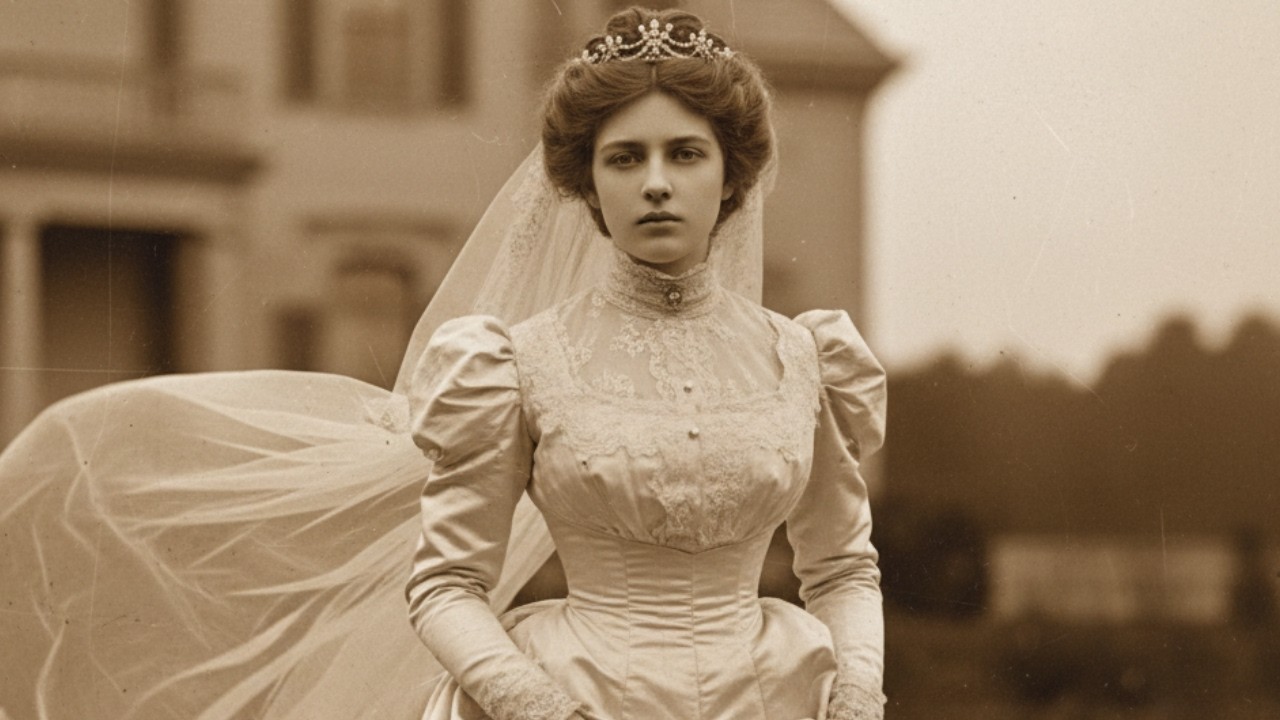
She met Robert at a train station, and they fled to California. They lived in obscurity and poverty, but they were free.
The escape that truly captured national attention involved Catherine “Kitty” Van Renelair. She was the daughter of a New York banking family worth an estimated ten million dollars. In 1893, when Kitty was twenty-one, her parents arranged her marriage to Count Luigi Salviati, an Italian nobleman of forty-three who needed money for his Tuscan estates.
Kitty hated the count. She found him pompous and cruel. She was in love with Thomas Walsh, the son of her father’s business partner.
Thomas was American, young, kind, and utterly unsuitable. He lacked a title. Kitty’s mother sent her to Europe for six months, hoping distance would cool the romance.
It did not.
The wedding was planned for October 28, 1893, at Grace Church in Manhattan. Eight hundred guests were invited. The bride’s dress cost five thousand dollars.
The flowers alone cost three thousand. Everything was perfect except the bride had no intention of attending.
Two days before the wedding, Kitty confided her plan to her lady’s maid. She would flee the morning of the ceremony. Thomas would meet her with a carriage two blocks from the house.
They would take a train to Philadelphia, then continue west to Chicago.
On the morning of October 28, Kitty asked for a moment alone to pray. Her mother granted the request. Kitty changed into a simple traveling suit, grabbed a small bag, and climbed out her second-story window onto a ledge.
A trellis covered in ivy ran down the side of the house. She had climbed it as a child. She descended undetected and ran down Fifth Avenue in broad daylight.
Two blocks away, Thomas waited with a hired carriage. They embraced and disappeared into the city.
Back at the mansion, Kitty’s absence was discovered thirty minutes before the ceremony. Her mother opened the bedroom door to find the room empty, the window open, and the wedding dress hanging unused. At Grace Church, the groom waited for two hours before a messenger whispered the news.
The count’s face turned purple with rage, and he stormed out.
Newspapers printed special editions. “Heiress Flees Wedding” screamed the headlines. Some praised Kitty’s courage.
Others condemned her selfishness. The Van Renelair family claimed she had suffered a nervous breakdown, but the truth leaked out. The count sued for breach of contract and was settled out of court for an undisclosed sum.
Kitty’s father disowned her. He removed her from his will and forbade anyone in the family from contacting her. As far as he was concerned, Kitty Van Renelair no longer existed.
Kitty and Thomas married in Chicago. For a brief moment, it seemed like a fairy tale ending. But the real test was surviving the aftermath.
The press treated runaway brides as a national obsession. Conservative papers condemned them as selfish and ungrateful. Progressive publications praised their courage.
Women’s rights advocates seized on the stories as evidence that marriage laws needed reform. One suffragist wrote: “When a woman must flee her own wedding to claim her freedom, the institution of marriage has become a prison.”
Working-class women often sympathized with the runaway brides. One factory worker told a reporter: “Rich or poor, a woman’s got no say in her own life. At least these girls are trying to change that.”
But wealthy society condemned the rebellions without mercy. Old money families closed ranks, spreading vicious rumors that the women were mentally unbalanced or morally degenerate. They worked to ensure that any woman who fled would never be welcomed back.
In 1894, another heiress fled. Grace Wilson, daughter of a railroad magnate, was engaged to a British Earl. On the eve of her wedding, she eloped with a young American lawyer.
She was disowned. The Earl sued for breach of promise.

Then came Emily Aster, related to the famous Astor dynasty. She fled in 1895, hours before her ceremony, leaving a note explaining she could not marry a man she did not love. Her family claimed the note was forged and insisted she had been kidnapped.
Emily eventually surfaced in San Francisco, married to a music teacher.
The media dubbed it the great heiress rebellion. By 1896, at least a dozen high-profile cases had made headlines.
Disinheritance was the first and most immediate consequence. A father who removed his daughter from his will erased her from the family legacy. The financial impact was catastrophic.
An heiress raised in luxury had no concept of budgeting.
Kitty and Thomas started their married life in Chicago with approximately two thousand dollars from selling her jewelry. They rented a small apartment for thirty dollars per month. Within three months, half their money was gone.
Thomas earned sixty dollars per month as a clerk. Kitty had to learn skills she had never needed. She burned everything she cooked and ruined several shirts doing laundry.
The loss of status wounded her more than the loss of money. No one cared that she was a Van Renelair. That name meant nothing.
Emily Aster discovered that her husband, the music teacher, was already married. He had lied to her, assuming her family would eventually restore her fortune. When it became clear they would not, he abandoned her.
Emily took work as a seamstress, living in a boarding house that cost twelve dollars per month. She died in 1903, age thirty-five, in a charity ward. Her grave was unmarked.
Some women attempted reconciliation. Most letters went unanswered. A few received cold formal replies stating the door was permanently closed.
The social exile was perhaps the most painful price. Runaway brides were erased from social registers. Former friends crossed the street to avoid them.
They were pariahs.
Not every story ended in tragedy. Margaret Lawrence fled her wedding in 1897 and married a country doctor. They moved to rural Vermont.
Margaret adjusted to simple living, gardened, helped her husband, and raised three children. She never regretted her choice. “I was poor.
I was excluded from society, but I was myself,” she said in her old age. “I cannot imagine anything more valuable than that.”
But Margaret’s success was the exception. Most runaway brides struggled financially, emotionally, and socially.
The fundamental problem was structural. A woman in the late 1800s could not vote, could not own property in her own name if married, and could not enter most professions. If her husband chose to be cruel, she had little recourse.
The runaway brides had believed their oppression stemmed from wealth. They discovered the cage was larger than they realized. It encompassed all of society.
Some women returned to their families. The return was always shameful. Families imposed humiliating conditions.
The returning bride had to publicly admit her mistake. She was given a small room in the servants’ quarters, not her old bedroom. She ate meals with the staff.
She was a prisoner in her own family home.
One woman, known in historical records only as Mrs. H, had eloped with a man who abandoned her when he learned she had been disinherited. After three months of desperate poverty, she returned home.
Her father made her kneel in the drawing room and beg forgiveness. She lived out her days in servitude. In a letter discovered after her death, she wrote: “I destroyed my life for love.

But love was not enough. Love could not feed me. Love could not shelter me.
I wish I had been wiser. I wish I had stayed.”
The loneliness was the constant companion of runaway brides. It was more persistent than poverty, more painful than scandal. Kitty had been close to her younger sister.
After Kitty fled, her sister was forbidden from contacting her. For fifteen years, they had no communication. When they finally reunited by chance on a New York street, both women wept, but the damage was done.
They were strangers now.
The psychological cost extended beyond the women themselves. Children grew up in homes shadowed by loss and regret. Some descendants discovered family secrets by accident and reacted with anger, feeling their great-grandmother had selfishly thrown away advantages.
Others felt pride, seeing their ancestor as a rebel and pioneer.
Most runaway brides disappeared from historical record. They changed their names and moved to obscure places. When they died, their obituaries were brief and vague.
The drama of their youth was erased.
But their stories endure in fragments—in family letters hidden in attics, in newspaper archives, in whispered stories heard by grandchildren.
Did their rebellions change anything? On one level, no. Society continued to pressure women into arranged marriages for several more decades.
But on another level, the rebellions mattered. They demonstrated that women could resist. They proved that obedience was not inevitable.
They planted seeds of doubt in the minds of other young women.
The runaway brides were not suffragists or activists. But their personal rebellions had political implications. They challenged the fundamental assumption that women should accept whatever men decided for them.
Was it worth it? The question has no simple answer. Margaret Lawrence would have said yes.
Emily Aster would have said no. Kitty Van Renelair probably asked herself every day and answered differently depending on her mood.
Perhaps the most honest answer is that it depends on what you value. If you value security, comfort, and social acceptance above all else, then no, it was not worth it. If you value autonomy, authenticity, and self-determination above all else, then yes, it was worth it.
The tragedy of the gilded cage was that it should not have been a choice. Women should not have had to choose between happiness and security, between love and wealth, between autonomy and family. A just society would have allowed them to have both.
The runaway brides could not change society. They could only save themselves. And even that they barely managed.
Most of them paid terrible prices. But they tried. They dared.
They refused to accept that their lives were not their own.
The gilded cage still exists in various forms. It always will as long as power imbalances and social expectations constrain human freedom. But the runaway brides showed us that the cage can be escaped.
The locks can be picked. The bars can be bent.
It will cost you. It will cost you dearly. But it can be done.
Whether the price is worth paying is a question each person must answer alone.