In the spring of 1865, the Confederate capital at Richmond had fallen, and Jefferson Davis, president of the failed nation, was fleeing south through Georgia with his wife, Varina, and what remained of their family. Within days, they were captured. Jefferson was thrown into prison on suspicion of involvement in the assassination of Abraham Lincoln, and Varina, the only First Lady the Confederacy would ever have, was left to fight for his freedom while the world she had known crumbled around her. Varina Howell was born on May 7, 1826, in rural Louisiana while her parents, William and Margaret Howell of Natchez, Mississippi, were visiting relatives.
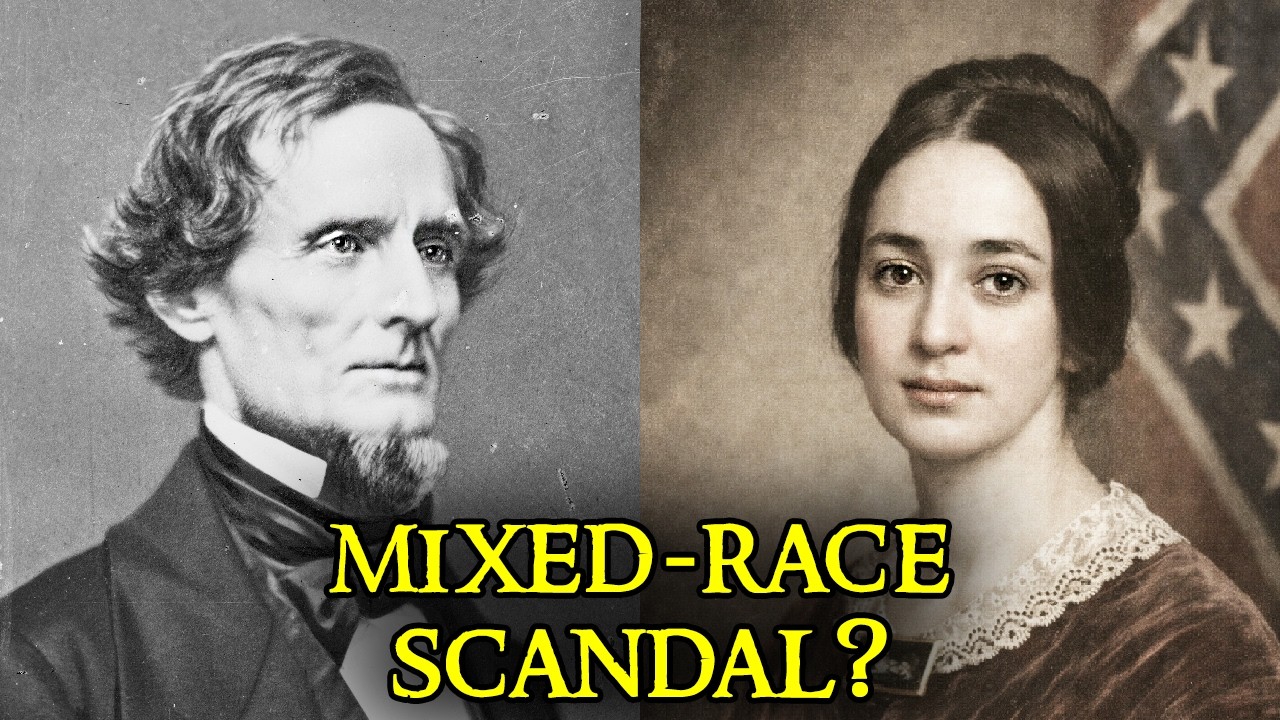
She was the second of eleven children, though only seven would survive to adulthood. Her family was part of the Southern elite. Her paternal grandfather had served as governor of New Jersey in the 1790s, and her father had fought the British in the War of 1812. Her mother was the daughter of a wealthy Mississippi planter and slaveholder.
From birth, however, some whispered about Varina’s appearance. She had an olive complexion, dark eyes, dark hair, and a broad nose, features her family attributed to Welsh ancestry. But in the race-obsessed society of the antebellum South, such traits invited suspicion that would follow her for the rest of her life. Her childhood was comfortable at first.
Her father was a successful merchant who owned a plantation and dozens of enslaved people. But in the 1830s, poor investments and an expensive lifestyle drove him into bankruptcy. It was his wife’s wealthy family who rescued them, and it was likely through their support that William sent Varina north to a boarding school in Philadelphia. There she received an excellent education and returned home one of the most well-read young women in her community.
In late 1843, at just seventeen, Varina met her future husband at a Christmas party at Hurricane Plantation. Jefferson Davis was then a wealthy plantation owner, eighteen years her senior. He had been married once before, to Sarah Knox Taylor, daughter of the future president Zachary Taylor, but she had died within months of their wedding in 1835. Davis had withdrawn from society for years afterward, mourning her.
Varina was smitten from the moment they met, but her parents hesitated, troubled by the differences in age, background, and politics. They eventually gave their consent. The wedding, planned as a grand affair, was instead a small ceremony at her parents’ home in 1845, with no members of the Davis family present. Only after the marriage did Varina realize how traditional her husband’s views were.
He expected her to play the role of a conventional Southern wife despite her education, and he still carried deep affection for his deceased first wife. Their honeymoon included a visit to his elderly mother and a solemn stop at the grave of the woman who had come before her. Varina would later admit she sometimes felt like a consolation wife. The newlyweds settled at Brierfield, a plantation Jefferson had established on land provided by his older brother, Joseph, and soon after, his widowed sister arrived with her seven children to live with them, a decision made without consulting Varina.
In 1846, Jefferson Davis was elected to the US House of Representatives, and Varina accompanied him to Washington, D. C. , a city she quickly adored. She became one of the capital’s most popular and youngest hostesses.
But Davis soon resigned his seat to serve in the Mexican-American War, and when he returned to politics, tensions grew between the couple. His views on slavery were harsher than hers; she held more northern-influenced views and once described herself as a half-breed because of her ties to both regions. Despite these differences, the relationship held steady. Davis served for years as a senator from Mississippi and was appointed Secretary of War under President Franklin Pierce in 1853.
The family spent most of the years between 1845 and 1861 living in Washington, where Varina felt more at ease than in Mississippi’s increasingly heated atmosphere. Between 1852 and 1864, the Davises had six children, four boys and two girls. Most would not survive to adulthood. In 1854, their first child, Samuel, died before reaching the age of two.
The following year, their daughter Margaret was born, the only one of their children who would grow up, marry, and have a family of her own. A third child, Jefferson Junior, survived into adulthood but died at just twenty-one during a yellow fever epidemic in 1878. Two more sons, Joseph and William, died in childhood. Their youngest, Winnie, born in 1864, would become especially close to her mother.
The course of Varina’s life changed utterly in late 1860. The debate over slavery had been escalating for decades, dividing the northern free states from the slave-owning South. The election of Abraham Lincoln as president in November 1860 pushed the South to the breaking point. In December, South Carolina became the first state to secede, and other states followed between January and April 1861, forming the Confederate States of America.
In April, the first shots of the Civil War were fired. Mississippi had seceded on January 9, 1861, and Jefferson formally resigned from the Senate twelve days later. Within a month, he became the provisional president of the Confederacy at a convention in Montgomery, Alabama. The position was made permanent on February 22, 1862, by which time the capital had moved to Richmond, Virginia.
As Jefferson’s wife, Varina immediately became First Lady of the Confederacy. But she never truly believed in the Confederate cause, and her doubts left her ill-suited for the role. Those who met her in Richmond picked up on it, and the openly racist press began to comment on her appearance. Newspapers drew attention to her dark features, suggesting she might be part Native American or African American.
Hostile critics described her as a mulatto or an Indian, slurs calculated to inflame racial anxieties in a society obsessed with bloodlines. During the war years, Varina was frequently pregnant, grieving the loss of her son Joseph in April 1864 after a fall just after his fifth birthday, and publicly criticized, all while serving as the most prominent female figure of a cause she did not truly support. The Civil War ended in Confederate defeat in April 1865. As General Robert E.
Lee organized the surrender, Jefferson, Varina, and their family fled south from Richmond. They were captured in Georgia, and Jefferson was detained on suspicion of involvement in Lincoln’s assassination, which had occurred just days after the fighting stopped. He spent two years in confinement. During that time, Varina sent their children to Canada for safekeeping and campaigned for her husband’s release.
He was freed on bail in May 1867 and included in a general amnesty issued by President Andrew Johnson at Christmas 1868. The Davises were free, but their world had changed. Jefferson’s wealth had been built on plantations run by slave labor, and that was gone. There was no chance of a renewed political career, and the war and legal fees had decimated the family’s finances.
They traveled to Europe, making money through speaking and appearance fees as the former president and First Lady of the Confederacy. Varina and the children remained in Europe after Jefferson returned to America, and she considered taking up teaching roles. In England, she was outraged to read reports of Jefferson’s possible affairs back in the United States in 1870 and 1871. Their son William died just before his eleventh birthday, and the collapse of their fortunes plunged them into prolonged depression.
In the mid-1870s, Varina returned to America, and the couple gradually reconciled, living together again by 1878. By then, Jefferson was relying on the generosity of Sarah Dorsey, the wealthy widow of a Louisiana planter who had known Varina since their boarding school days in the 1830s. Dorsey invited the Davises to live on her estate at Beauvoir, Mississippi, and eventually sold them a house there at a cheap rate. When she died in 1879, she left Jefferson a substantial sum that largely alleviated their financial problems for the rest of his life.
He died in 1889 during a massive yellow fever outbreak, aged eighty-one. After her husband’s death, Varina moved to New York City, a decision seen as controversial in the South. She was related to the media magnate Joseph Pulitzer, who gave her a job writing for the New York World in 1891. Her daughter Winnie went with her.
Varina published several books, including a study of the Irish revolutionary Robert Emmet, and she and Winnie lived a middle-class life as writers in Manhattan. The Southern press occasionally criticized her for moving north and writing for a Yankee newspaper. She responded that the war and her husband’s death had forced her to work to support herself. In 1898, tragedy struck again when Winnie died at thirty-four, possibly from pneumonia or gastritis.
Varina arranged for her burial in Richmond, next to her father and brother. Varina continued writing, and many of her later articles focused on reconciliation between the North and South, still bitterly divided three decades after the war. In her later years, she took an interest in expanding educational access. In 1901, she met with the influential African-American leader Booker T.
Washington to discuss ways women and African-Americans could gain greater educational opportunities. Varina Davis lived to be eighty years old. She died of pneumonia in her midtown Manhattan apartment on October 16, 1906, survived by her daughter Margaret and several grandchildren and great-grandchildren. She was honored with a funeral procession through the streets of New York City and was later laid to rest in Richmond, the capital of the brief nation her husband had led.
Her tombstone simply read, At peace.