When Marie Louise d’Orléans first laid eyes on her new husband, she was reportedly shocked. The man standing before her at their wedding in November 1679 was the King of Spain, Carlos II, but he hardly looked the part of a majestic sovereign. He was frail, had a pronounced jaw that made speech and eating difficult, and his body had never fully developed. Marie Louise was just seventeen, beautiful, graceful, and raised in the glittering court of Versailles.
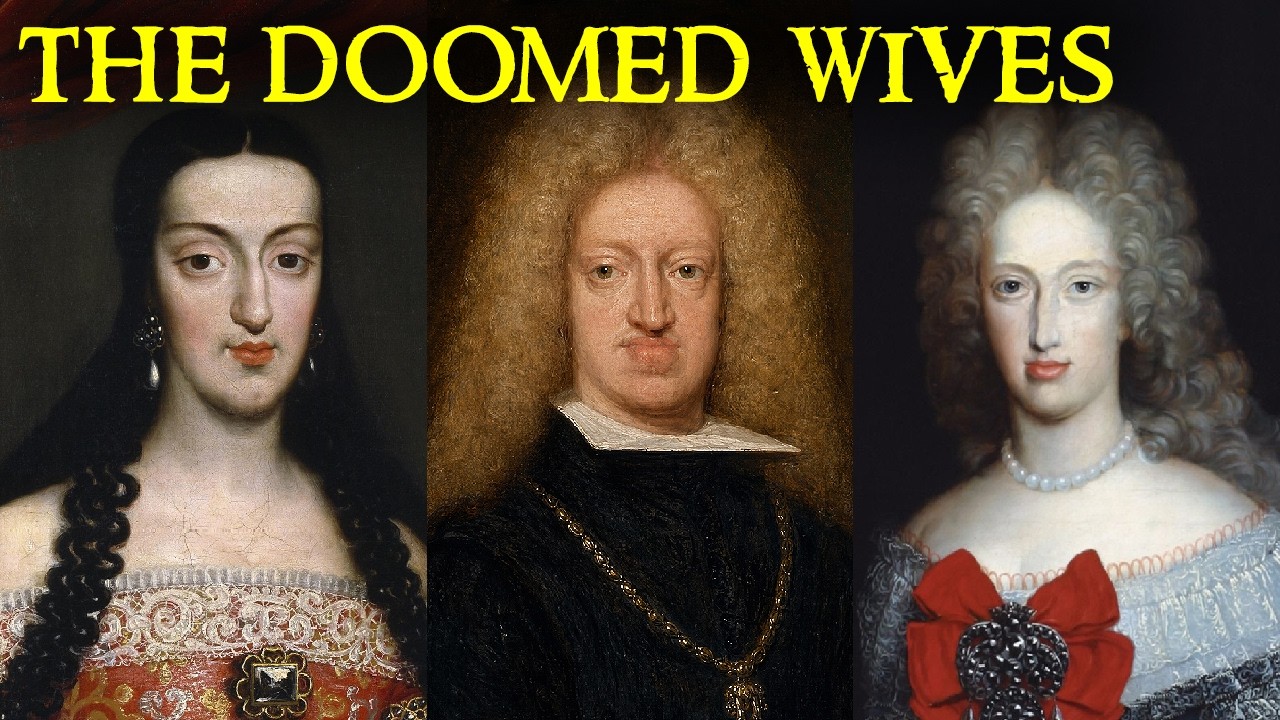
She had been told that she was to marry the King of Spain, and she had spent months in tears over the news. Now, confronted with the reality of his appearance, her worst fears seemed confirmed. Carlos, however, was instantly captivated. He was deeply taken with his young bride, enchanted by her beauty and elegance.
For the young king, this marriage was a rare moment of warmth in a life marked by illness and isolation. But for Marie Louise, life in Spain would prove to be a gilded cage, one that would end in tragedy and set Europe on a path toward a devastating war. Carlos II was born on November 6, 1661, the youngest son of King Philip IV of Spain and his niece, Mariana of Austria. The Habsburg family had intermarried for generations, and the consequences were written across the young prince’s body.
His father had originally intended Mariana to marry his son, Balthasar Charles, but when that heir died of suspected smallpox in 1646, Philip IV married his own niece instead. By the time Carlos was born, the Spanish Habsburg line had become dangerously thin, and the king’s health was already a matter of grave concern. When Philip IV died in September 1665, Carlos succeeded to the throne just weeks before his fourth birthday. A long regency followed, and his mother, Mariana of Austria, and his illegitimate half-brother, John of Austria, fought bitterly for control of the government.
The struggle was fueled by a widespread understanding that even when Carlos came of age, he might never rule independently. He struggled to walk without assistance, his development was delayed, and many at court believed his condition was so unnatural that it could only be the work of sorcery. He became known as El Rey Hechizado, the Bewitched King. In truth, his condition was almost certainly the result of centuries of Habsburg inbreeding, though historians still debate the exact nature of his ailments.
Despite his frailty, the future of the Spanish monarchy depended on one thing: Carlos needed a queen. The direct male line of the Spanish Habsburgs had all but vanished, and securing an heir was a matter of pressing urgency. Negotiations for a bride began across Europe. A match with his own niece, Maria Antonia of Austria, was considered but put aside as impractical.
A Portuguese princess was briefly mentioned, but the idea never gained traction. In the end, it was a French alliance that proved most attractive. Relations between Spain and France had been strained for years, with Louis XIV’s wars having stripped Spain of territory in the Low Countries and along its eastern frontier. A royal marriage offered a fragile chance to ease the rivalry.
Marie Louise d’Orléans was chosen. Born in Paris in March 1662, she was the daughter of Princess Henrietta of England and Philip I, Duke of Orléans, the younger brother of Louis XIV. She had grown up in a warm and relatively happy childhood, doted on by her father and close to her grandmothers. She was highly educated, skilled in riding, dancing, and conversation, and contemporaries spoke of her beauty in glowing terms.
But when she learned that she was to marry the king of Spain, she was devastated. She had hoped to marry her cousin, Louis Grand Dauphin, and perhaps one day become queen of France. That dream was impossible now. The decision had been made, and she had no choice.
Marie Louise left France in July 1679 and never returned. She met Carlos for the first time on their wedding day, November 19, 1679, at Quintanapalla near Burgos. He was eighteen; she was seventeen. From the beginning, their marriage was complicated.
Carlos adored her, but Marie Louise found the Spanish court oppressively formal. Her movements were tightly controlled, her days rigidly structured, and meals were often taken in silence and alone. She clashed with the Duke of Medinaceli, the chief minister, who believed that the French ambassador, Pierre de Villars, wielded too much influence at court as Marie Louise’s close confidante. Villars was expelled in 1681, and a fresh war between France and Spain followed in 1683, placing Marie Louise in an especially difficult position.
More troubling was the lack of an heir. Years passed, and no pregnancy followed. The failure was blamed on the queen, who was subjected to primitive fertility treatments that only worsened her health, leaving her with severe intestinal problems. She developed a taste for sweetened drinks made with lemon, cinnamon, and large amounts of sugar, and began to gain weight.
By the late 1680s, it was clear that she would never bear children. In early February 1689, Marie Louise fell gravely ill. A severe fever set in, accompanied by intense abdominal pain, convulsions, and vomiting. Doctors were summoned, but there was little they could do.
On her deathbed, she is said to have told Carlos that many women might be with His Majesty, but none would love him more than she did. She died on February 12, 1689, at just twenty-six years old. Carlos was devastated and would reportedly love her for the rest of his life. Rumors of poisoning spread, especially in France, but an autopsy found no evidence to support them.
Most likely, she died of appendicitis. Marie Louise’s death threw the Spanish court into a panic. Carlos’s health was in steep decline, and the need for an heir was more urgent than ever. Within weeks, the search was on for a second wife.
The woman chosen was Maria Anna of Neuburg, born on October 20, 1667, near Düsseldorf. She was the twelfth child of the Elector Palatine, and in a rare departure from Habsburg practice, she was not closely related to Carlos. The Spanish government noted that her mother had given birth to at least sixteen children, most of whom survived into adulthood, and they hoped that fertility might be hereditary. In August 1689, just half a year after Marie Louise’s death, Carlos and Maria Anna were married by proxy.
The formal wedding took place in Spain on May 14, 1690. Maria Anna was twenty-two; Carlos was twenty-eight. When she saw her husband, she would have already known about his reputation for ill health and deformity, which had only worsened with age. Whatever she thought, she did not voice it.
She focused on her duty as queen, engaging in frequent relations with the king and even claiming to be pregnant on several occasions. She encouraged Carlos to undergo treatments to improve his fertility, making it clear that the failure to produce an heir was not hers alone. She also became associated with the king’s exorcisms, carried out in the belief that he was bewitched. Hostility toward her grew in Madrid, and satirical verses circulated portraying her as a sinister, almost demonic figure.
But the marriage produced no children. By the mid-1690s, Carlos was largely bedridden, his body collapsing. It had become clear that he was almost certainly impotent. All of Europe was watching, waiting for him to die, and bracing for an inevitable conflict over who would claim the Spanish throne.
In November 1698, Carlos published his will, naming Joseph Ferdinand of Bavaria, a six-year-old boy, as his successor. For a moment, the crisis seemed resolved. But in 1699, Joseph Ferdinand died suddenly, likely from typhoid. Carlos struggled on until November 1, 1700, surprising everyone by living until he was nearly thirty-nine.
Just before he died, he changed his will, designating his French cousin, Philip of Anjou, as his successor. That decision triggered the War of the Spanish Succession, a massive European conflict that pitted France and Spain against a coalition led by the Austrians, British, and Dutch. Maria Anna, who had favored the Austrian candidate, was left in a difficult position after her husband’s death. She remained in Spain, playing the part of the traditional widow, but she was viewed as a fifth column for the Austrian Habsburgs.
She was exiled to Toledo, then, in 1706, when Austrian and British forces moved through Spain, she made an outward statement of support for her nephew, Archduke Charles. Philip V’s government exiled her again, and she settled in Bayonne, on the French side of the Pyrenees, living in limbo until the war ended with a series of peace agreements signed between 1713 and 1714. In the end, Philip V was confirmed as king of Spain, with the condition that the crowns of France and Spain would never be united. The Austrian Habsburgs received the Spanish Netherlands and Spain’s Italian territories, including Naples and Milan.
Maria Anna continued to live in Bayonne for decades, maintaining an aristocratic life, commissioning portraits, and corresponding with Europe’s royal houses. She is believed to have clandestinely married a local commoner, though the details were never confirmed. She petitioned for years to be allowed to return to Spain, and permission was finally granted in 1738 after she fell ill. She died on July 16, 1740, at the age of seventy-two, leaving her possessions to Elizabeth Farnese, the queen of Spain.
She was buried at El Escorial, alongside Carlos’s first wife, Marie Louise. Her death marked the passing of the last queen of Spain from the Habsburg era.