On a rise above the Anatolian town of Abydos, a marble throne had been set for the King of Kings, a seat carved from white stone so that one man could look down and take in the whole of his empire’s labor in a single glance. Below him, the Hellespont churned, a narrow strait of cold, dark water pouring out of the Sea of Marmara toward the Aegean, running at four knots, indifferent to kings. Along the shore, hundreds of ships lay moored, their masts standing like a burned forest stripped of leaves. Timber rose in ranges taller than houses, and the great cables lay coiled on the sand like enormous sleeping things.
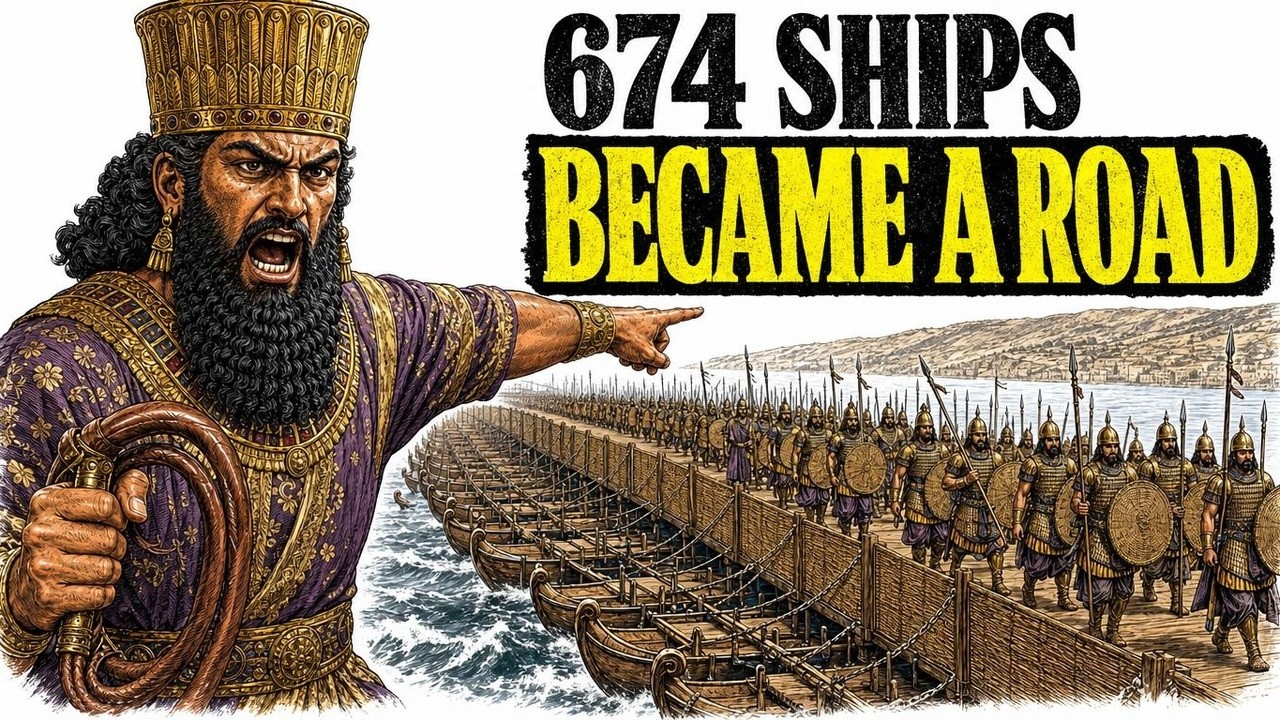
The Achaemenid Empire had gathered the largest army ever assembled at the western edge of Asia, ready to cross into Greece and crush it, and between that army and its target lay the water. Xerxes did not call for boats to carry his men. He ordered his engineers to bind the sea itself, to lay a bridge over it broad enough and strong enough to carry an entire empire to war. The man who wrote it all down despised the men who built it.
Herodotus of Halicarnassus gave posterity the weight of their cables measured to the talent, the count of the ships lashed together one by one, the exact width of the road laid across open water. What he never gave was a single name. The engineers who served the Persian great king are blanks in the record. No blueprints survive, no diaries, no stones raised to their own skill.
Their masterpiece reaches us only because the people they came to destroy wrote it down. Yet the enterprise itself reveals more about the nature of Persian power than any battle in the campaign that followed. The Persian Empire was no wild horde ruled by rage and impulse. It was a cold, precise system of administration, a bureaucracy stretched across three continents, satraps and scribes, treasurers and quartermasters bound together by the fastest courier network in the ancient world.
The machine existed to turn the will of one man into stone, water, and iron, whatever the cost in silver or lives. If the great king wanted a canal cut through a mountain, the orders went out, the labor was tallied, and the mountain opened. The system did not know the word impossible. It knew requisitions, supply, and deadlines.
In 480 BC, the machine received its boldest order yet. The command from Xerxes was short and allowed no argument. The bridge would hang on enormous cables. Four were to be twisted from papyrus, the same reed that made scrolls, now scaled into a loadbearing line.
Two more, the heaviest and most vital, were to be woven from white flax. Herodotus, who questioned men whose grandfathers had seen the thing standing, recorded the specification like an auditor reading back a contract: one talent per cubit. A talent was a weight near sixty-six pounds, and a cubit was roughly a foot and a half. That meant sixty-six pounds of rope for every eighteen inches of it.
At its narrowest, the Hellespont ran about seven stades across, some forty-two hundred feet. One flax cable spanning that distance came to more than one hundred eighty thousand pounds, ninety tons for a single rope, one of six that would hold the bridge. In the Nile Delta, a levy went out. Thousands of farmers were lifted from their fields and sent into the marshes to cut papyrus by the tens of thousands of stalks.
The green reeds were stripped, the inner fibers laid in the sun, then twisted by hand into cords, which were braided into ropes on long rope walks. On the Phoenician coast, craftsmen who spent their lives weaving fine linen were told to produce cables as thick as a grown man’s chest. The finished lines could not ride on one ship. They had to be coiled across several barges just to be floated toward the strait.
Every part of the operation was paid for in gold darics, coins stamped with the figure of the great king as a running archer, a man in motion. The coin was the fuel that let the machine burn, turning the king’s wealth into food in a laborer’s hand and a plank on a beach. Xerxes had inherited both the machine and a grievance. His father Darius had sent an army to punish Athens and Eretria for backing the Ionian revolt, and at Marathon in 490 BC that army had been thrown back into the sea.
Darius died before he could answer it. Herodotus tells us Xerxes had a servant instructed to say three words at every meal: Master, remember the Athenians. In the war council, the one voice that dared to object, the king’s own uncle Artabanus, warned that two great enemies would work against him, the land and the sea, because no harbor could shelter a fleet that size and no country could feed an army that large. He was overruled.
The bridge was not only logistics. It was a debt being collected and a warning being ignored. The work converged on Abydos, a modest fishing settlement on the Asian side of the strait. The sources put the ship count at 674 vessels drawn from Phoenicia, Egypt, and Ionia.
The chief engineers were Phoenician and Egyptian, men from coasts and river valleys with centuries of shipbuilding and monument raising behind them. They were not celebrated as geniuses in any Persian text, because Persia did not celebrate its technicians. They were project managers handed a mandate of terrible simplicity, and they had watched what happened to a wealthy Lydian named Pythius, who fed the entire army at his own cost and offered his fortune to the crown. When Pythius later asked that one of his five sons be spared the march, Xerxes had the son killed, and the army marched out between the two halves of his body.
The machine did not accept the word no, even from the man who had bankrolled it. The first attempt to yoke the Hellespont was the machine doing what it did best, applying pressure until something moved. Warship by warship, the fleet rode out into the strait and took up position against the current, hull touching hull, until a floating road reached out from the Asian shore. The crossing was set between Abydos and a headland near Cestus, where the channel narrows.
On both shores, great windlasses began to turn, and the six cables lifted off the sand and crawled across the decks of the anchored fleet. The ropes were as thick as a man’s chest. As they took the load, they made noises no rope should make, deep creaks and sharp cracks as the inner fibers settled under ninety tons of pull. For a time, the strait looked beaten.
The end came down from the north in a single night. A storm rolled off the Black Sea and poured through the funnel of the strait, and the wind struck the bridge across its whole length at once. The anchor lines went first, parting one after another. Ships tore free and slammed into the ships beside them.
The tension stored in the great cables released in an instant, and the sources describe it not as fraying but as a bursting apart. The whole structure came to pieces. Ships capsized, broke against the rocks below the white hill, or were dragged out into the open and lost. In one night, the labor of months was gone.
Xerxes did not call his surviving engineers together for a review. He treated the storm as a rebellion. Attendants were marched to the shore while the waves were still running high, and there the strait was formally punished for insubordination. Men waded into the surf and brought whips down on the water, three hundred strokes counted out against the waves.
A pair of iron fetters was heated in a brazier until it glowed and then thrown into the sea, and branding irons cut with the royal mark were plunged hissing into the surf. Herodotus even preserves the words shouted at the water: Bitter water, your master lays this on you for wronging him without cause, and King Xerxes will cross you whether you will it or not. The historian adds that men were sent to brand the Hellespont as if the sea were a slave that had run from its master. He calls the act barbarous and impious in his own voice.
Herodotus was himself a subject of the empire, born under Persian rule, and even he set down that this was a line no ruler should cross. It was theater, and the audience was not the sea. The audience was the tens of thousands of soldiers camped along the shore who had just watched the king’s power torn apart in the dark. The message was exact: there was no such thing as a neutral force of nature.
A storm was not weather. It was an insult to the crown. Then the system purged its error. The chief engineers of the first bridge were brought before the king.
There was no trial. The component had not performed its function, therefore the component was defective, therefore it was replaced. They were beheaded. Their names went unwritten.
Their work was struck from the record as if the storm had erased them along with the ships. Every man who touched the second bridge now knew what waited for a second failure. The new engineers were the dead men’s lieutenants, the ones who had stood on the shore and watched their superiors lose their heads over a miscalculation against the sea. Their brief was reduced to two words: succeed or die.
Under that pressure, they treated the collapse not as divine judgment but as a chain of mechanical faults, each of which could be named and fixed. They built not one bridge but two, laid side by side so the crossing carried a redundancy the first attempt never had. They used 674 vessels between the two spans, packed tight into a dense, deep platform instead of a fragile ribbon. They turned the ships bow on, angled into the current so the water slid past streamlined hulls instead of hammering flat sides.
They specified heavier anchors on every ship, set on both the northeast and southwest sides to hold against storms from either direction. They mixed papyrus and flax cables in the same span so the load was shared. Over the cables they laid planks cut to a fixed width, packed them with brushwood, and tread down a layer of earth on top, so from above it read as a road and not a raft. Along both edges they raised tall screens of wood and wicker, high enough to block the sight of the water.
The screens held nothing up. They existed so the horses and mules crossing would not see the waves moving beneath their feet and bolt. The machine had accounted for the physics of the current and the fear of a single mule in the same document. The second bridge was raised in the space between an order and an axe.
The northern span was made of 360 ships, the southern span of 314. The twelve great cables went across, six to a bridge, and the men leaned into the levers and winched them tight. This time the water did not answer back. It stayed under the ropes and did as it was told.
Laborers swarmed the anchored hulls, laying planks edge to edge and spiking them down to the decks. Over the planking they laid brushwood, then earth shoveled from barges and beaten flat by teams swinging heavy tampers. Where there had been open water there was now a strip of packed ground that felt underfoot like any road in the empire. Before a single soldier stepped onto the road, there was a ritual.
At first light, attendants burned incense along the whole length of the bridge and strewed the path with myrtle branches, so the army walked out over a road that smelled of smoke and leaves rather than salt and tar. Then Xerxes poured a libation from a golden cup into the sea and threw the cup into the strait, followed by a golden mixing bowl and a Persian sword. Herodotus admits he cannot say whether these were offerings to the sun or gifts of apology to the sea he had branded. The king who had chained the water was now buying it off with gold.
Then the crossing began, and it did not stop. For seven days and seven nights, the army moved from one continent to the other in a continuous stream. First across were a thousand chosen Persian cavalry and a thousand spearmen with their spears reversed, points toward the ground. Behind them walked ten sacred horses of the Nisaean breed and the sacred chariot of the supreme Persian god, drawn by eight white horses with the charioteer walking on foot, because no mortal was permitted to sit in that seat.
Only after the gods had crossed did the king himself go over, riding in his chariot among the household guard the Greeks called the Immortals, kept always at exactly ten thousand. Then the empire poured across, cavalry and infantry of every subject nation, Persians and Medes, Cissians with their bows, contingents from the Indus and the Caucasus and the river valleys of Mesopotamia. The bridge did not sag. It did not shift.
It did exactly the one thing it had been built to do. From the marble seat on the white hill, Xerxes watched the machine carry the world across at his command. Herodotus preserves one more scene from that hill. Looking down at the strait packed with ships and the shore packed with men, Xerxes was said to have wept.
His uncle Artabanus, the same man who had warned against the war, asked why. The king answered that he had been seized by pity, thinking how short human life is, that of all this vast host, not one man would be alive in a hundred years. It is the one moment the record shows him understanding the cost of the thing he had set in motion. It changed nothing.
He gave the order to march. The bridge carried his army to Greece and delivered his judgment to a place it never came back from. At Thermopylae, a narrow pass swallowed his advantage for days until a local man showed the Persians a mountain path around the defenders. At Salamis, he forced a sea battle in cramped water where his larger fleet had no room to use its size and was cut apart by the lighter Greek ships.
He watched that defeat from a throne set on the slopes of Mount Aegaleos, and this time the record shows no weeping. When the beaten Xerxes fled back toward Asia that same autumn, the bridge was gone. A storm had broken it apart again, and this time there was no year to rebuild and no army to rebuild it. The king who had marched over the sea on packed earth had to be ferried back across in an ordinary boat, exactly as the omens had foretold.
The general Mardonius was left behind with the best of the army and died the next summer on the field at Plataea. With him died the last Persian bid for Greece. For a long time, scholars reading Herodotus set the whole account aside as Greek propaganda. They filed it next to another tale that seemed just as unlikely, the claim that Xerxes had cut a canal clean through the neck of the Mount Athos peninsula, wide enough for two warships to row abreast.
In the late twentieth century, teams working with seismic survey went to the Athos peninsula and found the canal. It lies exactly where Herodotus placed it, running the width he gave, filled in now but unmistakable beneath the surface. The discovery changes how the rest of his account has to be read. The engineers who built the thing were forgotten by the empire they served.
The strait remembered nothing. Only the enemy wrote it down, and that is the sole reason we know it happened at all. The true ending of the Hellespont bridge is not a story of failure. It is a story of success so complete it became a weapon aimed backward.
A system strong enough to conquer the water could not save its king from the one force no requisition reached and no cable held: the man giving the commands.