For thousands of years, the Southern Appalachians—western North Carolina, eastern Tennessee, and the high valleys of Georgia—were the heart of Cherokee country. The story of the Cherokee seemed simple: a Southeastern people, rooted in these mountains since the beginning of time. But there was a problem hiding in plain sight. Cherokee is an Iroquoian tongue, and every other member of that language family—the Mohawk, the Seneca, the Oneida—lived roughly eight hundred miles to the north, ringing the Great Lakes.
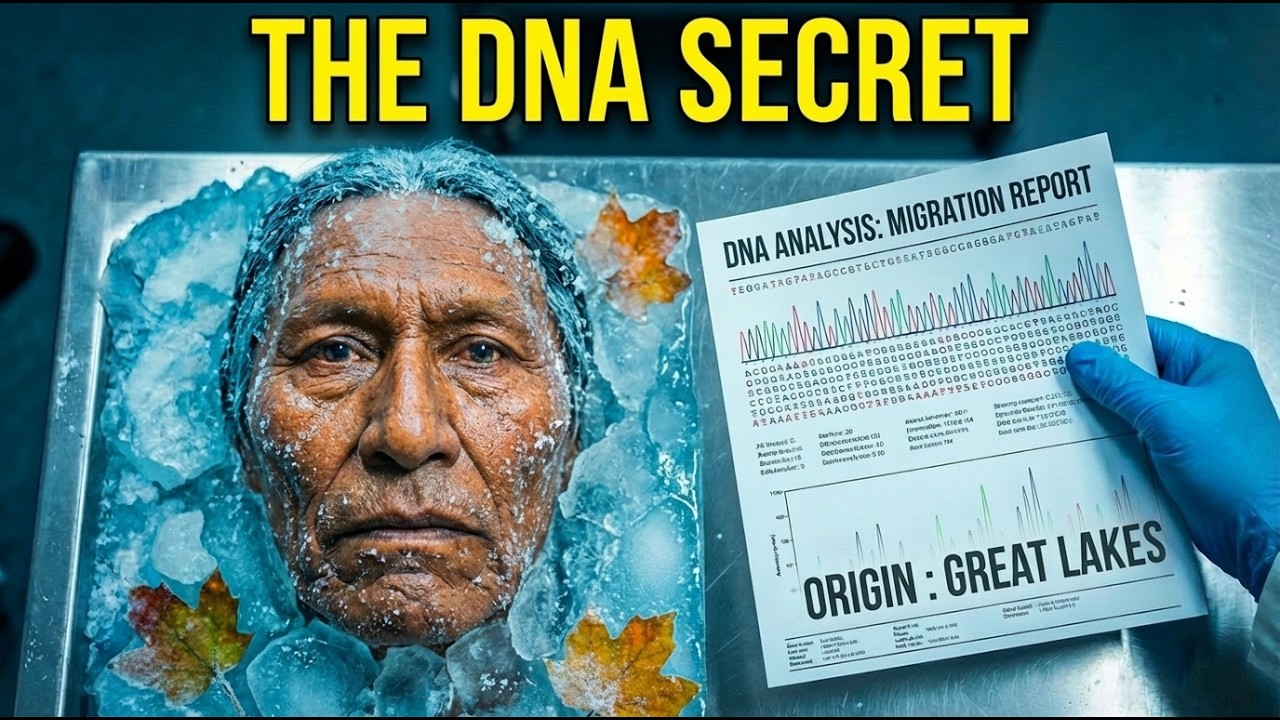
The Cherokee sat alone in the deep South, speaking a language that had no business being there. The linguistic mystery was baffling enough. But in the late 1990s, a new kind of evidence entered the conversation. Mitochondrial DNA, the tiny ring of genetic code passed unchanged from mother to child for generations, began to reveal what maps and word lists could not.
For Native Americans, nearly all maternal ancestry falls into four founding haplogroups—A, B, C, and D—lineages that trace deep roots back to Siberia and the first migrations into the Americas some fifteen to twenty thousand years ago. Each haplogroup acts like a signature of ancient journeys and population splits. By comparing the patterns and frequencies of these haplogroups across different tribes and regions, researchers could reconstruct how populations moved, settled, and sometimes vanished. Then came an anomaly.
A fifth haplogroup, called X, appeared in a small but significant number of Native American lineages. This was not supposed to happen. Haplogroup X was known to exist in Europe and the Near East, and for years that coincidence fueled speculation that Native Americans might be descended from ancient Israelites or lost European travelers. But the science told a different story.
In 1999, the debate shifted from speculation to established fact. Two independent research teams, working on separate continents, extracted mitochondrial DNA from Native American volunteers in sterile, isolated facilities. Every sample underwent duplicate testing, with negative controls sequenced alongside to detect even the faintest trace of contamination. The results were unmistakable.
A subclade called X2a appeared in a distinct set of Native American lineages, carrying a genetic signature absent from every known European or Near Eastern sample. Cross-checks with hundreds of contemporary European genomes confirmed the pattern: no overlap, no recent admixture. By replicating the results in multiple laboratories, researchers closed the door on laboratory error and colonial contamination. X2a was ancient, rooted in the Americas long before Columbus.
Its presence demanded a new look at who the Cherokee and their northern cousins really were. A single map, published in 2002, changed the way researchers visualized the mystery. Nearly 1,600 mitochondrial DNA samples from tribes across North America were plotted as a heat map, each point marking the frequency of X2a. The result was impossible to ignore.
A vivid hotspot glowed around the Great Lakes, stretching from Michigan and Ontario through the heart of Iroquoian and Algonquian country. There, X2a appeared in up to twelve percent of some tribal groups—the Ojibway, the Menominee, the Sioux. In the Southeast, including the Cherokee homeland, it dropped to less than one percent. When the genetic map was overlaid with the historical boundaries of Iroquoian languages, the match was almost exact.
The spatial overlap pointed to a shared past, a population movement from north to south, written in both language and maternal DNA. Genetic geography and linguistic history were converging on the same answer. Linguists reached the same conclusion through a separate line of evidence. Working with hundreds of core words and patterns of sound change, they used Bayesian models to trace when Cherokee split from its northern relatives.
Their calculations placed the divergence three to four thousand years ago, matching the era when Iroquoian-speaking ancestors would have left the Great Lakes behind. The clock of language and the memory of the people arrived at the same answer. The Cherokee themselves had never forgotten. In their oral tradition, the Keetoowah stories recall a migration from the north, a journey carried in memory long before it was mapped by science.
The elders had been telling this story for generations. The genetics simply confirmed what the language had always suggested and what memory had preserved. The implications were more than academic. The old narrative of a people rooted in the Southern Appalachians since time immemorial began to unravel.
The Cherokee were not always southern. Their ancestors had come down from the north, carrying an Iroquoian language and a distinctive maternal lineage into a landscape that would become their homeland. The mountains they called home had been adopted, not inhabited since the dawn of time. But genetics alone could not tell the whole story.
Mitochondrial DNA traces only the maternal line, one thread in a much larger tapestry. Rare lineages like X2a can vanish after a single generation. The Trail of Tears in 1838, with a mortality rate near twenty-five percent, carved a deep genetic bottleneck into Cherokee history, erasing many ancestral lines that had survived for millennia. Modern consumer DNA kits, sold directly to the public, often miss these complexities and cannot substitute for rigorous, tribally approved research.
The claims that haplogroup X ties Native Americans to ancient Israelites or Europeans were built on a misunderstanding of the evidence. X2a split from its Eurasian relatives at least fifteen thousand years ago and is found nowhere in the Old World. Those theories hijacked the data to support a narrative that the science never supported. The real story, written in DNA and tradition, was far more remarkable than any legend of lost tribes.
What emerged was a picture of an ancient migration, hidden in plain sight, confirmed by both word and blood. The Cherokee language carried the memory of a northern origin. The mitochondrial DNA carried the same memory in a different form. And the oral tradition had never wavered.
The ancestors came from the north. They traveled south. They made the Southern Appalachians their own. And they stayed—long enough for the world to forget where they had come from, until the evidence finally caught up.
The next chapters in this mystery will depend on partnership. Research must be guided by tribal consent, data sovereignty, and the principles of ethical collaboration. The Cherokee are no longer just subjects of scientific inquiry; they are the custodians of their own past. Science is still chasing what Cherokee memory never forgot.
The story is no longer a question of whether the Cherokee came from the north—the language, the DNA, and the tradition all agree. It is a question of how their ancestors made the journey, and what happened along the way. The answer lies somewhere in the long road between the Great Lakes and the Southern mountains, a path that the Cherokee walked thousands of years ago and that science has only now begun to trace.