For much of the twentieth century, the Brach’s Pick-A-Mix display stood at the end of aisle seven in grocery stores across America. You could smell it before you saw it: butterscotch and peppermint and something warm and sugary that had no name. For a five-year-old holding a mother’s hand, it was the most beautiful thing in the building. Forty open bins in a single wooden display, each filled with a different candy and topped with a small metal scoop.
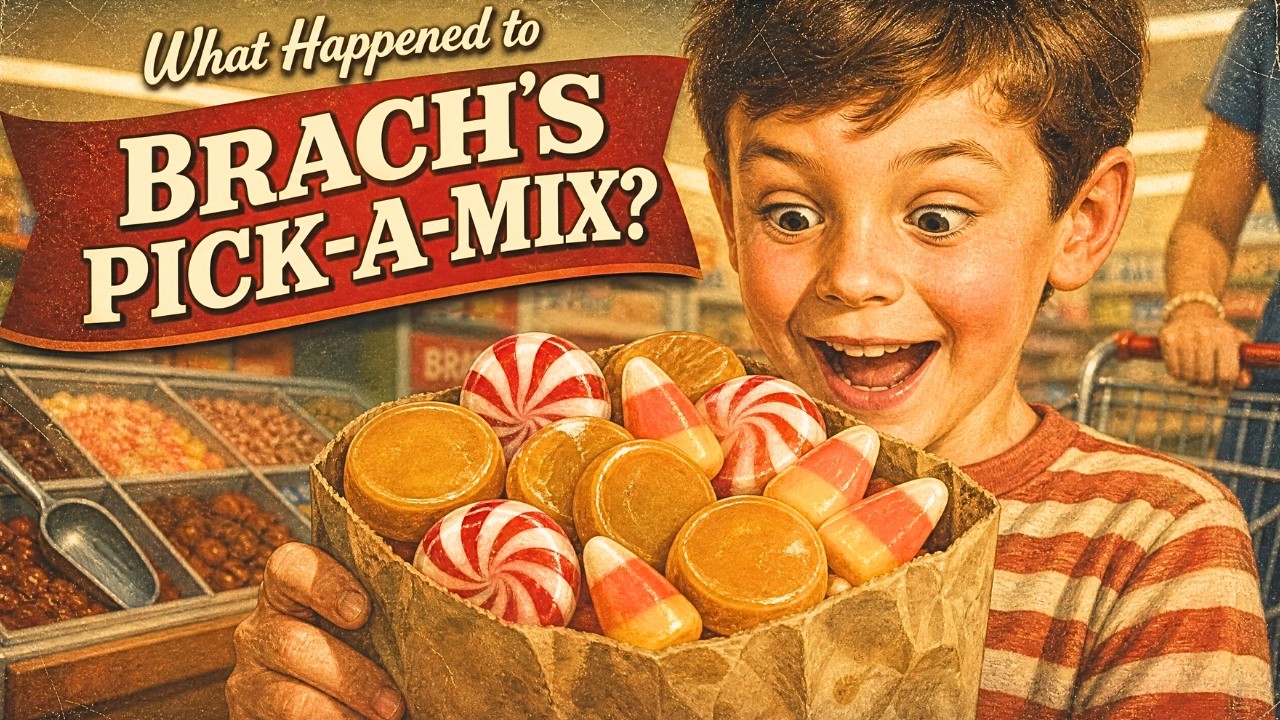
Children stood on their toes, calculated how many butterscotch discs they could fit into one paper bag, and listened to the rattling rush of candy tumbling in. The deal was unspoken but universal: one bag, one trip down the candy aisle, one chance to build the perfect combination. The cashier weighed it, the mother glanced at the price, and the look on her face told the child whether they had gotten away with something or gone too far. The display changed with the seasons.
In October, candy corn and mellow cream pumpkins replaced the summer sweets. At Christmas, ribbon candy and foil-wrapped chocolate bells appeared. The bins were a calendar; every holiday had a flavor that came from that display and nowhere else. Grandmothers filled crystal bowls from the same bins and carried them home in the same paper bags.
At their houses, the candy was not a reward; it was simply there. Jelly nougats, Neapolitan coconuts, royals, caramels, and hard candies arranged like a small edible garden. By the end of a visit, every piece was gone, consumed by grandchildren who would not understand for another forty years what it meant that a woman who had survived the Depression and two wars spent her money on candy she would never eat herself, just so the children would always have a reason to walk through her door. The hygiene of the open bins was appalling by any standard, and in the 1970s, nobody cared.
Children reached in with bare hands, teenagers palmed caramels, grown men dropped butterscotch into coat pockets. A small cardboard box on the display said “Samples, 10 cents each or three for a quarter,” and the honor system lasted about six minutes. The joy was immeasurable. The man who started it all was Emil J.
Brock. He arrived in Chicago from Germany in 1881 with nothing but the clothes he wore and a knowledge of candy learned from generations of candy makers. He saved a thousand dollars, and in 1904 he opened a storefront at the corner of North Avenue and Town Street, calling it Brock’s Palace of Sweets. The store was eighteen feet wide.
Behind the counter stood a candy case and an ice cream parlor; behind a partition was the kitchen where Emil made the candy himself in a single kettle. His fourteen-year-old son Frank knocked on doors and sold the candy to department stores. His other son Edwin kept the books. The family sold candy for twenty cents a pound, half the price of every competitor in Chicago, because Emil believed that if you made the best candy at the lowest price, people would find you.
By 1911, he was producing twenty-five tons a week. By 1918, a thousand tons. By 1923, he had built the largest candy factory in the world: a five-million-dollar complex on Kinzie Street covering twenty-three acres, producing over two million pounds of candy every day. There were 127 varieties and 3,500 employees, and the sweet smell of butterscotch drifted over the west side of Chicago like weather.
It was Frank, the boy who had sold candy door-to-door at fourteen, who invented the pick-a-mix concept in 1958. The old general stores had sold candy from barrels, but the barrels were gone. Frank saw that the desire was not, and he built a display that brought the barrel experience into the modern supermarket. Open bins, metal scoops, one price per pound.
The idea spread so quickly that within a decade, you could not walk into a grocery store in America without passing a Brach’s Pick-A-Mix display on the way to the checkout. By 1986, Brach’s controlled two-thirds of the entire American market for bagged and bulk candy: $640 million in sales. The largest non-chocolate candy operation in the country, built on a thousand-dollar investment and a father’s belief that good candy at a fair price would always win. Then the family lost the company, and the company lost everything that made it worth keeping.
American Home Products bought Brach’s in 1966. They sold it to a Swiss firm. The Swiss sold it to a German investor. The German let it slide into bankruptcy.
New owners came and went. The Chicago factory, the one Emil had built with five million Depression-era dollars, the one that had employed 3,500 people and perfumed the West Side for eighty years, closed in 2003. Over a thousand workers lost their jobs in a single announcement. Production moved to Mexico.
The building stood empty for five years, windows broken and candy kettles cold. In 2008, Christopher Nolan used it as Gotham Hospital in The Dark Knight and blew part of it up on camera. A few years later, the rest was demolished. The largest candy factory in the world was now a vacant lot on the west side of Chicago, and the only thing left of Brock’s Palace of Sweets was the name on a bag of candy corn at Walmart, manufactured by an Italian conglomerate that had never seen the inside of that kitchen on North Avenue.
The family fared no better than the factory. Helen Brock, who had married into the family and inherited the fortune after her husband passed in 1970, vanished on a February afternoon in 1977. She was last seen leaving the Mayo Clinic in Rochester, Minnesota. Her body was never found.
For seventeen years, nobody was held accountable. Then investigators uncovered a scheme that sounded like fiction. A network of horse traders and con men in the Chicago equestrian world had been swindling wealthy owners and quietly eliminating the ones who threatened to talk. A man named Richard Bailey, who had romanced Helen and sold her horses worth a fraction of what she paid, was convicted of conspiracy in her disappearance and sentenced to life in prison.
He never revealed where she was. The woman whose family had filled the candy bowls of a nation disappeared into a mystery that has never been solved. The pick-a-mix displays disappeared so quietly that most people did not notice until they were gone. One year the bins were there; the next year they were replaced by shelves of pre-packaged candy in sealed plastic bags.
No scoops, no paper bags, no choosing, no standing on your toes to see what was in the back of the butterscotch bin. The supermarket said it was about hygiene. The lawyers said it was about liability. The accountants said it was about efficiency.
All of them were right, and none of them understood what they had taken away. Those who have tried to buy Brach’s candy recently have noticed something they wish they had not: it does not taste the same. The recipe changed somewhere between the third and fourth corporate owner. The candy that arrives in a sealed bag from a factory you will never see is not the candy your grandmother put in the crystal bowl.
It is close. It is almost right. But almost right is worse than completely different, because completely different would let you forget, and almost right keeps reminding you of exactly what you lost. People brought their own children to those bins and stood behind them the way their mothers once stood behind them, watching a generation discover the same thing: a grocery store could contain a place where you were allowed to choose.
The bins were not about candy. They were about a child standing in front of forty bins and being trusted to decide, to scoop, to hold the bag, to hand it to the cashier. They were about a grandmother who filled the crystal bowl every week because love sometimes looks like butterscotch in November. They were about a man who arrived in Chicago with nothing and built a palace of sweets with a single kettle and a thousand dollars and a belief that the world would always want something sweet if you made it well enough and sold it fairly.
The bins are gone now. The factory is gone. The grandmother is gone. But the taste is still there if you close your eyes, and the weight of that metal scoop is still in your hand, and the sound of candy falling into a paper bag is still the sound of a Saturday morning in a grocery store that does not exist anymore.
There is a woman in Ohio who cleaned out her mother’s house last spring after the funeral and found the crystal bowl in the back of a cabinet, empty and washed clean. She held it for a long time. She did not put candy in it, because the candy that belonged in that bowl does not exist anymore. She put the bowl on her own coffee table.
It is still empty. She cannot bring herself to fill it with anything else.