In the final decades of the nineteenth century, as America’s industrial giants ruled steel and steam and their fortunes rivaled the treasuries of nations, their daughters discovered a limit that money alone could not buy: the ancient bloodlines of Europe. Across the Atlantic, in crumbling palaces where portraits of long-dead warriors stared at empty vaults, the British aristocracy faced a choice between pride and survival. What emerged was a grand bargain that would reshape two civilizations. Millions in American dollars flowed east to restore dilapidated estates, while westward traveled the most valuable currency of all—titles that turned merchants’ daughters into duchesses.
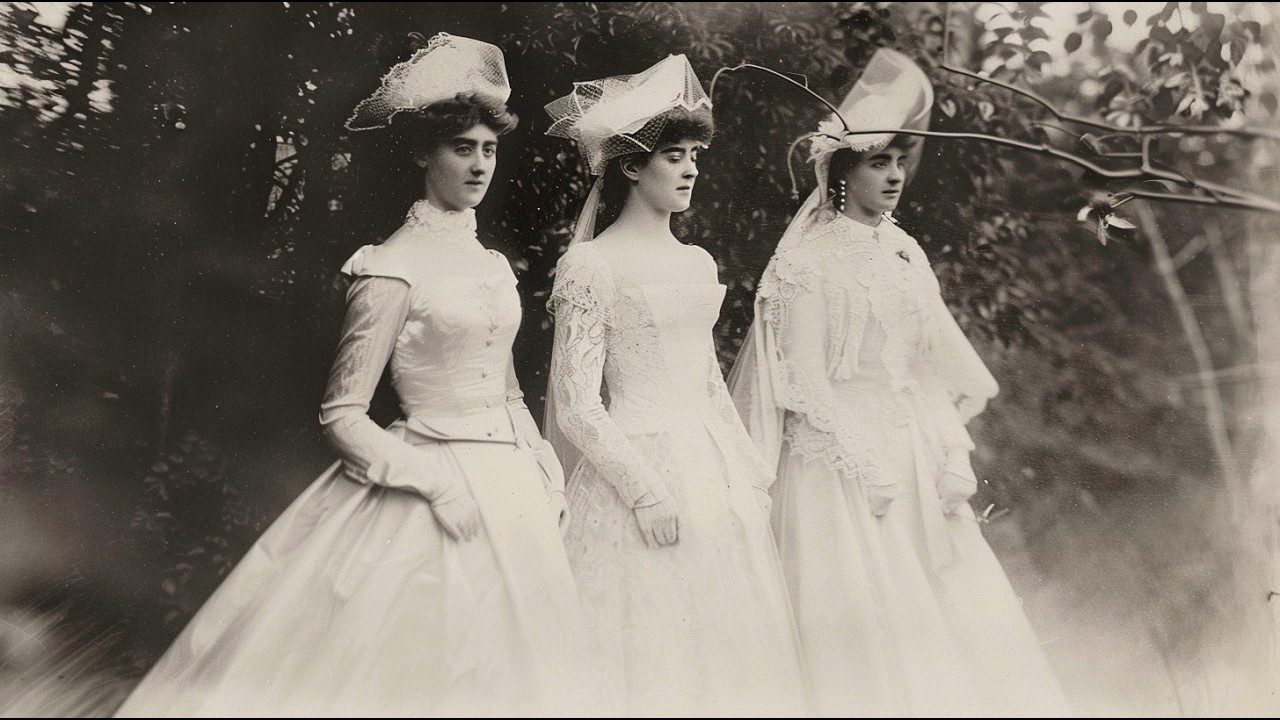
This was the age of the Dollar Princesses, when marriage became diplomacy and matrimony became the great merger that changed forever the fates of two nations bound by language but separated by centuries of tradition. Among the first and most famous of these women was Jennie Jerome Churchill. Born Janet Jerome on January 9, 1854, in Brooklyn—a place with no connection whatsoever to aristocracy—she came from purely American stock that made British nobles recoil at her democracy. Her father, Leonard Jerome, ruled Wall Street with the imperious confidence of a man nicknamed the King of Wall Street, amassing wealth with the same ruthless efficiency his daughter would later apply to collecting admirers across two continents.
The Jerome family’s cosmopolitan life included summers in Newport and long periods in Paris, where young Jennie and her sisters caught the attention of the Empress Eugénie herself, gaining a European polish that proved invaluable when navigating the treacherous waters of British high society. In 1873, during a three-day regatta, the nineteen-year-old Jennie met Lord Randolph Churchill, the second son of the seventh Duke of Marlborough, in what could only be described as the Victorian version of a speed-dating success story. Their whirlwind romance culminated in marriage on April 15, 1874, making Jennie one of the earliest Dollar Princesses—American heiresses who exchanged their fathers’ industrial wealth for British titles with the precision of Wall Street brokers. The wedding bells had barely stopped ringing before the first scandal erupted with all the force of a Fourth of July fireworks display.
Winston Churchill’s birth on November 30, 1874, at Blenheim Palace came under circumstances that fueled speculation and whispers for decades. The official announcement in The Times diplomatically described it as a premature birth, but the timing pointed either to extraordinary medical circumstances or to severely lax Victorian calculations. Seven months to the day after their wedding, Jennie gave birth to a future prime minister, producing a kind of arithmetic in elite drawing rooms that sent even the most seasoned gossips reaching for their smelling salts. Lord Randolph explained in a letter to his mother-in-law how Jennie had fallen on Tuesday while walking with the shooters, and how an unwise and jolting ride in a pony cart had brought on labor pains on Saturday night—an explanation that convinced no one with even basic counting skills.
Contrary to popular legends claiming Winston was born in a cloakroom or a ladies’ room during a social event, the birth actually took place in a bedroom at Blenheim Palace that was temporarily being used to store guests’ coats. Labor lasted more than twenty-four hours, during which Jennie displayed the iron constitution she would later use to survive decades of social wars and financial crises. The enduring legend of Jennie Churchill’s two hundred lovers stands as one of the most mathematically improbable sexual achievements in history, requiring logistics that might challenge a military quartermaster and stamina that could exhaust a thoroughbred racehorse. This sensational figure originated from the Irish novelist George Moore, who tossed off the claim with the casualness of someone discussing the weather, offering no evidence whatsoever.
The mathematical impossibility becomes glaring upon scrutiny. Assuming Jennie maintained romantic relationships between the ages of twenty and sixty, she would have needed an average of five lovers per year, maintaining affairs lasting only ten weeks each with brief pauses for recuperation and wardrobe changes. The transportation constraints of the Victorian and Edwardian eras alone render the scenario logistically absurd. Modern scholarship has demolished this titillating fantasy with ruthless efficiency.
Celia and John Lee, who gained unprecedented access to the Churchill family papers through their friendship with Winston’s nephew Peregrine Churchill, concluded that Jennie’s actual number of romantic partners was twelve or fewer—far less exciting, but infinitely more believable. Their examination of thousands of never-before-seen family documents revealed evidence of only one relationship that may have coincided with her marriage to Randolph: her affair with the Polish count Charles Kinsky. The two-hundred-lovers myth persists because it is easy to share and titillating enough to boost any website’s Google statistics, serving the internet’s appetite for scandal rather than substantive truth. The historian William Manchester dismissed Moore’s claim as absurd because Jennie was more discreet than that, and in any case, only she alone knew the number.
The most well-documented extramarital relationship was with Albert Edward, Prince of Wales, who later became King Edward VII, although this relationship began only after Lord Randolph’s death in 1895, making it technically irrelevant to questions of marital fidelity. The Churchill Archives Centre in Cambridge holds extensive correspondence between the prince and Jennie, providing tangible evidence of their intimate relationship that lasted about two years, which historians describe as primarily a relationship of mutual sexual convenience. The prince’s letters address her as “Macheer” instead of the formal “Lady Randolph,” while Jenny’s pet name for the future king was “Tomtoy. ” An earlier incident in 1889 had paved the way for their relationship when Lord Randolph returned home to find the prince and his wife together unsupervised in a compromising situation, and angrily threw the future king out of his house.
This relationship carried significant political implications beyond personal gratification, strengthening Jennie’s social standing and political influence as a member of the prince’s inner circle. Yet this royal relationship paled before the most important romantic attachment of Jennie’s life: a twelve-year love story that tested her loyalty to marriage, motherhood, and social conventions in ways that made her brief fling with royalty seem like a passing amusement. Count Charles Kinsky, born into an Austrian noble family in 1858, achieved his two greatest goals in Britain in rapid succession: appointment as Austro-Hungarian attaché and victory in the 1883 Grand National on his horse “Zouave. ” Their relationship began during Kinsky’s success in British society when he became utterly infatuated with her, beginning an affair that lasted roughly from 1883 to 1895, representing the longest and most emotionally stable extramarital attachment Jennie ever experienced.
For more than a decade, Kinsky urged Jennie to divorce Randolph and choose a future with him, offering the emotional devotion that Victorian novels promised but aristocratic marriages of convenience rarely delivered. The relationship ended in 1895 under heartbreaking circumstances. While Jennie accompanied her dying husband on their final journey around the world, Kinsky’s family begged him to marry appropriately to preserve the family line. The sacrifice required to marry Jennie was enormous.
Any marriage would be morganatic, meaning any child would not receive noble rank and would not inherit his titles, possessions, or wealth. Kinsky finally bowed to family pressure and became engaged to the twenty-year-old Countess Elisabeth Wolff-Metternich zur Gracht while he was thirty-five. The timing was cruelly precise. Jennie learned of the engagement just as she was about to become a widow and finally free to marry her lover of twelve years, watching her great romantic opportunity evaporate at the very moment it could have become reality.
Kinsky kept a framed photograph of Jennie in his study until his death in 1919. After Lord Randolph died of syphilis in 1895, leaving the forty-one-year-old Jennie facing financial chaos, she embarked on a marital strategy that made her previous scandals seem tame. In 1900, she married George Cornwallis-West, a handsome Guards officer who was only sixteen days older than Winston, creating the bizarre situation where Winston’s stepfather was roughly his age. The twenty-year age gap caused such scandal that George’s parents boycotted the wedding.
The marriage lasted from 1900 to 1914, marked by George’s growing discontent and financial difficulties so severe that when they divorced, George gallantly assumed a pile of her unpaid bills—perhaps the most expensive divorce settlement in British history. In 1918, at sixty-four, Jennie achieved the pinnacle of her marital scandals by marrying Montague Porch, a colonial official twenty years her junior and three years younger than Winston himself. Despite the social scandal, this marriage appears to have been Jennie’s happiest. While society obsessed over Jennie’s personal arrangements, her professional achievements were revolutionizing women’s roles in British cultural and political life.
In 1899, she founded the Anglo-Saxon Review, a prestigious quarterly featuring contributions from Henry James, Winston Churchill, and Stephen Crane. During the Boer War, she organized the American Women’s Hospital Ship Fund, raised more than $150,000 to equip the hospital ship Maine, then sailed personally to South Africa and worked as a nursing assistant treating wounded soldiers, including her son Jack. Remarkably for a woman whose influence came through traditional channels, Jennie opposed women’s suffrage, serving as president of the North Wales Anti-Suffrage League. But her greatest achievement was crafting Winston Churchill’s career, becoming his enthusiastic ally, promoting his plans, and arranging meetings with figures like Mark Twain and Theodore Roosevelt.
When Jennie Churchill died on June 29, 1921, at sixty-seven from complications of a broken leg, she left behind a legacy that transcended the titillating myths of two hundred lovers. The most famous Dollar Princess of all was Consuelo Vanderbilt, born on March 2, 1877, into the wealthiest family in America. Her mother, Alva Vanderbilt, wielded ambition as a weapon, carving the family’s path through society with the same ruthless determination her husband, William Kissam Vanderbilt, used to expand his railroad empire. Consuelo became her mother’s masterpiece in progress—every breath, every gesture, every word was sculpted according to Alva’s exacting standards.
The stone mansion on Fifth Avenue and Sixty-Fifth Street where Consuelo spent her formative years was simultaneously a palace and a prison. Alva’s plans crystallized with terrifying precision: a European title would lift the Vanderbilts above their newly-rich peers. When Consuelo debuted in society in 1895, she set New York ablaze with speculation. But behind the carefully arranged exterior was a quiet rebellion brewing.
Consuelo had formed a romantic attachment to Winthrop Rutherfurd, a New York gentleman whose lack of a title made him unacceptable in Alva’s calculating eyes. That autumn, the Duke of Marlborough arrived in New York. Charles Spencer Churchill, known since childhood as “Sunny,” came seeking what many of his peers sought in America: wealth to restore his crumbling family seat, Blenheim Palace. He found in Consuelo not only extraordinary beauty and impeccable lineage but also the vast Vanderbilt fortune that might save his estate.
When the young heiress resisted the marriage, Alva employed tactics that shocked even their jaded social circle. She even threatened to kill Winthrop Rutherfurd. Through emotional manipulation and relentless pressure, Alva wore down her daughter’s resistance until surrender became inevitable. On the morning of November 6, 1895, New York witnessed what the press called the wedding of the century.
Few guests could see the tears that had soaked Consuelo’s pillow the night before, or feel the deep despair beneath her composed exterior. The dowry was calculated in cold numbers: $2. 5 million in railroad stock, an astonishing sum equivalent to more than $75 million today. Blenheim Palace appeared before Consuelo in late autumn 1895.
Its massive facade was a monument to centuries of aristocratic power. She became mistress of one of England’s greatest estates, with its cavernous rooms and endless corridors and the weight of traditions she was expected to uphold. Years of neglect had left the palace in a state of elegant decay. Leaking water threatened priceless textiles while entire wings stood empty after previous generations had sold the furnishings.
The marriage settlement, providing an annual income of $100,000 for the duke and another $100,000 for Consuelo, was quickly used to fund extensive renovations that would save this architectural treasure from ruin. Yet even as she devoted herself to restoring Blenheim, Consuelo discovered that renovating a palace was far easier than building a marriage. The duke, though perpetually polite, maintained an emotional distance that grew more evident with each passing month. Motherhood came with mechanical precision as duty demanded.
The birth of their first son, John Albert Edward William Spencer-Churchill, in 1897, fulfilled the duchess’s primary obligation by providing an heir to the dukedom, followed by a second son, Lord Ivor Spencer-Churchill, in 1898. The young duchess found her true calling in the role of social reformer. She engaged in charitable work with an energy that astonished and perhaps scandalized traditional aristocratic circles. Under her management, Blenheim became a center for progressive social initiatives.
She established programs for estate workers and their families, including housing improvements and educational opportunities. Her work with London’s poor, especially unmarried mothers and their children, revealed a compassion that crossed class boundaries. In English society, Consuelo’s beauty and natural grace made her the center of attention wherever she went. But beneath this apparent success grew her realization that she had exchanged one gilded cage for another.
Meanwhile, the duke pursued his own interests and sought companionship elsewhere. Their public appearances together became increasingly formal occasions, carefully designed to maintain the appearance of marital harmony while concealing the reality of their estrangement. In 1906, the facade finally began to crack. The comfortable fiction of the Marlborough marriage could no longer withstand the pressures of their mutual unhappiness.
For Consuelo, then twenty-nine, the decision to separate marked the beginning of a profound personal transformation, though the legal bonds took years to fully dissolve. Freed from the strict protocols of her position as Duchess of Marlborough, she became involved in causes reflecting her true passions. Her work with the Women’s Municipal Party in London revealed a keen political mind long obscured by social duties. The suffrage movement found in her an eloquent advocate, her personal experience of powerlessness lending credibility to her support for women’s rights.
When World War I broke out in 1914, Consuelo directed her organizational skills toward vital war relief efforts. As chairman of the Economic Relief Committee of the Women’s War Relief Fund, she worked tirelessly to assist those affected by the conflict. The long road to divorce finally ended in 1921. The legal dissolution of her marriage to the Duke of Marlborough marked not just the end of a marital bond but the beginning of Consuelo’s true independence.
In 1921, at forty-four, Consuelo Vanderbilt began her second chapter. Her marriage to Jacques Balsan, a French aviation pioneer, represented not merely a new bond but a triumph of personal choice over social obligation. Unlike the theatrical spectacle of her first wedding, this ceremony celebrated a genuine bond between two people who had freely chosen each other. The contrast could not have been more profound.
The young duchess who had once walked down the aisle crying now progressed with quiet joy. Their life together between France and America allowed Consuelo to bridge the two worlds that had shaped her existence. At their French estate, Château Saint-Georges-Motel, she created the kind of home that Blenheim, for all its grandeur, never represented. When France fell to Nazi Germany in 1940, the Balsans were forced to flee, leaving behind their beloved château.
They made their way to America, where Consuelo once again demonstrated her resilience. During these years, she directed her energy toward supporting the Free French movement and various relief organizations assisting European refugees. In 1953, Consuelo published her memoirs, “The Glitter and the Gold. ” The book provided not merely a glimpse into the vanishing world of the Gilded Age but a profound meditation on privilege, duty, and the enormous price of social ambition.
With astonishing candor, she detailed her mother’s ruthless machinations and her own journey from a stripped young bride to an independent woman. The memoirs became a bestseller, introducing a new generation to her story. Consuelo Vanderbilt Balsan died on December 6, 1964, in Southampton, Long Island, at eighty-seven. Her legacy rests not in titles or crowns but in the example she provided of a woman who found the courage to chart her own course.
Perhaps the grimmest tale among the Dollar Princesses is that of Mary Leiter, the American heiress who literally worked herself to death for her husband’s political ambitions. Born on May 27, 1870, into obscene wealth, Mary was her father’s spoiled princess with a $20 million trust fund. Her father, Levi Z. Leiter, co-founded the Field & Leiter textile empire that became the legendary Marshall Field company.
When Mary was eleven, her socially ambitious mother made a strategic move that changed everything: the family relocated to Washington, D. C. , purchasing a stunning fifty-five-room mansion on Dupont Circle. By 1890, the twenty-year-old Mary was ready to conquer London society.
At one of those glittering balls, Mary spotted her perfect target: George Nathaniel Curzon, the thirty-five-year-old Conservative MP with handsome features, a brilliant political future, and money problems that would make a usurer weep. Mary looked at this handsome disaster and announced something that shocked even her bold contemporaries: “I shall marry him because I think he needs me. I am not ashamed. ”
After nearly no communication during the engagement, they finally married on April 22, 1895, in Washington.
The Leiter family demonstrated their commitment to their investment immediately by providing a staggering dowry of $200,000 and paying off all of Curzon’s crushing debts. Mary’s social ascent reached dizzying heights in 1898 when Curzon received the greatest political prize: appointment as Viceroy of India at the absurdly young age of thirty-nine. This promotion transformed Mary into Vicereine of India, making her the most powerful American woman in the entire British Empire, literally second only to Queen Victoria in the imperial hierarchy. The position placed Mary in charge of governing more than 400 million people in the Indian subcontinent.
She became legendary for her stunning appearance at the 1903 Delhi Durbar, wearing the iconic peacock dress that became the most famous garment in imperial history. Mary engaged in her role with astonishing effectiveness, becoming Curzon’s secret weapon during what would become an increasingly catastrophic political tenure. She founded Lady Curzon’s hospitals for women’s healthcare, supported female doctors, and her conservation appeals contributed to the creation of what became Kaziranga National Park. The couple had three daughters.
Insiders attributed much of Curzon’s early success to Mary’s grace, charm, and uncanny ability to make his unpopular policies seem almost reasonable. But the imperial grandeur that made Mary historically significant was systematically destroying her health, happiness, and will to live. India’s climate proved brutally harsh on European women, and Mary’s delicate constitution began to crumble under the heat, humidity, and constant pressure to project imperial perfection. The breaking point came in the summer of 1904 when Mary suffered a near-fatal illness connected to a miscarriage and subsequent infection that permanently destroyed her health.
Instead of staying with his dying wife, Curzon made the staggeringly cruel decision to abandon Mary during her recovery and rush back to India to pursue politics. When Mary dragged herself back to India despite being half-dead, the decision constituted suicide by imperial duty. The final political catastrophe occurred when Curzon clashed with Lord Kitchener, Commander-in-Chief of the Indian Army, over bureaucratic reforms that no one saw as important except Curzon himself. This battle of egos escalated into a full governmental crisis ending with Curzon forced to resign in disgrace during the summer of 1905.
By the time they secretly returned to England in August 1905, Mary was visibly dying, destroyed by seven years of imperial service beyond any hope of recovery. On July 18, 1906, barely a year after escaping the Indian nightmare, Mary’s exhausted heart finally gave out. She was only thirty-six, leaving behind three young daughters. The official cause of death was heart failure, but everyone knew the real killer was eleven years of marriage to a man who treated his wife as a political accessory rather than a human being.
Affluent, beautiful, beloved by society, and possessing every material advantage the Gilded Age could offer, Mary Leiter Curzon proved that money can buy aristocratic titles and imperial power but not happiness, health, or longevity. The era of the Dollar Princesses reshaped both nations. These transatlantic alliances brought American wealth to rescue crumbling British estates while granting American heiresses the titles and social standing they craved. The women wielded their new positions to advance causes from suffrage to healthcare, and their children shaped politics on both sides of the Atlantic.
Winston Churchill, son of Jennie Jerome, would become the man who saved Western civilization. The Maritime unions of these women formed a crucial bridge between two cultures, accelerating the transformation of women’s roles and demonstrating the evolving dynamics of love, ambition, wealth, and social standing in a world where old money met new, and both were forever changed.