On the morning of October 11, 1776, a British fleet sailed south across Lake Champlain carrying enough firepower to end the American Revolution in a single afternoon. The force numbered twenty-five warships and some four hundred transports, bearing nearly ten thousand soldiers, sailors, and native warriors. At the head of the column, HMS Inflexible mounted eighteen twelve-pound cannons, any one of which could punch through the hull of the largest vessel America then had afloat. The British commander, General Guy Carleton, had spent months preparing this armada for one purpose: to sail down the lake, crush all remaining resistance, push toward the Hudson River, and cut the rebellious colonies in half.
But on the western side of a small, heavily wooded island, hidden in a narrow channel that most British officers did not even know existed, a man who would one day become the most infamous traitor in American history was about to perform the act that would save the country he later tried to destroy. To understand how Benedict Arnold came to command a fleet of homemade warships on a lake in upstate New York, one must go back ten months. In the winter of 1775, the American Revolution was barely a year old and already in serious trouble. In a desperate attempt to keep Britain from using Canada as a staging ground for invasion, the Continental Congress authorized a bold and arguably reckless attack.
Two American columns marched north through frozen wilderness toward Quebec City. One was led by General Richard Montgomery, a veteran officer born in Ireland who had defected from the British army. The other was led by Benedict Arnold, an ambitious and restless Connecticut merchant. Arnold was not a professional soldier.
Before the war he had earned his living as a merchant captain operating out of New Haven, running cargo ships between New England and the Caribbean. He had spent years at sea, navigating coastal routes, managing crews, and learning the hard way how ships handled rough seas and narrow channels. He knew vessels the way a farmer knew his land. He was also known for an aggression that bordered on recklessness, a trait that had already landed him in trouble more than once.
He had helped Ethan Allen seize Fort Ticonderoga in May 1775, storming the lightly guarded fort at dawn before the British garrison understood what was happening. The Quebec campaign tested every ounce of that aggression and more. On the last night of 1775, Montgomery and Arnold launched a desperate assault on the fortified walls of Quebec City during a blinding snowstorm. Snow and freezing rain lashed the attackers as they moved through the narrow streets of the lower town.
Montgomery was killed almost immediately, cut down by a burst of cannon fire from a concealed artillery position. Arnold took a musket ball in his left leg at the start of the fighting but refused to leave the field until his men physically carried him to a field hospital. The attack failed disastrously. The surviving American forces spent the following months camped outside Quebec in miserable conditions, dying of smallpox and frostbite, before finally retreating south in the spring of 1776 as thousands of British reinforcements arrived by ship across the Atlantic.
By June of that year, the entire American Northern Army had withdrawn to Fort Ticonderoga and Fort Crown Point at the southern end of Lake Champlain. They were exhausted, disease-ridden, and critically short of everything from gunpowder to boots. But the strategic situation was far worse than the condition of the troops, because Lake Champlain was not just a lake. It was the key to the entire war.
Stretching roughly 145 miles from the Canadian border into the wilderness of New York and Vermont, it formed, together with Lake George and the Hudson River to the south, a natural highway running from Montreal all the way to New York City. Whoever controlled this corridor controlled the fate of the continent. If the British could push a large enough force through this waterway, they could isolate New England from the middle and southern colonies. If that happened, the Revolution was over.
The Continental Army, already struggling, could not survive being split in half. Everyone on both sides of the war knew it. The question was not whether the British would try. The question was whether anyone could stop them.
On July 7, 1776, just three days after the Continental Congress voted on the Declaration of Independence in Philadelphia, General Philip Schuyler called a council of war at Crown Point to find out exactly that. In the room were Generals Horatio Gates and John Sullivan, along with the newly promoted Brigadier General Benedict Arnold. His leg had still not fully healed from the Quebec wound. Arnold proposed an idea that seemed utterly insane to most of the officers present.
He wanted to build a fleet. Not a real fleet. The Continental Congress could barely afford to feed its army, let alone build warships from scratch. What Arnold proposed was something far more desperate and far more creative.
He wanted to build a fleet of small, flat-bottomed gunboats, vessels designed specifically for the shallow waters of Lake Champlain. Fast enough to maneuver, sturdy enough to carry cannons. He knew the British could not march their army south along the lake’s shores, because the roads on either side were nearly nonexistent. They had to come by water.
If the Americans could challenge them on the water, even with a weaker force, they might delay the invasion long enough for the Continental Army to regroup and prepare a real defense. The council agreed. Arnold was sent to Skenesborough, a small settlement at the southern end of Lake Champlain, to personally oversee the construction effort. Skenesborough proved to be a strangely ideal location.
A loyalist named Philip Skene had developed the settlement over the previous decade. It sat near a stream feeding into the southern bay with an outlet to the lake. Crucially, Skene had built two large sawmills and established an iron foundry that could produce some of the best iron bars in the colonies. Wood was there.
Iron was there. What Arnold needed was men who knew how to turn those materials into ships, and he needed them immediately. Calls went out across New York, Connecticut, and Massachusetts. Within weeks, some thirty shipwrights arrived from New York, followed by about a hundred more from Connecticut and Massachusetts.
They were joined by Continental Army soldiers pressed into service as builders, most of whom had never touched a shipbuilding tool in their lives. The operation was chaotic from the start. Smallpox swept through the workers almost immediately, followed closely by malaria. Morale collapsed.
Supplies arrived late, damaged, or not at all. General Schuyler had optimistically predicted a new gunboat could be launched every six days. This proved almost laughably ambitious. But Arnold drove the work forward with the same relentless energy he brought to everything.
He personally oversaw the design of some vessels, constantly walked the shipyard, and spent days traveling to procure supplies that the army’s supply chain had failed to deliver. The main vessel they built was called a gondola, a flat-bottomed, shallow-draft gunboat about fifty-four feet long, fitted with a single mast and square sail, armed with cannons that a crew of about forty-five men could load and fire. They were not beautiful ships. They were ugly, squat, built from green timber that had not had time to dry before being nailed and bolted into place.
The planks warped and leaked through the seams, but they could float, they could fire, and they could be built in weeks rather than months. By early October 1776, Arnold had assembled a fleet of sixteen vessels. His flagship was Congress, a row galley about seventy-two feet long and twenty feet wide, armed with ten cannons of various sizes. His total force numbered around 650 men, the vast majority soldiers who had learned the basics of sailing within weeks.
Most of them had never been on a ship before, let alone fired a cannon from a pitching deck. They had no formal naval training, no experience in fleet tactics, and only about three-quarters of the ammunition they actually needed for a sustained engagement. The British, meanwhile, had spent the same summer building something far more impressive at their own shipyard at St. Johns on the Richelieu River north of Lake Champlain.
Carleton had assembled a fleet that would have been impressive even by European standards of the day. The Royal Navy shipped prefabricated parts of warships across the Atlantic from England, packed in crates, and delivered them to Canada. Carleton also ordered three completed warships dismantled at Quebec City, loaded onto wagons, hauled twelve miles overland through muddy forest roads to St. Johns, and reassembled.
The most imposing of these was Inflexible, a three-masted warship displacing roughly 280 tons and carrying eighteen twelve-pound cannons. British shipwrights rebuilt the vessel entirely in just twenty-eight days. They also built Thunderer, a massive flat-bottomed barge armed with six twenty-four-pound and six twelve-pound guns, capable of carrying three hundred soldiers across the lake. When Carleton finally sailed from St.
Johns on October 4, his combined fleet numbered about twenty-five warships and four hundred smaller transports and supply boats carrying an invasion force of between seven and ten thousand men. Arnold knew with absolute certainty that he could not win a battle in open water. His ships were slower, smaller, and lighter-armed, and his crews were amateurs facing the professional Royal Navy. So instead of sailing north to meet the British head-on, he did something his second-in-command, General David Waterbury, considered suicidal.
He anchored his entire fleet in the narrow, rocky channel between Valcour Island and the western shore of Lake Champlain, about seven miles south of present-day Plattsburgh, New York. The channel was narrow, perhaps three-quarters of a mile wide in places. The high cliffs and dense trees on both shores created gusty, unpredictable winds, and the shallow, rocky bottom prevented deep-draft warships from maneuvering freely. Arnold arranged his ships in a crescent formation facing south across the channel’s entrance, with his eastern flank protected by the island and his western flank by the mainland.
If the British wanted to fight, they would have to come to him, one or two ships at a time, in a space where their enormous numerical advantage counted for almost nothing. Waterbury argued strongly for retreating toward Ticonderoga and fighting a tactical withdrawal. Arnold refused. He pointed out that their crews lacked the experience needed for the complex sailing maneuvers a fighting retreat required, especially against seasoned Royal Navy crews who could outmaneuver them in open water.
Inside this channel, the Americans could anchor, aim their guns, and fire. That was something even soldiers who had never set foot on a boat three months earlier could do. Arnold wanted a battle on his terms, on his chosen ground, and he was willing to stake everything on it. On the morning of October 11, the British fleet sailed south along the eastern shore of Valcour Island with a strong north wind driving them from behind.
They did not know the Americans were there. The island completely blocked their view of the channel, and Arnold had ordered his ships to stay hidden and silent behind the tree line. It was not until around ten in the morning that British lookouts aboard the ship Maria spotted the masts of Royal Savage poking above the trees on the island’s western side. Carleton immediately ordered his fleet to turn and attack, but the strong winds that had been pushing the British south now worked against them.
Sailing back against the wind toward the narrow channel was painfully slow for the large warships. Inflexible, the most dangerous ship in Carleton’s fleet, spent most of the day stuck outside effective cannon range, unable to claw its way against the wind to join the fight. The battle began shortly before eleven in the morning. Arnold sent Royal Savage and three of his fastest gunboats forward from the American line to lure the British deeper into the channel, and the plan worked brilliantly.
The British ship Carleton led the attack aggressively, driving straight into the narrow pass with several gunboats behind it, but the maneuver cost the Americans their decoy. Royal Savage came under heavy fire trying to withdraw, lost control in the gusty winds, and ran aground at the southwestern tip of Valcour Island. Eventually British boarding parties set it ablaze. Arnold shifted his command to Congress and kept fighting.
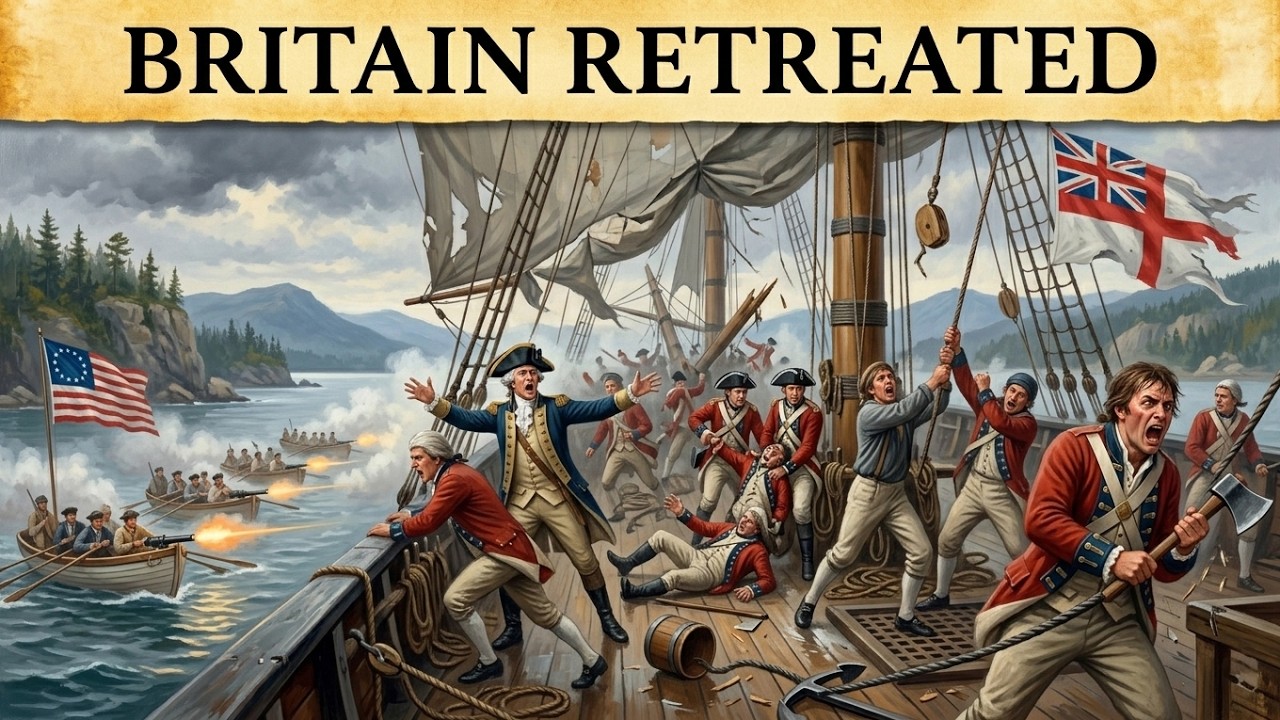
For the next five or six hours, the two fleets exchanged fire at close range within that narrow waterway. The British gunboats advanced in waves, pouring fire into the American crescent formation. Arnold personally directed the guns of Congress, moving among the cannons on the smoke-filled deck, aiming fire and issuing orders. It was brutal, continuous, deafening close-quarters naval combat, the kind where you could see the faces of the men shooting at you.
Cannon fire echoed off the cliffs on both shores and rolled across the water like thunder. Shot smashed through wooden hulls, sending clouds of splinters flying like shrapnel. Masts toppled. Rigging and spars collapsed.
Men were killed at their guns and replaced by whoever stood nearest. The British ship Carleton took a severe beating from concentrated American fire. Most of her crew were killed or wounded, and she nearly had to be abandoned before a boat crew managed to tow her out of the channel. A British gunboat exploded when a lucky American shot found its powder magazine.
At least two others sank. But the Americans were taking far worse. A twenty-four-pound shot struck the vessel Philadelphia below the waterline, and she sank within about an hour, settling to the bottom of Lake Champlain. By late afternoon, Inflexible had managed to close within range and delivered five devastating broadsides that tore apart what remained of the American line.
When darkness finally ended the fighting around five in the evening, the American fleet was shattered. Nearly every ship had multiple holes. Masts were down, rigging and spars torn. Around eighty men were killed or wounded, and the crews had consumed three-quarters of their ammunition.
The British placed their warships in a blockade line across the southern end of the channel, close enough to hear the Americans making desperate repairs in the dark. They also landed fighters on Valcour Island and the mainland shore to cut off any escape by land. Carleton was confident he had trapped Arnold. He would finish the job at first light.
But Arnold had one final move. Around seven o’clock that evening, he gathered his surviving commanders on the damaged deck of Congress and told them what they were going to do. They were going to break through the British blockade in the dark. Colonel Edward Wigglesworth would lead with the ship Trumbull.
Every vessel would hoist a single small lantern at its stern, shielded so it could only be seen from a distance of no more than fifty feet. Just enough light for the next ship to follow. Crews muffled the sound of their oars with greased cloth and slipped through the mile-wide gap between the southern end of the British line and the western shore, where Indian campfires burned on the sand. It was a moonless night.
A thick fog settled over the lake, so dense that the British ships could barely see their own anchor lights. The sound of British carpenters repairing the battered Carleton helped cover the muffled thud of the oars. The glow of Royal Savage, still burning at the island’s southern tip, drew British attention northward while the Americans crept south. One by one, the battered, leaking ships slipped south in a single line through the darkness, each vessel following the faint glow of the one ahead.
Arnold, aboard the crippled Congress, brought up the rear of the fleet. By dawn, the British discovered the channel was empty. By then, however, the Americans had lost their advantage. The retreating fleet hit contrary winds the next day, slowing progress to a crawl.
By October 13, several fast British warships caught up with Arnold’s rearguard near a coastal stretch called Split Rock. They rained cannon fire on Congress and the remaining American gunboats for nearly five hours. Arnold’s crew fought with everything they had, but their ammunition was almost gone and about half their number were dead or wounded. Arnold realized he would never reach Crown Point, still about ten miles to the south.
So he made his final decision of the battle. Rather than strike his colors and surrender to the British ships, he ordered the remaining vessels to run for Ferris Bay on the lake’s eastern shore, where the water was so shallow that Carleton’s larger warships could not follow. He drove Congress and four gunboats hard aground on the muddy shore and ordered the evacuation of every wounded man first, then set them all on fire. He made sure every vessel burned with its Continental flag still flying from the mast.
It was a deliberate act of defiance, telling Carleton that he might control the lake, but he would never have the honor of capturing a single American ship. As British boarding parties approached and long-range cannon shot smashed into the shallows around them, Arnold stood on the shore and watched his fleet burn to the waterline. Then he marched the survivors, some two hundred men, overland through the woods to Crown Point. When Arnold’s men staggered into Crown Point, exhausted and many still bleeding, they were surprised to find four American ships that had earlier slipped away from the British fleet and reached Fort Ticonderoga.
But Arnold knew control of the lake now rested entirely with the British. He ordered the remaining facilities at Crown Point burned and withdrew his surviving force to Ticonderoga. Carleton and his fleet reached the smoldering ruins of Crown Point on October 20. Snow was already falling over the Adirondack Mountains.
The fierce and unexpected resistance Arnold’s improvised fleet had put up clearly weighed on the British commander. He pushed reconnaissance parties south to within three miles of Ticonderoga, but he did not attack. The campaigning season was over. His supply lines stretched back to Canada through a wilderness soon to be buried under feet of snow, and the image of those amateur American sailors holding their guns for hours inside that channel gave him pause.
On November 2, Carleton ordered his entire force back to Canada to set up winter quarters and wait for spring. Arnold had lost the battle. He had lost his fleet. He had lost more than two hundred men killed, wounded, or captured.
But he had gained the one thing that mattered more than all of it: time. When the British returned south the following year, in 1777, everything had changed. Guy Carleton had been replaced as invasion commander by General John Burgoyne, a man more ambitious but far less cautious and far less familiar with the terrain. The Continental Army had spent the winter strengthening its positions, recruiting new troops, and stockpiling supplies.
When Burgoyne’s army finally pushed down the Lake Champlain corridor toward Albany, they met a force that was ready, and the result was the Battle of Saratoga, fought over several weeks in September and October of 1777. Arnold fought at Saratoga with the same ferocious energy he had shown at Valcour Island, riding into the thick of the fighting until another wound shattered his leg again. It was a decisive American victory, widely considered the turning point of the entire Revolutionary War. The victory convinced the French government that the Americans could actually win, and France formally entered the war on the American side.
That alliance changed everything. French troops, French warships, and French money ultimately tipped the balance toward independence. None of it would have happened without the Battle of Valcour Island. None of it would have happened without the months of delay Arnold bought by building a fleet from forest wood and raw iron, staffing it with soldiers who could barely tell a mast from a spar, and sailing it straight into the face of the Royal Navy.
A century after the battle, the naval historian Alfred Thayer Mahan looked at what Arnold had accomplished on Lake Champlain and offered perhaps the best summary ever written. He said: “The little American navy had been annihilated, but no force, great or small, had ever lived for a nobler purpose. ” And there is another part of this story that reaches across the centuries. Remember the ship Philadelphia, the fifty-four-foot gunboat hit by a twenty-four-pound cannonball that sank it on the afternoon of October 11, 1776.
It settled directly into the bed of Lake Champlain and remained there for 159 years. In 1935, a salvage engineer named Lorenzo Haglund, who had grown up hearing stories of the battle, located the wreck sixty feet below the surface. He raised the entire vessel intact, and when they examined the hull, the iron twenty-four-pound ball that sank it was still embedded in the timbers. For decades, Philadelphia was exhibited around the Champlain Valley, and for a time in the 1950s it sat in a dilapidated barn on Route 22 in Essex County, New York, where you could see it for fifty cents.
In 1964, it was donated to the Smithsonian Institution in Washington, where it remains today, currently undergoing restoration for the 250th anniversary of the United States. It is the oldest surviving American warship, a wooden fifty-four-foot boat built by soldiers who did not know how to build boats, crewed by men who did not know how to sail, and sent into battle against the greatest naval power the world had ever seen. Benedict Arnold went on to betray the country he had fought to create, and history never forgave him. But on that cold October morning on Lake Champlain, commanding a fleet built from the forest, he did something no amount of treason could erase.
He gave the Revolution the one thing it needed most: another year of survival. General Horatio Gates later said that Arnold’s conduct on Lake Champlain had retarded the enemy’s advance more than words could describe, and he was right.