Rose Kennedy kept index cards on her children. Weights, dental dates, diseases, vaccinations—each child had a card, updated in her own hand, filed like personnel records. She started the system when she had two babies and kept it running when she had nine. She was proud of it and described it publicly for the rest of her life.
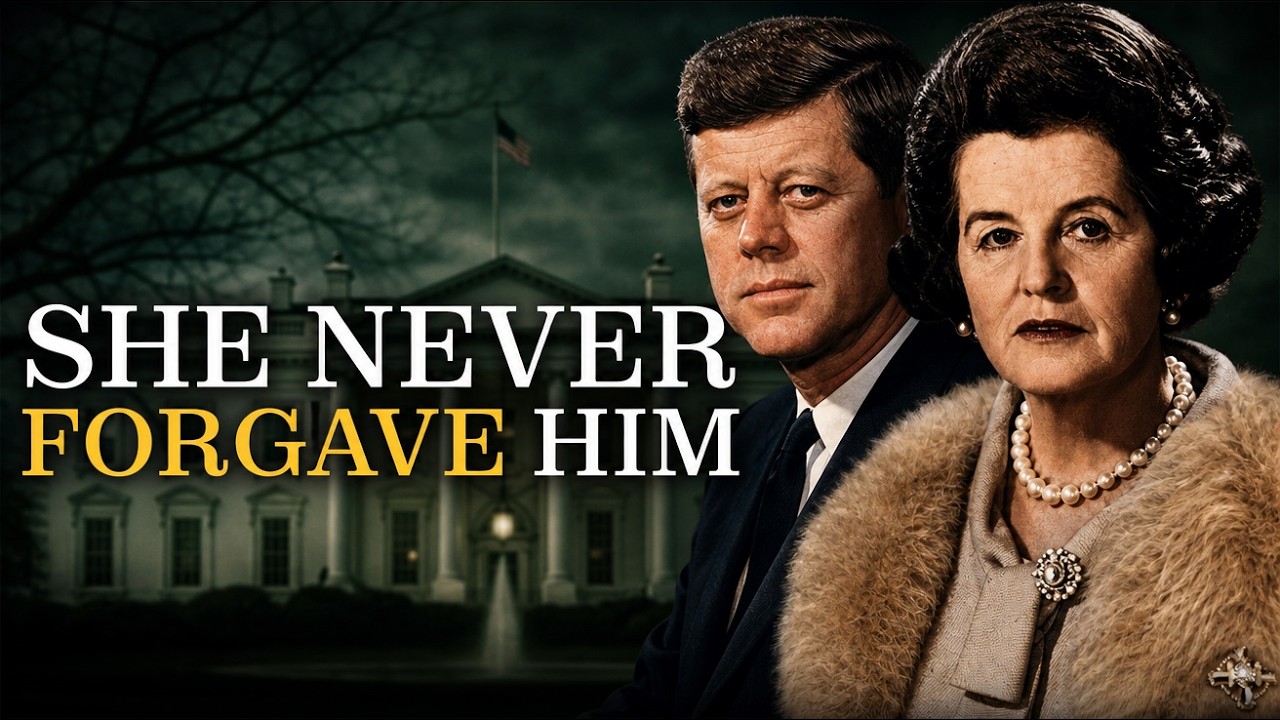
Reporters loved it. It sounded like competence, a woman running a household the way her husband ran money. But the cards recorded the illnesses. They did not record who sat in the room while the illness happened.
Her second son, Jack, spoke about his mother in short, flat sentences that landed badly. One of the most famous versions comes from a 1992 biography where a friend recalls Jack saying she never held him. That recollection must be treated carefully—it is a single account delivered decades later from a book the family loathed and fought. But it is not the only piece.
In the summer of 1961, Jack complained that his mother had gone off on another trip and that he had been raised by nurses. Rose herself printed in her own memoir the story of her small son telling her she was a great mother to go away and leave her children. She thought it was funny. That was the woman—not a monster, but a person who could hear a wound and file it as an anecdote.
To understand how she got there, one must go back to a decision made for her when she was sixteen. Rose Elizabeth Fitzgerald was the eldest child of John Francis Fitzgerald, called Honey Fitz, the singing, handshaking, relentlessly public mayor of Boston. Her mother, Josie, hated public life and stayed home, so Rose became the substitute. She was on the platform, on the ship to Europe, presented at the White House to William Howard Taft at seventeen.
She was smart, finished Dorchester High School at fifteen, and wanted Wellesley. She was admitted. She never went. Her father sent her instead to the Convent of the Sacred Heart, then to a Sacred Heart convent school in Holland near the German border, where the day was divided into prayer and silence and girls were graded on conduct as much as Latin.
The standard account is that Boston’s Archbishop William O’Connell let it be known that a Catholic mayor’s daughter at a Protestant women’s college would be a political embarrassment. Rose was told the decision was for her own good. She agreed publicly for eighty-five years. Privately, near the end of her life, she called it the greatest regret she had.
Then came 1913 and the second lesson. Her father was running for re-election when a rival, James Michael Curley, began circulating word about a cigarette girl at a roadhouse north of the city. Curley announced a lecture series, and one of the advertised titles concerned great lovers in history. Everyone in Boston understood the joke.
Fitzgerald withdrew from the race and blamed his health. Watch what the women did. Josie Fitzgerald said nothing and appeared nowhere. Rose said nothing and appeared everywhere, smiling, on her father’s arm through the whole humiliating collapse.
The word Rose used decades later when biographers asked about scandal was that these things happen and one does not discuss them. She was twenty-three and had just watched the technique work. She had also by then been in love with Joseph Patrick Kennedy for about seven years, mostly in secret because her father could not stand him. They had met as children at Old Orchard Beach in Maine.
Joe’s father, P. J. Kennedy, was a saloon keeper turned ward boss and state senator, a rival of Honey Fitz in the endless Boston Irish game of who owed whom. Fitzgerald’s objection was not that Joe was poor—Joe was Harvard, 1912, and already visibly on his way.
The objection was that no one was good enough. So Rose learned to lie. She and Joe arranged meetings at other people’s houses and at dances her father did not attend. Their courtship was effectively a conspiracy against her father, which tells you something about what Joe represented to her: not just a husband, an exit.
In January 1914, at twenty-five, Joe engineered his way into the presidency of the Columbia Trust Company and told newspapers he was the youngest bank president in America. He proposed with a title in hand. The warning signs were not hidden. Joe Kennedy at twenty-six was already ambitious in a way that read as hungry, and by the accounts of people who knew both families, not remotely inclined to fidelity.
Rose had spent her entire adolescence learning that public men behave this way and that wives absorbed it. They were married on October 7, 1914. The mayor’s daughter, the most photographed young woman in Catholic Boston, was married in Cardinal O’Connell’s private chapel in his residence before about seventy-five people at nine in the morning. There was a breakfast at her father’s house.
There was no cathedral, no crowd, no procession. That was not modesty. Honey Fitz was fourteen months past the Toodles collapse and politically radioactive. His disgrace shrank her day.
The same man who had taken Wellesley away because of what people might say now took the wedding away for the same reason. Again, she smiled through it. They honeymooned at the Greenbrier in West Virginia, where Joe played golf, and came home to a modest gray house on Beal Street in Brookline, bought with a loan. She was pregnant within weeks.
Joe Jr. arrived in July 1915. John Fitzgerald Kennedy, named for her father, arrived in May 1917. Rosemary in 1918, Kathleen in 1920.
Four children in under five years in a house with one bathroom, while her husband built an empire and was increasingly absent. There is no mystery about Rose’s position in those years. She had no money of her own, no career, a religion that regarded marriage as permanent, and a father whose entire political identity depended on the appearance of a happy Catholic family. Then, in the third week of February 1920, both things happened at once.
Rose gave birth to Kathleen, and two-and-a-half-year-old Jack came down with scarlet fever, which in 1920 killed children routinely. Boston hospitals were quarantining aggressively. Joe had to pull strings through his father-in-law to get his son a bed at Boston City Hospital. Joe went every day for weeks.
His later letters to the physician survive and are among the most emotionally naked things he ever put on paper. He made a private vow that if the boy lived he would give half his fortune to charity. Rose was not there. She had a newborn and had just come through a confinement, and in 1920 that was a legitimate reason.
But this is where the pattern begins. Jack survived and was sent to a sanatorium in Maine to convalesce, and the arrangement that formed around that illness never really dissolved. His father became the parent who showed up for emergencies. His mother became the parent who wrote down what the emergencies were.
A few months later, Rose Kennedy walked out of her own house. The date she gave for it changed depending on when she was asked. What stays constant is the shape. She packed and took herself to her father’s house in Dorchester, staying about three weeks.
She had four small children under five. Her husband was traveling, making money, and doing whatever else he was doing. She told an interviewer decades later that she had begun to feel she was nothing but a bystander in her own life. Honey Fitz came to talk to her.
He told her the Fitzgeralds did not do this. He told her she had made her commitment before God and the children needed her, and that she should go home and build the best life she could inside it. She went home, but first she went on a religious retreat—several days of silence at a convent. She came back with what she described as a decision, rather than a feeling.
That is the hinge of this entire story, and it happens before Jack is four years old. Rose Kennedy considered leaving, was told that leaving was not available, and responded by converting her marriage into a job. Not a metaphor. A job with a system, a filing method, a schedule, and measurable outputs.
She said openly for the rest of her life that she had decided motherhood would be a profession and that she intended to be as expert at it as any man in a bank. The index cards expanded into a full record. Children’s weights were tracked. Clippings were pinned up so the children could discuss current events at meals.
Dinner was at a fixed hour, and the younger children ate at a separate sitting from the older ones. Latecomers were not fed. At the table, Rose asked questions and expected answers. Church attendance was not optional.
She typed round robin letters, had them mimeographed, and mailed identical copies to all the children. Jack found this hilarious and wrote back mocking the format, suggesting her circulars would be improved by advertising. He was a teenager making fun of his mother’s newsletter, which is normal, except that the newsletter was the primary channel through which his mother communicated with him. Here is what the system produced, and it is worth saying plainly because it complicates the easy version.
It worked. Those children were competitive, verbal, informed, physically fearless, and unusually good in public. Rose built that. The reflex the country later admired in all of them—the ability to be interesting at a dinner table, to hold a room, to know the news—came out of her drills, not his money.
What the system did not produce was anyone sitting with a sick child, and the sick child was Jack. Whooping cough, measles, chicken pox, scarlet fever, then a decade of undiagnosed abdominal illness. Rose recorded it. She wrote about him almost clinically in her memoir, a boy who was always getting sick.
The household kept growing, and Joe kept getting further away. In 1926 he moved the family to Riverdale, New York, then in 1929 to a mansion in Bronxville. He rented a house at Hyannis Port in 1926 and bought it in 1928. He was in Hollywood by then, running film companies, gone for months.
He was also conducting the most public affair of his life. Gloria Swanson was the biggest female star in American movies when Joe Kennedy took over her finances and her production company in 1927. He brought Swanson to Palm Beach and Hyannis Port. He introduced her to his wife.
In 1929, all three crossed the Atlantic on the same ship. Swanson wrote that she could never work out whether Rose was a fool or a saint. She was neither. After the affair, Rose started to travel.
Her own diaries record something like seventeen trips abroad during the 1930s, several of them six weeks or longer, all of them without her children. She shopped in Paris. Joe paid and never objected. She stopped expecting a conventional marriage and started billing him for the difference.
He got a wife who would never leave, never complain publicly, and never, in eighty years of interviews, confirm a single thing about another woman. In 1938, Rose Fitzgerald Kennedy arrived in London as the wife of the American ambassador. She had spent twenty-four years being a professional, and now the profession had an embassy attached. She kept meticulous diaries of the dinners and the dresses.
She was magnificently happy. But hold that against what was happening to the child standing near the middle of the family photographs. Rosemary Kennedy, born in 1918, had been slow from the beginning. By 1940 and 1941, in her early twenties, she was increasingly difficult to contain, going out at night in ways that terrified her father.
In November 1941, Joseph Kennedy authorized a prefrontal lobotomy performed in Washington. It failed catastrophically. Rosemary was left permanently unable to speak clearly or care for herself, and she was moved eventually to an institution in Jefferson, Wisconsin. Rose’s account, given late, is that her husband arranged the entire thing without telling her and that she learned what had been done afterward.
Then she did not visit her daughter for roughly twenty years. Nobody physically prevented her from getting on a train to Wisconsin. She traveled constantly. She went to Paris.
She did not go to Jefferson. The visits began after Joe’s stroke in 1961, when he could no longer control the family’s information. Two and a half years after Rosemary was taken away, the same collision came again, and this time Rose moved first. Kathleen Kennedy, Kick, fell in love with William Cavendish, Marquess of Hartington, heir to the Duke of Devonshire.
The Devonshires were hereditary standard-bearers of English Protestantism, and no compromise on the children’s religion was possible. Kick married him in a civil ceremony in May 1944. No priest, no church, no Kennedy present except her brother Joe Jr. Rose was in a Boston hospital at the time, the family said stomach trouble.
From the hospital she cabled her daughter to stop. She had the Archbishop’s office contacted. The marriage lasted five weeks before Hartington returned to the front and was killed in Belgium in September 1944, a month after Joe Jr. died flying a volunteer mission over England.
Rose’s response to her widowed daughter’s grief included the thought that God had intervened. Kick stayed in England. By 1947 she was involved with an English earl, married, Protestant, and preparing to divorce. Rose’s position was total: if Kick married him, she would be cut off from the family and the money.
In May 1948, Kick and Fitzwilliam died in a plane crash in France. Joseph Kennedy was the only member of her family at the funeral. Rose did not attend. She lost three children in seven years and did not bend once on the terms.
Then the machine she had built for the family had one remaining use. In 1946, Jack Kennedy, twenty-nine, sick, thin, awkward on a stage, ran for Congress in Massachusetts. The campaign invented the reception: engraved invitations, white gloves, tea and cakes in a hotel ballroom, and the candidate’s mother receiving. In 1952, against Henry Cabot Lodge Jr.
, the Kennedys held something like thirty-three of these teas. Lodge’s people watched women wait ninety minutes to shake Rose Kennedy’s hand and understood they had no answer to it. She spoke French and Italian in the immigrant wards. She was the most effective retail politician in the family after her father, and she was in her sixties.
She was also, in those speeches, writing the first draft of the version we all inherited. The devoted mother, the nine children, the cards. By 1960, it was simply what Americans knew about Rose Kennedy. Then November 1963, and the machine met the thing it was built for.
She was at Hyannis Port. She went outside and walked. Her husband upstairs, disabled by stroke, was not told that day; the family held it from him until Ted could be there. Five years later, Bobby was killed, and she came out of the funeral and told reporters she was going to keep going.
That is the woman the country decided it loved. Not the mother of a president, the survivor. In 1974, at eighty-four, she published Times to Remember. It is a warm, detailed, extremely readable book, and it is also a legal document.
She gives you the cards, the letters, the retreat, the faith. She gives you Rosemary as a slow child helped by a family that loved her, the operation handled in a few careful sentences. She gives you Kick with the marriage sorrow softened. She gives you Joe as a devoted father, and the other women are simply not there.
The book was a best-seller. She also controlled the physical evidence. The family granted Doris Kearns Goodwin extraordinary access to the papers for The Fitzgeralds and the Kennedys, still the standard account of Rose’s early life. Writers who worked without permission got a different experience.
She died on January 22, 1995, at 104. Every obituary carried the same phrases: the rosary, the nine children, the mother who raised a president. Go back to the cards. For seventy years, they were offered as proof of devotion, and Rose offered them herself, over and over, because she understood what a small concrete detail does to a reporter.
A woman who writes down her son’s illnesses must love him. That was the reading, and she never corrected it. Look at them now. They are not a mother’s keepsake.
They are the first entry in an archive. She did not hate her son. She outsourced him, ranked him below the church and the name and her own hard-won peace. And then, when he was gone and could not answer, she wrote the account of it that the country believed.
Jack Kennedy has a library with his name on it. His mother chose what went in the boxes.