Anthony Armstrong-Jones seemed destined for a life far removed from the royal circle. His family was respectable and upper class—his father was a barrister, and his mother’s second marriage to Lawrence Parsons, the Earl of Rosse, lifted them firmly into the nobility. Educated at Eton and later Cambridge, he studied architecture until failing his second-year exams, a setback that redirected his future. Turning to photography, he found his calling, and his connections served him well.
By the 1950s, he was a success, photographing fashion models and stage stars, and his studio on Pimlico Road became known for raucous parties. Rumors also began to circulate about affairs with both women and men. His ambition soon turned toward the royal family. Queen Elizabeth II commissioned him to take photographs of her family, and his relaxed style, though controversial in some quarters, pleased the Queen.
The handsome, charming photographer was welcomed into royal circles, and he learned to keep his private life carefully guarded. He allowed gossip columnists to speculate about his on-and-off relationship with showgirl Jacqueline Chan, but that was merely cover for a far more consequential romance: with Princess Margaret, the Queen’s sister. What had begun as friendship blossomed into something more. Margaret, who delighted in disguising herself to visit him, was drawn to his world.
The royal family, still smarting from the intense scrutiny that had ended Margaret’s earlier relationship with Peter Townsend, insisted on a major condition: Anthony would have to give up his career if he wished to marry her. He agreed, quietly extricating himself from his professional commitments before the press even suspected a romance. The engagement was announced in 1960. His father, characteristically cold, doubted his son was suited for such a role, comparing his future home at Buckingham Palace to being confined to barracks.
The wedding took place on May 6, 1960, in a lavish ceremony that marked a historic first—televised coverage of a royal wedding, watched by twenty million people. The honeymoon was a six-week trip to the Caribbean, a period that would later prove to have grave consequences. But for the moment, the couple appeared happy. The marriage soon faced pressure from all sides.
Conservative segments of the British press disapproved of a princess marrying a commoner. Servants treated Anthony rudely, and Prince Philip, who had always been cold toward him, now showed pronounced distaste. Anthony, artistic and sensitive, clashed with the rugged outdoorsman Philip. Having surrendered his career, Anthony felt the strain of royal life acutely.
Princess Margaret gave birth to a son in November 1961, and Anthony accepted the title Earl of Snowdon. Both spouses plunged into the social whirl of swinging London in the early 1960s. Anthony circulated among the influential figures at Vogue, while Margaret befriended celebrities like the Beatles and Peter Sellers. In 1964, their daughter Sarah was born.
On the surface, they were the perfect family. By 1965, however, the pressure had worn Anthony down. He planned a trip abroad with a publishing friend, though the palace claimed Margaret could not join him because she was needed at home in the Queen’s absence. In reality, Anthony had been spending considerable time with Pamela Colin, a married Vogue editor.
Margaret responded in kind, beginning an affair with her daughter’s godfather, Anthony Barton, and then with actor Peter Sellers. Rumors linked her to Mick Jagger, Warren Beatty, and Leslie Hutchinson. She also had a brief affair with Robin Douglas-Holm, nephew of a former prime minister; eighteen months after the affair ended, Douglas-Holm took his own life at thirty-six. Years of mutual infidelity followed.
The royal family, acutely aware of the problems, hoped the couple would lead separate lives quietly and avoid the embarrassment of divorce. Margaret bore the strain less well than her husband. She drank heavily and behaved rudely in public, drawing criticism from anti-monarchists. Anthony, for his part, seemed largely unbothered.
As the 1960s drew to a close, the constant cheating had become simply another burden. During their honeymoon, a friend had given the couple six acres on the Caribbean island of Mustique. Margaret had long used the island as a refuge during the rocky periods of her marriage. It was there that she began an affair with Rody Llewellyn, the easygoing son of a famous British equestrian, who was twenty-five when they met; she was forty-three.
It seemed like just another indiscretion, but it proved to be the one that destroyed the marriage. Press magnate Rupert Murdoch sent a journalist to Mustique, posing as a vacationing family man. He captured photographs of Margaret and Llewellyn together. Their publication was the final blow.
The royal family could no longer pretend their marriage was viable. Anthony, however, was tired of waiting. While the family procrastinated, he had been working increasingly as a documentary filmmaker, closely involved with a production assistant named Lucy Lindsay-Hogg. Their professional relationship had long since turned romantic.
Without the consent or even the knowledge of Margaret or the royal family, Anthony announced their separation himself. The couple divorced in 1978. Five months later, he married Lucy. Margaret was taken by surprise.
The new marriage did not bring lasting peace. Somewhere between his separation and divorce, Anthony had begun an affair with Anne Hills, a married journalist. Because his marriage to Lucy was ostensibly going well, he kept the affair secret rather than flaunting it as he had with Margaret. The affair lasted twenty years.
Anne wanted more from him, but never received it. Deeply depressed, after losing her column at the Guardian and spending yet another Christmas without him, she took her own life in late 1996. She left a note telling Anthony she had always loved him and asking that a family heirloom he had given her be returned to him. Her diaries, containing the full details of two decades with Anthony, were discovered and soon splashed across the newspapers.
That was how Lucy learned her husband had been unfaithful for the entire duration of their marriage. Two years later, Lucy uncovered another bombshell. Anthony had fathered a child with Melanie Cable-Alexander, a magazine editor nearly thirty years his junior. He parted ways with Melanie, and Lucy filed for divorce.
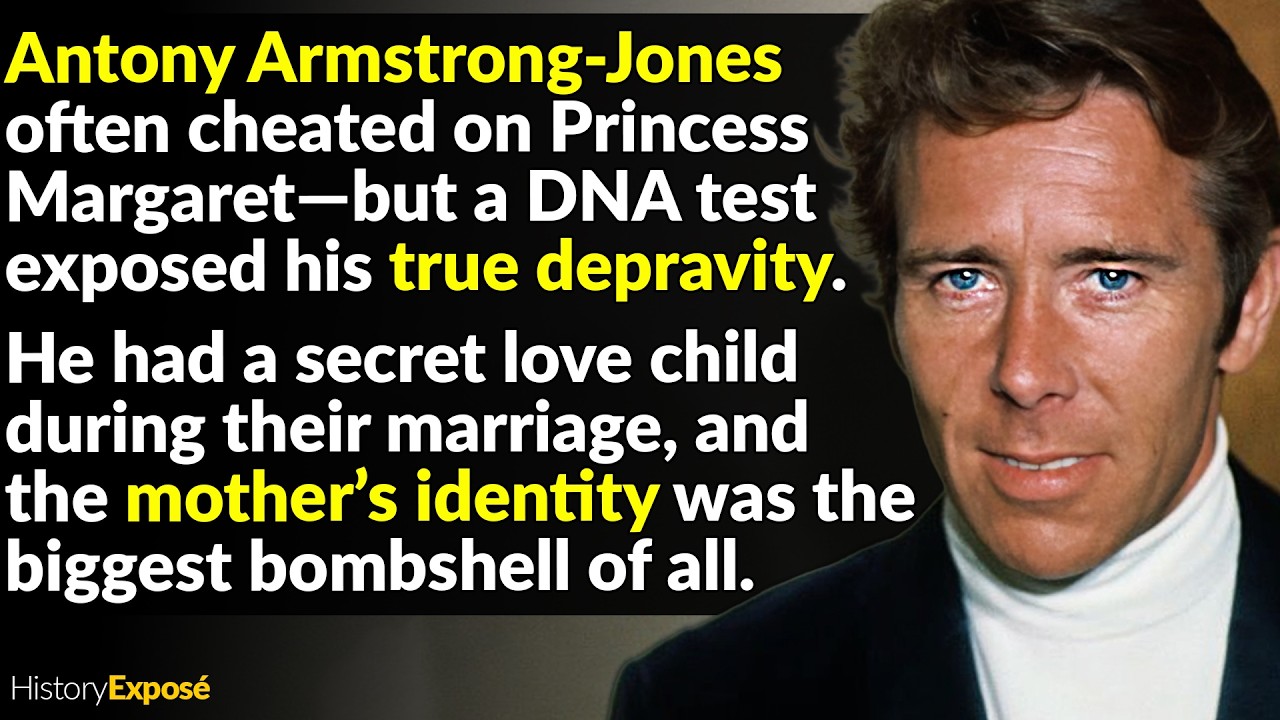
Remarkably, Anthony and Lucy remained friends afterward, and she cared for him in his final years. It was in those final years that his most scandalous secret finally came to light. In 2004, DNA testing proved that he had an illegitimate daughter born just weeks into his marriage to Princess Margaret. The daughter, a British woman named Polly Higgson, had grown up believing her father was Jeremy Fry, a member of the family behind Fry’s Chocolate.
Jeremy had been Anthony’s best friend and had nearly served as best man at his wedding to Margaret. Anthony had not only cheated on his bride during his honeymoon; he had done so with his best friend’s wife, Camilla Fry. Both men initially denied the story.
After Jeremy Fry’s death, Anthony finally admitted it was true.