On the evening of September 8, 1761, a seventeen-year-old German princess arrived in London, met her future husband for the first time, and married him within hours. Her name was Sophia Charlotte of Mecklenburg-Strelitz, and her new husband was King George III of Britain, who had taken the throne the previous year. The ceremony took place at St James’s Palace, and the bride, who spoke no English, was suddenly the queen consort of a kingdom she had never seen before. Charlotte was born on May 19, 1744, at the palace of Mirow in the duchy of Mecklenburg-Strelitz in northern Germany.
She was the second daughter of Duke Charles Louis Frederick and his wife, Elizabeth Albertina. Her education followed the standard pattern for aristocratic women of the era: she was schooled at home, with a tutor named Mademoiselle Grabow, a noted poet, who gave Charlotte a love of reading. Charlotte became widely read in theology and in the major works of the Enlightenment, and she spoke her native German as well as fluent French, which served as the international language of European courts in the eighteenth century. Her marriage to George III was part of the Hanoverian dynasty’s preference for German brides.
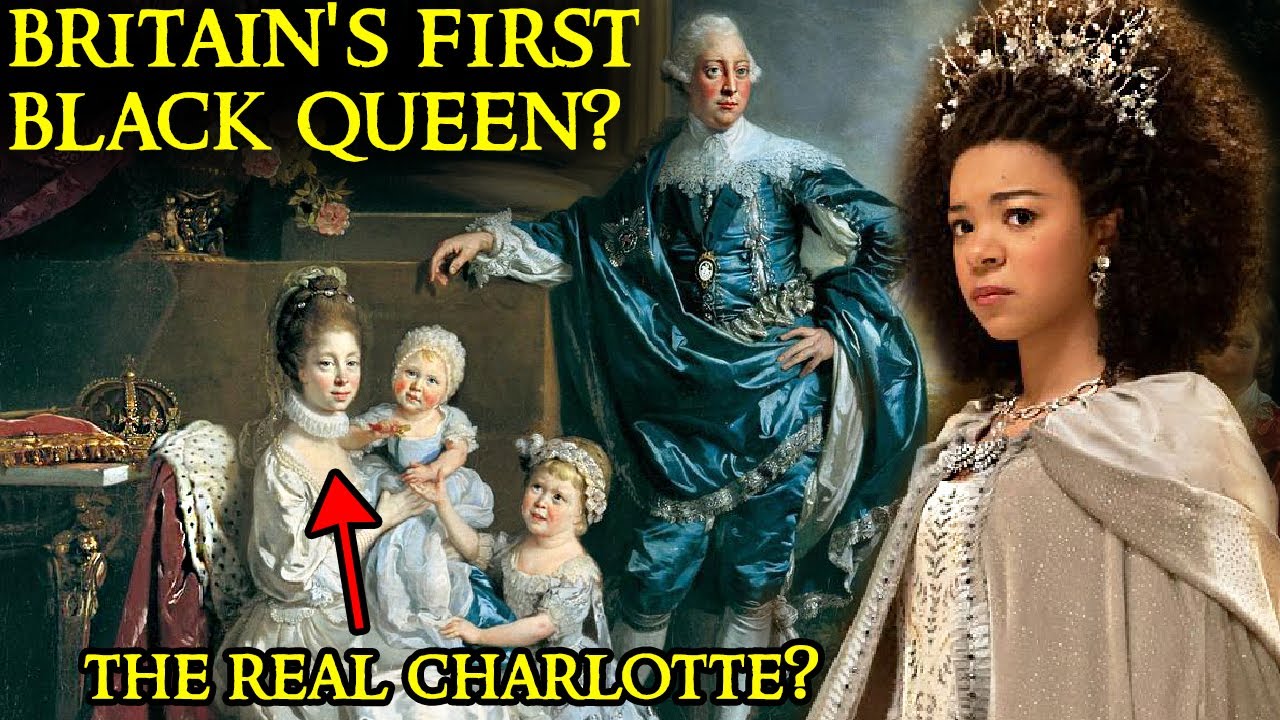
The marriage forged an alliance between two minor German houses, but unexpectedly, it produced a genuine partnership. Charlotte and George developed a lasting affection for one another, bound together by their large family and shared interests in the arts, theater, music, and the scientific breakthroughs that were reshaping European life. As Charlotte learned English and adapted to her role, she became George’s steady companion through many difficulties. Much modern attention has focused on Charlotte’s ancestry, particularly after her depiction in the Netflix series Bridgerton as Britain’s first Black queen.
There is some distant basis for talk of African ancestry. Charlotte was related, along a line of centuries, to Margarida de Sousa, the illegitimate daughter of Alfonso III, King of Portugal in the thirteenth century. Margarida’s mother was Alfonso’s Moorish mistress, and she was Black. Charlotte therefore possessed a faint thread of African Islamic ancestry, diluted over roughly five hundred years.
Historians generally consider it a stretch to claim she was Britain’s first Black queen. The idea has been compounded by portraits from her reign. Many paintings depict Charlotte with sallow skin and facial features that have been interpreted as reflecting her distant Moorish heritage. But there may have been a political dimension to some of these portraits.
During Charlotte’s reign, the issue of slavery became increasingly central to British politics. While George III began as a traditionalist on slavery, by the 1780s and 1790s he grew more sympathetic to the abolitionist movement. Several portraitists who painted Charlotte in ways that emphasized what could be called African features had abolitionist connections themselves. One was Sir Allan Ramsay, whose niece-in-law was Dido Elizabeth Lindsay, the adopted Black niece of Lord Mansfield, a prominent British nobleman.
The portraits produced in this period were therefore not politically neutral, and their representation of Charlotte’s skin tone and features may not have been accurate to her actual appearance. What is beyond debate is that Charlotte’s marriage, though loving, grew harder over time. The cause was not a falling-out but George III’s deteriorating psychological state. Beginning in the 1780s, the king suffered periods of mania during which he talked energetically to anyone present for hours on end, punctuated by crashes into lethargy and emotional collapse.
The exact cause remains unclear, but historians generally believe he suffered from porphyria, a liver ailment that causes toxins to build up in the blood, poisoning the brain over time without killing the patient. The king’s malady became a state crisis in October 1788, when he descended into a period of psychological collapse that took months to overcome. The government began preparations for a regency, under which George and Charlotte’s eldest son, George, Prince of Wales, would rule in his father’s place. Charlotte could see her son’s ambition, and she remained the king’s most stalwart supporter throughout his illness, encouraging the court to remain loyal even as the crisis dragged on.
Her devotion was rewarded when the king recovered in the late spring of 1789. But the episode left her relationship with her eldest son permanently damaged. The prince continued to wait, watching for another collapse. As queen consort, Charlotte became known for patronage of the arts and for charitable work.
The painters Thomas Gainsborough, Johann Zoffany, and Mary Moser all received royal patronage. Queen Charlotte employed Moser to teach her daughters drawing. Several English women writers began their careers with the queen’s financial backing at a time when women faced enormous obstacles in the literary world. Charlotte played the harpsichord with skill.
Johann Christian Bach, son of the more famous Johann Sebastian Bach, served as her music master in London from 1764 until his death in 1782, giving her singing lessons and earning the nickname “the London Bach. ” Wolfgang Amadeus Mozart, the era’s greatest composer, acknowledged her appreciation of music by dedicating six sonatas to her. Charlotte also gave substantial amounts to charity. She became patron of the Magdalen Hospital in London, a sanctuary for former prostitutes founded in 1758, and contributed thousands of pounds toward the construction of new buildings there in 1769.
She also supported St Catherine’s Hospital, which provided alms to widows. Charlotte bore fifteen children, thirteen of whom lived to adulthood. She appears to have suffered no miscarriages or stillbirths, a remarkable fortune for the time, when infant mortality remained very high. From 1762, when she became pregnant with her first child, until the mid-1780s, when she gave birth to her fifteenth, Princess Amelia, Charlotte was almost continuously pregnant or nursing.
Of the fifteen children, nine were boys and six were girls. Two sons, Prince Octavius and Prince Alfred, born in 1779 and 1780, died in childhood, apparently from smallpox within months of each other in 1782 and 1783. Charlotte and George were devastated, though their grief was eased by the birth of Amelia in August 1783. Amelia’s health began to decline in the late 1790s, in the first stages of tuberculosis.
She died in 1810, and her death appears to have pushed her father’s mind over the edge. Although George had recovered from his extended bout of madness in 1789, further episodes of mania and listlessness occurred in 1801 and 1804. Each time, governments prepared for the possibility that the prince would need to step in. In 1810, around the time of Amelia’s final illness, the king descended into another collapse from which he never returned.
Prince George became regent. In 1811, the king was moved to separate apartments at Windsor Castle, where physicians advised that he should be largely left alone. He spent his final nine years largely isolated, conversing with people long dead, including two of his deceased sons. By 1820, when he died, he was blind and completely incapacitated.
Charlie did not leave her husband out of indifference; no one at the time understood his condition, and the medical advice was that stimulation would only worsen his state. For the first months and years of his final illness, she tried to maintain continuity in government, hoping he might recover as he had in 1789. When it became clear he would not, she concentrated on supporting her eldest son in his role as regent. There was a further sorrow.
Despite twelve of Charlotte and George’s children surviving into adulthood, Charlotte had only one grandchild born during her lifetime: Princess Charlotte, the daughter of the Prince Regent, who had named her after her grandmother. Princess Charlotte’s own life was unhappy, marked by her parents’ bitter separation, and she died in childbirth in 1817. It was another blow to the aging queen, who carried lingering doubts over the continuation of the royal line. Charlotte died on November 17, 1818, at the age of seventy-four.
She was buried in St George’s Chapel at Windsor Castle on December 2, 1818, and her husband joined her there just over a year later. She remains the longest-serving female consort in British history, having held the role for fifty-seven years and seventy days.