On the evening of September 3, 1981, a twenty-year-old volunteer football coach pulled up to a small apartment on North Brunell Parkway in Lakeland, Florida. He was dropping off twelve-year-old Tim Slaton after practice, as he had done many times before. Tim’s mother, Linda, came outside to thank the coach, and he drove away. The next morning, Linda’s sister Judy arrived for their usual coffee visit.
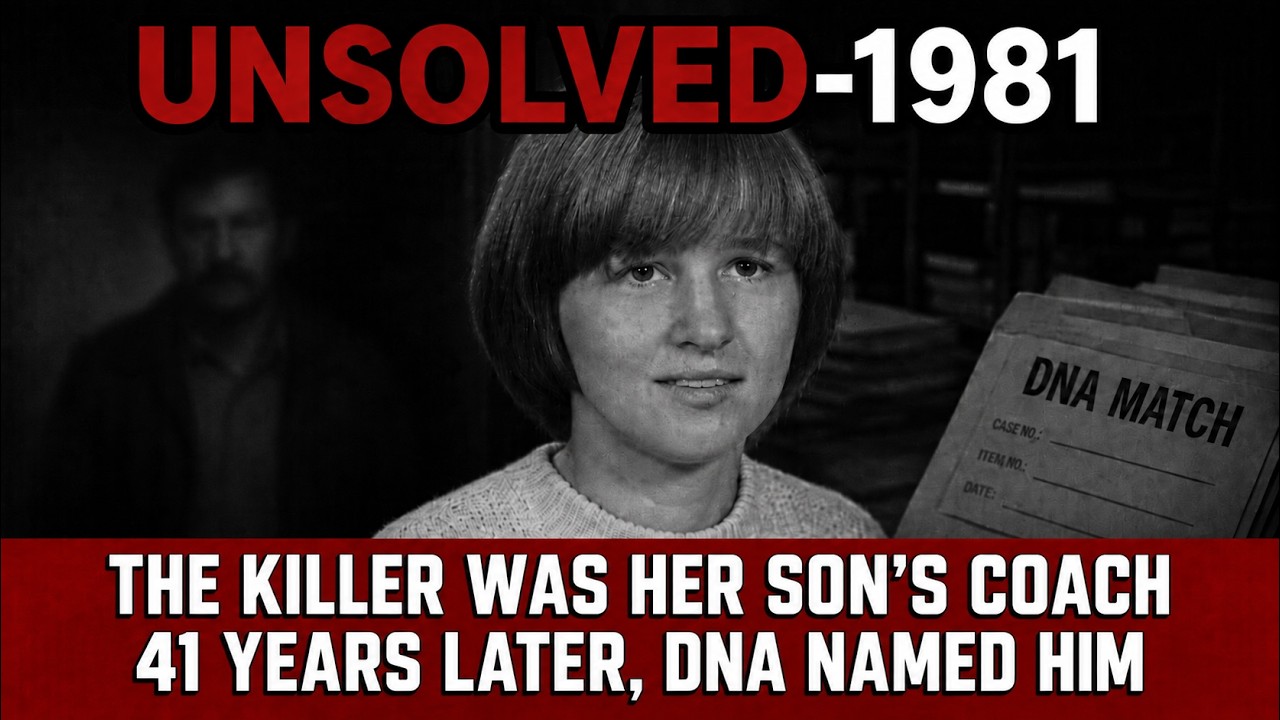
No one answered the door. She noticed the bedroom curtain was missing, peered through the glass, and began to scream. Linda Slaton, a thirty-one-year-old mother of two, had been strangled with a wire hanger from her own closet. Her sons were asleep in the apartment at the time.
Neither of them woke up. Police questioned the football coach within days. He told them he had never been inside that apartment. They believed him and moved on.
They did not take his fingerprints. They did not test his DNA. The case went cold for thirty-eight years, while the coach, Joe, stayed in the same city, raised a family, and grew old in the same community where he had killed a woman whose son trusted him completely. What investigators did not know was that a crime scene technician named Sergeant Edgar Pickett, a year from retirement, had lifted a partial palm print from the windowsill of that bedroom and had sealed and preserved a rape kit.
Those two pieces of evidence would wait four decades for a science that did not yet exist. Linda Patterson Slaton was trying to start over in a place where no one knew her name. She was thirty-one, with two sons. Jeff was fifteen.
Tim was twelve. She had spent nine years married to Frank Slaton, a violent alcoholic. Jeff remembered standing between his parents as a small child while his father choked his mother and held a gun to her head. Linda had finally filed for divorce and, sometime in mid-1981, packed what little she had and moved her boys to Lakeland.
There was no savings, no car, no support system. They moved into subsidized housing on North Brunell Parkway and depended on welfare and food stamps. Linda sewed her own clothes to save money. She could not afford a car, which is why the offer from a volunteer football coach named Joe Mills to drive Tim to practice was such a relief.
On the morning of September 4, Judy Butler arrived at the apartment for coffee. No one answered the door. She noticed the bedroom curtain was missing and looked through the glass. Linda lay across her bed, partially clothed, a wire hanger twisted around her neck.
The killer had entered through an unlocked bedroom window. There were no clear signs of a struggle, meaning Linda had likely been taken by surprise. Fifteen-year-old Jeff slept in the living room. Twelve-year-old Tim was in the second bedroom.
Neither heard anything. But when police woke Tim and walked him through the apartment, the bedroom door swung open, and he saw everything. He was twelve years old. He later said the scene still appears before his eyes whenever he closes them.
That scene was where Sergeant Edgar Pickett went to work. Pickett was fifty-three, a Black fingerprint specialist with the Lakeland Police Department, one year from retirement. Another detective on the scene told him there was no place for a Black man at the scene of a white woman’s murder. Pickett ignored him.
He dusted everything in that bedroom—the dresser, the windowsill, the frame, even the floor. From the bedroom windowsill, the exact point where the killer entered and exited, he lifted a partial palm print. It sat in evidence storage for thirty-eight years. That print would become the most important physical evidence in the entire case.
The autopsy confirmed the scene. Linda Slaton had been sexually assaulted and strangled. A rape kit was collected and preserved, but DNA profiling did not exist in 1981. The technology would not emerge for several more years.
Detectives worked the case with old methods. They interviewed suspects. Frank Slaton, the violent ex-husband, had an alibi in Alabama. A boyfriend was cleared.
Neighbors were questioned. Then the investigation turned toward Jeff. The fifteen-year-old boy sleeping in the apartment became a suspect in his own mother’s murder. Police pulled him out of school and interrogated him repeatedly.
One detective told the grieving teenager that his hands were strong enough to have strangled his mother. Jeff passed polygraph tests. They proposed hypnosis. Only when his grandparents intervened did the questioning stop.
Joseph Clinton Mills was interviewed within days of the murder. He told police he had dropped Tim off around 8:30 on September 3, that Linda came outside to thank him, and that he never got out of the car, never went inside, and never returned. The detective accepted his story. Mills was never formally questioned.
His fingerprints were never taken. Neither were his DNA samples. Meanwhile, Black men in the area were brought in, fingerprinted, and their prints compared against the palm print from the windowsill. None matched.
But the white volunteer football coach, the last person to see Linda alive besides her children, was never checked. The investigation stalled. Mills continued his life. He coached Tim.
He drove the boy to practice. He brought Tim to his grandparents’ house after Linda’s death. About a month after the murder, the youth football team took a team photo. Tim stood in the front row in his jersey, twelve years old, still reeling from his mother’s death.
Directly behind him stood Coach Joe—Joseph Clinton Mills. That photo hung on Tim’s bedroom wall for decades. He looked at it thousands of times without knowing he was looking at his mother’s killer. Mills also used his relationship with the boy to monitor the investigation, casually asking Tim whether there was any news about the case, whether police had shared anything new.
The child was his eyes inside the investigation. Mills went on to live a completely ordinary life. He married, had children and grandchildren. He ran a cleaning business.
He drove trucks. He lived in Kathleen, about thirty minutes from the apartment where he killed Linda Slaton. He was never arrested for a violent crime. His only arrest record before 2019 was a 1984 grand larceny charge involving forged wills, for which he never served time.
But that 1984 arrest meant the police took his palm prints, and those prints would eventually be his undoing. For thirty-eight years, Joseph Clinton Mills lived free. He built a family. He went to work.
He came home. He celebrated birthdays and anniversaries. He watched his children graduate. He never left the Lakeland area.
He never ran. The case never completely closed. Two dozen detectives worked it over the decades. In 1999, Detective Brad Grice took it on.
He traveled to Louisiana and North Carolina on old leads. He collected elimination DNA samples from dozens of people. He even convinced Frank Slaton, who had long since quit drinking, to provide a sample. The DNA cleared him.
Grice pursued a convicted offender named Jimmy Wall whose crimes matched the pattern, even collecting DNA from Wall’s mother after Wall died in prison. No match. Another dead end. Grice promised Jeff and Tim that he would not retire until the case was solved.
In 2015, he retired without solving it. Jeff later named his own son Brad, after the detective who had tried for over fifteen years. In 2016, the case passed to Detectives Scott Karcher and Russ Harley. They reviewed the evidence.
By then, new technology had emerged. In April 2018, the Golden State Killer had been identified through investigative genetic genealogy, a method that uses public DNA databases to find relatives of an unknown suspect. The killer did not need to be in the database. His relatives did.
In December 2018, the Lakeland Police Department sent the Slaton DNA sample to Parabon NanoLabs, a Virginia-based forensic company. CeCe Moore, Parabon’s lead genetic genealogist, uploaded the profile to GEDMatch, a public database where people voluntarily share genetic data for genealogy research. She found three separate genetic networks converging on the same family. The only son in that family was Joseph Clinton Mills.
Moore identified the suspect in a single weekend. Detective Tammy Hathcock opened the original file and found a name that froze her blood: Joseph Clinton Mills. He had been questioned days after the murder. He was the football coach, the last person seen with Linda, the man who had slipped through the investigation from the beginning.
Investigators needed physical evidence to confirm. They had two paths. The first was the palm print. In 1984, Mills had been charged with grand larceny, and his palm prints were taken.
In August 2019, investigators compared the 1984 prints with the partial palm print Sergeant Edgar Pickett had lifted from Linda Slaton’s bedroom windowsill in 1981. They matched. The second path was trash. On July 29, 2019, police began surveillance on Mills’s home.
They collected garbage from his address, recovering cotton swabs, adhesive patches from colostomy bags, a plastic spoon, and used medical tape. On August 9, 2019, the Florida Department of Law Enforcement reported that DNA from the original rape kit matched DNA from the colostomy bag adhesive. Two independent confirmations, thirty-eight years apart, pointed to the same man. On December 12, 2019, thirty-eight years and three months after Linda Slaton’s murder, Joseph Clinton Mills was arrested at his home.
Detectives described him as calm and steady—not nervous, not confused, not angry. He stuck to his original story, insisting he had never been inside the apartment and never had a relationship with Linda. When confronted with the fingerprint and DNA evidence, his story changed. He claimed Linda had invited him in, that she had asked him to come through the bedroom window, that the encounter was consensual, and that the wire hanger around her neck had been her idea.
No one believed him. The physical evidence contradicted every element of his new account. The autopsy showed injuries inconsistent with any consensual encounter, and the scene showed a man who entered through a window, attacked a woman in her bed, and fled the way he came. A grand jury indicted Mills on six charges: first-degree murder, two counts of sexual battery, burglary with assault, and two counts of lying to investigators.
He was held without bail. On February 9, 2022, forty-one years after the murder, sixty-one-year-old Joseph Clinton Mills stood before a judge and pleaded guilty. He had chosen to avoid the possibility of the death penalty. He was sentenced to four consecutive life sentences without parole.
He offered no explanation, no apology. His only statement was that he was a good man, that he was not what they thought. In court, Jeff Slaton looked at Mills and asked why he had taken his mother. Mills said nothing.
Jeff told him he hated him and hoped he died in prison. Tim Slaton told Mills how much he hated him and that he hoped something terrible happened to him in prison. Their aunt Judy Butler asked the most basic question: how could he do it, did he have a soul, did he have any remorse. Mills answered no one.
He sat in his chair, silent and still, until the judge pronounced the sentence. The two brothers had lost their mother. They had lost their childhood. Jeff had slept with a switchblade under his pillow for years, haunted by the belief that he should have heard something, should have woken up, should have stopped it.
Tim had carried the image of his mother’s bedroom from the age of twelve, and had hung on his wall a photograph of his mother’s killer without ever knowing it. What finally solved the case was a chain of people who refused to let it die. Two dozen detectives kept the file active for four decades. Sergeant Edgar Pickett lifted a palm print in 1981, despite being told he had no place at that crime scene.
The crime lab at the Lakeland Police Department is now named after him. He died in April 2023, after seeing his work validated and after Jeff and Tim personally thanked him. CeCe Moore identified the killer in a weekend. And Jeff and Tim Slaton, who never gave up, who live a few miles from each other, who work on cars together, who visit their mother’s grave and keep her memory alive, finally have an answer.
Jeff lights a candle next to Linda’s photo every year on September 4. He has done it every single year for more than four decades. Linda Patterson Slaton was born March 8, 1950. She was a mother who gave everything she had.
She was a survivor who left a violent marriage to give her sons something better. Forty-one years after she was taken from those who loved her, she received something most cold case victims never get. Justice.