On the morning of December 9, 1775, roughly 120 British soldiers marched out of a wooden fort near a settlement called Great Bridge in Virginia, straight toward what would become one of the worst decisions of the entire American Revolution. Their target was a Patriot breastwork on the far side of a narrow bridge crossing the southern branch of the Elizabeth River. The orders came from Lord Dunmore, the royal governor of Virginia, a man who had run out of patience and options. The bridge could barely fit six men standing shoulder to shoulder.
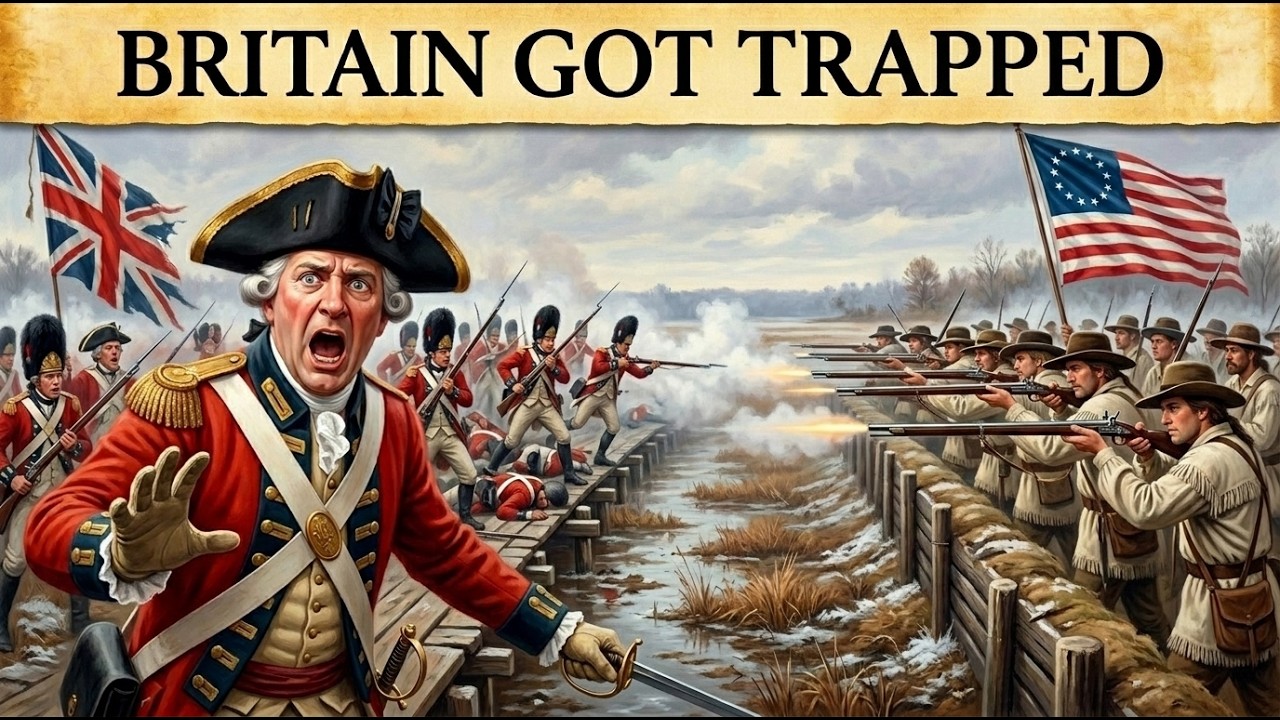
The causeway leading to it was flanked on both sides by swamp. On the other end, nearly 900 armed Virginians waited behind earthen walls with loaded muskets and fingers off the triggers. They had been ordered to hold their fire. It was all over within roughly half an hour, and by then, Britain had lost Virginia for good.
That bridge, and what happened on it, is one of the most overlooked moments of the American Revolution. Ask anyone to name the early battles, and you will hear Lexington and Concord, Bunker Hill, perhaps the Siege of Boston. Almost no one mentions the Battle of Great Bridge. That is strange, because the numbers are so lopsided they sound invented.
The British suffered between 60 and 100 casualties. The Americans? One man was wounded in the hand. That was it.
The entire Patriot casualty list in Virginia’s first major battle of the Revolution was a single finger. Colonel William Woodford, the Patriot commander, later wrote home calling it a minor Bunker Hill, except that his men held their ground and lost only one man. How did it go so badly for the British? And how did a governor who once controlled the largest and wealthiest colony in America end up stranded on a warship with nowhere to go?
The answer begins eight months earlier, in Williamsburg, on a night when most of the town was asleep. Virginia in the spring of 1775 was a colony on the edge. It was the largest, most populous, and richest of the thirteen colonies. Tobacco plantations stretched along the James and York Rivers.
The planter class ran the politics, and their relationship with the British Crown was unraveling. In Massachusetts, the confrontation between British soldiers and colonial militia had already turned violent at Lexington and Concord in April. News traveled slowly in those days, but Virginians did not need Boston to tell them something was wrong. They had their own problem, and it had a name.
Their royal governor, John Murray, the Fourth Earl of Dunmore, had been in conflict with Virginia’s House of Burgesses for months. He dissolved the assembly to stop their protests. They met anyway, secretly, at the Raleigh Tavern in Williamsburg. When the Second Virginia Convention met at St.
John’s Church in Richmond in March of that year, Patrick Henry stood and delivered the most famous line in American political history: Give me liberty, or give me death. It was not a metaphor. He meant it. Dunmore knew it.
So Dunmore made a move. On the night of April 20, 1775, he sent marines from the armed ship Magdalen to slip into the public magazine in the center of Williamsburg. Under cover of darkness, Royal Navy sailors loaded fifteen barrels of gunpowder onto the governor’s wagon and moved it to the James River. The idea was simple.
Seize the colonists’ powder and they could not resist. But someone spotted the wagon. Alarms went off. By dawn, angry crowds had gathered outside the Governor’s Palace, some of them armed.
Peyton Randolph, the speaker of the House of Burgesses, managed to calm the situation and persuade the crowd to seek a diplomatic solution. The assembly politely asked Dunmore to return the powder. He refused, offering a flimsy excuse about protecting the powder from a supposed slave insurrection. No one believed him.
Then he issued a threat that would follow him for the rest of the year. He told the Burgesses that if any British official were harmed, he would declare the freedom of the slaves and turn Williamsburg to ashes. Patrick Henry raised a militia and marched toward Williamsburg. The confrontation was eventually resolved without a shot when Dunmore agreed to pay 330 pounds for the seized powder.
But the damage was done. Dunmore had shown his hand, and the colonists had shown theirs. They were organized, angry, and fast. Dunmore noticed how quickly the militia had mobilized.
It frightened him. By June 1775, he no longer felt safe in his capital. On the night of June 8, he gathered his family and slipped out of the Governor’s Palace in Williamsburg. They boarded a British warship anchored near Yorktown.
The royal governor of Virginia, the king’s man in America’s largest colony, now ruled from the deck of a ship. Stranded on his warship with a dwindling force and almost no hope of reinforcements from London, Dunmore devised a plan that was both brilliant and deeply troubling. On November 7, 1775, he issued a proclamation that stunned both sides. He declared martial law across Virginia, then offered something no British official had ever offered before: freedom.
Specifically, he promised that any enslaved person owned by a Patriot who escaped and agreed to bear arms for the British would be declared free. Within weeks, hundreds of enslaved men began slipping away from their masters under cover of darkness, making their way toward the British lines. They came through swamps and along riverbanks. Some traveled alone.
Some came with their families. They risked everything on the promise of a man they had never met, because the alternative, remaining enslaved, was no alternative at all. Dunmore organized the men who arrived into a military unit called the Royal Ethiopian Regiment. Roughly 300 men joined in the first month.
British officers and sergeants commanded them. Each recruit received his freedom, a pound sterling, and a guinea. The uniform they wore carried an inscription stitched across the chest: Liberty to Slaves. In Virginia in 1775, a regiment of formerly enslaved Black men was marching under a banner of liberty, fighting alongside the British against Patriots who claimed to be fighting for freedom.
The contradiction was not lost on anyone at the time. Dunmore himself still owned enslaved people. He allowed loyalist slaveholders to keep theirs. His offer of freedom applied only to the property of rebels.
It was a military tactic wrapped in the language of liberation, and the men who answered the call knew it. They came anyway because an imperfect promise of freedom was still better than no promise at all. Dunmore’s proclamation terrified white Virginians for reasons beyond military tactics. There were nearly 200,000 enslaved people in Virginia in 1775.
The fear of a widespread uprising haunted slaveholders, and Dunmore poured fuel on that fear. In fact, his proclamation pushed many wavering Virginians toward the Patriot cause. Suddenly, people who had been neutral had a reason to pick a side. For a few weeks, things seemed to be going Dunmore’s way.
On November 15, his combined force of British regulars, loyalist volunteers, and men of the Ethiopian Regiment won a quick skirmish at a place called Kemp’s Landing, about ten miles from Norfolk. A local Patriot militia of about 170 men tried to ambush them along the road to Great Bridge. It failed almost immediately. The inexperienced militiamen opened fire too early, and Dunmore’s disciplined soldiers drove them from the woods and forced them to flee.
During the chaos, one of the emancipated soldiers from the Ethiopian Regiment encountered his former master, a militia leader named Joseph Hutchings. Hutchings raised his weapon and fired at the man who was once his property, but missed. The Black soldier drew his sword and wounded him. News of that encounter spread quickly across Virginia.
For Dunmore, the victory was exhilarating. He believed his strategy was working. His proclamation was drawing men to his cause. His soldiers were beating the militia in the field.
All he needed was another push. That overconfidence is what led him to Great Bridge. Geography matters here because the terrain is why the battle unfolded as it did. Norfolk in 1775 was the largest and wealthiest port city in Virginia.
The only land route from the south ran across the Elizabeth River at a place called Great Bridge. On both sides of the road, the Great Dismal Swamp made any flanking movement impossible. If you wanted to reach Norfolk by land, you crossed that bridge or you did not get there at all. Dunmore ordered a small fort built on the Norfolk side of the bridge.
They called it Fort Murray. In theory, the position made sense. Control the bridge, control the road to Norfolk. But the bridge itself was a simple wooden structure, and the causeway leading to it was long, narrow, and exposed.
Swamp grass and stagnant water surrounded it on both sides. Any man who stepped off the road would sink to his waist in mud. The only way across was straight ahead, in the open, with no cover. For a defender, it was a gift.
For an attacker, it was a death trap. Dunmore had only about 175 officers and men of the 14th Regiment of Foot. That was his entire British regular force in Virginia. The rest of his troops were loyalist militia and the Ethiopian Regiment, neither of which had any significant formal military training.
Meanwhile, Virginia’s Committee of Safety had sent Colonel William Woodford with the 2nd Virginia Regiment and a detachment of Culpeper Minutemen to deal with Dunmore. Woodford arrived at the southern end of the bridge on December 7 and began building earthen breastworks. Over the next two days, his force grew. By the night of December 8, he had nearly 900 men under his command, and word arrived that North Carolina would send an additional 500 troops with artillery.
Dunmore grew worried. If the North Carolina forces arrived with cannons, they could destroy Fort Murray entirely. He had to attack before reinforcements came. Around that time, he received intelligence that convinced him the moment had arrived.
This is where the story becomes almost unbelievable. Colonel Woodford had sent a Black man into Dunmore’s camp disguised as an army deserter. This double agent told the British exactly what they wanted to hear. He said the Patriot force numbered no more than 300 men.
He said they were raw recruits, poorly trained. He said they would scatter at the first volley. Every word was a lie, designed to lure Dunmore into doing the one thing that would destroy him: attacking a fortified position across open ground. Woodford had three times the number of men the spy reported, and the 2nd Virginia Regiment included experienced soldiers who knew how to hold a defensive line and shoot accurately.
Dunmore believed the false report. On the night of December 8, he ordered Captain Samuel Leslie to take the available regulars from Norfolk to Great Bridge and launch an attack at dawn. Leslie gave command of the assault column to Captain Charles Fordyce. Fordyce was a professional officer who had spent most of his military career commanding the grenadier company of the 14th Regiment.
His grenadiers were the regiment’s elite. They were big men. They wore tall bearskin caps that made them look even larger. On the morning of December 9, they came out of Fort Murray into the cold fog and formed up for the attack.
The plan was straightforward. The grenadiers would march across the bridge and down the causeway in a tight column, six men abreast. Behind them, a reserve force of loyalists and men of the Ethiopian Regiment would follow to exploit any gap the grenadiers opened in the Patriot line. Two small cannons would fire from the British side to soften up the breastworks first.
Around sunrise, the British cannons began firing. Shot slammed into the Patriot earthworks. Inside the breastwork, most Americans assumed it was just the usual morning harassment. The British and Patriot pickets had been exchanging fire for two days, and no one paid much attention to a few cannon shots at dawn.
But one man was watching closely. Billy Flora was a free Black man from Portsmouth. He was about twenty years old. He had joined the Norfolk County militia voluntarily, bringing his own musket with him.
On the morning of December 9, Flora was stationed at an advanced guard post near the bridge, behind a pile of planks, more than 300 yards in front of the main Patriot defensive line. He was alone. When the British cannons began firing, Flora saw something the men behind the breastworks could not see. Soldiers were replacing the planks on the bridge that the British had previously removed.
That meant only one thing: an attack was coming. Flora fired his musket. He reloaded and fired again. The other guards near the bridge got off a few shots, then turned and ran back to the safety of the breastworks.
Flora did not. He stayed behind his pile of planks and kept shooting. He fired eight times, eight loads, eight shots, while an entire British company advanced toward him through the fog with bayonets fixed. The scattered gunfire of the pickets could easily have been mistaken for the intermittent sniping of the past few days, and Flora knew it.
So he kept firing. He bought minutes, and minutes mattered. When Flora finally left his hiding spot and ran back toward the breastworks, the British were right behind him. He dashed across a narrow wooden footbridge in front of the Patriot line, then stopped.
While British musket balls flew around him, he reached back, grabbed the plank, and pulled it away behind him. He prevented the attackers from crossing the bridge easily. Then he threw himself behind the wall. He was the last guard to reach the breastworks, and he had not been scratched.
By then, the alarm had been raised. The Patriots rushed through the smoke and fog to take their positions. Lieutenant Travis, commanding about 60 men holding the main breastwork, gave a very specific order. Hold your fire.
Let them get close. On the causeway, Captain Fordyce led his grenadiers forward. They were packed tightly, six men abreast, about 20 ranks deep. The road was narrow, swamp on both sides, with no room to spread out or take cover.
The breastwork ahead was silent. That silence did something to the British. They had been told the rebels were amateurs, poorly trained, and would break at the sight of bayonets. The fact that no one was firing at them seemed to confirm it.
The grenadiers quickened their pace. Fordyce was in the lead. At 50 yards, Travis gave the order. The Patriot line erupted with fire.
Muskets and rifles opened up from the front and the flank. Culpeper Minutemen had taken position on the side and were firing into the packed British column at an angle. The first volley cut through the ranks like a scythe. Men fell in heaps.
Fordyce was hit in the knee. He went down. Then he did something that earned the admiration of the Patriots themselves. He got back up.
He took off his hat and waved it above his head. He shouted to his men that victory was theirs. He urged them forward and kept walking toward the breastwork. The soldiers behind him, watching their commander stagger through the hail of fire, tried to follow.
Some of them actually reached the base of the Patriot breastwork, but they were being shot to pieces from two directions and had nowhere to hide. Fordyce made it to within about 15 feet of the breastwork. There he fell for the last time. When the Patriots examined his body afterward, they counted 14 musket balls in it.
Fourteen. He had taken shot after shot and kept advancing until his body simply gave out. The few soldiers who followed him died there, piled up against a wall they could never cross. Behind them on the causeway, the rest of the column was in chaos.
The dead and wounded blocked the narrow road. The men in the rear could neither advance nor retreat without turning their backs to the fire, nor leave the road without sinking into the swamp. Behind the regulars, the loyalist militia and the Ethiopian Regiment moved toward the bridge to try to continue the attack. The Culpeper marksmen shifted their aim and began picking off those men as they crossed.
The column stopped, then collapsed. The survivors turned and ran back across the bridge toward Fort Murray, with the Patriot marksmen firing at their backs the whole way. The entire battle, from the first cannon shot to the last soldier withdrawing, lasted about 30 minutes. When the smoke cleared, the toll was astonishing.
About half of the 120 men who led the attack were killed, wounded, or captured. Total British casualties, including the reserve, numbered between 60 and 100. Two soldiers of the Ethiopian Regiment, a man named James Sanderson and another known only as Caesar, were among the wounded and captured. Their fate was certainly a return to slavery.
On the Patriot side, one man was wounded in the finger. That was the entire American casualty list. One finger against an attacking force of professional British soldiers. After the battle, Colonel Woodford did something that tells you a great deal about the men who fought this war.
He ordered Captain Fordyce buried with full military honors. Fordyce had led a doomed attack with exceptional courage, and the Virginians recognized it. Even in 1775, soldiers on both sides could respect courage when they saw it, even in an enemy. The aftermath came quickly.
That night, under cover of darkness, the surviving British forces abandoned Fort Murray and withdrew to their ships anchored in Norfolk harbor. They left behind their wounded. They left behind their dead. And they left behind any realistic hope of holding Virginia for the Crown.
Four days later, on December 13, Woodford marched his Virginia troops into Norfolk without firing a shot. The loyalist merchants who had supported Dunmore had already fled to the ships. The city that had been Dunmore’s base of operations, the largest and wealthiest town in Virginia, was now in Patriot hands. Dunmore was stuck on his ships.
His soldiers were crowded, short on supplies, and demoralized. Loyalist families who had fled Norfolk to join him were packed onto decks and in holds, barely enough food or clean water. His fleet swelled with people who had nowhere else to go. Enslaved people kept arriving, sometimes entire families, driven by the promises of the proclamation.
Women and children came alongside the able-bodied men, because Dunmore’s proclamation may have targeted soldiers, but desperation does not read the fine print. The ships became unbearably crowded. Disease spread almost immediately, especially among the Ethiopian Regiment and the formerly enslaved people who had answered Dunmore’s promise of freedom. Smallpox and typhus swept through the fleet in the cramped, unsanitary conditions below deck.
Many of the men who had risked everything to fight for their freedom died not from gunfire but from disease in the holds of a British ship. When Colonel Howe refused to stop his sharpshooters from firing on the ships and refused to send supplies, Dunmore announced he would bombard the town. On New Year’s Day 1776, he carried out the threat. His ships opened fire on the Norfolk waterfront, and British landing parties came ashore to burn loyalist-owned warehouses to keep them out of Patriot hands.
The bombardment started the destruction, but the Patriot forces occupying the city finished it. Over the following weeks, Virginia troops, partly on orders and partly on their own initiative, burned what remained of Norfolk. By February, the most prosperous port in Virginia was reduced to ashes. Not a single building remained standing.
For decades, the destruction was blamed entirely on Dunmore, but a committee that investigated in 1777 found that Patriot forces had actually destroyed 96 percent of the city. That report was not made public for 60 years. Dunmore remained in Virginia waters for months, conducting small raids and watching his forces dwindle through disease and desertion. By August 1776, he gave up and sailed for New York, then eventually returned to England.
He never went back to Virginia. The royal governor’s chair sat empty, and it stayed empty. Four days after the Battle of Great Bridge, the Virginia Convention adopted what historians consider one of the earliest official public statements expressing the spirit of independence from Britain. It came months before the Continental Congress debated and eventually signed the Declaration of Independence in Philadelphia the following July.
Virginia moved first, and with the British threat to the colony eliminated, the Patriot government was free to send Virginia troops north to support the Continental Army under General George Washington. Those reinforcements helped keep the Revolution alive through the hard winter months that followed. Great Bridge was the battle that made all of that possible. The whole affair lasted about 30 minutes, and it settled the fate of the largest colony in British America.
A governor bet everything on a desperate attack. A double agent fed him exactly the lie he wanted to hear. A free Black man of twenty stood alone on a bridge and fired eight shots into the fog. A captain of infantry took 14 musket balls and died 15 feet from the wall he was trying to reach.
And 900 Virginians held their nerve until the right moment, then did not miss. Billy Flora, the free Black man who fired eight shots from behind a pile of planks and pulled a plank from the bridge while the British were shooting at him, did not stop at Great Bridge. He continued serving in the Continental Army for the rest of the war, including at the Battle of Yorktown. After the Revolution, he received 100 acres of land in what is now Ohio for his service.
He returned to Portsmouth, Virginia, established a livery stable and a hauling business, and became one of the first free Black men in Virginia to purchase property in the city. He died around 1819, a respected man in a country that had not yet figured out the value of his freedom. Great Bridge does not get the attention of Lexington or Bunker Hill. No famous painting of it hangs in a museum lobby.
No holiday commemorates it. No postage stamp bears its image. But in the winter of 1775, at a muddy crossing over a river next to the Great Dismal Swamp, the British Empire lost Virginia in the time it takes to eat lunch, and it never got it back.