Lake Ronkonkoma, the largest freshwater lake on Long Island, has no outlet. No river, no stream, no spillway—nothing carries water away. The lake is a glacial bowl that catches everything and releases nothing. Fertilizer runoff, road salt, and septic seepage that entered this water over the past century are still there.
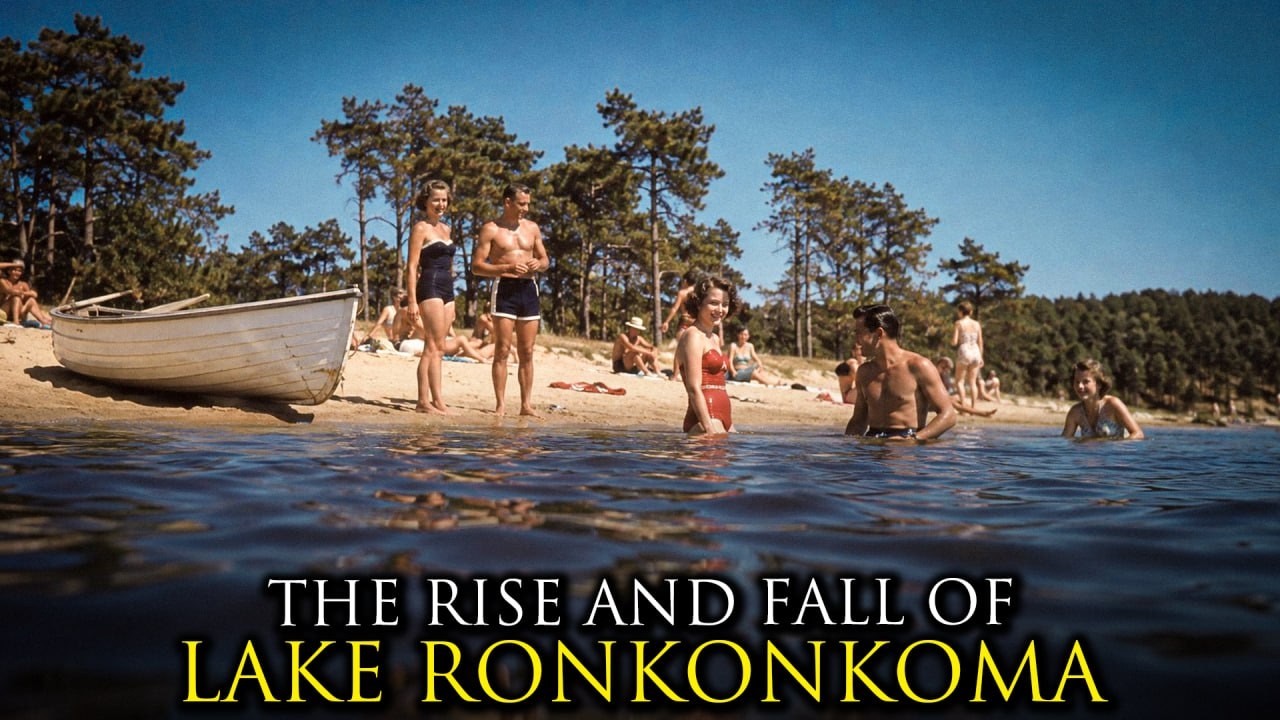
The famous legend claims a drowned princess pulls one young man beneath the surface every year. Suffolk County records show five drownings in thirty years. The real curse is not supernatural. It is geological, and it is the one thing nobody can fix.
The lake was born roughly 18,000 years ago, when the Wisconsin glacier was retreating north across what would become Long Island. The island itself is a wall of debris the ice dragged down from New England and dumped here. As the glacier pulled back, it left enormous blocks of ice buried in sand and gravel. When they finally melted, they left depressions in the ground.
Geologists call them kettle holes. Most on Long Island are small. A few became something bigger. Lake Ronkonkoma became the largest, roughly 240 acres of open water.
Official surveys put its deepest point at around 60 to 65 feet. That sounds unremarkable until you remember the lake sits on an island made entirely of unconsolidated glacial material. There is no bedrock bowl holding the water. The lake exists because the water table is high enough to fill the hole the ice left.
It is, in a sense, a window into the groundwater—a place where the aquifer breaks the surface and becomes visible. A lake with no outlet has what scientists call a long residence time. Water entering Lake Ronkonkoma may remain for years before seeping out through the ground. Everything dissolved in that water stays at least as long.
Every decade adds a layer. Nothing subtracts. For most of its existence, that flaw did not matter. The Algonquian-speaking people who lived around the lake for centuries before European contact knew it was unusual.
The name Ronkonkoma is generally believed to derive from an Algonquian word, though historians and linguists have argued about the exact meaning for over a century. What seems clear is that the lake was named and important enough to deserve a name. The first European settlers in the 17th century treated it mostly as a big pond in the woods. For nearly 200 years, it stayed that way.
The surrounding forest filtered rainwater before it reached the shore, and the lake remained clear, cold, and clean. The change came with the railroad. When the Long Island Railroad reached the Ronkonkoma area in the latter half of the 19th century, a lake that had been a two-day wagon trip from Brooklyn became a couple of hours by train. New Yorkers in the sweltering summers desperately wanted a place to escape the heat.
The resort era arrived fast. Hotels went up in the 1880s and 1890s. Dance halls, bathing pavilions, boat rentals, and concession stands multiplied. By the turn of the 20th century, Lake Ronkonkoma had become one of the premier summer destinations for working-class and middle-class New Yorkers—factory workers, clerks, shop girls, immigrants saving nickels.
On a good weekend, thousands of people passed through the area. Those resort years brought the first meaningful damage. Hotels had outhouses and early septic pits. Horses left their own contributions in the street.
Rain carried everything downhill. The crowds trampled the vegetation that had once filtered rainwater. For the first time in the lake’s existence, human activity sent meaningful quantities of nitrogen and phosphorus into the water. In a lake with an outlet, this would have been manageable.
Lake Ronkonkoma had no stream. The nutrients stayed. Prohibition tilted the economy sideways, and the Depression hollowed out the summer crowds. More consequential was what happened after the Second World War.
Robert Moses and the post-war highway builders laced Long Island with parkways and expressways. New Yorkers no longer needed the train to reach the water; they had cars and could drive to Jones Beach on the Atlantic. Air conditioning spread through New York apartments, and the original reason for the lake resorts—escape from killing city heat—was engineered into irrelevance. Third, the suburbs arrived.
The same forces that created Levittown rolled eastward through the 1950s and 1960s. When they reached Ronkonkoma, they didn’t wash around the lake. They surrounded it. The old resort hotels were torn down or converted to year-round residences.
The dance halls closed. The bathing pavilions disappeared. In their place came houses—hundreds, then thousands—each with a driveway, a lawn, a septic system, and a family that intended to stay twelve months a year. Within two decades, Lake Ronkonkoma went from a seasonal resort to a year-round suburban community.
The Ronkonkoma station became one of the busiest commuter rail terminals on the entire LIRR system. The lake was no longer the reason the place existed. It was a real estate amenity. And here is where the geological story became a crisis.
Every new house had a lawn. Lawns on Long Island need fertilizer, especially in sandy glacial soil that doesn’t hold nutrients well. Fertilizer is chemically a concentrated dose of the nutrients—nitrogen and phosphorus—that cause algae to grow explosively in water. Rain washed it off lawns, down driveways, into storm drains, and into the lake.
Every house had a septic system. Large parts of Suffolk County still rely on individual cesspools and septic tanks today. Nitrogen compounds pass through soil with disturbing efficiency, enter the groundwater, and because the groundwater feeds the lake, enter the lake. Every driveway, street, and parking lot was paved.
Rainwater that once soaked into the sandy soil and filtered cleanly into the water table now ran off hard surfaces, picking up motor oil, gasoline residue, antifreeze, road salt, and pet waste, and carried it directly into the lake. The lake began to change. Not overnight, but across decades the nutrient load built up quietly and relentlessly. Phosphorus accumulated in the sediment.
Nitrogen levels crept upward. Then, in warm months, the blooms arrived—thick green, sometimes blue-green mats of algae spreading across the surface like a stain. The technical term is eutrophication, the process by which a body of water becomes over-enriched with nutrients, triggering explosive plant growth that chokes the ecosystem. In a healthy lake, natural eutrophication takes thousands of years.
In Lake Ronkonkoma, that process has been compressed into decades. Some of those blooms are not just ugly; they are dangerous. Cyanobacteria, often called blue-green algae, can produce toxins that cause skin rashes, nausea, vomiting, and in severe cases liver damage. Children and dogs are particularly vulnerable.
When Suffolk County health officials detect cyanobacteria above certain thresholds, they close the public beach. It has happened multiple times. The lake that once drew thousands of swimmers now periodically displays signs telling people to stay out of the water. The largest freshwater lake on Long Island, a lake people built an entire resort economy around, has summers when you are advised not to touch the water.
Suffolk County has commissioned studies and written reports. The science is not in dispute. The lake is heavily nutrient-loaded. The algae blooms are a direct consequence.
The primary sources are storm water runoff, septic system leachate, and lawn fertilizer. The diagnosis is clear. The prescription is the problem. How do you fix a lake with no outlet?
Dredging the bottom would cost millions and is temporary—you haven’t stopped the flow of new nutrients. Building an artificial outlet raises enormous practical questions: where does the water go, and who accepts the pollution? Aeration treats a symptom while the disease progresses. Chemical treatment with alum locks phosphorus in the sediment but requires periodic reapplication and does nothing to stop ongoing input.
Every proposed solution runs into the same wall. The geology is the constraint, and the geology is not negotiable. There is a deeper layer. The lake is a window into the aquifer.
Water seeps in from the groundwater, and water seeps out into the groundwater. The nutrient contamination isn’t only in the lake; it’s in the groundwater beneath and around it—the same groundwater residential wells draw from. Suffolk County has spent hundreds of millions of dollars addressing groundwater contamination from multiple sources: industrial sites, leaking gas stations, dry cleaners, and the Grumman Aerospace facilities in Bethpage, which left a plume of contaminated groundwater migrating southward for decades. The entire island is in a sense one giant version of the same problem: a landmass with no bedrock, built on sand, where everything put on the surface eventually reaches the water below.
The community around the lake is not abandoned. Schools function. Streets are plowed. The railroad runs on schedule.
But the lake at its center is not working the way a lake should. The water that was clear enough to see your feet in 1910 now turns opaque green in a hot August. Old-timers who remember swimming across the lake as teenagers look at the water their grandchildren would swim through and keep the memory to themselves. The body of water is there.
The experience is gone. The legend endures because legends are easier to repeat than hydrology. The ghost story gives the lake drama. The science gives it a diagnosis.
People prefer the drama. But the real story is stranger and more dramatic than the legend. The legend is about one woman’s grief reaching across centuries. The real story is about an entire community, thousands of families over decades, collectively and unknowingly filling a geological trap with the invisible byproducts of comfortable suburban life until the water itself changed state.
The legend claims one victim a year. The real problem doesn’t claim victims. It claims the lake itself, degree by degree, summer by summer, in a process so gradual that no single person caused it, and no single action will reverse it. Even if every source of external pollution were stopped tomorrow—every lawn replaced with native plants, every septic system connected to a sewer, every parking lot torn up—the fundamental problem would remain.
The nutrients already in the lake would remain. The residence time would remain. The lack of an outlet would remain. The lake would be cleaner going forward, gradually, but it would still be a closed basin with no natural flushing mechanism, sitting in the middle of a suburb, unable to do what a healthy lake does: let the past flow away.
The glacier didn’t curse this lake. It created it. But the creation contained the flaw, and the flaw was invisible for 18,000 years because nobody was putting anything into the water that shouldn’t have been there. The lake could handle a party.
It cannot handle a neighborhood. Drive to Lake Ronkonkoma today, and you’ll find a small county park, a beach, picnic tables, and a view of the water that on the right morning is still arresting. Ospreys hunt the surface. The surrounding trees arch over the water the way they always have.
There are moments early, before the sun has warmed the shallows enough for the algae to thicken, when the surface catches the light at an angle that turns it silver, and you can almost see what the resort guests saw 115 years ago. Almost. The houses around the shore are full. The lawns are green.
The septic systems are working, which means they’re leaching. The storm drains are catching the rain and channeling it with everything it carries toward the low point in the topography. The low point is the lake, and the lake has no outlet. The sun drops behind the tree line, and the surface goes still.
The lake waits. It always waits. It has nowhere else to send anything.