The warmth of a steaming bowl of ramen on a cold night is a modern comfort so common it is easy to forget it once seemed impossible. Yet the story of how a single block of dried noodles could be revived with hot water in minutes is not the tale of a single genius, but the culmination of centuries of human experimentation. It begins not in a high-tech factory, but in the ancient fields of northern China, where wheat did not yet exist, and people relied on a grain called millet. They ground it against stone, mixed it with water, and made simple dough.
When wheat eventually arrived, cooks discovered something remarkable: this new flour, when kneaded with water, became pliable. It could be stretched, bent, and shaped without breaking. This single characteristic laid the foundation for everything that followed, a discovery made not by one person, but by countless hands across generations that pulled, cut, and folded dough in their own homes. Ancient Chinese texts contain the word ”bing,” which is often translated as noodle.
In reality, the term referred to any food made from flour, whether boiled, steamed, or baked. During the Han dynasty, records mention a dish called ”tangbing,” which translates to dough pieces in soup. Many consider this to be the world’s first noodle, though no one knows for certain if it resembled the long, thin strands we recognize today. Over time, cooks refined their skills, developing different techniques: some flattened the dough and cut it with knives, others stretched it by hand, and some held firm pieces of dough over boiling water, shaving off small pieces directly into the pot.
In regions where wheat was unavailable, rice was soaked, ground into a thick paste, steamed, and then cut into noodle shapes. By the Song dynasty, between 960 and 1279, dedicated noodle shops began appearing in cities across China, marking the dish as an established part of daily life. From China, the noodle spread outward. In Korea, people made their own version from buckwheat, called naengmyeon.
In Japan, cooks developed udon and somen. Chinese settlers brought their skills to Southeast Asia, where local ingredients transformed the dish, as seen in Indonesia’s bakmi and the coconut-infused laksa. This was not simple imitation, but adaptation, with each region inventing its own unique creation. This parallel invention also occurred in Italy.
A popular myth claims that Marco Polo introduced pasta to Italy after returning from China. The story is charming but false, originating in the early twentieth century from an American trade magazine with a vested interest in selling pasta. In reality, the geographer Al-Idrisi wrote in 1154 that people in Sicily produced a pasta-like food called itriya, which they even exported to other countries, long before Marco Polo ever reached China. Two distant regions, using similar grains, independently discovered their own paths, one creating noodles, the other pasta.
For centuries, all noodles were made entirely by hand. Kneading, rolling, and cutting required immense effort and time. Gradually, rollers and cutters were developed, making the process faster and more precise. It was in this era that a new food emerged in the port cities of Japan.
In 1870, a Chinese restaurant opened in Yokohama, followed by a similar establishment called Rai Raiken in Tokyo in 1910, where Chinese chefs served noodles in hot soup. This dish would eventually be known as ramen. For most people, however, ramen could only be enjoyed in shops, as making it at home required fresh noodles and significant time. This was the problem that defined the life of one man: Momofuku Ando.
Ando was born on March 5, 1910, in Chiayi, Taiwan, which was then under Japanese occupation. He lost both parents in childhood and was raised by his grandparents, who ran a textile business. As a young man, Ando started his own textile company, but fortune repeatedly turned against him. In 1948, he was jailed for tax evasion, and his business was destroyed.
In 1957, the credit cooperative he managed went bankrupt. He was left with nothing but a rented house in Ikeda, Osaka, a man who would one day own one of the world’s most famous food companies, yet at that moment was completely destitute. In post-war Japan, food was scarce, and Ando noticed long lines of people waiting outside Osaka Station for a bowl of ramen. He wondered why such a beloved food was so difficult to prepare.
The question haunted him until he decided to solve it himself. He set a goal to create a noodle that would be cheap, quick to make, and delicious. He built a small wooden shed behind his house and worked alone, reportedly sleeping only four hours a night and taking no days off for an entire year. He experimented daily with new techniques.
Sometimes the dough was wrong; other times, the noodles dried into a hard, stone-like mass that remained stiff even in boiling water. He faced repeated failure, but he refused to give up. One day, he watched his wife making tempura. As the batter hit the hot oil, the water inside rapidly evaporated and escaped, leaving behind a structure of tiny holes.
A new idea struck him: if noodles were fried in the same way, the resulting holes would allow hot water to penetrate quickly, rehydrating the noodles in a matter of minutes. He first steamed the noodles until they were half-cooked, allowing the starch to set. Then he dropped them into extremely hot oil. The intense heat caused the internal water to vaporize instantly, rushing out and leaving behind millions of microscopic pores.
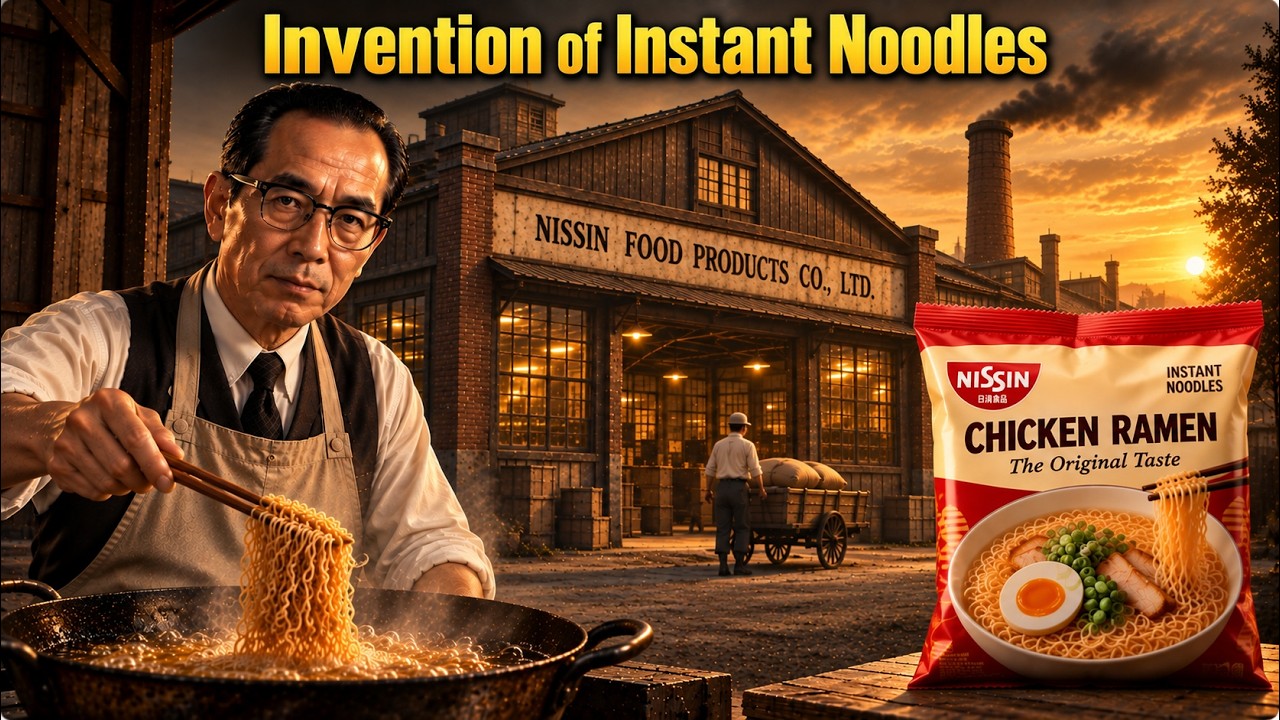
Once the noodles cooled and dried, they seemed hard on the outside, but inside they were like a sponge with a fine network of openings. Ando named this technique the instant oil heat drying method. On August 25, 1958, his work finally paid off. The dish was called Chikin Ramen, and it was the world’s first noodle that was pre-cooked, fried, and ready to eat simply by adding hot water.
It was initially priced at 35 yen, a significant markup compared to regular udon noodles, which cost only six yen. Shopkeepers were hesitant to stock it, but as consumers understood its convenience, demand skyrocketed, and lines of trucks formed outside the factory. In 1966, while traveling in the United States and Europe, Ando observed people breaking the Chikin Ramen into pieces, placing them in paper cups, and pouring hot water over them. This simple observation sparked a new question: what if the noodle brought its own bowl?
Thus, the concept for Cup Noodles was born. He tested around forty different cup designs before settling on a lightweight, heat-insulating cup made of expanded polystyrene foam. The design also had to keep the noodles suspended in the middle of the cup so that hot water could circulate evenly around them. Finally, on September 18, 1971, Cup Noodles was introduced in Japan at 100 yen, four times the price of a standard instant noodle packet.
Once again, retailers hesitated. But in February 1972, a police raid was broadcast on television, showing officers eating Cup Noodles while standing in the cold. That single image made the product a household name across Japan. In 1973, it arrived in the United States, where it was simply called Cup Noodles.
Ando’s idea had grown from a single workshop into a global industry. Modern factories still use the fundamental method he developed in his shed, only on a much larger scale. Wheat flour, water, and salt are mixed into a dough, rolled into a thin sheet, and cut into long strands by sharp blades. The strands are shaped into wavy blocks so they fit neatly into packaging.
They are then steamed to cook the starch, after which they are either fried in oil at 140 to 160 degrees Celsius for one to two minutes or dried using hot air for a lower-fat version. During frying, the moisture content drops from roughly thirty to fifty percent down to just two to five percent, allowing the noodles to remain stable for months without spoiling. Flavoring is then added, either in a separate packet or directly onto the noodles, before they are sealed. The story took on new shapes as it traveled to South Asia.
In 1983, Nestlé brought Maggi noodles to India, marketing them under the now-famous name of 2-Minute Noodles. The crucial change was replacing the Japanese chicken broth with Indian spices, a flavor profile that resonated deeply with local tastes. The strategy was so successful that Maggi controlled nearly eighty percent of the Indian market before 2015. Then, in June of that year, India’s food safety authority imposed a ban on the product, citing issues with lead content and labeling, and removed it from shelves nationwide.
Nestlé maintained the product was safe, and the Bombay High Court eventually lifted the ban after new tests. Maggi returned to the market in November 2015, and by 2025, sales had recovered at a rapid pace, showing that consumers had regained their trust. In Pakistan, the story repeated itself, slightly later and in its own style. Maggi arrived around 1992, Knorr noodles followed in 1993, and Shan Foods introduced its Shub brand in 2012.
Shan Foods, founded in Pakistan in 1981, originally produced only spices but later expanded into noodles, using the same successful strategy of chicken and spice flavors tailored to local palates. By 2026, noodles are eaten all over the world. Ramen has moved far beyond Japan’s borders, with dedicated restaurants opening in countless countries. Korean spicy noodles and instant ramen have surged in popularity thanks to social media.
Companies continually develop new flavors, spice levels, and styles. The noodle has crossed the boundary of simple food to become a central part of global food culture. And that transformation began with a bankrupt businessman standing in a small shed, watching his wife fry tempura, whose moment of inspiration changed the way the world eats.