In December 1943, American B-24 bombers crossed the North Sea toward Germany. Inside one of them sat a squadron commander whose voice millions of moviegoers already knew. On screen, James Stewart seemed to stumble toward every sentence by trial and error. In the air over wartime Europe, hesitation could cost an entire crew.
The men flying beside him did not need the image Hollywood had built. They needed an officer who could read weather, machinery, formation, and fear before the margin for choice vanished. The voice was still there, but now every word carried consequences no audience could applaud away. James Maitland Stewart was born on May 20, 1908, in Indiana, Pennsylvania, a small county seat east of Pittsburgh.
His father, Alexander, ran the family hardware store on Philadelphia Street. It was more than a business. It was a public room where farmers, tradesmen, and housekeepers came with practical problems. A broken hinge, a length of chain, a can of paint.
Each request required listening before offering the right object. James watched his father deal with people without ceremony, and the store taught a form of attention that later appeared in his acting. He was tall and thin long before that shape became a screen signature. He built model airplanes, played the accordion, and joined the Boy Scouts.
Indiana gave him security, but also a destination he was expected to accept. The hardware store had passed through the family, and Alex assumed his son might eventually return to it. James did not rebel in a dramatic way. He moved through available doors, testing each one.
In the fall of 1928, he entered Princeton University, initially imagining civil engineering. Mathematics made that plan painful. Princeton’s own archive preserves his later admission that college algebra struck him like a death blow. A professor advised him to consider becoming something other than an engineer.
The advice could have felt like failure. Instead, it redirected him toward architecture, where drawing, structure, and practical imagination could work together. His senior thesis proposed an airport terminal, joining architecture to his long fascination with flight. It helped him graduate with honors and win the Damato Prize.
But the country was in the Great Depression, and architecture graduates faced too few buildings and too little money. Princeton had also given Stewart another education. He drew cartoons, sang with the Triangle Club, joined the Glee Club, and became head cheerleader. His performances were experiments.
He was learning what happened when his long body, dry timing, and apparently unprepared speech met an audience. Joshua Logan, a Princeton friend who would become a major director, invited him to join the University Players, a summer stock company in Massachusetts. The pay was board and ten dollars a week. Stewart was approaching graduation with a scholarship in architecture and a family business waiting at home.
He accepted the offer anyway. The company gathered an extraordinary group of young actors before any of them had become famous. Henry Fonda was there. So was Margaret Sullavan.
They built sets, carried scenery, missed cues, covered mistakes, and learned that a production survives only when each person performs the unglamorous labor around the performance. Stewart was not immediately commanding. He took small parts and watched more experienced players. Sullavan, already more assured, helped him understand that a relaxed performance is made through listening, timing, repetition, and control of physical behavior.
The company moved toward Broadway, and Stewart faced a decision he later remembered with humor. He could return to Princeton for graduate architecture or remain with the troupe and become, as he put it, the skinniest actor on Broadway. He went home to Indiana and made his choice. What followed was what he called a moment of stunned Presbyterian silence.
Architecture seemed respectable. Acting sounded uncertain and faintly disreputable. His parents rallied, and Alex kept the hardware store as a refuge. If acting failed, home remained available.
Stewart’s Broadway debut came in 1932 in a small role in Carry Nation. More stage work followed. He was not an overnight sensation. He learned how to occupy a stage without pushing, that silence could be active, and that a delayed answer could draw attention.
The style began with his actual speech, but it became craft. His pauses were not empty. They allowed thought to appear. Hollywood noticed.
Stewart followed Fonda west in 1935 after a screen test and signed a contract with Metro-Goldwyn-Mayer. He was 27, unusually thin for a leading man, and possessed a voice that did not resemble the rounded assurance studios associated with romantic authority. His first film, The Murder Man, gave him a small role opposite Spencer Tracy. Other assignments followed, some barely using him at all.
The studio was testing where this strange lanky presence belonged. Frank Capra recognized the possibilities. Capra’s films often placed an ordinary individual against institutions that had grown large, cynical, or impersonal. In You Can’t Take It With You, released in 1938, Stewart joined a comic ensemble built around the conflict between money and a household that refuses to organize life around it.
The film was a major success. The next collaboration made him a national figure. In Mr. Smith Goes to Washington, Stewart played Jefferson Smith, a young senator appointed because political operators assume he will be easy to control.
He enters Washington with reverence for democratic ideals and discovers a system of manipulation and public deceit. The climactic filibuster demanded sustained physical and vocal deterioration. Smith speaks until his voice fails, continuing because speech is the only power he has left. Stewart’s cracked delivery did not feel theatrical.
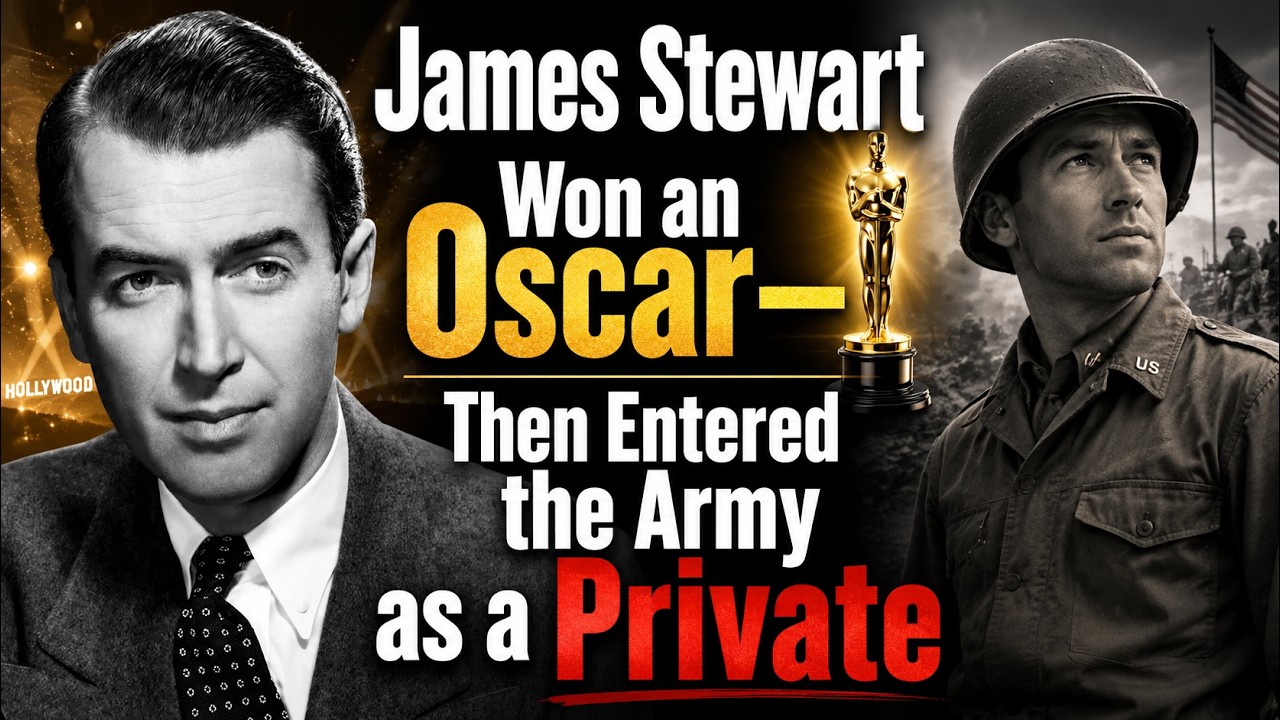
The pauses that had once made him seem uncertain now became evidence of endurance. By 1940, he had reached the front rank of Hollywood actors. The Philadelphia Story paired him with Katharine Hepburn and Cary Grant. At the Academy Awards held in February 1941, he won Best Actor.
He sent the Oscar home to Indiana, where his father placed it in the hardware store among practical goods and local conversation. Within weeks, the question of usefulness changed completely. Stewart had been selected in the nation’s first peacetime draft. He had already learned to fly and accumulated hundreds of hours as a civilian pilot.
When he reported for induction, he was under the required weight. One of Hollywood’s tallest stars was too light for military service. He returned after adding enough weight to qualify. On March 22, 1941, he entered the army as a private, months before the attack on Pearl Harbor brought the United States fully into the war.
He left a career at its peak. The Army Air Corps could use a popular actor for recruitment and training films, but Stewart did not want celebrity to become a shield. He earned his pilot wings and became an instructor. Training was necessary, but it frustrated him.
He continued to press for an operational assignment. In the fall of 1943, he arrived in England as commanding officer of the 703rd Bomb Squadron, part of the 445th Bomb Group. The unit flew B-24 Liberators, four-engine heavy bombers designed to carry war deep into enemy territory. A squadron commander was not simply a pilot with a famous name.
He was responsible for readiness, morale, planning, and the terrible arithmetic of crews who left and did not return. His first combat mission came on December 13, 1943, against U-boat facilities at Kiel. Stewart flew not as a visiting celebrity but as an officer responsible to the men around him. Military accounts describe a commander who did not seek special treatment.
The official record supports the essential facts. He flew twenty combat missions, received the Distinguished Flying Cross, and advanced to operations officer of the 453rd Bomb Group on March 31, 1944. By the end of the war in Europe, he had risen to colonel. Stewart rarely built his later public identity around combat stories.
He spoke little about what the missions had left behind. What the record gives us is enough. He accepted responsibility and led men in combat. In 1945, the immediate question was simpler and more difficult.
Could he act again? Hollywood had changed during his absence, and so had he. Frank Capra and his partners had formed Liberty Films, and Stewart agreed to star in its first picture. The choice carried risk.
He was returning not in a light comedy but as a man convinced that his life had become a burden to everyone he loved. The film was It’s a Wonderful Life. The title now sounds inseparable from holiday warmth, but the picture Capra released in 1946 is filled with frustration, debt, humiliation, and despair. George Bailey is often remembered as the friendly citizen of Bedford Falls.
Stewart plays him first as a young man whose body seems ready to leave before duty catches his sleeve. When money disappears and ruin threatens, George does not remain noble. He lashes out, terrifies his family, and reaches the edge of self-destruction. The familiar pauses no longer signal charming uncertainty.
They become fractures. The film received Academy Award nominations, including one for Stewart, but it was not the immediate commercial triumph later memory suggests. It gained much of its cultural presence through television broadcasts years after its original release. For Stewart, the film marked a return, not a conclusion.
He tested the limits of the audience’s trust. He worked with Alfred Hitchcock in Rope, Rear Window, and Vertigo, playing men whose authority was compromised by vanity, obsession, and control. In the Anthony Mann westerns of the 1950s, he played men carrying old wounds and private vengeance. The viewer wanted to trust the man on screen and therefore felt the shock when rage broke through.
In 1949, he married Gloria Hatrick McLean, a former model and actress who had two sons from an earlier marriage. Gloria had driven an ambulance during the war and built a life that did not depend on becoming an extension of a famous man. They had twin daughters in 1951. In 1959, Stewart was promoted to Brigadier General in the Air Force Reserve, and he retired from military service in 1968.
The following year brought a loss that no public role could absorb. Gloria’s older son, Ronald, had become a Marine officer. On June 8, 1969, he was killed in Quang Tri Province, South Vietnam. He was 24.
The father who had flown combat missions could not protect the son who went to another war. Stewart continued working into his later years, appearing in westerns, family pictures, and television. He returned to Harvey on stage and received an honorary Academy Award in 1985. After Gloria’s death in 1994, he withdrew from public life.
He died of cardiac arrest at his home in Beverly Hills on July 2, 1997, at 89. The films continued to change after his death. Vertigo rose in critical reputation until it was regularly placed among the greatest films ever made. The National Film Registry preserved his work.
The Jimmy Stewart Museum opened in Indiana, Pennsylvania, in 1995, including a recreation of the hardware store, completing a long circle. He had begun by watching his father listen to people who entered with practical problems. He became an actor by learning to listen before speaking. He became a commander in a world where listening had to become judgment.
And he became a lasting screen presence because he allowed audiences to see the instant when thought becomes choice. The man who died had been an architecture student, stage apprentice, contract player, Oscar winner, combat pilot, squadron commander, husband, father, reserve general, and one of the most technically subtle actors of his century. Jimmy made that complexity approachable.
James did the work.