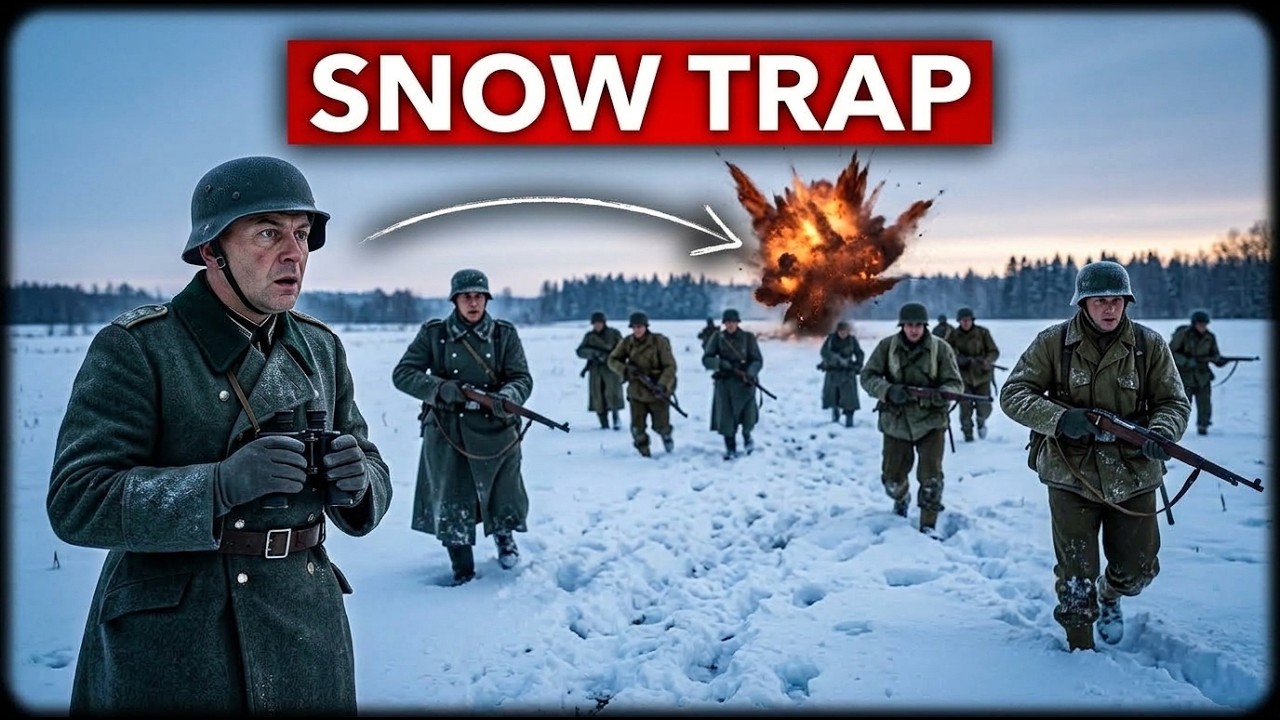
In December 1944, on an open slope above a river valley on the southern edge of the Ardennes, a German infantry company formed up in the snow just before daylight. Most of the men were young. Some were not young at all. By the winter of 1944, the German army was fielding men it would have rejected two years earlier.
Among them was a handful of veterans, including a sergeant who had survived three years of war by learning a few rules and never breaking them. The most important rule concerned artillery. When shells came while you were in the open, you lay flat. As flat as you could possibly make yourself.
You did not run, you did not kneel, you did not crouch. You hugged the ground, because a shell that burst on impact threw its fragments upward and outward in a cone, and a man lying flat stayed below most of that cone. He had seen it proven a hundred times. Men who stood were killed.
Men who lay down, even near the blast, often got back up. A shallow shell hole was better still. A deep trench was safe from almost everything except a direct hit. That rule had kept him alive on the Eastern Front and in France.
He had taught it to every replacement who passed through his platoon. This morning, the company had to cross the open slope in dim light and reach the Americans on the other side before enemy observers could see clearly enough to direct their guns. It was the kind of attack the German army had been launching in one form or another all through the war. The first American shells arrived when the company was a third of the way down the slope, and they did not hit the ground.
They burst in the air, high above the snow, above the men, in an open field with no trees to trigger them. Not one or two, which might have been a gunner’s error with a time fuse, but all of them, every round of the barrage, exploding at nearly the same height above the slope, as if someone had measured it. The fragments came straight down. The rule that had kept the sergeant alive for three years had suddenly stopped working, and no one in his ranks had warned him why.
To understand what happened on that slope, you have to understand why the sergeant’s rule had worked for so long. A World War II artillery shell was, at its core, a steel casing filled with high explosive with a fuse in the nose that determined when it detonated. The most common fuse was the direct impact fuse. The shell exploded when it hit something.
In open terrain, that something was the ground. When a shell burst on impact into soft earth, much of its energy was lost inside the soil. The fragments that flew outward went up and out at an angle. A standing soldier nearby was in the path of those fragments.
A soldier lying flat was often below their trajectory. A soldier in a hole was below the rim of the hole. That was why infantry from every side learned to dig and to go prone, and why armies built trench systems in World War I. Protection from artillery was mostly about staying below the path of the fragments.
Every army understood the obvious countermeasure. If you could make the shell burst in the air above the target, the fragments would fall downward, straight into the holes and onto the prone men. Gunners could do this with a different kind of fuse, the time fuse, which was set before firing to detonate a set number of seconds after the shell left the barrel. If the timing was exact, the shell burst in the air above the target.
The problem was the word exact. The shell covered hundreds of meters per second in flight. Any error of a small fraction of a second meant the shell burst far too high, where the fragments scattered and lost their energy, or too low, or on the ground like any ordinary shell. The timing depended on range, powder charge, temperature, wind, barrel wear, and every variable that changed from round to round.
Skilled gunners could produce air bursts with time fuses, and they did, but it required precise adjustment and ideal conditions, and it was not reliable for a dense barrage from several batteries at once. In forests, of course, the trees did the job for you. A shell that struck branches burst overhead, and both German and American infantry had learned to fear bursts among the trees in the Huertgen Forest and the Ardennes. But in open terrain, in snow, on bare slopes, the sergeant’s rule held.
Unless someone found a way to make every shell know how far it was from the ground. The solution was one of the strangest engineering challenges of the war, and it was solved by people who had never worked in a weapons factory. The idea itself was simple enough to describe. Put a small radio transmitter and receiver in the nose of the shell.
As the shell flies, it sends out a radio signal. When the signal bounces off something nearby, whether an aircraft or the ground, the reflected wave interferes with the outgoing wave in a way a circuit can detect. When that interference reaches a certain strength, meaning the shell is close enough to its target, the fuse detonates. A shell that knows how close it is to its target.
A proximity fuse. British researchers worked on the concept early in the war, and the ideas were shared with the United States as part of the scientific cooperation between the two countries. But turning the idea into something effective was another kind of problem, and the effort was concentrated in America, organized by a government scientific research office, and carried out mostly in a new laboratory created at Johns Hopkins University for exactly that purpose, under the direction of a physicist named Merle Tuve. The difficulty was almost absurd.
Radio in 1942 used vacuum tubes, thin glass bulbs with wire filaments and fragile grids inside, the kind of component that broke if you dropped the device on a table. The proximity fuse had to put working vacuum tubes inside an artillery shell that would be fired from a gun. At the moment of firing, the shell accelerated violently enough that everything inside it experienced forces equal to twenty thousand times the force of gravity, and the rifling in the barrel spun the shell hundreds of times per second. Any ordinary tube would shatter instantly.
So the tubes had to be redesigned from the inside out, miniaturized, strengthened, and had their internal structures reinforced to survive being fired from a cannon and keep working. Engineers fired test shells into the ground and dug them out to see what had broken, then changed the design and fired them again, over and over. The power source was equally complicated. A battery that sat in an ammunition depot for months would lose its charge.
The solution was a reserve battery. The chemical electrolyte was sealed inside a small glass ampoule within the fuse. When the gun fired, the shock broke the ampoule, and the spinning of the shell forced the electrolyte across the battery plates, making the battery work only during flight. A shell that powered itself after being fired.
Safety measures had to be built in as well. A fuse that could detonate near its own gun crew, reacting to the gun barrel or the ground just in front of the muzzle or a nearby vehicle, would be worse than useless. So the fuse stayed inert for a short time after firing, activating only after the shell had traveled well clear of the gun. A shell that switched itself on after firing, then waited until it was safe before it began to work.
Then came the part that made it matter, production. A few hand-built prototypes would change nothing. Millions of fuses had to be manufactured in factories that had never produced ordnance. The task went to American radio and electronics manufacturers, the companies that had been making radios for kitchens and living rooms before the war.
Their assembly lines, their experience in tube manufacture, and their workforce, a large percentage of them women, produced fuses on a scale that was hard to believe. By the end of the war, output reached tens of millions, and the cost of each fuse fell from hundreds of dollars at first to a small fraction of that. The same consumer electronics industry that had filled American homes with radios had just put a radio inside an artillery shell. The proximity fuse remained for a long time one of the most closely guarded secrets of the war.
It went first to the fleet. Its first combat success came in the Pacific in January 1943, when an American cruiser using the new shells brought down a Japanese aircraft attacking near the Solomon Islands. Antiaircraft fire had always been a game of probabilities. The shell had to burst very close to a fast-moving aircraft, and with an impact fuse it had to actually hit it.
With a proximity fuse, a shell that passed near an aircraft exploded on its own. The effectiveness of shipboard antiaircraft guns increased dramatically. Later it was used against the Japanese suicide planes attacking American ships, and it saved ships and lives in numbers that cannot be precisely counted. In the summer of 1944, it reached England.
Germany had begun launching its V1 flying bombs, pilotless jet missiles, against London. Allied antiaircraft guns were moved to the coast, paired with American radar and gun-laying equipment, and supplied with proximity-fused shells. The proportion of flying bombs brought down by fire rose sharply over the following weeks, until by late summer the vast majority of those engaged by coastal guns were destroyed before reaching London. But there was one place the fuse was not used, over land.
The reason was the fear of capture. A shell fired over the sea that failed to explode sank. A shell fired over enemy-held ground that failed to explode could be dug up. If the Germans found an intact proximity fuse, examined it, and copied it, they could put it in their antiaircraft guns and use it against the huge Allied bomber formations flying over Germany every day.
Allied leadership judged that risk too great, and for a long time the fuse was restricted to targets over water or over friendly territory. So while the fuse was saving ships in the Pacific and knocking down flying bombs over the English coast, the infantry and artillery fighting across France and into Germany did not have it. In mid-December 1944, the ban on using the fuse over land in Europe was lifted. The timing came at the exact moment the German offensive in the Ardennes began.
For the German infantry who fought through that offensive and the desperate weeks of winter combat that followed, the result was the sergeant’s experience on the slope. American artillery had always been heavy. German soldiers in the west had long since learned to fear it, its size, its speed, its ability to mass the fire of many battalions on a single point. But they had also learned how to survive it.
In the open, lie flat. In position, dig a trench. Now, over open snow, shells began bursting overhead. Fragments rained down into the snow, into the shallow holes men had dug, and onto the men lying flat.
The rule that had kept them alive no longer applied, and there was no new rule to replace it except overhead cover, which you could not build while attacking across an open field. The most famous description of the effect comes from the American side, in a letter George Patton wrote to the army’s chief of ordnance at the end of December. He called it “the wonderful new shell,” said it was devastating, and described a German battalion caught trying to cross the Sauer River, caught by a single concentration fired with the new shells, killing hundreds. The number he gave was 702 by actual count.
He wrote that when all armies get this shell, they will have to devise some new method of warfare. That number should be read soberly. It was one battle reported by an enthusiastic commander, and it describes young men killed in a snow-covered river valley within minutes. It is not a number to celebrate.
But it tells you what the fuse did to land warfare, and why the Americans had been so reluctant to risk exposing the secret. German prisoners taken in the following weeks described the new shells in almost identical terms. They spoke of artillery bursting above them wherever they were. Of trenches that no longer protected them unless covered with logs overhead.
Of attacks that fell apart before they could engage the enemy, because men caught in the open were being hit by fire that followed them down to the ground. Many said they had no idea what the Americans were doing. They had no idea because it had been kept entirely from them. The fuse had been in combat for nearly two years over water and the English coast, while the land war continued without it.
And when it finally arrived, it arrived all at once, at the moment the German army launched its last major offensive in the west. The judgment is that the proximity fuse was not a secret weapon in the traditional sense of a miraculous device. It was something more distinctive to the American war effort than that. It was an industrial product.
The idea was not entirely American. British research had paved the way, and German scientists had studied similar concepts. What made the difference was the ability to turn the idea into a device that worked, and then produce it in the tens of millions. That required a very specific set of capabilities.
A laboratory system that could concentrate physicists and engineers on a single urgent problem. An electronics industry that knew how to make vacuum tubes cheaply and in enormous numbers. A manufacturing workforce capable of assembling delicate electronics on a production line. And a supply chain capable of delivering finished shells to army ammunition trains on the other side of the world.
Germany did not lack clever scientists. It lacked the capacity to do all of those things at once in the middle of a war it was losing. By the time the proximity fuse reached the Ardennes, the German electronics industry was being bombed, dispersed, and starved of materials, and there was no realistic path to a substitute. It is also important not to exaggerate.
The proximity fuse did not decide the Battle of the Bulge. The American infantry who held in the hard early days, the fog that finally lifted to let Allied aircraft fly, German fuel shortages, and American reinforcements flowing in from every side were all far more significant. Proximity-fused shells made up a small fraction of the ammunition fired. Some of them malfunctioned.
The fuse made American artillery more lethal against men in the open. It did not make it invincible. But for the sergeant on that slope and the men of his company, it changed the one thing they had been able to rely on.
The rule that had kept him alive for three years, lie flat, stretch out, hug the ground, had been quietly broken by a radio in the nose of a shell, designed in a university laboratory and assembled by women on a production line in a country that had been told it was too weak to fight.