On Halloween morning 1955, the body of William Woodward Jr. lay on the floor of his Long Island mansion, his face torn apart by a shotgun blast fired from less than ten feet away. Standing over him, still gripping the smoking weapon, was his wife Anne, a former Kansas showgirl who had climbed her way into one of America’s oldest fortunes. Her story was that she had mistaken her husband for a prowler.
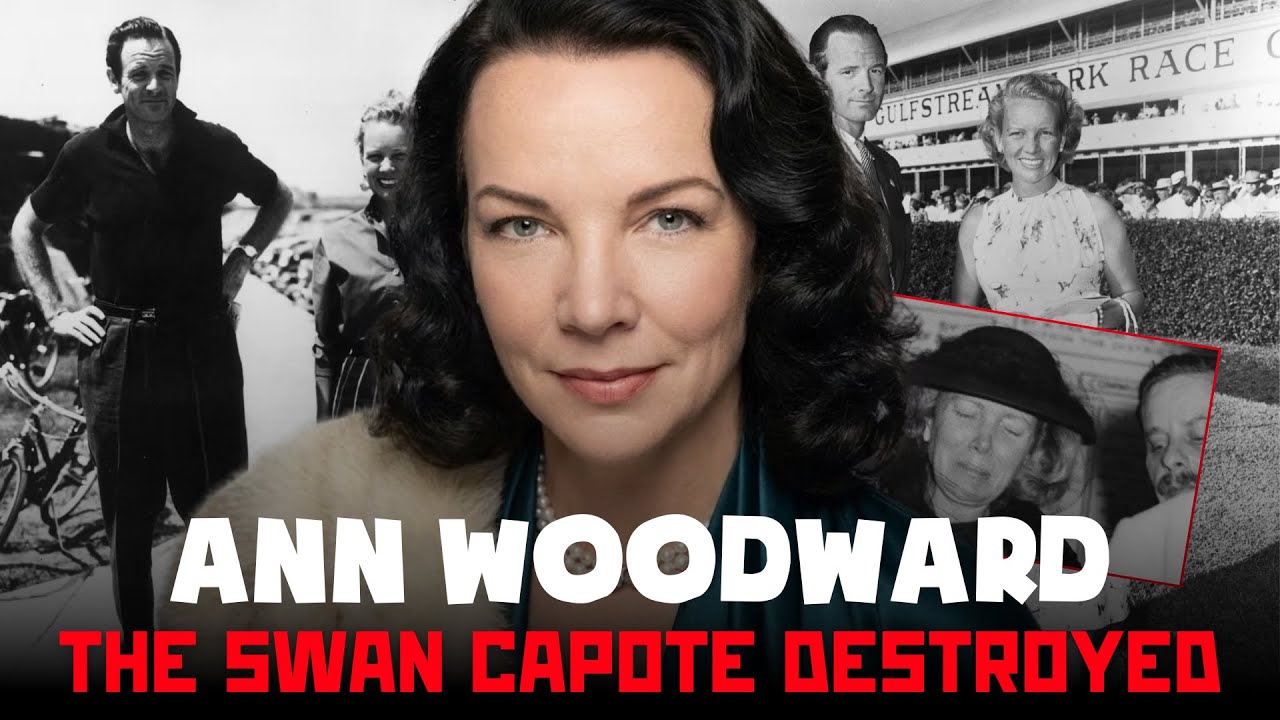
The grand jury believed her, or was made to believe her, and she walked free. Twenty years later, the man she had trusted with her deepest secrets turned those secrets into print, and the punishment she had escaped from the law was delivered instead by her closest friend. Anne Woodward was born Angeline Crowell in Pittsburgh, Kansas, into a childhood defined by instability and poverty. Her mother Ethel, a frustrated beauty who felt cheated by life, taught her daughter that beauty was the only currency that never lost value.
The family drifted across the Midwest, always one step ahead of eviction, and young Angeline learned early that home was fragile and that the men who passed through their lives were resources to be managed. She resolved that she would not end up like the women around her, worn down by farm marriages and early aging. In 1937, she left Kansas for New York and killed her past along the way. Angeline Crowell became Anne Eden, a name that sounded like it belonged on an invitation to something grander.
She found work as a model and then in radio, and by 1940 she had been voted the most beautiful girl in radio. But modeling and radio were only footholds. She wanted the fortress of a dynastic name. In 1943, at a nightclub, she met William Woodward Jr.
, the only son of one of New York’s most powerful banking families. Billy was handsome, wealthy, and profoundly aimless, a man who had spent his life suffocated by his mother Elsie’s icy control. Anne was everything the debutantes he was expected to marry were not: loud, vital, sexually confident. For Billy, marrying her was an act of rebellion against the mother who had ruled him.
For Anne, he was the finish line she had been running toward her entire life. Elsie Woodward declared war immediately. She investigated Anne’s past, uncovered the poverty and the divorces, and presented the findings to her son like a prosecutor. But her opposition only pushed Billy further into Anne’s arms.
He proposed in 1943, and they married in a small ceremony in Washington state. Elsie did not attend. Her telegram was cold and perfunctory, and the message was clear: Anne would have the name, but she would never have the family. The marriage was a brutal education.
Billy, financially dependent on his mother, had no real career or ambition. Elsie used the checkbook as a weapon, installing the couple in an apartment at the Waldorf Towers just floors from her own, so she could supervise their lives. Anne was never accepted by old New York society. She was the showgirl who had crashed the party, and the guests waited for security to remove her.
She reinvented herself obsessively, hiring speech coaches, starving herself into couture silhouettes, studying the style of the Duchess of Windsor. It was not enough. Billy’s rebellion burned out quickly. He returned to alcohol and mistresses, mocking his wife in public and reminding her that without him she was nothing.
Their fights became legendary among their friends. Their two sons, Woody and Jimmy, were paraded out for photographers and handed back to nannies. By the mid-1950s, Billy was talking openly about divorce. For Anne, divorce was not a legal term.
It was a death sentence. A divorced woman of her background would be cast out with nothing. In the fall of 1955, they moved to a sprawling, isolated estate in Oyster Bay on Long Island, hoping for a fresh start. Instead, it became the stage for the final act.
Anne spoke constantly of prowlers, insisting that the windows be locked and relocked, demanding that loaded shotguns be kept close. On the night of October 30th, they attended a dinner in honor of the Duke and Duchess of Windsor. It was the kind of social triumph Anne had dreamed of her whole life, but the evening was a disaster. She drank too much, laughed too loudly, and flirted desperately with the Duke.
Billy watched her with loathing. They drove home in silence. They went to separate bedrooms. Around two in the morning, the dog began to bark.
Anne later claimed she was jolted awake, grabbed the shotgun by her bedside, and stepped into the dark hallway. She said she saw a figure near Billy’s door and fired. The first shot hit her husband in the face at close range, killing him instantly. The second went wild into the wall.
Anne would never be able to explain, convincingly, why she had not seen that the shadow was her own naked husband stepping out of his own room. The police arrived to find the elegant hallway a slaughterhouse. Anne was hysterical, screaming that she had thought he was a prowler. The detectives noticed there was no forced entry, no footprints, and that Billy was unarmed, naked, and clearly not a burglar.
In any other household, she would have been booked for murder before sunrise. But this was Oyster Bay, and the machinery of wealth was already moving. Elsie Woodward made a cold calculation: a dead son was a tragedy, but a murder trial would destroy the family name. To save the name, she had to save the killer.
A petty criminal arrested in the area admitted to prowling the neighborhood that night. He had never entered the Woodward house, but his presence was enough. The prowler story gained the grain of truth it needed. The grand jury returned no indictment.
Anne Woodward walked out of the courthouse a free woman. She was free in the legal sense only. Society convicted her the moment she was acquitted. The nickname that followed her was cruel and cartoonish: Bang Bang.
Old friends crossed the street to avoid her. She fled to Europe, drifting through grand hotels with younger, titled, penniless lovers, but she was entirely alone. Her sons were sent to boarding schools, exiled from the house of horrors. Anne was erratic and ghostlike, unable to be the mother they needed.
She was a woman surviving on the legal fiction of her innocence, and the fiction was all she had. In this vacuum, Truman Capote entered her life. He was the most famous writer in America, a misfit from the South who had clawed his way into the same citadel of power that had rejected her. He understood what it meant to be an impostor in the palace.
He approached her with warmth and defended her loudly to the swans of New York society who had turned their backs on her. For Anne, starved for friendship, this was water in the desert. She let him in. Late at night, fueled by wine, she told him everything: the poverty in Kansas, Elsie’s cruelty, Billy’s mistresses, the humiliations, and finally, the night of the shooting.
She gave him the keys to her soul, believing he would keep them in a velvet box. Capote did not befriend secrets. He harvested them. By the early 1970s, his career had stalled since the triumph of In Cold Blood, and his ego could not tolerate the silence.
He was writing a new book called Answered Prayers, and he planned to strip the masks off the very society that had embraced him. For the centerpiece, he turned his gaze to Anne. In the chapter called La Côte Basque 1965, he barely changed her name. His character, Anne Hopkins, was a vulgar, grasping gold digger who, in his telling, had deliberately murdered her husband to secure her inheritance before a divorce could cut her off.
It was not an accident. It was an execution, and he had used the intimate details she had confided in him to make it ring with absolute truth. In early October 1975, advanced copies of Esquire magazine began to circulate through Manhattan. Anne obtained a copy and read it.
She read the words of her friend describing her as a murderer. It was a violation so complete that it ruptured her will to live. The story would be read by everyone, including her sons, now grown men. On the morning of October 10th, 1975, she swallowed a cyanide pill she had reportedly kept for twenty years, since the days of the investigation, a chemical exit door held in reserve.
She left no note. The housekeeper found her body. The family initially claimed she had died of a heart attack, but the autopsy revealed cyanide, and the connection to Capote’s story became undeniable. Capote was in California waiting for applause.
When he heard the news, he went into hysterical denial, insisting that he had not killed her, that she had been unstable. The swans of New York society read the story, looked at Anne’s body, and understood with chilling clarity that Capote was not their pet. He was a predator who would sell their secrets to the highest bidder. They closed ranks.
The man who had hosted the most famous party in New York was instantly excommunicated. Babe Paley, the great love of his life, refused to speak to him again. He was bewildered, insisting that he was a writer and that he used everything. He never recovered.
He spiraled into drugs and alcohol, never finished Answered Prayers, and died in 1984. The tragedy did not end there. The sons, carrying the weight of the shooting and the suicide in their blood, were left to navigate the wreckage. Jimmy, the younger son, served in Vietnam and returned damaged, drifting into addiction and mental illness.
In 1976, one year after his mother’s death, he stripped naked and jumped from a hotel window. He was twenty-nine. Woody, the older son, tried harder to outrun the shadow. He married and had a daughter, but he struggled with severe depression.
In 1999, he too jumped from a window in Manhattan. He was fifty-four. The Woodward line, the dynasty Elsie had sacrificed her soul to protect, was effectively extinguished. Elsie herself died in 1981 at the age of ninety-eight, outliving her son, her daughter-in-law, and one of her grandsons.
Looking back, it is difficult to find a villain who is not also a victim. Elsie was a monster of snobbery, but she acted according to the brutal logic of her class. Capote was a traitor, but he was also an artist who believed the truth was the only thing worth writing, and he paid for it with his life. And Anne, remembered as the gold digger, the killer, the Mrs.
Bang Bang, was a woman who entered a world rigged against her and fought with the only weapons she had. She killed her husband, whether by accident or calculation will never be truly known, because he represented the threat of returning to nothing. And she killed herself because the alternative was to be stripped naked in the public square. She believed the great lie of the twentieth century, that you can reinvent yourself and climb high enough to be safe.
She climbed higher than almost anyone, all the way to a dinner with royalty and the pages of Esquire. But the higher you climb, the thinner the air, and the longer the fall.