In 1976, amid a nationwide panic over red dye number two, the company behind M&M’s made a decision that would haunt candy lovers for over a decade. Studies had suggested a possible link between the dye and health risks, and the U. S. government responded by banning it outright.
But here was the catch: Mars Incorporated had never used that specific dye in its red candies. They used red number 40, a completely different coloring agent that wasn’t under scrutiny. The fear and confusion surrounding artificial dyes was so intense that Mars made a surprising corporate call. They pulled red M&M’s from production entirely, not because they had to, but because they wanted to avoid alarming customers.
For over a decade, M&M lovers had to settle for the other colors in the bag until red M&M’s finally made a comeback in 1987. By then, food dyes had been reevaluated, and red number 40 was considered safe. It was a perfect example of how public perception, even when not entirely based on fact, could shape corporate decisions in unexpected ways. The 1970s were a time of freedom and risk, an era when things that seemed totally normal back then are now illegal.
Kids bought cigarettes for their parents, played with dangerous toys, and rode in cars without seatbelts. From lawn darts to leaded gasoline, many everyday things that were taken for granted are now banned. Decades ago, many kids viewed railroad tracks as an adventure waiting to happen. Walking the rails, balancing on the steel beams, and taking shortcuts across train yards were common activities.
Some kids even placed pennies on the tracks to see them flatten under passing trains, completely unaware of the dangers. There were fewer restrictions, and the general attitude toward railway safety was much more relaxed. Today, railroad companies enforce strict trespassing laws, and safety campaigns warn against the severe dangers of playing near train tracks. Modern trains are faster, quieter, and take much longer to stop, making them far more dangerous than most people realize.
In the 1970s, if you were 18, you could vote, serve in the military, and in many states, legally buy a drink. The push to lower the drinking age gained momentum after the 26th Amendment was ratified in 1971, lowering the voting age from 21 to 18. The argument was simple: if young adults were mature enough to vote and be drafted into war, they should be trusted with alcohol. Many states agreed, and by the mid-1970s, the legal drinking age had been lowered to 18, 19, or 20 in most of the country.
However, this change came with serious consequences. Fatal drunk driving accidents surged, particularly among teenagers and young adults. Studies showed that alcohol played a role in more than 60% of traffic deaths, with a significant portion of those fatalities occurring among drivers aged 16 to 20. Concerned about rising numbers, lawmakers took action.
In 1984, Congress passed the National Minimum Drinking Age Act, which pressured states to raise the drinking age back to 21 by threatening to cut federal highway funding. One by one, states complied, and by 1988, all 50 states had adopted the higher drinking age. Smoking was so common in the 1970s that children could casually buy cigarettes for their parents, and many high schools actually had designated smoking areas for students. Yes, teenagers could legally light up between classes, often in a specific courtyard or section of the school grounds.
Smoking was so ingrained in everyday life that schools saw it as better to regulate the habit than try to eliminate it. After all, plenty of teachers smoked too, sometimes even at their desks or in the teachers’ lounge. Cigarette advertising was impossible to escape. Everywhere you looked, TV commercials, glossy magazine spreads, towering billboards, there were images of rugged cowboys, stylish socialites, and smooth-talking actors making smoking look effortlessly cool.
In 1971, the U. S. government banned cigarette ads from TV and radio, marking a huge shift. That didn’t stop the industry, though.
It simply adapted, flooding magazines, plastering logos on race cars and sporting events, and slipping products into Hollywood movies. Flying in the 1970s was a completely different experience. Step onto a plane and you’d be greeted not just by flight attendants in stylish uniforms, but also by the thick haze of cigarette smoke lingering in the cabin. Airlines had so-called smoking and non-smoking sections, but in reality, the smoke didn’t care about the seating chart.
It drifted everywhere. For years, this was just an accepted part of air travel. Passengers casually lit up mid-flight, ashtrays were built into every armrest, and cigarette smoke mixed with the scent of jet fuel and in-flight meals. The first step came in 1988 when smoking was banned on short domestic flights in the U.
S. Over the next decade, restrictions tightened until, in 2000, smoking was completely outlawed on all U. S. flights.
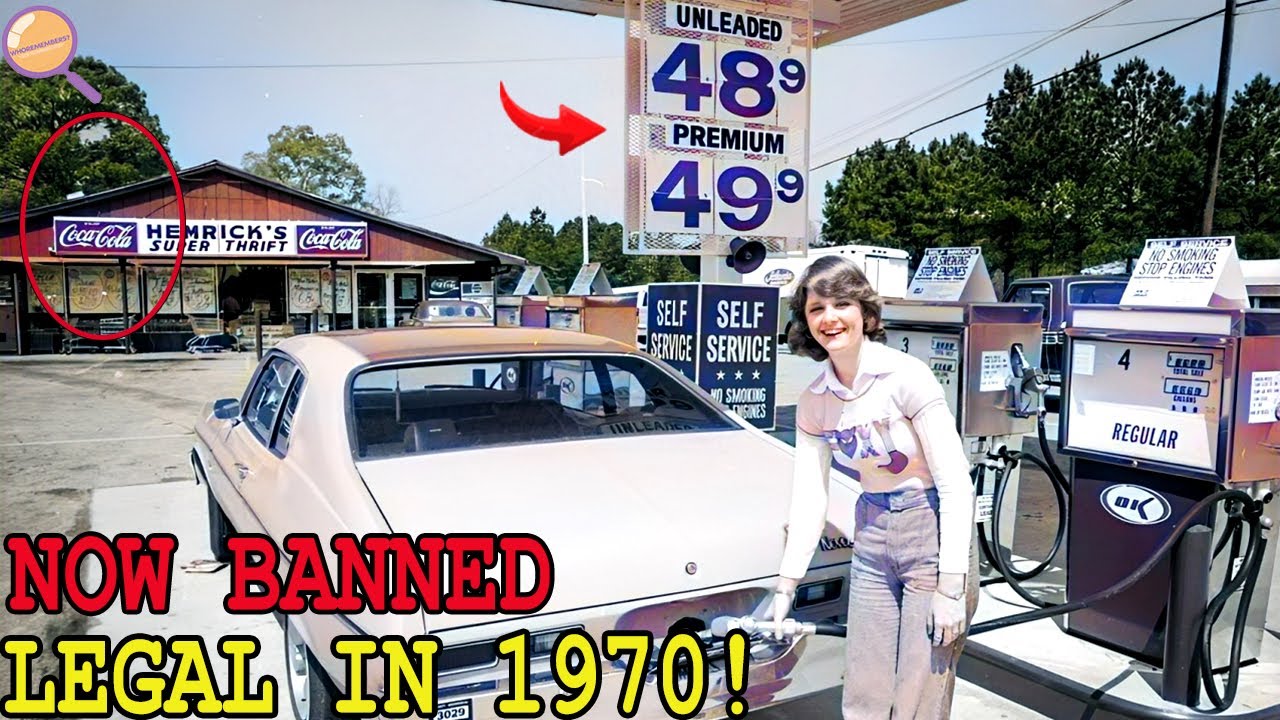
Leaded gasoline was another silent public health crisis. Nearly every pump dispensed leaded gasoline, a fuel additive that had been used for decades to boost engine performance and reduce knocking. Drivers loved it, and car manufacturers built engines to take advantage of it. But every trip to the pump was also contributing to a serious problem.
As cars burned leaded fuel, they released toxic lead particles into the air. Studies began linking lead exposure to developmental delays, brain damage, and behavioral issues, especially in children. By the mid-1970s, the U. S.
government took action, mandating a gradual phaseout of leaded gasoline. At first, there was pushback. Many believed unleaded fuel would harm car engines. But by the 1990s, leaded gasoline had mostly disappeared.
Lead-based paint was just as common, covering homes, schools, playground equipment, even children’s toys and cribs. Bright, durable, and long-lasting, it seemed like the perfect choice. But beneath its convenience lurked a dangerous secret. Children exposed to lead dust or chipped paint suffered severe health problems, including developmental delays, learning disabilities, and even organ damage.
In 1978, lead-based paint was banned for residential use. But by then, millions of homes were already coated in it, and many still are today. Disturbing old paint can still release toxic lead dust into the air. In the 1970s, lawn darts were a backyard staple.
Families and friends would gather outside, taking turns hurling large metal-tipped darts toward a circular target on the grass. The game seemed innocent enough, like horseshoes, but with high-flying projectiles. These darts weren’t lightweight toys. They were heavy and sharp enough to pierce the ground, and unfortunately, sometimes people.
A misplaced throw or a distracted child wandering into the game zone could result in serious injuries, and tragically, even fatalities. For years, warnings piled up, but the game remained wildly popular. It wasn’t until the late 1980s, after multiple severe accidents, that the U. S.
government finally banned lawn darts altogether. Drinking and driving were also shockingly common, and legal blood alcohol concentration limits were far more lenient than today. Many states allowed drivers to get behind the wheel with a BAC of 0. 10% or even higher, well above the current national standard of 0.
08%. In some places, law enforcement took a relaxed approach, often letting intoxicated drivers off with a warning. The social stigma surrounding drunk driving was minimal. A major turning point came in 1980 when Mothers Against Drunk Driving, MADD, was founded after a grieving mother lost her child to a drunk driver.
MADD and other advocacy groups fought hard for stricter DUI laws and public awareness campaigns. By the mid-1980s, most states had lowered the legal BAC limit to 0. 08%, and drunk driving began to be seen as a serious crime rather than just bad judgment. In the 1970s, air travel was remarkably relaxed.
There were no long security lines, no X-ray screenings, and no need to remove shoes or limit liquids. Passengers could walk straight to the gate with family and friends, and cockpit doors remained unlocked mid-flight. However, this lax security came at a cost. Hijackings surged, with over 200 incidents recorded in 1972 alone.
Despite this, major security overhauls were slow to take effect. The devastating attacks of September 11th, 2001, changed everything. The Aviation and Transportation Security Act led to the creation of the TSA, ushering in strict security measures, including baggage screenings, reinforced cockpit doors, and passenger screening protocols that continue to evolve today. Seatbelt use was more of a personal choice than a safety requirement.
Many cars, especially older models, didn’t even come with seatbelts in the back seats. It was common to see kids moving freely around the car, sitting on the armrests, or even standing on the backseat during long drives. Many drivers believed seatbelts were restrictive, uncomfortable, or even unnecessary. It wasn’t until 1984 that New York became the first state to enact a mandatory seatbelt law.
Over time, more states followed, and by the 1990s, seatbelt laws became the norm. Child car seat laws were practically nonexistent too. Many parents relied on standard seatbelts, or simply held babies in their laps. It wasn’t until a groundbreaking 1985 study revealed that car crashes were the leading cause of death for children aged 1 to 4 that attitudes began to change.
Today, every state has laws mandating child safety seats. Even toys were dangerous. Clackers, made of two heavy acrylic balls attached to a string, were as thrilling as they were dangerous. If you lost control, those hard plastic balls could smack you right in the face, or worse, shatter into flying shards.
Reports of injuries led to widespread bans in schools. The Easy Bake Oven, a miniature kitchen appliance that let children bake real cakes using just a tiny light bulb, could reach temperatures over 350 degrees Fahrenheit. Children’s fingers could get trapped inside, and in some cases, kids suffered second-degree burns. By the early 2000s, modern Easy Bake Ovens replaced the traditional light bulb with safer enclosed heating elements.
The 1970s were also a time when it wasn’t unusual to see children working, especially in agriculture, family businesses, or lower-income households. Many parents believed that having a job at a young age built character and taught responsibility. While the Fair Labor Standards Act had been in place since 1938, child labor laws remained relatively lax, particularly in industries like farming. In 1989, the United Nations adopted the Convention on the Rights of the Child, emphasizing the importance of education over employment.
The U. S. eventually tightened regulations under the FLSA, making it illegal for children to work in hazardous conditions. Times have changed, and so have the rules.
What once felt normal is now a thing of the past. The risks that were once shrugged off as part of everyday life are now recognized as serious dangers. The freedom of the 1970s came at a cost, and the laws that followed were a direct response to the harm that freedom allowed.