In the summer of 1937, a twenty-two-year-old American woman named Jean de Koven arrived in Paris with her aunts. A dance teacher from Boston who had trained in ballet and classical dancing, she had recently moved to New York before making the journey across the Atlantic. The city was hosting the World’s Fair, described as one of the most spectacular cultural events of the century, and the trio took rooms at the Hotel Ambassador on the Left Bank. Soon after their arrival, while trying to locate a friend, the young women were approached by a charming stranger who offered his services as an interpreter.
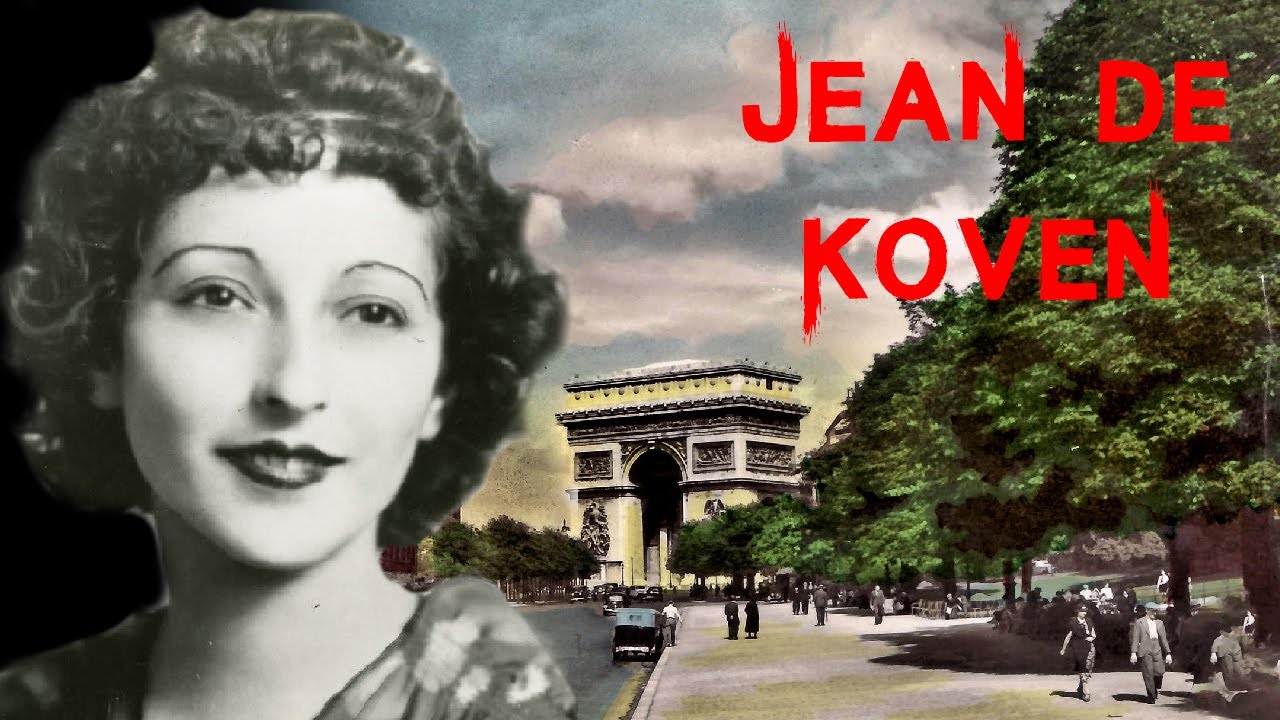
He introduced himself as Siegfried, joked that they should call him Bobby, and made a favorable impression. Before long, he asked if he could see Jean again. She agreed, and wrote excitedly to a friend that she had met a charming German of keen intelligence. On the 26th of July, she said goodbye to her aunts and went to visit him at his villa.
That evening, her aunt, Ida Sackheim, grew concerned. Jean was supposed to return for the opera. When a telegram arrived the next morning saying that all was well, the aunt remained uneasy and went to the police. They dismissed her worries, suggesting that a young lady spending the night with a man was hardly unusual.
The following evening, a second note arrived. This time it stated that Jean had been kidnapped and that five hundred dollars would be required for her safe release. The police still did not take the matter seriously, suspecting that the missing woman was simply seeking publicity, though they agreed to monitor the locations mentioned for the ransom handover. The American consulate was informed, and it was then noted that Jean had left the hotel carrying three hundred francs and four hundred and thirty dollars in traveler’s checks.
Soon afterward, those checks began to be cashed at respectable institutions, including a perfumery, two banks, and the Place de l’Opéra. The signatures were unconvincing, which suggested that someone was impersonating her, but this only deepened the mystery rather than solving it. Under pressure from the American consulate, the kidnapping was made public on the 7th of August. When her brother Henry arrived in Paris and offered a reward of ten thousand francs, he insisted that his sister was a serious-minded girl incapable of an escapade or publicity stunt.
The police, however, had noted discrepancies in the telegrams sent to the aunts. One had been addressed to “Aunt Seki,” while Jean always called her aunts “Aunt Saki. ” The aunts believed the mysterious young man was behind the disappearance. But as the weeks passed, no further ransom demands were made and no more checks were cashed.
Then, on the 8th of September, the body of a chauffeur named Joseph Cuffy was found on the Paris-Orléans road near Tours. He had been shot in the back of the neck, and about two thousand five hundred francs were missing from his wallet. His car was gone. Before his death, he had been hired outside the Palais Garnier by a wealthy, well-spoken client, possibly English, who had asked to be driven to Cannes.
Eleven days later, the case of Jean de Koven was closed. The police still believed she might have disappeared for publicity, though they classified the case as unsolved. Her brother and aunt returned to Boston. On the 16th of October, a theatrical producer named Roger Leblanc left his home in Paris to meet two gentlemen who had promised to invest in his shows.
He never returned. His body was found that same day in a parked car near a cemetery, shot in the back of the neck. Five thousand francs were missing. Six weeks later, on the 28th of November, a real estate agent named Raymond Lesobre was found dead in the cellar of a villa in Saint-Cloud, a property he had been showing to a potential client described as an elegant gentleman with a foreign accent.
He too had been shot in the back of the neck, his wallet taken and his car missing. The police searched the villa and discovered a business card belonging to Arthur Schott, a traveling salesman. Commissioner Primborgne took up the investigation and located Schott in Strasbourg, but he had a solid alibi. He did, however, mention that he had recently given a few of his new cards to people in Paris, including his nephew, a young German named Fritz Frommer, who had recently gone missing.
Frommer had been released from a German prison, where he had been held for his anti-Nazi views, and had come to Paris but had not been seen since the 22nd of November. The police traced Frommer to a backstreet hotel in the Rue Sébastien. His belongings were still in his room, and the owner mentioned that he had an uncle in Paris, a German named Hugo Webber. When questioned, Webber said that his nephew usually had dinner with him on Sundays but had not appeared.
He added that Fritz often visited a young German whose last name was Carrère, a handsome and charming man who spoke both English and French very well. Webber said he did not trust Carrère and thought he probably did not operate within the law. The two men had met while imprisoned together in Saarbrücken, in Germany near the French border. Commissioner Primborgne traced Carrère to a rented villa in Saint-Cloud.
The landlady, Madame Marie Bruh, said the tenant had been late with his rent in October and November, and that the November payment had not been made until the 29th, the day after Lesobre’s body had been found. Two detectives were sent to the villa. When they arrived, no one was there, but two cars sat in the yard, and one carried the same registration number as Lesobre’s missing vehicle. The detectives waited.
When a young man approached and introduced himself as Monsieur Carrère, they pretended to be tax inspectors and asked to speak with him inside. Once through the door, they identified themselves as police and asked for his documents. The young man calmly reached into his pockets and pulled out a gun. He shot one detective in the shoulder and fired twice more, grazing another named Bourgeon.
The officers managed to overwhelm him when one struck him with a small hammer found on a table. Carrère was arrested and taken to the station. On his person, the police found a gold lighter that was later confirmed to have belonged to Raymond Lesobre. Both cars in the yard were identified: one had belonged to Lesobre and the other to Joseph Cuffy.
At first, the prisoner refused to speak anything but German, but when he learned there were German-speaking officers available, he became far more cooperative. He admitted that his real name was Eugen Weidmann. Born in Frankfurt on the 5th of February 1908, he had been well educated by respectable parents. He was first imprisoned for theft at sixteen, then again in Canada for robbery, and once more in Germany upon his return.
In every prison, he was regarded as a model inmate. The search of the Saint-Cloud villa produced further horrors. A body found in the cellar was identified as Fritz Frommer. When police noticed that the front steps had recently been replaced, they dug further and made another macabre discovery: the body of a young woman buried with her camera.
It was Jean de Koven. The film was developed, and the photographs showed a tourist enjoying a lovely day in Paris, alongside images of the young man she had been so happy to visit, the man she knew as Siegfried. When questioned, Weidmann expressed some regret, saying tearfully that she was gentle and unsuspecting, and that when he reached her throat, she went down like a doll. Also found at the villa were the passports belonging to another missing woman, Mademoiselle Janine Keller, who had come to Paris from Strasbourg in early September after answering a help-wanted advertisement.
Weidmann told the detectives he had placed the ad for a private nurse. When she arrived, he took her for a walk in the woods near Fontainebleau, shot her in the back of the neck, robbed her of fourteen hundred francs, and removed a diamond ring from her finger. He agreed to take officers to the cave where he had hidden her body. Weidmann initially refused to name accomplices, but once the others were arrested, he became more forthcoming.
The gang had first come together in the prison at Saarbrücken, where they had planned to kidnap wealthy tourists. After their release, they recruited a woman named Renée Tricot to run errands and cash traveler’s checks, though she later claimed she had been forced to help. Fritz Frommer, who had been killed and buried in the cellar of Weidmann’s house, was believed to have been eliminated because Weidmann feared he would inform the police once their plot had turned to murder. The body of Jean de Koven was returned to New York, where a funeral service was held on the 31st of December 1937 before her burial in Mount Carmel Cemetery.
The trial of Eugen Weidmann, Roger Mylon, Jean Blanc, and Renée Tricot took place in Versailles in March 1939. It was a sensational affair that gripped the whole of France, with the papers reporting daily on the proceedings. The outcome was never in doubt. Weidmann and Mylon were sentenced to death.
Jean Blanc received a twenty-month jail term, and Renée Tricot was acquitted. Mylon’s sentence was later commuted to life in prison. Weidmann’s execution was set for the 17th of June 1939 outside the Saint-Pierre prison in Versailles. Crowds began gathering the evening before, desperate for a vantage point.
Building owners overlooking the square charged exorbitant sums for balcony seats. So many in the crowd became drunk and disorderly that President Albert Lebrun banned all future public executions. Eugen Weidmann was the last person to be publicly executed in France.