For two centuries, the story of Abraham Lincoln was treated as settled. He was the rail-splitter, the self-taught backwoodsman from a Kentucky log cabin, the self-made man who saved the Union. His ancestry, historians agreed, began in the American frontier and stretched back to England, where his forebears sailed from in 1637. The paper trail seemed complete.
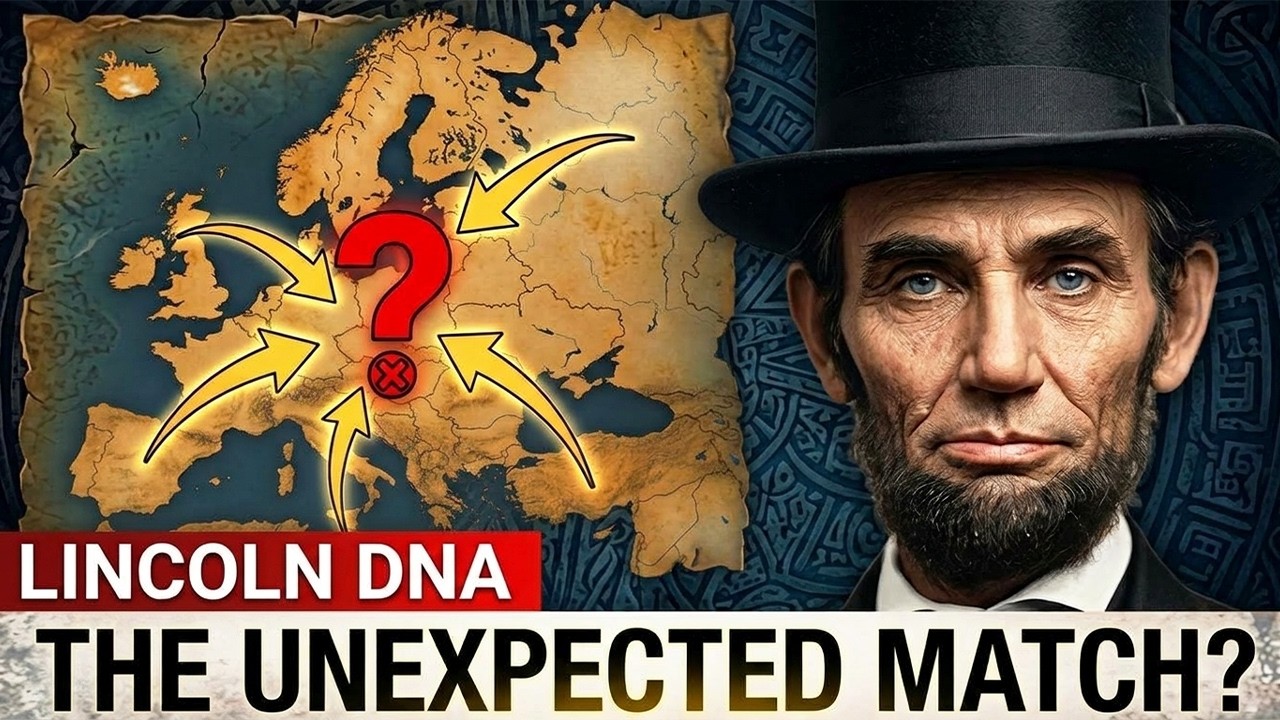
Then geneticists ran the Lincoln bloodline against the DNA databases of major European populations, and the result defied every expectation. It did not point to England. It pointed to the Alps, to a rare genetic signature concentrated in northern Italy and Switzerland, and further still, on his mother’s side, to the ancient Near East. The man who described himself as having no distinguished ancestors was carrying one of the most unexpected bloodlines in European history.
The Lincoln paternal line begins with a boy named Samuel Lincoln. He was born in 1622 in Hingham, a small village on the flat green edge of Norfolk, England. His grandfather had once owned property, but a bitter dispute over a will stripped Samuel’s father Edward of his inheritance and pushed the family to the margins. With no land and no fortune, Samuel was sent at a young age to become an apprentice weaver under a man named Francis Laws in the city of Norwich.
In 1637, at fifteen years old, he boarded a ship called the John and Dorothy at the port of Great Yarmouth and sailed west. He was not a conqueror or an explorer. He was a teenager betting his life on a continent he had never seen. He landed in Massachusetts Bay Colony and eventually settled in a town he named Hingham, after the Norfolk village he had left behind.
Every Lincoln who followed him, through Virginia, Kentucky, and finally Illinois, carried the same Y chromosome Samuel brought off that ship. For most of American history, that was where the story ended. Samuel Lincoln came from English stock, plain and simple. But geneticists do not accept a paper trail as the final word.
When researchers built the Lincoln DNA project and tested multiple verified descendants of Samuel Lincoln, the results were consistent. They all matched. They all belonged to Haplogroup R1b, the most common paternal lineage in Western Europe, shared by hundreds of millions of men across Britain, France, Spain, Germany, and Ireland. On its own, that told almost nothing.
But R1b is not a single thing. It is a tree with dozens of branches, each one pointing to a different ancient population, a different migration, a different homeland. The real question was not whether Lincoln was R1b. It was which branch.
The geography suggested one answer. Samuel Lincoln came from Norfolk, in East Anglia, where the dominant R1b lineages lean toward Anglo-Saxon and earlier northern populations. That is not what the DNA said. The Lincoln paternal line belongs to the subclade R1b U152, the Alpine and Italian branch.
Its highest concentrations are found in northern Italy, where it reaches over fifty percent of the male population in some regions, and in Switzerland, where it sits around forty percent. It fades through southern Germany and eastern France before disappearing toward the coasts. This was not an English lineage that picked up a stray marker. This was a lineage whose ancestral homeland lay thousands of miles from the Norfolk village where Samuel Lincoln was born.
It had reached England the way all ancient lineages travel: through centuries of migration, conquest, trade, and the movement of peoples across a continent that has never held still. The Romans carried U152 into Britain. Latin Celtic tribes carried it north and west across Europe long before Rome existed. At some distant point, a man carrying this Alpine signature settled in England, and his descendants eventually produced a weaver’s apprentice named Samuel.
The specific subclade beneath U152, known as L2, places Lincoln in remarkable company. The House of Habsburg, the dynasty that ruled the Holy Roman Empire, controlled Spain, Austria, Bohemia, and Hungary, and shaped the political destiny of Europe for six centuries, has been tested through the Habsburg family DNA project. All twenty verified male Habsburgs tested belong to R1b U152 L2, the same deep branch of the same ancient Alpine tree. This does not mean Lincoln was secretly royal.
R1b U152 is carried by millions of ordinary men across northern Italy, Switzerland, and southern Germany. Sharing a subclade with the Habsburgs means that, roughly three thousand years ago or more, Lincoln’s paternal ancestors and the Habsburgs’ paternal ancestors were part of the same Alpine population. But it also means the log cabin was not the beginning of the story. It was just the chapter America got to read.
The maternal side of Lincoln’s family is a different kind of story entirely: a story of silence, scandal, and a mystery Lincoln himself refused to touch. His mother, Nancy Hanks Lincoln, died of milk sickness in the Indiana wilderness when Abraham was nine years old. He barely spoke about her for the rest of his life. His law partner William Herndon, who knew Lincoln for seventeen years, wrote that Lincoln would go quiet when the subject of his mother came up.
He confided reluctantly, and only once, that Nancy had been born out of wedlock, that her mother Lucy Hanks had never married Nancy’s father, and that the father’s identity had never been established. Lincoln described his maternal grandfather as a so-called nobleman of Virginia, a deliberately vague phrase, the sound of a man protecting something he did not fully understand and did not want examined. For over a century, genealogists and biographers fought bitterly over Nancy Hanks’s origins. Two competing theories divided the field.
One held that Lucy Hanks was the daughter of Joseph Hanks and Anne Lee of Virginia, making Nancy the illegitimate child of an unknown Virginia man. The other held that Lucy was actually a woman named Lucy Shipley who married into the Hanks family, making the bloodline entirely different. The argument grew so fierce it became one of the most contested genealogical disputes in American history. Lincoln knew the ground was unstable, so he left it alone.
He chose the myth of the frontier over the truth of the blood. In October 2015, on the 150th anniversary of Lincoln’s assassination, a team of researchers announced the results of the Nancy Hanks Lincoln mitochondrial DNA study. They had tracked down living maternal descendants of Lucy Hanks, tested their mitochondrial DNA, and cross-referenced the results against both competing theories. The verdict was conclusive.
Lucy Hanks was the daughter of Joseph Hanks and Anne Lee of Virginia. The Shipley theory was eliminated. The DNA confirmed what Herndon and Lincoln himself had quietly believed. Nancy Hanks was born outside marriage, and her maternal grandfather remains to this day an unknown man.
But that was not the part that made researchers go quiet. Lincoln’s mitochondrial DNA, the line passed exclusively through mothers, belongs to Haplogroup X1c. This is not a common European lineage. It appears in less than one percent of most European populations.
It is concentrated with striking intensity among the Druze, an ancient religious community living in the mountains of the Levant in modern-day Syria, Lebanon, and Israel. Studies have found that the Galilee Druze carry the X haplogroup at rates as high as fifteen percent, the highest frequency of any X population on the planet. Geneticists describe them as a phylogenetic refugium, a living genetic time capsule preserving a snapshot of the ancient Near East from before the modern world reshuffled the population. Lincoln’s maternal blood does not begin in Virginia.
It begins somewhere far older, in the deep history of the ancient Near East, carried west by waves of migration so ancient they predate any written record, threading through generations of unknown women until it reached a girl named Lucy Hanks in the hills of Virginia, and then a nine-year-old boy standing at his mother’s grave in Indiana who would grow up to hold a nation together. The DNA also connects to Lincoln’s physical condition. He stood six feet four inches tall at a time when the average American man stood five feet seven. His limbs were disproportionately long, his hands enormous, his face asymmetric with one cheekbone slightly higher than the other.
His skin was leathery and deeply furrowed, his ears too large, his movements loose and slightly uncoordinated. Medical historians have debated his diagnosis for decades. In 1962, a physician proposed Marfan syndrome, a genetic connective tissue disorder producing extreme height, long limbs, and cardiovascular vulnerability. More recently, cardiologist John Sotos proposed multiple endocrine neoplasia type 2B, a rare genetic cancer syndrome producing a marfanoid body and progressive physical deterioration.
Both conditions are autosomal dominant, inherited from one parent, and researchers studying Nancy Hanks found she displayed the same tall, lean, angular frame, the same myopathic facial structure. Mother and son carried the same genetic shadow in their bones. Lincoln is not the only American founding figure whose DNA points back to this same Alpine corner of Europe. The Washington DNA project traced George Washington’s paternal ancestry to Oxfordshire and Lancashire, with the shared haplotype pointing strongly toward R1b U152, the same Alpine subclade as Lincoln.
Thomas Paine, author of Common Sense, came from a family originating in Norfolk, the same county as Samuel Lincoln, and at least one member of the Paine family DNA project with confirmed Norfolk ancestry carries R1b L2, the same deep branch of U152 that appears in the Lincoln line. What this suggests is not a conspiracy. It suggests that a specific ancient Alpine Celtic population, dispersed across Europe during the Iron Age, gradually pushed west through France, crossed into Britain, settled in the quiet counties of England, and then in the seventeenth century boarded ships and crossed the Atlantic. They did not know they were related.
They were simply chasing land and freedom. But the chromosome remembered what the men had forgotten. One thing has always haunted the field, however. Everything known about Lincoln’s DNA has been assembled indirectly, through descendants and maternal relatives, because researchers have never been able to sequence Abraham Lincoln’s own DNA directly.
The violence of his assassination on April 14, 1865 left biological evidence scattered across preserved relics: blood-stained items, hair samples, a skull fragment. The problem is contamination. Decades of handling have compromised nearly every object. In 2020, researchers grew excited over a blood-stained piece of curtain recovered from the theater box where Lincoln was shot.
A viable DNA sample was extracted. But when the mitochondrial DNA was sequenced and compared against the known Lincoln maternal line, the haplogroup did not match. It was not Lincoln’s blood. It was an identical match for Major Henry Reed Rathbone, the army officer sitting beside the president that night who was stabbed by John Wilkes Booth during the attack.
The relic had authenticated itself perfectly, just not as Lincoln. Researchers hold other samples under carefully controlled conditions, waiting for the moment when next-generation sequencing technology advances far enough to extract a clean signal from contaminated sources. When that moment arrives, the full genome of Abraham Lincoln will be readable for the first time. Scientists already have a prediction for what it will show: a Y chromosome pointing to the Alps, a mitochondrial line pointing to the ancient Levant, and in between, the genetic record of a man far more ancient and complex than the frontier myth ever allowed.
Abraham Lincoln knew almost nothing of this. During the 1860 presidential campaign, when asked about his ancestry, he waved the question away. He described himself as coming from undistinguished families, said there was nothing in his background worth examining. He chose the log cabin story because it was the only story available to him.
But the chromosomes were keeping a different record. The Y chromosome he inherited from his father traces back to the Alpine populations of ancient Europe, to Celtic and Italic tribes who carried their bloodline north through Gaul, across the channel, and into the quiet counties of England, where it produced a weaver’s apprentice who got on a boat. The mitochondrial DNA his mother carried belongs to one of the rarest lineages on Earth, connecting him through deep time to the ancient communities of the Near Eastern Levant. Two ancient bloodlines, one from the Alps and one from the Levant, each traveling thousands of miles and thousands of years, each threading through generations of ordinary, unnamed people, met in a log cabin in Kentucky in 1809 and produced a president.
Lincoln once said he did not know who he was. He meant it humbly, as a statement about social class and family obscurity. It turns out he was more right than he knew. The full answer to that question was written in a language he never had access to, pressed into every cell of his body, waiting two centuries for the science to catch up.
Now it has. The most American of all Americans was built from the oldest blood in Europe.