In the summer of 1944, the Allied campaign in Normandy had stalled. Forty days after D-Day, American forces had advanced only about 15 miles inland through the dense hedgerow country of the Cotentin Peninsula. The British had failed to capture the city of Caen on schedule. And the supreme commander of the Allied Expeditionary Force, General Dwight David Eisenhower, was exhausted, chain-smoking, and suffering from a gastric ulcer that had never fully healed.
Eisenhower was 53 years old and had spent 33 years in the United States Army. He commanded from Bushy Park, a royal park in London, where his headquarters consisted of about 200 Nissen huts and prefabricated buildings scattered under the trees. His personal driver, secretary, and aide was Kay Summersby, a 35-year-old Irishwoman who had served on his staff since 1942. She later wrote that she had never seen him more physically exhausted than during the July 1944 period.
The problem was simple to state and difficult to solve. The American forces needed to break out of Normandy. The general who could lead that breakout, Lieutenant General George S. Patton Jr., was not available. Patton was in Kent, England, commanding a fictional army group as part of the FUSAG deception, a plan designed to convince the German high command that the main Allied invasion would come at the Pas de Calais rather than Normandy.
The deception was working. Approximately 250,000 German soldiers of the 15th Army remained in defensive positions along the Channel coast from Dunkirk to Le Havre, waiting for an invasion that would never come. If Patton was seen in Normandy, the deception would collapse. The German 15th Army would be released south, and the American breakout would become impossible.
Patton was 58 years old and furious. His diary entries from early July 1944 recorded his belief that he had spent more of his career waiting to fight than any American general of his generation. He believed Eisenhower was allowing Montgomery to stall. He believed Bradley was doing his best but that the American First Army lacked the commander required to break out. He was, in practical terms, correct. But he could not yet be activated.
Field Marshal Bernard Law Montgomery, the British ground forces commander, was 56 years old. He had defeated Rommel at El Alamein in 1942 and was the most celebrated British general of the war. He was also a non-drinker, a non-smoker, and a vegetarian who ate one meal per day and went to bed at approximately 9:30 every evening, regardless of the tactical situation. He preferred to conduct meetings at his own Portsmouth headquarters rather than travel to Bushy Park, contributing to the communication difficulties that defined his relationship with Eisenhower.
Montgomery had promised that his British Second Army would capture Caen on D-Day itself. It had not been captured. Northern Caen was partially taken on July 9 during Operation Charnwood, at the cost of approximately 3,500 British and Canadian casualties and the destruction of about 80 percent of the city by RAF Bomber Command. Southern Caen remained in German hands on the evening of July 15.
The terrain itself was a formidable obstacle. The bocage of Normandy consisted of small agricultural fields, typically a quarter of an acre in size, surrounded by tall, thick hedgerows on earth banks 5 to 10 feet high. Every hedgerow could conceal a German machine gun nest. Every sunken lane could be infiltrated by German anti-tank fire. American Sherman tanks, designed for open ground, were blind, slow, and vulnerable in the bocage.
An American sergeant solved the problem. On July 14, 1944, Sergeant Curtis Grubb Culin III, aged 29, of Cranford, New Jersey, demonstrated an innovation he had welded to the front of his Sherman tank. He had taken pieces of German beach obstacles, the angle-iron structures nicknamed "Rommel's Asparagus," and welded them into a pronged plowing device. The device was called the Rhino. When the tank drove forward against a hedgerow, the prongs dug into the earth bank and uprooted the hedgerow rather than exposing the tank's unarmored belly to German anti-tank fire.
General Omar Bradley, commander of the American First Army, approved mass production immediately. Welding units began equipping Sherman tanks at a rate of about 50 per day. By July 25, approximately 60 percent of American Sherman tanks in the First Army had been equipped with Rhino prongs. Culin was awarded the Legion of Merit. He lost his right leg to a German mine in the Hürtgen Forest on November 3, 1944. He died in 1963 at the age of 48 from complications from his war wound. Most of the soldiers whose lives were saved by his invention never knew his name.
On July 17, 1944, Field Marshal Erwin Rommel was traveling in a staff car near the villages of Sainte-Foy-de-Montgommery and Vimoutiers, about 40 miles east of Caen. A formation of two Spitfire fighters of the Royal Canadian Air Force 412 Squadron spotted the car from about 8,000 feet. The lead pilot, Flight Lieutenant Charles William "Charlie" Fox, aged 24, of Guelph, Ontario, dove and opened fire. Cannon rounds struck the driver's compartment. The car swerved off the road and rolled into a ditch. Rommel was thrown from the vehicle and struck his head against a stone, suffering multiple skull fractures.
Rommel survived but never returned to his command. He was replaced by Field Marshal Günther von Kluge, aged 62, who was unfamiliar with the Normandy terrain. The historical debate over who fired the fatal rounds continued for decades. Fox survived the war and died in 2008 at the age of 88. Rommel recovered physically but was implicated by the Gestapo in the July 20 plot against Hitler. Given a choice between suicide with preservation of his family's honor or a public trial ending in execution, he chose suicide. He died on October 14, 1944, at the age of 52.
Eisenhower learned of Rommel's wounding on the morning of July 18. He acknowledged it as a tactical advantage and returned to his maps without further comment. He was preparing for a meeting with Montgomery, who was about to launch Operation Goodwood.
Goodwood was the largest British armored offensive of the Second World War. Approximately 700 British tanks would lead the opening attack, with about 1,100 total committed. The offensive would be preceded by the largest tactical air attack of the war to that date: approximately 1,000 RAF Bomber Command heavy bombers and 570 American Eighth Air Force heavy bombers dropping about 7,000 tons of bombs on German positions south of Caen.
The ground attack began at 8:30 a.m. on July 18. The British 11th Armored Division led the advance and initially moved about 5 miles into the German defensive zone. Then the advance stopped. The German 21st Panzer Division counterattacked from the eastern flank. German 88mm anti-tank guns on the Bourguébus Ridge engaged British tanks at ranges of 1,500 to 2,000 yards. By the evening of July 18, approximately 200 British tanks had been destroyed or damaged. By July 20, when rain began to fall and the ground became too soft for further armored advance, British losses had reached approximately 400 tanks, about one-third of the total British armor committed to Normandy. Approximately 5,500 British and Canadian soldiers had been killed or wounded. The Bourguébus Ridge had not been reached. The Falaise plain had not been approached.
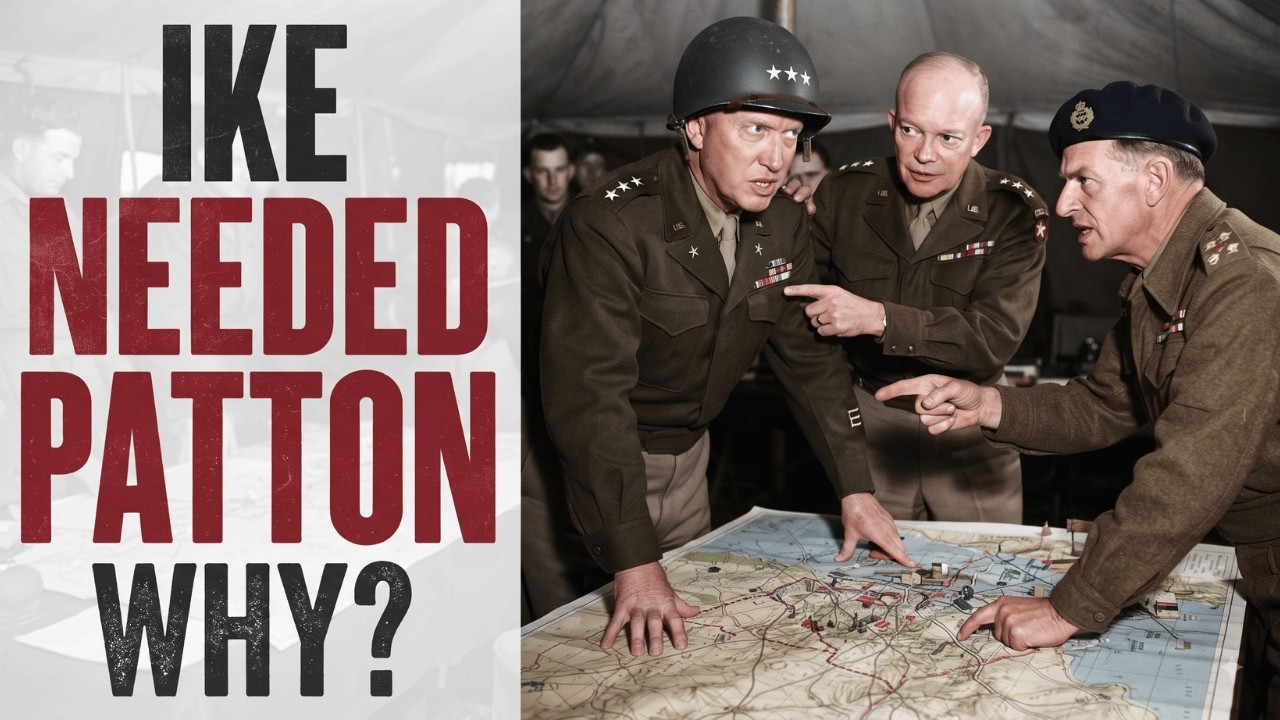
Montgomery held a press conference on the evening of July 20 and described Goodwood as a successful operation that had achieved its tactical objectives. Morning newspapers on July 21 described it as a successful breakout. Within 24 hours, the true tactical situation became clear. There had been no breakout. The American press turned against Montgomery. Churchill was furious.
Eisenhower received the after-action reports on July 20 and 21. He considered requesting Montgomery's removal from ground forces command but did not. The American Congress and public would not have accepted the removal of the British ground forces commander in the middle of the campaign. Churchill would not have permitted it. The damage to the Anglo-American alliance would have been severe. But Eisenhower's confidence in Montgomery was permanently reduced.
On the same evening of July 20, in a German military headquarters in East Prussia, Colonel Claus von Stauffenberg placed a briefcase containing a plastic explosive under a conference table in the presence of Adolf Hitler. The bomb detonated at 12:42 p.m. Four German officers were killed. Hitler was wounded but survived. Stauffenberg was executed by firing squad in Berlin at approximately 12:30 a.m. on July 21.
The German response was catastrophic. Approximately 5,000 German military and civilian personnel were arrested by the Gestapo in the months that followed. Approximately 200 were executed. The German officer corps was decimated. Rommel, recovering at his home, was implicated. Field Marshal von Kluge, commanding in Normandy, was also implicated. Both would die within three months. The German command in Normandy was paralyzed by the ripple effects during the critical weeks when Operation Cobra was being planned and executed.
Cobra was scheduled for July 24 but weather forced a 24-hour postponement. The new date was July 25, 1944.
At 9:38 a.m. on July 25, the first wave of approximately 1,500 American heavy bombers of the Eighth Air Force, 380 medium bombers of the Ninth Air Force, and 550 fighter-bombers began their bomb runs over a rectangular target zone west of Saint-Lô. Approximately 4,500 tons of bombs were dropped in the single most concentrated tactical air attack of the ground war in the European theater.
The bombing destroyed the German Panzer Lehr Division. Approximately 70 percent of the division was killed, wounded, or rendered combat ineffective. But the bombing had a catastrophic secondary consequence.
The target zone was located approximately 1,200 yards south of American forward positions. A north wind of about 15 knots was blowing from the American lines toward the German positions. The first wave of bombers dropped accurately. The explosions produced an enormous cloud of dust and smoke that drifted north toward the American forward positions. The second wave of bombers, arriving about 20 minutes later, could not clearly see the target zone through the dust cloud. They used the dust cloud as their visual reference and dropped their bombs on it rather than on the target zone beyond.
Approximately 111 American soldiers were killed and approximately 490 were wounded by bombs dropped by their own air force. The casualties were concentrated in the American 30th Infantry Division.
One of the dead was Lieutenant General Leslie James McNair, aged 61, of Verndale, Minnesota. McNair was the commanding general of the Army Ground Forces, responsible for the training and organization of American combat units sent to Europe since 1942. He was officially serving as the public commander of the FUSAG deception in Kent, having replaced Patton in that role when Patton was secretly transferred to Normandy in early July for the Third Army activation planned for August 1.
German intelligence believed McNair was in Kent commanding the fictional First United States Army Group. They did not know he was actually in Normandy observing the Cobra bombardment from a forward foxhole with the 30th Infantry Division. McNair was killed instantly by an American bomb. He was the highest-ranking American general officer killed in the European theater during the Second World War.
Bradley learned of the McNair casualty on the afternoon of July 25. Eisenhower learned that evening. Kay Summersby brought him the casualty report at approximately 8 p.m. She later wrote that he was silent for an extended period after reading it. He communicated the news to General George Marshall in Washington and communicated the decision that McNair's death would be kept classified for 30 days to preserve the FUSAG deception. Marshall did not overrule him. Eisenhower gave the order.
McNair was buried at a temporary American cemetery near Grandcamp-les-Bains in Normandy on July 26 with a small honor guard and no press coverage. His body would later be permanently interred at the Normandy American Cemetery and Memorial at Colleville-sur-Mer.
His wife, Clara Manley McNair, approximately 61 years old, of Washington, D.C., received the War Department telegram about three days later on July 28. The telegram informed her that her husband had been killed in action in the European theater on July 25. The circumstances were classified. She was not told that he had been killed by American bombs. She was not told that his death was to be kept secret for 30 days. She was told only that her husband was dead.
Twelve days later, on August 6, 1944, on the Pacific island of Guam, Lieutenant Colonel Douglas Cravier McNair, aged 37, chief of staff of the American 77th Infantry Division, was killed by a Japanese sniper while inspecting forward positions during the American reconquest of Guam. Douglas McNair was Leslie McNair's son.

The War Department telegram informing Clara McNair of her second loss arrived at her Washington home approximately five days later on August 11. She had buried her husband less than three weeks earlier. Douglas McNair was buried at the National Memorial Cemetery of the Pacific at Punchbowl Crater in Honolulu, Hawaii. His father lies in Normandy. They served in the same American army in the same American war. Their mother buried them both within 30 days.
Clara Manley McNair died in 1969 at approximately the age of 86 in Washington, D.C. She had lived for 25 years between her husband's death and her own. She never remarried. She lived alone. She visited neither grave. Colleville was too far and too expensive. Punchbowl was farther. She kept her husband's Army portrait on her mantelpiece and her son's portrait beside it. She spoke of them rarely. She lived in the silence that the American army had asked her to observe in the summer of 1944 and that she never fully broke.
After the bombing on July 25, the American VII Corps under Major General J. Lawton Collins, aged 48, of New Orleans, began the ground assault at approximately 11 a.m., less than one hour after the final American bombs had fallen on American positions. The assault force consisted of three infantry divisions and two armored divisions equipped with the Rhino tank prongs that Sergeant Culin had demonstrated 11 days earlier.
The German Panzer Lehr Division had been reduced to approximately 30 percent combat effectiveness. The American penetration on July 25 was about 3 miles. On July 26, about 6 miles. By July 27, the VII Corps had captured the French coastal town of Coutances and opened the breach in the German defensive line that Bradley had planned. Operation Cobra had succeeded.
On the evening of July 27, 1944, at Bushy Park, Eisenhower approved the Third Army activation timeline. Patton would depart England secretly on the final day of July. The Third Army would be officially activated at 12:01 a.m. on August 1, 1944, at an American Army command post near Coutances in Normandy. The activation date would be publicly announced approximately 30 days later to preserve the FUSAG deception. The German intelligence services would continue to believe that Patton was in Kent commanding FUSAG. The German 15th Army would continue to hold at the Pas de Calais, awaiting the main invasion that would never come.
Patton flew from England to France on the final day of July. He arrived at the American Army command post near Coutances at approximately noon on August 1, 1944, wearing the uniform of a lieutenant general of the United States Army with the ivory-handled revolver on his belt. He assumed command of the Third Army and addressed his staff officers at approximately 5 p.m. He recorded in his diary the sense of personal fulfillment that he had waited for throughout his 39-year Army career.
The Third Army raced from Normandy through Brittany to the west, through the Loire Valley to the south, and through the Marne region to the east during the 31 days between August 1 and August 31, 1944. It liberated Laval on August 8. It reached the Falaise pocket on August 13. Between August 13 and August 19, approximately 100,000 German soldiers escaped east through the unclosed northern shoulder of the pocket. Patton had been ordered by Bradley to halt at Argentan on August 13 because of concern about friendly fire between American forces advancing north from Argentan and Canadian forces advancing south from Falaise. The pocket was finally closed on August 20. Approximately 50,000 German soldiers were killed or captured, but 100,000 had escaped. Patton was bitter about the missed opportunity for the rest of his life.
Paris was liberated on August 25, 1944. On August 31, 1944, at approximately midnight, the Third Army reached the Meuse River in eastern France. It had covered approximately 400 miles in 31 days. It stopped. It had run out of gasoline.
The SHAEF communication zone, responsible for American logistical operations behind the front, had not been able to maintain the fuel supply at the rate the Third Army required. American fuel supplies were being delivered to Normandy at a rate of approximately 2,500 tons per day. The Third Army was consuming fuel at a rate of approximately 400,000 gallons per day. The arithmetic did not balance.
The fuel that reached the American front on August 31 was diverted by Eisenhower and Bradley from the Third Army to the British 12th Army Group under Montgomery. Montgomery was planning Operation Market Garden, which would launch on September 17, 1944. It would attempt to cross the Rhine River at Arnhem in the Netherlands using the American 82nd and 101st Airborne Divisions and the British 1st Airborne Division. It would fail catastrophically. The British 1st Airborne Division at Arnhem would be destroyed. The Allied crossing of the Rhine would be delayed until March 1945. The fuel that had been diverted from Patton to Montgomery had been wasted.
Patton was bitter for the rest of his life. He recorded in his diary his belief that the American logistical decision had cost the Allied forces the opportunity to reach the Rhine before the German defensive positions could be restored. He may have been correct. He may not have been. The historical debate would continue for decades. But the practical operational fact was that the Third Army had stopped on August 31, 1944, and did not resume its advance until early September. By the time it resumed, the German defensive position along the Siegfried Line had been reinforced, and the American race across France that had defined August 1944 had ended.
Field Marshal Bernard Law Montgomery was promoted to the rank of field marshal on September 1, 1944, one day after the Third Army had stopped for lack of fuel. He commanded the 21st Army Group through the final year of the war. He gave a controversial press conference on January 7, 1945, at which he took personal credit for saving the American army during the Battle of the Bulge. He wrote his memoirs in 1958. He died on March 24, 1976, at the age of 88 at his country home at Isington Mill in Alton, Hampshire, England.
Lieutenant General Omar Nelson Bradley commanded the American 12th Army Group through the final year of the war. He was promoted to the rank of General of the Army in September 1950. He served as the first chairman of the Joint Chiefs of Staff. He died on April 8, 1981, at the age of 88 at a New York hospital. He is buried at Arlington National Cemetery.
Lieutenant General George Smith Patton Jr. commanded the Third Army through the final 10 months of the European war. He was appointed military governor of the American occupation zone in Bavaria on May 6, 1945. He was removed from that command on October 7, 1945, after political controversy over his denazification remarks. He was reassigned to the ceremonial 15th United States Army at Bad Nauheim on December 9, 1945. On December 9, 1945, near Mannheim, Germany, Patton's Cadillac staff car collided with an American Army truck at approximately 11:45 a.m. He was paralyzed from the neck down. He died on the evening of December 21, 1945, at the 130th Station Hospital in Heidelberg, Germany, at the age of 60 years and 40 days. He is buried at the Luxembourg American Cemetery at Hamm, in Row 1, Grave 228, among the 5,076 American soldiers of his Third Army who had been killed in the final year of the European war.
Lieutenant General Leslie James McNair is buried at the Normandy American Cemetery and Memorial at Colleville-sur-Mer. His son, Lieutenant Colonel Douglas Cravier McNair, is buried at the National Memorial Cemetery of the Pacific at Punchbowl Crater in Honolulu, Hawaii. They lie in two different oceans. They served in the same American army in the same American war. Their mother buried them both within 30 days of each other in July and August 1944. She died alone in Washington, D.C., in 1969.

Sergeant Curtis Grubb Culin III, the American cavalry sergeant who welded the Rhino tank prong from German beach obstacles on July 14, 1944, and whose innovation equipped 60 percent of the American Sherman tanks that broke through the Cobra opening at Saint-Lô, lost his right leg to a German mine in the Hürtgen Forest on November 3, 1944. He was awarded the Legion of Merit for his Rhino invention. He returned to civilian life in Cranford, New Jersey. He died in 1963 at the age of 48 from complications from his war wound. The majority of the American soldiers whose lives were saved by his Rhino tank prong never knew his name. His grave in New Jersey is marked with a simple military stone that lists his name, his rank, his unit, and the dates of his birth and death. The stone does not mention the Rhino.
Field Marshal Erwin Rommel, wounded by the Canadian Spitfire pilot on July 17, 1944, was forced to commit suicide by Adolf Hitler's personal emissaries on October 14, 1944, at his home in Herrlingen. He was 52 years old. Field Marshal Günther von Kluge, implicated in the July 20 plot, was recalled to Berlin on August 17, 1944. He committed suicide by potassium cyanide on August 19, 1944, in a staff car parked on a road near Metz at the age of 62.
Colonel Claus von Stauffenberg, the German officer who placed the briefcase bomb under Hitler's conference table on July 20, 1944, was executed by firing squad at the Bendler Block courtyard in Berlin at approximately 12:30 a.m. on July 21, 1944, at the age of 36. Adolf Hitler committed suicide in the Führerbunker in Berlin on April 30, 1945, at the age of 56.
Winston Churchill returned to Downing Street in October 1951 at the age of 76. He served as prime minister for a final three and a half years. He died on January 24, 1965, at the age of 90. General George Catlett Marshall served as Secretary of State under President Truman. He was awarded the Nobel Peace Prize in 1953 for his European recovery program. He died on October 16, 1959, at the age of 78 at Walter Reed Army Medical Center. He is buried at Arlington National Cemetery.
Kay Summersby remained at SHAEF headquarters in Frankfurt through June 1946. She came to the United States. She met Eisenhower briefly at the Pentagon. She was assigned to a secretarial position with the War Department. She married an American stockbroker named Reginald Morgan in 1952 and divorced him in 1958. She wrote her 1948 memoir, "Eisenhower Was My Boss," and her posthumous 1976 memoir, "Past Forgetting." She was diagnosed with lung cancer in the autumn of 1972. She died in London on January 20, 1975, at the age of 66. She never saw Eisenhower again after 1946.
Dwight David Eisenhower served as Supreme Commander of the Allied Expeditionary Forces through the final month of the European war. He accepted the formal German surrender at Reims on May 7, 1945. He returned to the United States. He served as Army Chief of Staff between November 1945 and February 1948. He served as president of Columbia University between June 1948 and December 1950. He served as the first NATO Supreme Commander between December 1950 and May 1952. He was elected the 34th president of the United States on November 4, 1952, and served two terms in the White House between January 20, 1953, and January 20, 1961.
He suffered his first heart attack on September 24, 1955, in Denver, Colorado. The accumulated hypertension of the European campaign, which his post-war cardiologist, Colonel Thomas Mattingley, assessed as a contributing factor, had weighed on his body since the summer of 1944. He suffered a stroke in November 1957. He suffered additional heart attacks in the years between his 1961 retirement and his 1969 death. He died on March 28, 1969, at Walter Reed Army Medical Center in Washington, D.C., at the age of 78. His last documented words, spoken to his son John and his medical staff at Walter Reed, were, "I want to go. God take me."
He is buried at the Place of Meditation at the Eisenhower Presidential Library and Museum in Abilene, Kansas. The Place of Meditation is a small stone chapel of approximately 40 feet in diameter constructed on the grounds of the presidential library in the early 1960s. It contains the three graves of the Eisenhower family set into the polished stone floor before the altar. Ike's grave is at the center. Mamie's grave is on his right. Doud's grave is on his left.
Mamie Doud Eisenhower died on November 1, 1979, at the age of 82 at Walter Reed Army Medical Center in Washington, D.C., from a stroke she had suffered in the first week of September of that year. She had lived for the 10 years and seven months between Ike's death and her own. She had during the first years of her widowhood remained at the Gettysburg farm where she and Ike had lived during his retirement. She died at Walter Reed in the same hospital where her husband had died. She is buried on his right.
Doud Dwight Eisenhower died on January 2, 1921, at the age of 3 years and 3 months of scarlet fever at Walter Reed Hospital in Washington, D.C. His body was originally buried at Fairmount Cemetery in Denver, Colorado, where Mamie's parents lived. He was reinterred at the Abilene presidential library site in the 1960s when it was consecrated as the final resting place of the Eisenhower family. He is buried on his father's left.
Three graves at Abilene, Kansas: an American general who commanded three and a half million Allied soldiers in Europe during the Second World War, his wife of 53 years, and their firstborn son who died at the age of three years and three months in January 1921, 23 years before his father approved the Cobra breakout at Saint-Lô that killed Leslie McNair, and 48 years before his father joined him in the Kansas earth.
Two more American graves: Leslie McNair, aged 61 at his death, killed by American bombs at Saint-Lô on July 25, 1944, buried at Colleville-sur-Mer in Normandy, France. Douglas McNair, aged 37 at his death, killed by a Japanese sniper on Guam on August 6, 1944, 12 days after his father, buried at Punchbowl Crater in Honolulu, Hawaii. Two graves, two oceans, one mother who buried them both within 30 days in the summer of 1944, kept her silence for the 25 remaining years of her life, and died alone in Washington, D.C., in 1969.
Five American graves. The American general who could not save his firstborn son from scarlet fever at Walter Reed Hospital in January 1921 was made responsible in July 1944 for the American breakout at Saint-Lô. He approved Operation Cobra. He ordered Lieutenant General Leslie McNair's death by American friendly fire kept secret for 30 days to preserve the FUSAG deception. He activated Lieutenant General George Patton for the race across France. He watched Patton stop at the Meuse River on August 31. He diverted the Third Army's fuel to Montgomery's Market Garden that would fail at Arnhem in September. He carried the weight.
Five months later, on the evening of December 26, 1944, at the Chateau de Versailles, he would receive the news from Bradley that the Third Army had reached Bastogne. He would stand silent at his east wing office desk for a full minute. He would say only two words: "Thank God." Kay Summersby would write it down in her 1948 memoir.
Two years later, on December 21, 1945, in a hospital bed at Heidelberg, Patton would die. Twenty-four years later, on March 28, 1969, at Walter Reed Army Medical Center, Eisenhower would die. They lie today at Hamm, Luxembourg, and at Abilene, Kansas. Three graves at Abilene: Ike, Mamie, Doud. Two graves in Normandy and Hawaii: Leslie and Douglas McNair.
The American cost of the 12 days between July 15 and July 27, 1944, when Eisenhower needed Patton after Montgomery had stalled in Normandy, and when the American army broke out of the Norman hedgerow country at the cost of the highest-ranking American general officer killed in the European theater, and when Sergeant Curtis Culin welded a Rhino tank prong that would save thousands of American lives at the cost of his own right leg, and when Clara Manley McNair began the 25-year silence that would define the rest of her American life.
Five American graves. May we always remember them.