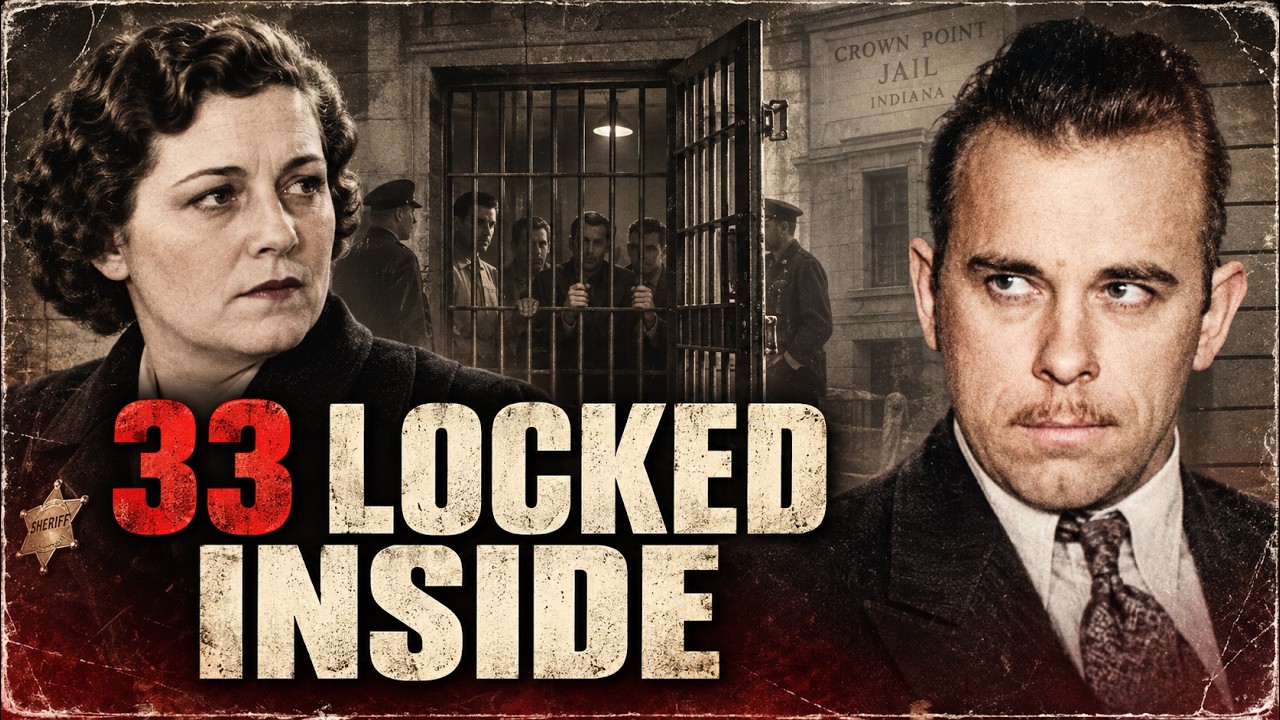
John Dillinger locked the guards inside their own cells and walked out of a jail that answered to a woman. Her name was Lillian Holley. She was the sheriff.
A commissioner up in Chicago said that was about what you would expect with a woman for sheriff. Back home, a county board member demanded on the record that she resign.
She did not resign. That spring, a courtroom in her own town read out who was responsible. She lived to be 103.
Thirty-two days before that jail emptied out, a plane carrying John Dillinger landed at an airport in Chicago. It was Tuesday night, January 30.
PBS's American Experience calls the airplane an unusual way to move a prisoner in those days. It says he had struggled so hard in Arizona that police put him in shackles and hauled him aboard.
From the airport, the Lowell Tribune reported, a Chicago police machine gun squad escorted him the rest of the way to Crown Point, Indiana.
Two men had gone all the way out to Tucson, Arizona, to claim him. One was the Lake County prosecutor, Robert Estill. The other was the sheriff's chief deputy, Carol Holley.
And he was her nephew. Hold on to that name. It comes back before the year is out.
Indiana was holding Dillinger on a charge of killing an East Chicago patrolman named William O'Malley during a bank robbery that January. The trial was set for Monday, March 12.
On the ride back, according to the Lowell Tribune, Dillinger admitted to Estill that he had done plenty. The East Chicago job, he said, was not one of them.
When he got to Crown Point, the sheriff's office filled up with reporters and cameras. Estill and Dillinger posed arm in arm. Sheriff Holley stood in the same picture.
In newsreel film of Dillinger posing with the sheriff, kept today in the Indiana Memory Archive, her nephew stands just behind them. That photograph had a long way still to travel.
Local officials were telling the press the jail was escape-proof. Time magazine set two promises side by side. Dillinger had said he would shoot his way out. And the sheriff had made one of her own about her new prisoner.
"I know he's a bad baby and a jailbreaker, but I can handle him."
Three days after he arrived, the Galveston Daily News, all the way down in Texas, ran her photograph on its front page. The caption called her a woman sheriff guarding a bandit. She was 43 years old.
A little over a year earlier, the badge she wore had belonged to her husband.
Monday, January 16, 1933. The sheriff of Lake County was Roy Holly. He was a dentist and people called him Doc. He was early in his second term, the 31st man to hold that office.
That day, out near Gary, in the community of Ross, a 64-year-old farmer shot and killed his neighbor. The neighbor was 54. He had been cutting down a tree the farmer believed stood on his own land. It did not.
Doc Holly took four deputies, went into the farmer's house, and told him he was under arrest. The Indiana Law Enforcement Memorial keeps the record of what happened inside.
The farmer ran for the stairs, and the officers went up after him. As the sheriff neared the top, the farmer turned and fired. The sheriff was hit twice.
His deputies got hold of him and pulled him back out to the back porch. As they tried to get him to a car, the farmer came out after them and fired again, and three deputies went down wounded.
Police came from Gary, and four of them were hit before it was over. It lasted about four hours. When it ended, the farmer was dead.
Roy Holley died early the next morning at Mercy Hospital in Gary. He was 43. He left his wife, three brothers, and twin daughters still in their teens.
That same memorial record notes that he had earned his dental degree in Chicago in 1911, that he had served in the army in the First World War, and that he is the only Indiana officer killed in the line of duty who is known to have been a dentist.
For the short time in between, the Old Sheriff's House Foundation's list of sheriffs shows a man named Andrew Hoffman as acting sheriff. Within days, the county appointed Roy Holley's widow to serve out the rest of his term.
Lillian Holley became the first woman to serve as sheriff of Lake County. She had been born Lillian May Hatch in the summer of 1890 in Newton County just to the south. She was 42 when she took the job.
James Emerson, a board member of the Old Sheriff's House Foundation in Crown Point, has said she took over with an iron hand.
A year and two weeks after that night on the stairs, John Dillinger was locked in her jail.
By Saturday, February 10, he had been there 11 days. The jail was attached to the sheriff's residence on Main Street near the courthouse square.
The week he arrived, the Lowell Tribune had told its readers he would be kept under heavy guard around the clock so that nobody could get him out.
That Saturday, Prosecutor Estill went to Judge William J. Murray and asked him to send Dillinger to the state prison at Michigan City for safekeeping. It was the prison he had been paroled from the May before. The request was turned down.
Before that spring was over, that decision would be read back in a courtroom with names attached to it.
A photograph from one of his court hearings that February, kept today by the Indiana album, shows him seated in a courtroom handcuffed to one of her deputies, a man named R.M. Pierce.
According to the Mob Museum in Las Vegas, the sheriff was confident her jail could hold him. She told reporters she didn't expect any trouble out of him.
"He had been warned on his first day," she said, "and deputies with machine guns would be close at hand if he tried anything."
Outside, deputies and National Guardsmen kept watch. The Lowell Tribune, a weekly paper from the south end of the county, wrote afterward that the guards had been expecting his friends to try to free him from outside.
"Inside," the same paper said later, "he played the part of a model prisoner, and he had been given too much leeway."
He met with his lawyers. He wrote letters home. One of those letters went to his sister on jail stationery with the sheriff's name printed across the top.
He told her he was doing fine and wanted to see them all. "Mrs. Holly will let any of you in to see me," he wrote.
Both of his lawyers had been by on Friday, he told her, and things were moving along. Then he asked her to have their father send him $10 right away, about $250 in today's money.
Time magazine would later report how he spent those weeks. He sat in his cell working at a small piece of wood with a razor blade.
Some of the men in the cells around him knew he was working on something, the Lowell Tribune reported, and that he meant to use it to get out. None of them knew how or when. The guards were watching the street.
On the first Saturday in March, his trial was nine days away. It was a little after 9:00 that Saturday morning. Exercise hour. The prisoners were out of their cells in the bullpen.
A turnkey named Sam Cahoon came in carrying soap for the washrooms. Something pressed into his side. Cahoon took it for a pistol, and he handed over his keys.
Dillinger had Cahoon call up a deputy named Ernest Blunk. And then Blunk was made to call up the warden, Lou Baker. One man at a time they walked into cells, and the doors were locked behind them.
By Time's count, it took him about 15 minutes. Time magazine reported that Dillinger held the way out open for the other prisoners. His cellmate cursed at him and said he wouldn't take a single step with him.
Only one man went, a prisoner named Herbert Youngblood. They took Blunk along with them as a hostage.
In the jail office, there were two machine guns. They took both of them. In the jail kitchen, the Lowell Tribune reported, they came on more guards and ordered them to their feet. On the way out, they locked every door behind them.
The cars in the jail garage wouldn't start. By Time's account, Dillinger tore the ignition wires out of them, and the three of them went out the back way and over an eight-foot wall.
They made for a garage on Main Street, just north of the criminal court building. Time says the man who owned it was the foreman of the grand jury that had indicted Dillinger back in January.
Behind them, 33 people were locked inside her jail. Prisoners, trustees, guards, and the warden. The Chicago Tribune reported that the guards called out of the jail windows for help until people came in from outside to let them loose.
At the garage, a mechanic named Edwin Saeger got the sheriff's car started. It was her new Ford V8. Time said it had a siren, a radio set, red lamps up front, and the sheriff's badge on it.
The Lowell Tribune reported that Saeger was forced to start it. Dillinger's own lawyer later told a writer that the mechanic had been paid to have it ready. And that is the version the Mob Museum gives.
Blunk drove, and Saeger rode along with them. They pulled out onto Main Street and headed north out of Crown Point.
Time magazine told its readers where the sheriff was when the news reached her. At home, it said, lying on her divan when the telephone rang. Then she was on the line to the police in Gary, asking for every man and every gun they could send.
Toward noon, the sheriff's office got a long-distance call. It was Ernest Blunk from near Peotone, Illinois, about 25 miles away, Time said. He and Saeger had been put out of the car with a cigarette apiece and $4 for car fare, about $100 in today's money.

By that afternoon, the Chicago Daily News had the escape from what it called the strongest jail in Indiana across its front page.
Her Ford turned up later on a Chicago street, abandoned. The Mob Museum says police kept watch on it for a while in case someone came back for it. Nobody did.
That car's story did not end in Chicago.
By Sunday morning, the Brooklyn Daily Eagle up in New York had her on its front page at the head of the manhunt.
Time magazine told its readers she had been close to hysterics on the telephone when the news came. Another report had her shrieking into it.
Time also had her telling the reporters around her that if she ever saw Dillinger again, she would shoot him herself. And that the whole thing was too ridiculous to talk about.
The governor's office opened its own investigation. Indiana state archives describe what the public anger was aimed at. Most of it, they say, landed on the sheriff and the prosecutor. And on how friendly they had looked with their prisoner.
Over in Chicago, a lawyer named Frank Loesch had been president of the Chicago Crime Commission, a citizen's group, since 1928. Nearly four years earlier, he had put out a list of Chicago gangsters and called them public enemies. And papers across the country picked the phrase right up.
Now, Loesch had something to say about the jail in Crown Point. That's what might be expected of having a woman for sheriff.
Melvin Purvis, the federal agent who ran the bureau's office in Chicago, wrote in his memoir a couple of years later that she was not at fault for the escape. Then, in the same breath, he wrote that a sheriff's office was no place for a woman.
She answered the papers herself, more than once. "I'm not a sissy," she told reporters. "I can take it on the chin."
And to the Chicago Tribune, she said, "I feel that I'm getting the blame for this just because I'm a woman." She said she could not see what she had done wrong.
She made it known she would not run for sheriff again.
That Tuesday, March 6, the county commissioners met. Their president, Charles Barron, read out a long statement demanding her resignation. Another commissioner, named Martin, said they ought to wait until the investigations came in.
The Lowell Tribune reported that Governor Paul McNutt might ask her to step down, but that he had no authority to put her out. Only a circuit judge could do that.
That same day, the turnkey and the deputy from Saturday morning, Sam Cahoon and Ernest Blunk, were arrested on the order of the state attorney general.
On Wednesday, the Tulsa Daily World ran a story about the sheriff buckling on her revolvers and called her an excellent shot. The Mob Museum recorded something she told Judge Murray, too. If she got Dillinger back, she said, there would be no trial for the judge to hold. He could put her on trial instead.
In Washington, the Attorney General of the United States, Homer Cummings, pointed to the photograph from her jail, the one with Estill and Dillinger arm in arm. Time reported what he said. "If those people had been federal officials, I would remove them in 10 minutes."
The same magazine said Democrats all over Indiana were worried the escape would cost them votes and that ridicule was the most dangerous thing a politician could face. People had started calling the town Clown Point.
The Chicago Tribune reported that a letter mailed from California to a farmer near town, addressed to Wooden Gun, Indiana, was delivered right to him. Time said a captain in the Indiana State Police got a book in the mail about how to be a detective.
The Lowell Tribune counted four or five investigations underway. All of them meant, in the paper's words, to place the blame where it belongs.
Four weeks went by. Early on, the Lowell Tribune reported that Edward Barce, the attorney investigating for the state attorney general, had found no evidence of collusion and plenty of negligence.
Then came Tuesday, April 3, 1934, 31 days after the escape. Keep that date in mind.
A Lake County grand jury had been called to look into the escape. It filed its report with the criminal court of Judge William J. Murray, and the foreman, Donald Perdy, read it aloud in open court in the criminal court building a short walk from her jail.
The Lowell Tribune printed the highlights.
On where Dillinger belonged, the jury said he should have been returned to the state prison as a paroled man to finish his old sentence.
On the photograph, it said the prosecutor had gone 48 hours without sleep when that picture was taken.
On the gun, it found that Dillinger had used a wooden one first. It also found that he'd had every chance to hide a wooden gun or a real one.

On the transfer, it said the prosecutor, his chief deputy John Underwood, and the police in Hammond and East Chicago had all pushed to have Dillinger sent to the state prison. Judge William J. Murray and William J. Schroeder, president of the county council, had decided to keep him in Crown Point.
The jury said those two men should be held responsible for what happened. So should the executive department of the state for never moving him at all.
The report that named Judge Murray had been filed in Judge Murray's own court.
On the jail itself, it named neglect and cowardice among the employees as the main cause of the escape. Among the other factors it listed were inexperienced guards and collusion by Sam Cahoon and Ernest Blunk. Both men, arrested back on March 6, were indicted.
And on the sheriff, there was one line. She had no one on her payroll who knew how to guard a prisoner like John Dillinger, and no one had ever been sent to her who did.
In the highlights the Lowell Tribune printed, that is the only line with her name in it.
In May, Robert Estill ran in the Democratic primary for prosecutor. Time magazine reported that he lost his party's nomination, and that his opponent, Fred A. Egan, had passed that photograph around.
Years later, a Hearst newspaper series said that picture had ended Estill's career and that he had died a broken man. Estill was alive to read it. Federal court records show he sued and his case reached an appeals court in 1951.
On Sunday, July 22, federal agents ended the manhunt outside the Biograph Theater in Chicago. John Dillinger was 31 years old. Lillian Holley never got him back to Crown Point.
That November, Lake County elected a new sheriff. His name was Carol Holley, the nephew who had gone out to Tucson to bring Dillinger back. He ran as a Democrat, like his uncle Roy.
Time put his race next to another one that fall. In Lima, Ohio, the acting sheriff was the son of the sheriff who was killed when Dillinger's friends broke him out of that jail in 1933. That son lost. Her nephew won.
When Roy Holley's term ran out at the end of 1934, she handed the office to her nephew. She was 44 years old. The Old Sheriff's House Foundation's list of Lake County sheriffs has Carol Holley in that office through 1938.
She stayed in Crown Point for the rest of her life.
In the middle of that town stands the old Lake County Courthouse with a clock tower on top. It had stood there since 1880. The Lake Courthouse Foundation says a group of local people saved it from being torn down to make room for parking in 1973.
In her later years, well past 80, Lillian Holley put a good deal of money into restoring it.
Marian Kellam taught art and directed plays at Crown Point High School. He says some of her money got the clock in that tower running again after it had stood still for years. And some of it paid for the chandeliers.
James Emerson says anytime that courthouse clock quit, she covered the repair.
Sometime in the 1980s, Kellam wrote her a letter. He wanted to put her life on a stage, and he told her he thought her story could inspire young women.
A few weeks later, she telephoned him. Kellam says they talked for a long time. Then she asked him not to go ahead with it, and he dropped the idea. Kellam says he never could let go of her story.
Lillian Holley died in Crown Point on Sunday, June 12, 1994. She was 103 years old. It had been 60 years, three months, and nine days since the escape. And nearly 60 years since John Dillinger's death.
She was buried in Beaver City Cemetery in Newton County, the same cemetery where Roy lies.
Jonathan Forgie, a vice president of the Old Sheriff's House Foundation, once told Chicago Public Radio how that foundation had handled the Dillinger story while she was alive. In respect, we did not deal with it at all until she passed away.
She spent one spring as the country's punchline. And when she was finally offered a stage to answer it, she picked up the phone and asked for quiet.
In July 2015, 21 years after she died, a John Dillinger Museum opened in the lower level of that courthouse.
On March 3, 2017, the anniversary of the escape, Kellam's play opened upstairs in the courthouse ballroom. It was called Lillian, and it played under the chandeliers her money had paid for while the Dillinger Museum was still open downstairs.
A writer for the Newton County Enterprise went to a matinee on closing day and every seat was filled.
On April 3, 2021, 87 years to the day after the grand jury's report, her Ford came home. It pulled up at the old sheriff's house behind sheriff's cars and a helicopter.
Mark Love of Arizona says he hunted that car for 27 years before tracing it to Maine. Her family watched. So did Dillingers.
Love says bringing it home honors her. Don Casper, married to William O'Malley's granddaughter, says she would have been furious to see it celebrated.
Roger Pace, a Crown Point realtor who helped organize the homecoming, says the car is helping raise money for Concerns of Police Survivors, which helps families of officers who died in the line of duty.
She stayed 60 years in that town. It took her car 87 years to find its way back.