Frances Ruth Roche was born on January 20, 1936, in a house on the Sandringham estate in Norfolk—the very day King George V died in the main house just a few hundred yards away. The coincidence seemed to mark her from her first breath as a child of the royal world, though she would never truly own her place in it. Park House, where she was born, had been built in 1863 by Edward, Prince of Wales, to accommodate guests during the great shooting parties at Sandringham. The Roche family lived there as tenants of the Crown, enjoying a residence they could never own on land that would never be theirs.
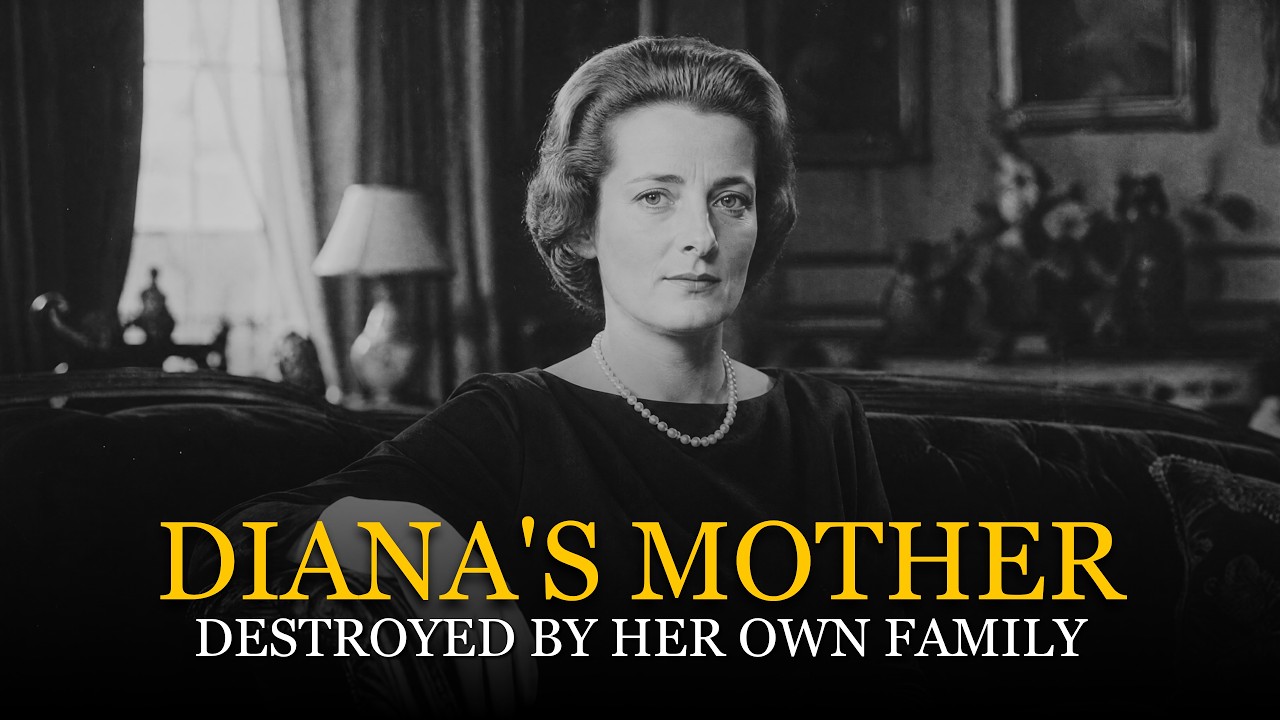
Frances’s father, Maurice Roche, the Fourth Baron Fermoy, was a friend and shooting companion of the royal family. The money that kept the title standing came from his American mother, an heiress whose fortune had crossed the Atlantic to refresh an old Irish title. Her mother, Ruth, Baroness Fermoy, had risen from the daughter of a Scottish army colonel to become a woman of the bedchamber to Queen Elizabeth the Queen Mother—a trusted friend who served in that role for more than 30 years. Ruth had built her entire identity on closeness to the Crown.
On June 1, 1954, at the age of 18, Frances became the youngest bride to marry at Westminster Abbey in more than 60 years. The groom was John Spencer, Viscount Althorp, heir to one of the grandest families in England, a man nearly 12 years her senior who had served as an equerry to both King George VI and the young Queen Elizabeth II. The wedding joined two families who both lived in the light of the monarchy. The Queen herself was among the guests.
For a girl born on a royal estate, it was the summit of everything her world could offer. But the marriage carried a contract as old as the aristocracy itself. The Spencer earldom passed down the male line, and the house needed a son. Frances had married into that arithmetic at 18, and she began to live it immediately.
Her first child, Sarah, arrived in 1955. Her second, Jane, followed in 1957. Two daughters, healthy and adored—and yet each birth was met with quiet disappointment. In the cold logic of primogeniture, a daughter did not solve the problem.
In the first ten years of her marriage, Frances was pregnant six times. Only four of those pregnancies were carried to term. She was barely out of her teens, mistress of a great household, and her worth in her husband’s eyes had narrowed to a single desperate hope: a boy. In January 1960, the son they had prayed for arrived at last, and within hours he was gone.
The baby, named John after his father, was born with severe malformations. Some accounts say he was stillborn; others say he lived only a short while. He did not survive the day. Worse than the loss itself was what followed.
In the customs of that time and class, Frances was not allowed to see her dead son. The baby was taken away quickly and quietly. Years later, she spoke of it in words that still cut: her baby was snatched away from her, and she never saw his face, not in life, not in death. There was no funeral she could take part in, no room made for her sorrow.
The household’s response was not comfort but concealment. The great project had failed, and the machine simply removed the broken piece and carried on. At 23, still raw with a grief she was never allowed to voice, Frances was sent to clinics in London to be examined for a failure everyone had already assigned to her. No one suggested her husband be tested.
The assumption ran in one direction only: toward the wife. She later called the experience humiliating and unjust. In the summer of 1961, Frances gave birth again at Park House, in the same rooms where she herself had been born. The child was a girl.
They named her Diana. She was healthy and golden, but she was once more a daughter—a consolation rather than a triumph. The boy finally came in 1964. Charles, the longed-for heir, was born and lived.
On paper, the succession was secured. But by then it was too late. The decade of pressure, buried grief, and humiliation had hollowed out the marriage from within. The private reality of the marriage came out only much later, through biographers and the children themselves.
Reports indicate that Johnny could be violent, and that Frances came to feel that she and her children would be safer away from the home than in it. Diana, still a small child, is said to have witnessed her father strike her mother. These are reported accounts rather than proven facts established in any court, but they come from serious sources and have never been convincingly denied. Into that airless house in 1966 came a man named Peter Shand Kidd.
He was married, as she was—a warm, unpretentious adventurer who had sold his family’s wallpaper business in 1962 and gone to farm sheep in Australia. He looked at Frances and saw a person, not a womb. The difference was intoxicating. By 1967, she had made the decision that would define the rest of her life.
She left. She walked out of the marriage, out of the great house, and toward the man she loved. The newspapers found their word for her quickly: the bolter, a contemptuous term for a woman who ran from her marriage. The label erased everything that had driven her and would follow her to her grave.
The affair became public when Peter’s wife, Janet, named Frances in her divorce. The scandal reached Frances’s mother, Ruth, whose worst fear had been realized. A woman who had spent her whole life guarding the family’s place in the royal circle now saw scandal brought by her own daughter. For a few months, a fragile normal held.
Frances moved to London and took the two youngest children, Diana (aged 6) and Charles (aged 3), with her. She still believed a workable settlement could be reached. The break came at Christmas in 1967. The children went to Norfolk to spend the holiday with their father at Park House.
When the holiday ended, Johnny did not send them back. He held every advantage: the great house, the ancient name, the money, the lawyers, and the weight of a social order that assumed children belonged with the family that carried the title. The divorce came in 1969, and the law had already decided which party was guilty. The marriage was dissolved on the grounds of Frances’s adultery with Peter Shand Kidd.
In the England of that era, an adulterous wife was almost by definition considered unfit to raise her children. Her sin as a wife was taken as proof of her unfitness as a mother. Frances fought for custody. She later said that she and Johnny might have managed things between themselves, and that it was only when the lawyers became involved that a friendly agreement was made to seem complicated.
Then came the blow no one could have prepared her for. When the custody hearing came, the most damaging witness against Frances was not her husband but her own mother. Ruth, Baroness Fermoy, gave evidence in support of Johnny’s claim. In the terms reported from those proceedings, she told the court that Frances was a bad mother.
Ruth lent the weight of her respectability, her royal connection, and her unimpeachable reputation to the case for taking Frances’s children away from her. She chose the Crown’s good opinion over her own daughter’s motherhood. The result was never truly in doubt. Johnny was granted custody of all four children.
Sarah, Jane, Diana, and Charles would live with their father. Frances was left with limited occasional access—a visitor in the lives of the children she had carried and born and loved. In a single judgment, she had lost them all. Diana was 6 years old.
On May 2, 1969, Frances married Peter Shand Kidd, and together they turned their backs on the world that had cast her out. They made their home on the Isle of Seil, a small island off the west coast of Scotland near Oban, joined to the mainland by a single old stone bridge. Frances, once in line to be a countess of one of England’s grandest houses, ran a gift shop on the waterfront at Oban. She had traded grandeur for ordinariness, and after everything she had endured, ordinariness had its own quiet mercy.
Meanwhile, in the south, the world she had left rearranged itself without her. In 1975, Johnny became the eighth Earl Spencer, and the family left Park House for the ancestral seat at Althorp. The following year, he remarried. The life that was to have been Frances’s now belonged to another woman.
In 1994, Frances converted to Roman Catholicism. She made pilgrimages to Lourdes as a helper, pushing wheelchairs and caring for sick pilgrims. She supported the families of fishermen lost from that dangerous coast and raised money for families bereaved by the bombing of an airliner over Lockerbie. On one occasion, she used a magazine interview fee of some £30,000 to help establish a Catholic house of prayer on Iona.
But there was a darkness running alongside the grace. In 1996, Frances was arrested for drink driving near Oban. Her blood alcohol reading was more than two and a half times the legal limit. She was fined £400 and banned from driving for a year.
She denied having a problem with drink. Her mother, Ruth, had died in 1993 after a lifetime in the service of the Crown she had chosen over her daughter. Whether the two women ever truly made peace over that courtroom is not recorded. Frances’s second marriage did not survive in the end.
She came to blame the relentless press attention that came with Diana’s fame for the strain that pulled it apart. She and Peter separated in 1988 and divorced in 1990. Then came the cruelest turn. In the last year of Diana’s life, mother and daughter fell out.
Frances gave a magazine interview in which she spoke about Diana’s loss of the style “Her Royal Highness” after her divorce and about her struggles with bulimia. Diana took the words as a betrayal and is said to have returned her mother’s letters unopened. For about four months, they did not speak. On August 31, 1997, Diana was killed in a car crash in Paris.
She was 36 years old. The silence between them, which Frances must have believed was temporary, became permanent in an instant. Frances had lost Diana once already in a courtroom when the child was six. Now she lost her again forever, with angry words unhealed between them.
Frances died on June 3, 2004, at her home on the Isle of Seil, aged 68. Her health had failed in her last years, and her death followed a fall. She was buried near Oban. Her son Charles remembered her as an open book, a woman who wore her heart on her sleeve.
That in the end was her crime and her glory—in a world that demanded hearts be hidden. Park House still stands on the Sandringham estate, silent and empty. Althorp endures, and on a small island in its lake lies Diana, the daughter born in the house on the royal estate, come home at last to Spencer ground. The buildings lasted.
The grandeur lasted. It was the woman who was broken.