He was the most photographed human being who had ever lived, and for 20 years the most adored man on the face of the earth. To the crowds who choked the streets of Melbourne and Toronto and Bombay to see him pass, he was simply the prince: young, golden, the living future of an empire on which the sun never set. He gave it all away — the throne, the empire, the adoration — in a single week for the love of a twice-married woman from Baltimore, in the only voluntary abdication in the thousand-year history of the English crown.
That is the legend. Like most legends about this family, it is not exactly a lie, and it is nowhere near the truth.
Behind the golden prince stood a hollow man who could feel almost none of it. Behind the great romance stood a wedding no king would attend and three small letters. His own family refused his wife. There were red boxes left lying unread on a table. There was a tea table in the Bavarian mountains and the man who poured the tea. There was a plot in a Lisbon summer and a file locked in a German castle. And at the end of it, 36 years of silence in a rented house in a Paris park.
His grandfather had waited 60 years for the throne and been given nothing to do with it. This grandson would wait a lifetime for the same crown, hold it for 11 months, and hand it back.
This is not the story of the king on the coins. He was never crowned, and there are almost none. It is the story of what a man will pay for the one thing that finally quiets the emptiness.
It begins with the most fortunate boy in the world.
He was born on the 23rd of June, 1894, at White Lodge in Richmond Park, in the 57th year of the reign of his great-grandmother. His birth performed a trick of dynastic arithmetic the 19th century had never quite managed before and the 20th would never manage again.
For a few hours on that summer morning, four generations of the house that ruled a quarter of the world were alive at the same instant. The old Queen Victoria at Windsor; her son, the stout and genial Prince of Wales, who would shortly be Edward VII; his son, the sober naval officer who would be George V; and now this new child, pink and bawling in a Georgian hunting lodge, who would one day be Edward VIII.
They posed the four of them together for the cameras, the baby on a cushion between the old woman and the two waiting men, and the photograph went round the empire as a promise. The line was secure unto generation. Nothing, it seemed to say, could ever go wrong.
They christened him Edward Albert Christian George Andrew Patrick David, a name very nearly for every nation he would inherit. Then, having laid all of that upon an infant, the family called him by the last of the seven. To his parents, to his brothers, and in time to the one woman who would undo him, he was never Edward at all. He was David.
He grew up in a house with a cold hearth. His father, Prince George, Duke of York, and from 1910 King George V, was a decent, dutiful, narrow man who had learned discipline on the quarterdeck of a warship and could imagine no better way to raise a son. He loved his children in the abstract and frightened them in person.
He shouted, he corrected, he kept them to a timetable of chilly, unbending correctness. The boy's mother, Mary of Teck, was dignified and emotionally sealed, a queen before she was a parent, and never once able to place herself between her sons and their father's temper.
It was a childhood measured out in fear and formality. The cruelty of it was that it mirrored the exact opposite of the warmth the boy's own grandfather scattered so freely on everyone but his heir. Bertie, the old pleasure-loving king, could thaw a room of strangers in 90 seconds and never managed, to the end of his life, to be easy with his son. Now that son, grown cold in his turn, could not be easy with his. The chill ran down the generations like a fault in the stone.
From the very beginning, David learned to look for warmth outside the walls of his own home, and to find, in the adoration of people who did not really know him, a substitute for the love of the people who did.
He was sent to train as a naval cadet at Osborne and then at Dartmouth, drilled alongside boys who did not have to become kings. On his father's accession in 1910, he was created Prince of Wales. The following summer, on the 13th of July 1911, he was presented to the newsreel cameras at Caernarfon Castle in an investiture staged for a brand new age, dressed to his lasting mortification in white satin breeches and a mantle of purple velvet that he was certain would make his naval friends howl.
He submitted, scarlet with embarrassment, and the film of it played in the picture houses. It was the first time the machinery of modern celebrity closed its hands around him. It would never quite let go.
A spell at Magdalen College, Oxford, came and went and left little mark. He was not a reader, and no tutor alive had managed to make him one.
Then the world caught fire. The empty ceremonial prince found for a few years something very like a purpose. He was 20 when the Great War began, and he wanted, with an ache that was entirely genuine, to fight.
He joined the Grenadier Guards and begged to be sent up with his battalion. Lord Kitchener refused him — not because the prince might be killed, which was a soldier's ordinary risk, but because he might be captured, and a captured heir to the British throne was a bargaining counter no government on earth could afford to hand the enemy. It was a sound decision, and it galled the young man to the bone.
He got as close to the fighting as they would permit, and a good deal closer than they wished, touring the lines, visiting the wounded, walking the mud in the plain khaki of a staff officer. A shell once killed his driver while the prince himself was a few yards off. Soldiers noticed. Here was a prince who came up the line, who asked their names, who looked as tired and afraid as they were.
When it was over, he had something no ceremony could ever have bought him. He was loved, and by the sort of people who did not, as a rule, love princes.
The peace made him the most famous young man on earth. Between 1919 and the middle of the 1930s, the Prince of Wales was sent out again and again to show the imperial flag — 16 tours across the whole vast reach of the thing his family ruled. Canada and the United States in 1919; Australia and New Zealand in 1920 aboard the battle cruiser Renown.
Everywhere he went, the crowds were beyond anything the old queen's jubilees had ever drawn. Not the dutiful hat-doffing multitudes of the Victorian age, but something newer and hungrier, a mass adoration that behaved less like loyalty than like desire. They mobbed his carriage. They snatched at his sleeve. Women wept and fainted in the streets of cities he had never seen and would never see again.
He was, every newspaper agreed, the most photographed human being alive, and the photographs sold by the ton. He had become, without ever intending it, the first genuine celebrity to sit upon the steps of a throne.
His clothes were studied and copied on two continents — the soft collars, the checks, the Fair Isle sweater he wore to golf, the very knot of his tie. An American menswear paper reported, without a flicker of irony, that the average young man in the United States took a keener interest in the wardrobe of the Prince of Wales than in that of any other person on Earth.
He danced until dawn in the new nightclubs. He rode in point-to-points and came off his horse with cheerful regularity. He flew his own airplanes. And a song went round the music halls that caught the whole giddy phenomenon in a single line: I've danced with a man who's danced with a girl who's danced with the Prince of Wales.
It was youth and modernity and the future itself. And an empire that could feel the ground shifting under its feet looked at him and told itself that everything, after all, would be all right.
But the people who stood closest to him saw what the crowds could not. They saw that the adoration went into him and simply vanished, as though poured into a vessel with no bottom. They saw the restlessness that could not endure a ceremony, the boredom that curdled so easily into melancholy, the something close to dread in him at being left alone with his own company.
They saw a man past 30 who was somehow still a boy — charming, golden, and hollow, forever reaching after a thing the ovations of half the world had never once supplied. He did not know what it was. He knew only the shape of its absence, and that nothing he possessed, not the cheering, nor the fame, nor the crown descending toward him as surely as nightfall, had ever been able to fill it.
He was, by every measure the age could apply, the most fortunate young man alive. And he was empty.
The search for whatever might fill him had, in truth, already begun quietly years before, while the guns still spoke across the channel. In the spring of 1918, in the cellar of a London house with the zeppelins droning overhead and the anti-aircraft guns hammering back across the rooftops, the Prince of Wales fell into conversation with a small, calm, exquisitely self-possessed young married woman and found, for the first time in his gilded and famished life, someone who made the emptiness go still.
Her name was Freda Dudley Ward. She was the first of the women who had come to rule him. And the last of them would cost him a throne.
The pattern was set that night in the cellar, though it would take the rest of his life to show what it meant. For the whole of his adult existence, the Prince of Wales reached, again and again, for the same kind of woman: married, poised, a little older in manner if not always in years, and quietly in command.
He did not fall for the debutantes paraded before him. He did not want to be worshipped by girls who trembled at his rank. He had a whole empire of those already, and they filled nothing at all. What he wanted was a woman who would take him in hand, who would mother him and manage him, choose his friends and correct his faults, tell him plainly when he was being a fool, and love him on terms that she, and not he, would set.
It was not romance in any ordinary sense of the word. It was government. The hollow at the center of him could not be filled by adoration, only by rule. And the strange tragedy knotted into his character was that the most envied young man in the world wanted, above everything the world could offer him, to be told what to do.
Freda Dudley Ward understood this first, and for 16 years she understood it better than anyone alive. It was she, the small, dark, unhurried wife of a Liberal Member of Parliament, who had talked the young prince through that first air raid in the cellar until the guns fell quiet. From that night, she was fixed in his life.
She was everything his own household was not: warm without weakness, amused by him without being awed, steady when he was frantic. She became his confidante and his keeper, the calm hand on the bridle of a man who bolted at the first touch of boredom. He telephoned her compulsively, sometimes twice in a day, for years on end.
He poured into her the misery beneath the gold, the loathing of his own duties, the dread of the throne crawling slowly toward him. And she asked nothing, sold nothing, told no one, keeping his confidences with a discretion so complete that she carried them unbroken to her grave. She simply held him together.
To anyone who knew, it can have looked like nothing but the steadying love of his life, which is what made the end of it so chilling. In 1934, without a word of warning or a syllable of explanation, he let her go.
Freda Dudley Ward telephoned as she had telephoned for 16 years, and an embarrassed operator told her at last that she could not be put through, that the order had come from the top, and that her calls were no longer to be connected. That was all. After a decade and a half, she was switched off like a lamp, and for the rest of her long life she never spoke a bitter public word about it.
It was the first clear sight of something cold and absolute beneath the celebrated charm — the capacity of the most amiable man in the empire to close a door on a human being forever the same instant they stopped being of use to him.
And yet the coldness was only the other face of the need. This was the thing the cheering crowds could never see: that the golden prince could not bear an evening alone with himself, that he had to be organized and steered and told, and that he fastened without shame onto whoever was strong enough to do it. He did not cast these women off because he had stopped needing to be ruled. He cast them off the moment he found the ruling done better somewhere else.
It was the whole secret of him, hidden in plain sight beneath the most watched face on earth, and it was about to be handed, like a set of keys, to a stranger.
By then, another woman had long since taken her share of him. Thelma Lady Furness — Thelma Morgan of New York, one of a pair of celebrated American twins, married to a British shipping viscount many years her senior — had come into his life around 1929. For five years she was the woman on his arm at the long country weekends, on the safari in Kenya, in the firelit rooms of the small castle.
She was gayer than Freda, and a good deal less wise, genuinely dazzled by her prince in a way the older woman never had been. She mothered him in her own lighter fashion, arranging his evenings and making herself the fixed point of his private world. She assumed the arrangement would last exactly as long as she wished it to.
She had no notion how casually the same man had already erased 16 years of Freda Dudley Ward, and no idea at all that she was about to make, with the very kindest of intentions, the most catastrophic introduction in the modern history of the crown.
The castle was called Fort Belvedere. It stood at the southern edge of Windsor Great Park, a battlemented 18th-century folly of turrets and toy cannon that George V had signed over to his son in 1929 with a baffled shrug. What could the boy possibly want with that?
The boy wanted it more than he had wanted anything in his life. At the fort, and nowhere else on earth, the Prince of Wales was wholly himself. He drained and remade the garden. He hacked at the laurels that had swallowed the grounds until his hands blistered, pressing his weekend guests into the same cheerful labor. He shrank the vast, unmanageable world down to a few acres of hedge and lawn that would actually do as they were told.
It was the one kingdom he ever ruled in contentment, because it was small enough to obey him. It would also be the stage on which he lost the other one.
His father saw all of it — the nightclubs and the married women, the American turns of phrase, the soft collars and the softer discipline, the undisguised horror of the ceremony that was the whole trade of kingship. George V watched, and his heart sank a little further with every passing year.
He was a hard, blunt, dutiful man who held that the monarchy was a trust and never a pleasure, and in his heir he saw a charm he could not trust and a will he could not stiffen. He never doubted the boy was loved. He doubted, with a father's exact and sleepless terror, that the boy was fit.
By the middle of the decade the old king had begun to say so aloud to more than one grave listener — a prophecy half spoken and half prayed about what his son would do to himself the moment the restraining hand of a father was gone.
But it would be an injustice to leave him there as nothing but a hollow charmer, because one gift in him was entirely real. He had the common touch, the same warmth his own grandfather had scattered so freely on strangers. And in these years he turned it on the poorest people in the kingdom.
Through the grim early thirties he went down into the districts the comfortable preferred to forget: the silenced coalfields, the shipyards where nothing was built, the gray unmoving queues outside the labor exchanges. He did not perform his sympathy; he appeared to the men who met him genuinely to feel it. And they went home and told their families that the Prince of Wales was on their side.
Perhaps he truly was. The tragedy was never that he lacked feeling. It was that the feeling drained into the same bottomless vessel as everything else, and that behind the warmth there was no ballast, no discipline, no settled center — nothing to keep the golden prince from walking straight off a cliff the day a woman appeared who could show him the edge.
Sixteen years the arrangement had held because the women who ran his life had all understood the terms of it: that they were keepers of a prince who could not keep himself, and that discretion was the whole of the bargain. Freda Dudley Ward had understood it. Thelma Furness had understood it.
And in January of 1934, sailing for New York, and not imagining for a moment what she was setting in motion, Lady Furness turned to a sharp, plainspoken American friend and asked her lightly to look after the Prince of Wales while she was away.
The friend was a married woman from Baltimore named Wallis Simpson. She was not impressed by princes. And she was about to become the most dangerous woman in the British Empire.
To understand what came next, you have to go back to Baltimore and to a childhood that the newspapers of 1936 would labor to turn into a legend of scheming and never once trouble to understand.
She was born Bessie Wallis Warfield in the summer of 1896 in a small resort in the Pennsylvania mountains where her parents had gone in the failing hope that the air might mend her father's ruined lungs. It did not. He was dead within months.
The young widow carried her infant daughter back to Baltimore to live in plain fact on the charity of wealthier relations. The Warfields were an old and respectable Maryland family. Wallis's own corner of it was poor, and she grew up sharply, permanently conscious of the gap — a girl in made-over dresses at parties given by cousins who would never once have to count the cost of anything.
It marked her for the whole of her life. It bred in her a horror of being pitied, a watchful and unsentimental intelligence about people, and an iron determination to belong completely, unquestionably, to the world that had allowed her to stand just outside its warmth.
The portrait the press would later paint of the adventuress and the huntress who had plotted her way toward a throne was the work of people who badly needed a villain. The woman underneath was harder to hate and sadder to know: proud, clever, and frightened, taught young that security was the one thing you could never take for granted.
She married early and badly. In 1916 she became the wife of Earl Winfield Spencer, a dashing young naval aviator whose charms soured almost as soon as the wedding was over into heavy drinking and a temper that could empty a room. The marriage gave her years of unhappiness and drift, a long and disorienting interlude in China through one of their many separations, and at last, in 1927, the quiet disgrace of a divorce in an age when divorce still left its mark on a woman and rarely on a man.
The next year she tried again and more wisely. Ernest Simpson, a cultured, courteous, half-British shipping man, solid where Spencer had been wild. The second marriage carried her across the Atlantic to London, to a comfortable flat at Bryanston Court, and a respectable footing in the city's Anglo-American society.
It was everything the first marriage had not been. It was safe, and calm, and kind. And to a woman made as she was made — restless and quietly desperate to matter — it was also, in a way she would not have confessed even to herself, slowly, gently suffocating.
She met him on the 10th of January, 1931. The Simpsons had been drawn into the glittering set that turned around Thelma Furness, and Lady Furness asked them down to Burrough Court, her husband's house in the Leicestershire hunting country, for a weekend whose guest of honor was the Prince of Wales.
By her own telling, Wallis arrived nursing a heavy cold, and in no state to be dazzled by anyone, which may be why what passed between them became the founding legend of the entire affair. The Prince, making the practiced small talk of a man who had made it 10,000 times, asked the American woman whether she did not badly miss the comforts of home — the central heating, say, that no English house ever seemed to possess.
It was the kind of question built to draw a grateful little murmur of agreement. She declined to murmur. She told him, more or less, that she was disappointed in him, that she had expected the Prince of Wales to manage something less predictable, and that every American woman who crossed the ocean was asked precisely the same weary thing.
For a beat, the room seemed to stop. And the Prince, who had been flattered without interruption since before he could walk, looked at the one woman in England who had just refused to flatter him, and could not look away.
What drew him was not beauty exactly. She was striking rather than pretty, spare and immaculate and severe, but she had a completeness of self-possession he had never met in a woman of his own world. She kept a small perfect table at Bryanston Court. She was funny in a flat, dry, faintly wicked American way. She remembered everything and flattered no one, and she treated the heir to the throne with the same brisk teasing candor she turned on everybody else.
To a man drowning in deference, it was like air. It was not love, not then and not for a good while yet. For two or three years, the Simpsons were merely part of the crowd — one couple among the many the prince kept about him at the fort, invited, entertaining, unremarkable. Ernest was quietly gratified by the royal friendship. Wallis stayed cool, dry, and unimpressed. And her coolness only drew him further on.
Then, at the very start of 1934, Thelma Furness sailed for America, and in the easy confidence that her place was hers to lend out, she asked her sharp-tongued friend to keep the prince amused until she returned. By the time Lady Furness came home, her place was gone.
Somewhere in those few unwatched weeks, the Prince of Wales had slipped from one woman to the next as helplessly as a tide going out, and this time the tide did not turn. That same year, the telephone calls from Freda Dudley Ward, 16 years faithful, simply stopped being put through. The keepers had changed hands for the last time. This one would never be replaced.
What Wallis Simpson gave him was not tenderness, and the people nearest the couple grasped that this was the whole of the point. She did not soothe him. She ruled him. She teased him before others until seasoned courtiers had to look away. She corrected his manners, his clothes, his opinions. She contradicted him to his face, which no one in the whole of his gilded life had ever quite dared to do.
And he came back for more of it, like a man who discovers in middle life a thirst he has carried unknowing since boyhood. Here at last was the strong hand he had been reaching for since the cellar in 1918: someone wholly unafraid of him, someone willing to pick up the entire exhausting apparatus of his existence and simply run it.
The men who served him watched, half appalled and half transfixed, as the heir to a quarter of the earth fetched and carried and hung upon the word of a twice-married woman from Baltimore who had no title, no fortune, and not a particle of awe for him — and who, under her firm command, seemed for the first time in his life to be plainly, uncomplicatedly content.
To the court, it was a nightmare that arrived by slow degrees. The old king and queen would not receive her. Her name was not to be spoken in their presence. And the spectacle of the future king-emperor in thrall to a married American commoner filled the men around the throne with a foreboding they could not yet fit into official language.
The prince did not care. For the first time in a golden, applauded, famished life, the emptiness had gone quiet in him, and he would have paid any sum on earth to keep it quiet — though no one, himself least of all, had yet begun to reckon the size of the bill.
The court called her an adventuress. The government called her a problem. History has too often called her a schemer who set out to catch a king. The likeliest truth is stranger and sadder than any of them: that Wallis Simpson never wanted a crown at all, that the whole thing frightened her, and that she had simply become indispensable to a man who did not know how to be told no.
It did not matter which version was true. Because on the 20th of January, 1936, in a darkened bedroom at Sandringham, the King of England — the old, hard, disappointed man who had prayed that this exact catastrophe would never come to pass — drew his last breath. And his son, the golden empty prince, and the woman who ruled him, became His Majesty King Edward VIII.
The old king was dying by inches and he knew it. George V had come to the throne in 1910, a sober naval officer of 45, and the quarter century since had used him without mercy. He had steered his country through the deadliest war in its history. He had watched the crowned houses of his own cousins swept, one after another, into exile and the cellar and the grave. And he had presided with a stubborn and uncomprehending dignity over the first cracks in the great imperial edifice that his mother's generation had believed eternal.
It had aged him past his years. His lungs, never strong, had been worn thin by a lifetime of tobacco and a near-fatal illness in the 1920s. By the middle of the 1930s he was a gray, breathless, prematurely old man wrapped against the Norfolk cold, wheezing through the long winters at Sandringham and fighting some nights simply for air.
And yet the country loved him — loved him, as it turned out, far more than either he or anyone about him had ever understood. In May of 1935 they kept his Silver Jubilee, 25 years upon the throne, and the celebrations astonished everybody, the old king most of all. The crowds that filled London were vast and spontaneous and genuinely tender. They had come not out of duty, but out of something nearer to affection for a plain, gruff, unglamorous man who had somehow become, across a generation of upheaval, the very emblem of steadiness itself.
He was, by every account, bewildered by it. He had never once thought himself clever, or gifted, or beloved. He had only ever tried to do the thing in front of him correctly, to the end. And now, in the last summer of his life, an empire was telling him that the correctness had been enough — that they had loved him, after all, for himself.
But the cheering could not reach the one fear that had settled over his final years like the Norfolk fog. It was not death. It was his son.
For George V looked at the golden, restless, modern young man who would follow him, and he was afraid. He had watched the nightclubs and the married women and the borrowed American slang, the horror of ceremony and the endless craving for novelty, and he had drawn from it all a conclusion of terrible simplicity.
To more than one listener in that last year or so of his life, he is reported to have said a thing that would echo, with the precision of a curse, through everything that came after: that after he himself was gone, the boy would ruin himself within 12 months.
The words reach us at second hand, and their exact shape is disputed, as the last words of kings so often are. But no one who knew the father and the son ever doubted for a moment that he had meant them.
And he went further. In the privacy of his own despair, he is said to have prayed — and here we tread as the careful historians do, for these words come to us only at a remove — that his eldest son might never marry, and that nothing would ever come between Bertie and Lilibet and the throne.
It was an extraordinary thing for a king to wish. Bertie was his second son, Albert, Duke of York, shy and stammering and dutiful, the temperamental opposite of his glittering elder brother. Lilibet was Bertie's small elder daughter, Elizabeth, a grave and careful child not yet 10 years old.
In praying for the two of them, the old king was praying in effect that the crown might leap clean over his own heir, that it should pass David by altogether and come to rest instead upon the quiet second son and the little girl beyond him. A father upon his knees asking his God to disinherit his firstborn. It tells you everything about how little faith the old man had left.
The end came quickly and quietly in the January dark. By the middle of the month, the king had taken to his bed at Sandringham, sinking through a long gray drowsing toward the close. On the evening of the 20th of January, 1936, his physician, Lord Dawson of Penn, composed at the bedside the bulletin a listening empire would never forget: that the king's life was moving peacefully towards its end.
It was, in the most literal sense, assisted toward it. We know now from Dawson's own notes, made public half a century afterward, that he hastened the death with an injection of morphine and cocaine — partly to spare his patient the last indignities of a passing that was already certain, and partly, by his own admission, so that the news might break in the grave columns of the morning papers rather than the clamor of the evening editions.
It is a strange and discomforting detail, and our own age has made a great deal of it, but it was a mercy administered at the very edge of an inevitable death, and it is not, in the end, the heart of this story.
A few minutes before midnight, King George V died. He was 70 years old. His son was king before the night was out.
And almost at once, the small, strange omens began. Two days later, when Edward VIII was proclaimed at St. James's Palace with all the ancient ceremony, he did a thing no sovereign before him had done. He chose to watch his own proclamation from a window above the courtyard — and standing beside him at that window, by more than one account, was Mrs. Wallis Simpson.
It seemed, to the very few who knew, a small and reckless intimacy at a solemn hour. It would come to look, in the retrospect of everything, like a warning left in plain sight.
Then came the second omen, and this one the whole of London saw. As the dead king's coffin was borne on its gun carriage through the streets toward Westminster Hall, the Imperial State Crown rode upon the lid, and set into that crown was a small jeweled Maltese Cross. Somewhere along the route, the cross worked loose and fell, and dropped into the gutter of the road.
The glittering emblem of sovereignty itself tumbling into the mud beneath the marching feet, to be stooped for and swept up by a sergeant major of the guard. And the new king, walking behind, saw it fall. He is said to have wondered in that instant whether it might not be a fitting motto for the reign just beginning. Superstitious London shivered.
It is the kind of story that gathers its meaning only afterward, and afterward there would be a great deal of meaning to gather.
Edward VIII came to the throne genuinely popular and unmistakably modern. A king who spoke the plain language of the century, who slashed the cost of his own household, who swept away the dust and the stiffness of his father's court, and who seemed to a country still climbing out of depression like the future itself arriving at last.
The newspapers adored him. The crowds adored him. And behind the adoration, in the quiet offices where the real business of the monarchy was done, a handful of watchful men had begun, very carefully, to be afraid.
The Prime Minister, Stanley Baldwin, shrewd and patient and unhurried; the king's own private secretary, Alec Hardinge; the Archbishop of Canterbury, Cosmo Gordon Lang — men who saw the king at close quarters and saw the woman who was never far from his side, and felt the ground begin to move beneath them. They said nothing yet. They only watched and waited, and felt the first cold breath of a crisis for which their whole history offered them no precedent at all.
The old king had named a span of 12 months. The clock had started a few minutes before midnight on the 20th of January, and it was already running.
They buried George V at Windsor in a nation's genuine grief, and the crown passed, exactly as the law required and exactly as the old king had prayed it would not, to his eldest son. For a few weeks the new reign gleamed with promise — a young, modern, popular king, the first of the century who actually seemed to belong to it.
But the king had a life he would not give up, and a woman still legally married to another man, and a father's prophecy ticking somewhere beneath the floorboards of the palace. Within the year, almost to the very month the old king had named, every word of that prophecy would come true.
It began quietly, with a set of red leather boxes that the new king of England simply could not be troubled to read.
Every reign has its secret machinery, and for the modern British crown that machinery traveled in a box. They were dispatched boxes of red leather stamped in gold. They arrived each day from every department of state: the telegrams and the cabinet papers and the Foreign Office memoranda through which a constitutional sovereign learned what his ministers were doing in his name, and by which, in the reading and the questioning, he exercised the last real influence the office still possessed.
Every monarch since Victoria had lived by them. To open the boxes each morning was to hold the whole turning world for an hour in one's own two hands. Victoria had devoured them deep into her old age. George V had labored over them with conscientious and unimaginative thoroughness to the very last week of his life.
His son could not be bothered.
There is a bitter symmetry here, and the older courtiers, the ones with the long memories, felt it keenly. For this same king's grandfather, Edward VII, the pleasure-loving Bertie of a vanished golden age, had spent the best years of his manhood begging for those very boxes and being refused them — kept from the papers of state deep into his middle years by a mother who would not trust her own heir with a single secret.
The grandfather had hungered for the work and been denied it for the better part of a lifetime. Now the grandson had been handed it freely, completely, and without condition, and would not so much as lift a lid. One had waited 40 years for something to do and never been given it. The other had been given everything and could not be troubled to begin.
Edward VIII read his boxes late, or carelessly, or not at all. Papers that ought to have been returned within hours sat for days at Fort Belvedere. Some came back ringed with the wet circles of cocktail glasses, and some did not come back at all.
And there was worse — a thing that carried the men who ran the government from mere irritation across into genuine alarm. The king left the boxes lying open and unattended about the house, their contents spread upon the tables of Fort Belvedere, where anyone at all might read them: the weekend guests, the servants, and the sharp-eyed American woman whom His Majesty's government had already, and very quietly, resolved that it could not trust.
The most closely guarded secrets of the British state lay scattered across a private drawing room in front of whoever happened to be standing in it.
The response was discreet and unprecedented and frankly sinister. The Foreign Secretary, Anthony Eden, began to screen what was sent up to the palace, holding back the most sensitive material altogether. Papers that a king had every constitutional right to see were simply, silently, kept from him. It emerged, long afterward, that his very telephones may have been listened to.
Set it down plainly and without melodrama: the elected government of the day had ceased to trust its own sovereign with the secrets of the realm and had begun, cautiously, deliberately, to work around him. They were not persecuting a king; they were managing one.
And beneath their caution there lay a question that no one dared yet ask aloud, and that history itself has never been quite able to answer: whether the carelessness was nothing worse than vanity and idleness, the boredom of a man who found the red boxes a tedious interruption of the only life he cared about — or whether, in a king so careless with his country's secrets, something colder was already taking its shape.
The question was planted that year and left to grow. It would not be answered for a long time. By some, it has never been answered at all.
For the king, meanwhile, that summer meant escape. In August of 1936 he chartered a steam yacht called the Nahlin and sailed her down the length of the Adriatic, along the Dalmatian coast, and on toward the eastern Mediterranean, with Mrs. Simpson and a party of friends aboard. And he did precisely nothing to hide it.
Crowds pressed to the water's edge at every port to see them pass. Photographers swarmed the quaysides. And pictures of the King of England — half-dressed and sunburnt and unmistakably, helplessly in love — strolling ashore with a married American woman on his arm ran across the front pages of the newspapers from New York to Vienna to Athens.
The whole of the western world could see, in plain black and white, exactly what was happening to its most famous man. The whole of the western world, that is, but the one country it most nearly concerned.
For in Britain, the newspapers said nothing.
By an arrangement almost impossible to imagine in any later age, the great press barons of Fleet Street — Lord Beaverbrook of the Express, Lord Rothermere of the Mail, and behind the two of them very nearly the whole of the trade — had agreed among themselves to keep their silence, and they kept it with an astonishing discipline. Month after month, while the foreign papers roared, the British press printed not one single word.
A king's subjects might be forgiven later for feeling that they had been handled like children who could not be told. But the restraint was real, and it was voluntary, and for the better part of a year it held absolutely. Copies of American magazines reached the British newsstands with the offending pages reportedly scissored clean out of them, and their readers were left to wonder why. It stands as one of the strangest feats of collective discretion in the whole history of a free press.
And it could not, in the nature of things, last.
There was, in the very middle of it, one last flare of the old magic. That November, the King went down into the derelict coalfields of South Wales, into the shuttered ironworks and the long dole queues of Merthyr and Dowlais. And he was visibly, genuinely moved by the misery he found waiting there.
The exact words have come down to us a dozen different ways, and the precise phrasing is honestly lost, but the sense of them was that something must be done for these people, and that he meant to see that it was.
For a moment, the country glimpsed once more the prince it had first fallen in love with 20 years before — the golden young man with the common touch, the king who seemed, against all odds of his birth, to stand on the side of the poor. It was very nearly the last good moment of the reign.
But the applause in the Welsh valleys was already an echo, mourning a reign that was in the most literal sense already over. For the mechanism that would end it had been set quietly turning some weeks earlier, that October, in a place about as far from a coalfield as the imagination could reach: a small and unremarkable courtroom on the Suffolk coast, where Wallis Simpson had gone to be made free.
She had taken lodgings by the sea so that her case might be heard well away from the glare of London. The suit was arranged, the grounds conventional and discreet, the outcome never for a moment in doubt. Once the court had done its brief work, she would be within a matter of months a single woman once again, free at the last to marry. And the king had already made it plain to the handful of men with any right to know that marry her he fully intended to do.
Everyone at the summit of the government could see now precisely where the road was running. The public still saw nothing at all. And the date was already fixed.
Through the late summer of 1936, Wallis Simpson had gone quietly to ground on the coast of Suffolk. To bring a divorce suit, a petitioner first had to establish residence within reach of the court that would try it, and so she took a house at Felixstowe, a plain windswept little resort where a woman might come and go and no crowd would gather — in order that her case be heard not amid the roar of London but at the sleepy Ipswich Assizes, where the reporters were few and the wider world was not yet looking.
It was a careful piece of stage management, and everyone close to the king understood exactly what it was for. Free her from Ernest Simpson, and only the constitution of Great Britain would stand between Wallis and a crown.
The grounds were her husband's adultery. Ernest Simpson, the courteous shipping man who had watched his wife drawn out of his life into the orbit of a king, and who behaved throughout with more dignity than almost anyone else in the affair, consented to supply them in the way the divorce law of that buttoned age habitually required.
It was a convention as old as the statute. A husband and wife who both wished to part would arrange for the husband to be discovered on paper at a seaside hotel with another woman, so that the wife might sue as the injured innocent. Ernest duly furnished the evidence. The machinery did the rest. It was a legal fiction of the most gentlemanly kind.
On the 27th of October 1936, the case came before Mr. Justice Hawke at Ipswich, and the public were shut out of the court. It took barely 20 minutes. Evidence was heard, the petition granted, and a decree nisi pronounced in favor of the wronged wife with a brevity that some of those present found faintly indecent, as though the judge himself could smell what was being asked of his courtroom.
Wallis Simpson rose a woman all but free — but not yet wholly free. By the iron arithmetic of English law, the decree was only provisional. It would ripen into a final, absolute dissolution only once six clear months had passed, in the last days of April 1937.
And that date, spoken aloud, ran cold through Downing Street. For a coronation had already been fixed, with all its oaths and its anointing, for the 12th of May 1937. If the king meant to marry this woman, he had until the spring to do it, and barely a fortnight's grace between the freeing of her and the crowning of him. The clock from that afternoon was no longer a figure of speech.
Abroad, the newspapers had already lost all restraint. Across the United States and the whole of continental Europe, the divorce ran on the front pages beneath headlines that set the king's name and Wallis Simpson's in a single line and spelled out in plain type the thing they all meant.
In Britain, not a word. The great press silence held. Beaverbrook, Rothermere, and the rest keeping faith with their extraordinary gentleman's blackout. The British papers noticed the Ipswich decree, where they noticed it at all, as a bare and meaningless paragraph among the day's minor news: a Mrs. Simpson, of no evident consequence, had been granted a divorce in Suffolk. American magazines shipped to the London newsstands arrived with the offending pages torn or scissored clean out.
An entire people was being kept in the dark about the private life of its own sovereign, and the silence was living now on borrowed time.
And at the center of all that noise stood the woman herself, and she was beginning to be afraid. Back in London after the decree, besieged in a rented house near Regent's Park, Wallis was no longer the tart, unimpressed American who had declined to flatter a prince. She could feel the current now, and feel that it had carried her long past any bank she might have climbed out on.
Whatever the establishment chose to believe of her, the likelier truth was plainer and sadder: that she had never wanted a crown, that the whole gathering catastrophe appalled her, and that she had simply become indispensable to a man who did not know how to be refused.
For the men who did know, the silence had grown unbearable. On the 13th of November, the King's principal private secretary, Alexander Hardinge, wrote his master a letter of grave and formal candor — the letter of a loyal servant who believed he was watching a catastrophe assemble in slow motion.
The press, he warned, could not be held quiet much longer. When it broke, the storm would be violent. The government was giving serious thought to resignation, and were Baldwin's ministry to fall upon such a question, no alternative could be formed to fight the ensuing election save on the issue of the King's own marriage, dragging the crown itself into the mire of party politics.
And then the sentence that could not be unwritten. Would it not be wise, Hardinge suggested, for Mrs. Simpson to leave the country without delay?
The King read it as a betrayal. He was coldly, lastingly furious that a servant of his household should presume to counsel him to send the woman away, that the machine of state should turn its face against him in his own palace. From that day, he scarcely spoke to Hardinge again.
In his place, he drew close a man of his own choosing: Walter Monckton, a barrister of great subtlety and greater discretion, an old acquaintance who now became the king's confidant and his steady pilot through the wreck to come. Monckton served him throughout with a devotion that never wavered and was never quite blinded by love — one of the very few figures in the whole sad business to walk out of it with his honor entire.
But the king had already resolved upon the one act that placed the matter beyond any saving. On the 16th of November, he summoned Stanley Baldwin to Buckingham Palace and told him plainly the truth he had until then only let others infer. He intended to marry Wallis Simpson, and if he could not marry her and remain king, then he would cease to be king.
He said it quietly, as a man reports a decision long since made. And in that moment, the Prime Minister understood that the thing in his hands was no longer a scandal to be managed, nor a passion to be waited out. It was an abdication — the first the English crown had ever faced by a monarch's own free choice — and it had already begun.
There remained, his friends insisted, one narrow path that might yet lead out of the trap. Marry her, they urged, but not as queen. Let there be a union of the kind the courts of Germany and Austria had long recognized: a morganatic marriage, in which a king might take a wife of lesser rank who shared his name but neither his throne nor his royal style, her children barred from the succession. Wallis would become perhaps a duchess of some invented dignity. The country would keep its king; the crown would sit undisturbed upon his head.
The notion had been pressed on him by the newspaper heir Esmond Harmsworth, and the king, clutching at it, put it to Baldwin and asked him to wear it. The Prime Minister was deeply doubtful. The thing had no root in English law and reeked of continental compromise, but he was far too shrewd to refuse it outright. He agreed to lay the proposal before his cabinet and before the parliaments of the great dominions across the seas, and let them return their verdict.
It was untried and fragile, and it was the last bridge left standing over the chasm. Everything now hung upon the answer.
In 20 minutes in a Suffolk courtroom, the last legal barrier had fallen. Within six months, Wallis Simpson would be free to marry. The king had told his Prime Minister that marry her he would, throne or no throne. And now everything — the crown, the government, the silence, the future of the monarchy itself — rested on one slender, untried idea: that Parliament and the great dominions of the Empire might permit a king to marry the woman he loved on condition that she never be called his queen.
Baldwin sent the question out across the world to Ottawa and Canberra and Cape Town and Wellington. And one by one, from every corner of the Empire, the answers began to come back. Every single one of them was no.
Four hundred years before, another king of England had set his whole kingdom by the ears over a marriage his advisers could not stomach. When Henry VIII resolved to put away one wife and take another and found the Pope immovable in his path, the lawyers and courtiers of Tudor England learned to speak of the crisis in a single careful phrase: the King's great matter — as though a mild euphemism might tame a thing that would, before it was done, tear England out of the communion of Rome and remake the very soul of the nation.
Now, in the winter of 1936, that old phrase fitted itself almost mockingly to a second king and a second forbidden marriage. Edward VIII's great matter would sunder nothing so vast as a church from Christendom, but it pressed upon the very same fault line his distant ancestor had cracked open: the place where the crown, the church, and the marriage bed of a king all meet. And it would break in the end not a nation, but only the man himself.
For the trap, at bottom, was religious. The King of England was not merely head of the state; he was supreme governor of the Church of England, sworn defender of its doctrine. And the Church of England, in 1936, did not recognize the remarriage of a divorced person whose former husband or wife was still living. Wallis Simpson had two former husbands, and both of them were alive.
In the eyes of the Church the King was bound to protect, a marriage between the two of them would be no marriage at all, but an open and continuing scandal. And the man due to set the crown on Edward's head the following May, Cosmo Gordon Lang, Archbishop of Canterbury, held to that doctrine with an unbending, chilly rectitude.
To be crowned was to be consecrated by the Church. The Church would not consecrate a king who meant to marry Wallis Simpson. Between those two facts there was no room at all, and no reconciling them.
Between the King and the abyss stood Stanley Baldwin: patient, pipe-smoking, unspectacular, and, as it proved, immovable as granite. He was courteous throughout and by all accounts genuinely sorry, and he never once gave way.
For Baldwin grasped, as the King would not, that a British sovereign does not act alone. Under the Statute of Westminster of 1931, the Crown had become the shared possession of a family of nations, and no marriage that touched the succession could be made without the assent of the great dominions beyond the seas.
So the question was carried out to them. And the answers, when they came, spoke very nearly with one voice. Canada, through its Prime Minister Mackenzie King; Australia, through Joseph Lyons; New Zealand; South Africa — every one of them consulted, returned the same verdict. Their peoples would not accept Wallis Simpson as their Queen, and would not accept her under any lesser device or borrowed title either.
So Baldwin, having no comfort to bring, laid before his sovereign the three stark doors that were all the constitution left standing. The King might give the woman up and remain King. He might marry her against the formal advice of his ministers and, in doing so, bring down his government, drag the Crown into a general election fought over his own private life, and shatter the ancient convention that the monarch stands above the strife of parties. Or he might abdicate.

There was no fourth door. Baldwin had searched, and there was none.
The morganatic marriage — that last continental compromise, the wife who would not be Queen — died in the opening days of December. The cabinet weighed it and rejected it. The dominion governments put the same question and rejected it too. And its rejection sealed off the one path by which the king might have kept both his throne and his marriage.
It had never been more than a hope, and a foreign-looking one, requiring a special act of Parliament that no minister in the land was willing to father. Now it was gone. The verdict, stripped of its legal courtesies, was brutally plain: Wallis Simpson would be Queen of England or she would be nothing at all in the king's official life. And Queen, every authority in the realm and every Parliament of the Empire had now agreed, she could never be.
And still — this was the strangest thing of all — the British people knew almost none of it. While the fate of their king was argued out in the studies of Downing Street and the halls of Lambeth Palace and the small rooms of Fort Belvedere, the newspapers of Britain kept their long-disciplined silence unbroken.
Abroad, it was another world. The American press had flung off all restraint weeks earlier. The papers of New York and Paris carried the king, the divorcee, and the looming abdication in enormous type day upon day as the sensation of the age. Travelers crossing the Atlantic read the whole story in the ship's news sheet and stepped ashore at Southampton into a country that had been told nothing at all. Britons with American friends opened letters fat with clippings about their own sovereign.
Yet Fleet Street held. For the better part of a fortnight after the dominions had spoken, a nation of 40-odd million people went out to work, read its papers over breakfast, and slept, while at the very summit of its state the king made ready to give up his throne — and not one line of it reached the public eye.
The king was not even so entirely without champions, and would be even less so once the truth at last broke cover. In the shadows, a loose and ill-assorted sympathy was already gathering. Winston Churchill, out of office, out of favor, and moved by a loyalty to the throne that was wholly and romantically sincere, pleaded privately for delay, begging that the king be given time, that nothing irrevocable be done in haste and heat.
The newspapers of Lord Beaverbrook leaned his way. And further out on the disreputable fringe, Oswald Mosley and his blackshirts prepared to throw their support behind what men were beginning to call the king's party. For a giddy moment, it seemed the country, once it knew, might tear clean in two.
But it was a coalition of the marginal and the mistrusted: the maverick, the press baron, and the fascist. Against it stood the whole ballasted weight of the British establishment — the cabinet, the church, both houses of parliament, the palace, and the sober, immovable bulk of respectable opinion. The king's friends could make a great noise. They could not make a government, nor bend a church, nor summon back the assent of a quarter of the world.
And slowly, at Fort Belvedere, alone with the red boxes he would not read and the woman he could not make his queen, the king came to understand that the walls really were as solid as Baldwin had drawn them. The church would not yield. The dominions would not yield. His ministers would not yield. He turned it over, hour upon hour, day upon day, and found no way through that he had not already been shown and already been refused.
His reign was not yet 11 months old, and his father's grim little prophecy was running quietly down toward its appointed hour.
Beyond the gates of the fort, in the pubs and the parlors and the offices the length of the land, the people of Britain still went about their ordinary lives in perfect ignorance of the thing that was about to fall upon them — until, on a December evening in a cathedral city in the north of England, an elderly clergyman rose to address his flock and, without in the least intending to, spoke aloud the words that would bring the whole vast silence crashing down.
For weeks the argument had been fought in silence behind the doors of Downing Street and Lambeth Palace and Fort Belvedere, while a whole nation went about its business unaware that its king was preparing to give up his throne. Baldwin had closed every exit but three, and the king could not bring himself to walk through any of them.
The church would not yield. The dominions would not yield. The cabinet would not yield. And the terrible silence, which had held for the better part of a year, was about to be broken not by a newspaper, not by a politician, but by an elderly bishop in Bradford who almost certainly never intended to break it at all.
His name was Alfred Blunt, and he was the Bishop of Bradford. On the 1st of December, 1936, he rose to address his diocesan conference on a theme as dry as the December air: the coming coronation and the spiritual burden it would lay upon the man about to be crowned.
A king, Blunt reminded them, stood in need of the grace of God for so great a task. And then he added the sentence that would bring the whole edifice down. The king would need that grace, and Blunt hoped that he was aware of his need of it. Some of them, the Bishop went on, in the words that have come down to us, wished that the king gave more positive signs of his awareness.
It was, on its face, a remark about a man's churchgoing, and that, Blunt insisted, was all it had ever been. He had been thinking, he said afterwards, of the king's known indifference to religion, of the empty pew and the neglected Sabbath, and of nothing else whatever. He had scarcely heard the name of Mrs. Simpson. He had not, he maintained to the end of his life, had her remotely in mind.
Historians have, on the whole, been inclined to believe him. But it made not the smallest difference. To ears grown taut with a secret the whole world seemed to share except the people it most concerned, more positive signs of his awareness could carry only one meaning.
And the provincial press, unbound by the gentleman's agreement that gripped Fleet Street, printed the Bishop's words the very next morning. The Yorkshire Post went first. A sovereign who could not command the confidence of his own bishops, its editor observed, was a matter of legitimate public concern.
And with that, the year-long silence was over.
Within a day, the London papers, released from a discretion that had begun to choke them, abandoned it altogether. On the 3rd of December, 1936, the story broke across every front page in the land at once. Not as rumor, not as insinuation, but as a full-blown constitutional crisis already weeks advanced.
For the British public, it was a thunderclap out of a clear sky. A people who had known nothing the evening before woke to learn everything in a single morning: that their golden young king was in love with a twice-divorced American with two former husbands, both still living; that she was not yet even free; and that the king meant to marry her, and might — the papers could scarcely frame the words — give up his throne to do it.
There had been no warning, no slow gathering of suspicion. The whole thing arrived complete in the time it took to unfold a newspaper. A nation sat down to breakfast in one rain and rose from it on the edge of another.
And the cruelty of the timing was lost on no one. Barely a fortnight earlier, the same king had walked through the derelict coalfields of South Wales among the idle men and the silent pits, and had spoken the words, variously reported but everywhere remembered, that something must be done for them. For a moment, he had looked like the people's champion. Now the country was asked to reconcile that king with this one, and could not. The two images would not fuse.
For the woman at the center of it, the breaking of the silence came very close to a physical assault. Overnight, Wallis Simpson — a name the public had not known existed 48 hours before — became the most hated woman in England. Crowds gathered in the street beneath her windows. Stones, it was reported, were thrown in the dark. The letters that arrived were poisonous with threat.
On the 3rd of December, she fled. Driven out of England and clear across France in a hired car, pursued the length of the road by reporters, to the Villa Lou Vie above Cannes, the home of her old friends Herman and Katherine Rogers. There, at the end of a crackling and unreliable telephone line, she would sit out the crisis — ever more frantic and ever more powerless, listening to a catastrophe she could no longer do anything to halt.
For she did try to halt it. This is the part of the story the legend has always found most inconvenient, and it deserves to be set down plainly. On the 7th of December, 1936, from the villa at Cannes, Wallis Simpson issued a public statement, considered and deliberate, addressed to the very newspapers that had spent four days tearing her to pieces.
She was willing, it read, if such action would solve the problem, to withdraw forthwith from a situation that had been rendered both unhappy and untenable.
Historians have argued ever since about how sincere it was: a genuine attempt to release him, or a gesture made too late and in the certainty that he would refuse it. The argument cannot be settled. But the statement was real, and it was public, and it points hard against the caricature that has clung to her for the better part of a century — the scheming adventuress who set out to hook a king and land a crown.
A woman bent upon a throne does not offer, before the eyes of the world, to walk away from one. The likelier truth is the one the establishment could never afford to admit: that Wallis Simpson was frightened, that she had never wanted any of this, and that she would have taken the escape had the man at the other end of the line permitted it.
He would not. When she reached him, the king refused even to discuss it. He did not want to be released.
Behind him, for one extraordinary week, the country argued as it had not argued in living memory — in the pulpits and the public houses, the correspondence columns, and across the floor of the Commons. The sentimental wept for a king in love. The respectable and the churchgoing were appalled, and said so loudly.
And the real weight of the thing came down, quietly and unmistakably, upon one side. The Dominions would not have the marriage. The labor movement, whatever its private sympathy for the man, stood with the government. The so-called King's party — Churchill, Beaverbrook, Mosley — swelled for a few days and then, having no true weight beneath it, fell in upon itself.
Slowly it became plain to everyone, and at the last to the king himself, which way it had all gone.
And at Fort Belvedere, at the still center of the storm, the king had already made up his mind — had made it up, in truth, long before. Those admitted to see him in those days came away unsettled by his calm. He was not agonized. He did not waver. He had weighed the throne of Great Britain and the crown of a quarter of the earth against one woman, and found, with a serenity that frightened them, that it was no contest at all.
On the 9th of December, he told his mother, Queen Mary, and his three brothers what he meant to do. The old queen, who understood duty as a form of faith, could not comprehend it and never would. But there was no moving him. The lawyers were set to their work, the instrument was drawn, and the machinery of the first voluntary abdication in English history began without fuss to turn.
She had offered to vanish. She had said, for all the world to read, that she would withdraw and set him free. And it changed nothing, because the one man it was meant to persuade would not be persuaded. He did not want to be saved. He wanted her, and if the price of her was the throne of Great Britain and the crown of an empire that reached around the world, then he had decided, with a calm that unnerved everyone who saw it, that he would pay it.
On the morning of the 10th of December, 1936, at a small desk at Fort Belvedere, with his three brothers standing witness, the King of England reached for a pen. He signed without hesitation: Edward R.I. — the initials of a king and emperor that he was, in the very act of writing them, ceasing to be.
It was mid-morning in the drawing room at Fort Belvedere, the small castellated house on the edge of Windsor Great Park that he had loved beyond any other place on Earth. He put his name to the instrument of abdication and to its several copies, one after another, in the same firm and unhurried hand.
And ranged along the table, watching in near silence, stood the witnesses the law required and history would not forget. His three brothers: Prince Henry, Duke of Gloucester; Prince George, Duke of Kent; and first among them, pale and wretched, the brother who would carry the cost of this quiet morning for the rest of his life — Prince Albert, Duke of York, who within hours would himself be king.
One by one, beneath his signature, the three of them set down their own. Witnesses to what their eldest brother had chosen. There was no ceremony to it, no music, no crown — only a few minutes, a plain table, and the scratch of a pen. An empire changed hands and scarcely a voice was raised.
The signature settled the matter. In fact, the law of the land had still to be brought into line with it. The following day, the 11th of December, 1936, both houses of Parliament passed His Majesty's Declaration of Abdication Act, the measure that would make the thing real and irreversible. And in the early afternoon, a little before two o'clock, in the last act he would ever perform as sovereign, Edward VIII gave the royal assent to the act that unmade him.
At that single stroke, without a coronation ever having touched his head, he ceased to be king.
And here the old prophecy closed like a trap. His father, George V — worn, disappointed, watching his heir with dread — was reported to have said, in the last year of his life, that after he himself was gone, the boy would ruin himself within 12 months. The words had been remembered and repeated, half disbelieved. Now the reckoning was in.
Edward had come to the throne on the 20th of January, 1936, and surrendered it on the 11th of December — a reign of 326 days. He had undone himself precisely as the old king foretold, inside 11 months, inside almost to the very week the 12 that his father had named. The dead hand had reached up out of the grave and been proved right.
There remained one thing to do: to tell the empire himself. That evening, no longer a king, reduced once more to the style of Prince Edward, he was driven the short way to Windsor Castle, where the BBC had set up its microphones in a small room. Sir John Reith, the corporation's austere director-general, announced him to a listening world in five plain words — His Royal Highness Prince Edward — and then rose and left him alone before the microphone.
The speech that followed had been labored over with care and polished, it is thought, with the help of Winston Churchill. It was grave, generous, and almost wholly without self-pity. And it turned, as every soul who heard it would remember to the end of their days, upon a single sentence.
He had found it impossible, he told them, to carry the heavy burden of his responsibilities and to discharge his duties as king as he would have wished to do without the help and support of the woman I love.
In cottages and public houses, in the drawing rooms of the great and the kitchens of the poor, across Britain and the whole vast reach of the empire, an audience beyond any counting sat still and heard him. And in the villa above Cannes, at the end of the very telephone line down which she had argued and pleaded through the worst fortnight of her life, Wallis Simpson listened to the man she had tried, three days earlier, to set free, and wept.
She was still not divorced, absolute. She was still not his wife. She could not marry him until the spring, if the law and the world allowed it even then. She had offered, before all the earth, to withdraw and spare him. Precisely this he had refused her, and now it was beyond recall, and the quiet voice on the wireless was surrendering an empire and naming her, without naming her, as the reason for it.
Whatever the withdrawal statement of the 7th of December had been, it was not the work of a woman who wanted this. She had asked to be allowed to disappear. He had made her instead the most famous cause on the face of the world.
In the small hours, he made his farewells. There was a last dinner at Royal Lodge, and at the end of it the extraordinary, scarcely bearable moment when the man who had that day been king rose and bowed to his younger brother — now, by his own hand, his sovereign. Those who witnessed it never forgot it.
Then he was gone, driven through the night to Portsmouth and away aboard the destroyer Fury, bound for a European exile that he assumed would prove brief, and that would in the event consume the whole of the rest of his life. He left behind him the throne, the country of his birth, and a family that would never again be quite at ease in his presence.
Ahead lay a borrowed Austrian castle, and months of waiting apart from her for the decree that would at last set her free. Behind him, the crown had come down upon a man who had never wanted it and had never, until these last dreadful days, truly believed he would be made to bear it.
Prince Albert — shy, diffident, cursed with a stammer that turned the ordinary speech of kingship into an ordeal — is said to have broken down and wept upon his mother's shoulder at the enormity of what was now his. He took, with deliberate purpose, the name George VI, reaching back past his own unhappy accession to bind himself to his father and to steady a monarchy badly shaken on its foundations.
In that choice, the second half of the old king's prayer was answered. For George V, it was said, had prayed upon his deathbed that nothing should come between his second son, Bertie, and Bertie's small daughter, Lilibet, and the throne — that the crown might pass over his glittering, unstable heir to the quiet line he trusted.
It was a terrible manner in which to have a prayer granted, but granted it was. The very ruin the old king had dreaded above all things was the thing that handed him the succession he had prayed for.
The new king's terror of the microphone, the exact mirror of the brother whose ease with it had been effortless and squandered, would in time become the most human emblem of his reign. With the patient and unorthodox help of an Australian speech therapist named Lionel Logue, George VI learned to master, phrase by hard-won phrase, the affliction that had shadowed him since boyhood. And the halting, courageous voice that resulted would carry a frightened people through the war that was even then drawing on.
The weaker brother would prove the stronger. The stronger had already sailed.
As for Edward — Prince Edward now, and soon to be Duke of Windsor — he believed that night upon the water that the hardest part was behind him. He had done the thing the whole world had called impossible. He had surrendered the greatest throne on earth for love, and paid, as he understood it, the highest price a man could be asked to pay.
He was wrong about that. The sacrifice he imagined he had just completed was not the end of anything. It was the first entry in a long account that the years ahead would go on adding to without mercy for the remainder of his life.
He sailed that night into the darkness of the channel and into exile — a prince again, giving up an empire of 500 million souls for a marriage he had not yet even been permitted to make. He believed sincerely that he had made the greatest sacrifice a man could make. What he had not yet grasped, what would take the better part of 40 empty years to teach him, was that the abdication was not the price. It was merely the deposit.
And the first cruelty of the new life waiting for him would be inflicted not by his enemies, but by his own family, over three small letters he thought no one could possibly deny him.
He had sailed into the dark of the channel, a prince again, and left behind him a brother who had never once wanted the thing he threw away. Albert, Duke of York, Bertie to the family, the second son, the quiet one, had not imagined himself a king and had every reason to dread the crown that now came down upon him.
He was hesitant where his brother had been golden, halting where his brother had been fluent, and he carried all his life a stammer that turned the one indispensable duty of a modern monarch — to stand before a microphone and speak to millions — into a private ordeal. It is reported that when the abdication became certain, he went to his mother, Queen Mary, and wept. He was not weeping for a throne. He was weeping for the peace it would cost him.
And then, being the man he was, he squared his shoulders and took the thing up anyway. He chose to reign as George VI, reaching past his own first name to his father's — a deliberate, quiet act of reassurance, a way of telling a shaken country that the line had not broken, that the son the old king had trusted was the son who now wore the crown.
With the help of Lionel Logue, whom he had been consulting for years, he set himself to master the impediment word by painful word. In time that struggle, more than any pageantry, would become the truest emblem of his reign: a reluctant, dutiful, unassuming man who steadied a monarchy his brother had very nearly overturned, and carried it and the country into the war already gathering on the horizon.
The brother who had fled the microphone had left it to the brother who feared it most. That contrast — the one who ran, the one who stayed — would harden across the years into something colder than grief between the two households. And its first and most lasting cause was set down in the language of the law within weeks of the abdication, in three letters of the alphabet.
On the 8th of March, 1937, George VI created his elder brother Duke of Windsor, and that much was graciously done. What followed was not. When the letters patent were issued that May, they granted the new Duke the style of His Royal Highness — and then, in careful and unmistakable language, withheld that same style from his wife and from any children the couple might have.
He would be a royal highness. She, in her own husband's country, would never be one.
It was not an oversight, and it was not a technicality. It was the whole intention. It meant that in Britain, no one need curtsy to Wallis. That whatever dignity the marriage conferred upon her stopped precisely short of the single distinction that mattered. And that the woman for whom a king had surrendered an empire would remain, in the eyes of that empire's law, something less than the man she had married.
To the Duke, it was a wound that never healed. He regarded it — and would go on regarding it through decades of cold letters and colder lawyers — as a calculated insult and a breach of faith, an injury aimed not at him but through him, at her.
His defenders and his detractors have argued ever since over whether the denial was mean or merely prudent, an act of spite or an act of state. What is beyond dispute is what it did to him. It poisoned his dealings with his family for the remainder of his life, and it planted at the very center of his exile a grievance he would nurse until the day he died: that his own blood had refused his wife the single courtesy that would have cost them nothing to grant and meant everything to withhold.
He could not even marry her yet. Her divorce would not become absolute until the spring. And so he waited out the intervening months apart from her, a guest in a borrowed castle in the Austrian hills, filling the hollow days as a purposeless man must.
And while he waited, the calendar dealt him one last exquisite cruelty. On the 12th of May, 1937, his brother was crowned at Westminster Abbey upon the very date already fixed, printed, and prepared for the coronation of Edward VIII. The Duke of Windsor listened to it on the wireless from across the channel — the ceremony that was to have been his own, read out over the air in another man's name.
Three weeks later, on the 3rd of June, 1937, he married her at last. They were wed at the Château de Candé, a manor house in the Valley of the Loire, lent to them by a wealthy Franco-American businessman named Charles Bedaux — a man they scarcely knew, whose hospitality would prove the most dangerous gift of their lives.
The Church of England, which the Duke had governed only months before, would not bless the marriage of a woman with two living former husbands. And so the religious ceremony was performed by a lone English clergyman, the Reverend Robert Anderson Jardine, who traveled out to France on his own initiative, against the plain wishes of his superiors, to do what no other churchman would.
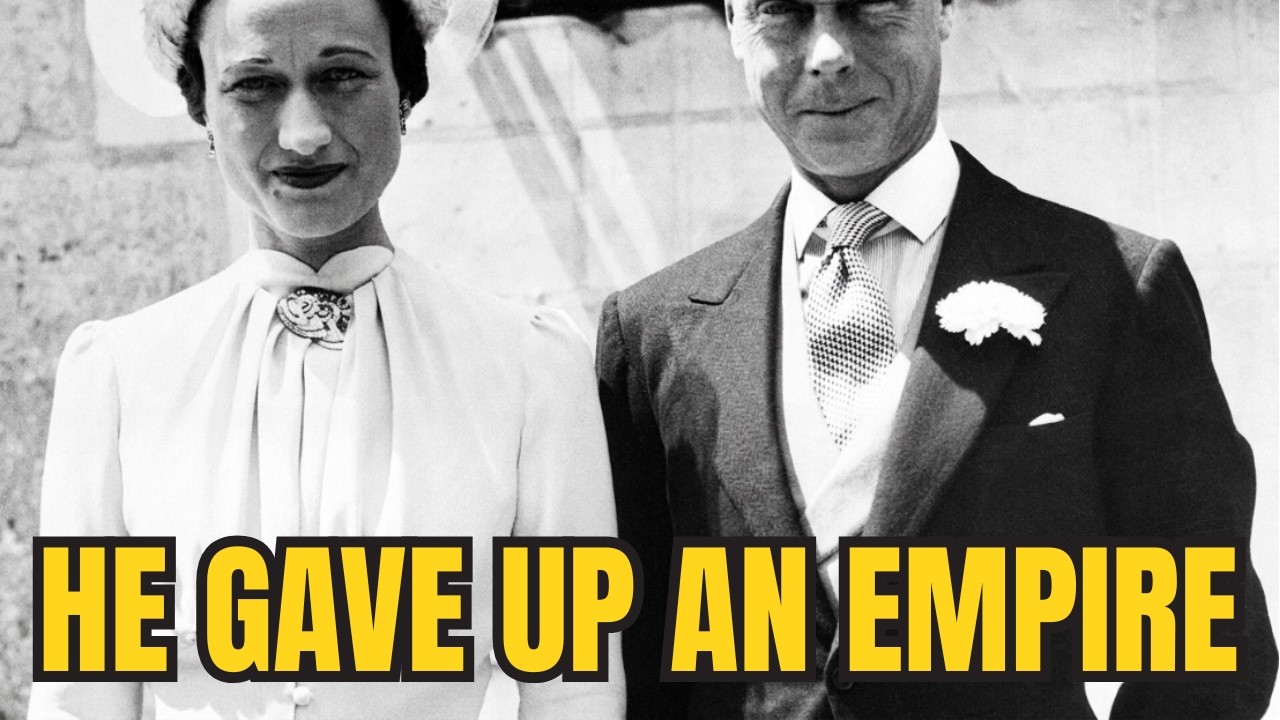
Perhaps 16 guests were present. The bride wore a gown of soft blue-gray that the dressmakers of the world would christen Wallis blue. His old friend, Fruity Metcalfe, stood as his best man. And not one member of the royal family was there — not his mother, not one of his brothers, not a single cousin. None had been permitted to come.
The absence of his family, and the three letters his bride would never be allowed to bear, hung over the small proceedings like a sentence handed down in another room. There were no crowds, no cathedral, no peeling bells, nothing of the pageantry that had attended his every public act since boyhood. Only a scatter of guests in a French drawing room, and a bride the Empire had been instructed not to honor.
They honeymooned at a castle in the Austrian mountains, and began, as husband and wife at last, the only life that had been left to them.
It was a strange life, and a hollow one. They had a marriage, a dukedom, a fortune, and the attentions of a small traveling court of the fashionable and the curious — and no country, no throne, no work, and no way home. They drifted between France and Austria and the smart resorts in between: the most celebrated idle couple on the continent, a former king-emperor and his American Duchess with nothing whatever to do and the rest of their lives in which to do it.
There were houses to arrange and clothes to order and the small perfections of a life with no larger shape, and friends who came for the glamour and drifted away when it dimmed. But there was no work in any of it and no meaning, and the Duke, who had never been able to sit still even when an empire hung upon his word, began to chafe. It was, though he seems never to have seen it, the old family affliction in a new dress: a royal existence with everything in it but a use.
And into that idleness and that resentment stepped the very man who had lent them his chateau. Charles Bedaux moved easily in circles that reached into the new Germany, and he had a suggestion to make to a wounded, restless, under-occupied man who wanted above all else to matter again.

In October, 1937, the Windsors boarded a train for Germany, and a photographer was waiting on the steps of a house in the mountains.
The invitation had come dressed as a study tour, and perhaps to the Duke that is very nearly all it ever seemed to be. Officially, the visit that Charles Bedaux had arranged and that the German Labor Front under Robert Ley had agreed to host was a journey of inquiry into German housing and working conditions. The Duke of Windsor, self-appointed champion of the ordinary man, come to observe how a modern industrial state provided for its workers.
There was in the pose a thread of something real. He had walked the derelict coalfields of South Wales as king and had seemed to the men in the dole queues genuinely to care. Now, stripped of a throne and starved of a purpose, he had found a stage on which to be useful again — or at least to feel useful, which in his case had too often been the same thing.
It ran for some 12 days in October, 1937, from about the 11th to the 23rd, and on its glittering surface it was a triumph. There were factories and model housing estates, civic receptions and formal dinners, officials in attendance and crowds along the pavements. And everywhere the couple went, the Duchess of Windsor was received with a deference that must, after the spring she had endured, have felt to her like water in a desert.
She was bowed to. She was feted. She was given, freely and without a flicker of hesitation, the courtesies her husband's own family had spent the year withholding. To a man who had surrendered a throne and been repaid with a public insult to his wife, the contrast can hardly have been lost.
The centerpiece came on the 22nd of October, when the Windsors were driven up into the Bavarian mountains to a house above the town of Berchtesgaden to take tea with the Chancellor of Germany.
What passed between Adolf Hitler and the Duke of Windsor that afternoon has never been reliably established, and it is important to say so at once. Hitler's own interpreter, Paul Schmidt, was present. There was a period of private conversation between the two men, from which the Duke appears to have carried away the impression that Germany wished to be seen by Britain not as a coming enemy, but as a bulwark against the spread of Bolshevism.
But the record is thin, and the accounts do not agree. No one can now say with any confidence how much was truly said, how much was meant, or how much a flattered man simply heard what he wished to hear. The tea and the pleasantries were exchanged, and the meeting passed almost at once into a legend that has been quarreled over ever since. Much of what has since been claimed about that hour came later, and came from men with reasons of their own to shape the telling. The honest position, then as now, is that we do not truly know what was said and cannot.
Yet one detail of that day reached straight to the center of the Duke's private grievance. By several accounts, the Duchess of Windsor was addressed in that house in the German tongue as royal highness — the precise honor, the exact dignity, that a law drawn up in her own husband's country had been written expressly to deny her.
Whether it was studied or merely careless, no one can prove. But it was, whatever else it may have been, the cheapest and most calculated flattery in Europe. And it was aimed with real precision at the softest and sorest place in a proud and injured man. His family would not permit the world to call her royal highness. Here, for the price of a single word, was a host who would.
It is recorded by the biographer Frances Donaldson, among others, that the Duke gave the Nazi salute on more than one occasion during the tour.
The visit alarmed London deeply. The king and his advisers moved quickly to set distance between the crown and the spectacle of a former sovereign being escorted in state through a hostile power. The monarchy was still raw from the abdication, not yet a year old, under a new and anxious king, and it could ill afford the sight of the man who had walked away from the throne now touring the continent as though he still carried its weight.
A proposed second leg of the journey, a tour of the United States, collapsed within weeks beneath the opposition of American labor and the cool reserve of a weary Roosevelt administration.
The Duke had wanted, in all likelihood, nothing more intricate than to be received once again as a man of consequence, to feel the old warmth of importance he had thrown away. What he had in fact done was to hand his enemies in history a set of photographs he would never outrun.
It is easy, from the far side of the war that came after, to see the visit as self-evidently damning. It did not look so simple at the time. In the autumn of 1937, the policy of the British government itself was one of accommodation with Germany, and a great many respectable, patriotic people still believed or hoped that a general war might yet be reasoned away.
The Duke was foolish and vain and blind to how the pictures would age. But he was not, in that October, doing a thing his whole country had already agreed to condemn. The distinction matters, because it is the ground on which his defenders have always stood, and because fairness asks that it be granted before the harder questions are put.
How the episode should be understood has divided serious people from that day to this, and honesty requires that the divisions be set out rather than smoothed away.
There is the reading of the naive duke: a shallow, incurious man who saw a study tour, a warm welcome, and a courteous host, and genuinely perceived nothing beneath them. There is the reading of the vain man flattered: a wounded exile so starved of the honors his own family had withheld that he walked, half knowing and scarcely caring, into a trap baited with precisely the deference he craved. And there is the darker reading, pressed by his sterner critics: a former king-emperor with sympathies and resentments of his own, whom a calculating power was patiently cultivating toward a purpose not yet named.
Each reading can point to its evidence. None has ever been proven to the exclusion of the rest. And it must be stated as plainly as everything else that the Duke of Windsor was never charged with any crime, never brought to trial, and carried the question with him unanswered into the grave.
And yet — and here is the part that outlived all the argument — what finally mattered was less what the Duke intended in the autumn of 1937 than what those 12 days set in motion. He was now, in the eyes of a Germany drifting steadily toward war, a known and useful quantity: a former king-emperor who believed himself wronged by his own country, wounded in his pride, warm toward the men who had flattered him, and adrift in Europe with neither place nor purpose.
That was not treason, but it was a temptation laid out in the open. A name, a grievance, and a man who might be reached.
None of that was proof of anything, and it is only fair to say so. A man may be wounded and idle and unwise without being disloyal, and the Duke would maintain to the end of his life that he had been exactly that and nothing darker. But the services that watch such men do not trade in a subject's innocence. They trade in his usefulness.
And by the close of those 12 autumn days, the Duke of Windsor had made himself, whether he ever meant to or not, one of the most useful names in Europe to precisely the wrong people. He had wanted, more than anything, to matter again, to be received somewhere as the important man he had once been, to see the world bow to the wife his own family would not honor. And for 12 autumn days in 1937, he got it, and never seems to have asked himself why it was being given or what it was going to cost.
His defenders have argued ever since that he understood nothing, meant nothing, was guilty of nothing worse than vanity and a bad eye for company. Perhaps. No charge was ever brought, and none ever would be. But the photographs existed now, and the impression had been made: a former king-emperor, wounded, resentful, and available.
And when the world went to war two years later, there were men in Berlin who remembered exactly that. In the summer of 1940, in a hotel in neutral Lisbon, they would come looking for him.
They came looking for him in the end in the summer of 1940, and the road that delivered a former king of England into a neutral city thick with the enemy's agents had begun as the last of the peace ran out in France.
When war came in the September of 1939, the Duke of Windsor was where he had spent the two aimless years since his wedding: restless, useful to no one, and nursing still the old wound of the dignity withheld from his wife. He was found a liaison post with a military mission near the fighting and near nothing that mattered.
Then, in the early summer of 1940, the German armies tore through the French line, the roads clogged with refugees, and the Third Republic came apart in a matter of weeks. The Windsors went south with the flood, down through Biarritz, over the frontier into Spain, and on at last to Lisbon — neutral, crowded, watchful, the last open door on a continent fallen almost wholly under German arms.
There they came to rest, lodged in the villa of a Portuguese banker of frankly pro-German sympathies, marooned between a country that did not want them home and an enemy that wanted them badly. And through the long hot weeks of that summer, the most compromising episode of a compromised life gathered itself around him.
For the Germans had a plan for the Duke of Windsor, and of this much there is no doubt. It carried the code name Willy, and its running fell to Walter Schellenberg, an ambitious young intelligence officer of the SS. The purpose was patient and clear: to keep the Duke in Europe and within reach, to work upon his grievances with flattery, with planted rumor, and with a dangle of an enormous fortune, to draw him, if drawing would serve, quietly away from Britain and into readiness — and, if flattery failed, to take him by force.
For a defeated Britain might be made to yield up a use for such a man: a former king-emperor, aggrieved and amenable, set back upon a conquered throne as the pliant sovereign of a broken people. Rumors were planted that the British Secret Service meant the couple harm, the better to make Lisbon seem safer than London, and to keep him rooted where Berlin could reach him.
It is essential to be exact here, because the thing has so often been left blurred. Operation Willy was a German design, conceived by Germans and aimed at the Duke. The surviving record is a record of what Berlin hoped and plotted and told itself, and not a confession of anything the Duke agreed to. That the plot existed is certain. The documents are there, and no one disputes them.
How far the Duke inclined toward the whispers reaching him, how much of the flattery he swallowed, whether he grasped what was being spun around him or merely enjoyed being courted again after years of neglect — these things are disputed to this day, and the honest account leaves them so.
He haggled, in those Lisbon weeks, over the terms of any return, pressing for a meeting with his brother the king, for a rank worthy of him, for the reception at last of his wife. To his critics that looked like a man setting injured pride above his country in its most dangerous hour. To his defenders, it was only the old grievance surfacing at the worst imaginable moment, the vanity of a slighted man and not the calculation of a disloyal one.
Which of the two it was, the documents cannot finally say, for a man's wounded pride and a man's disloyalty can wear, from the outside, precisely the same face.
In London, Winston Churchill, Prime Minister now and fighting for the survival of the nation, read the danger exactly and moved to end it. The remedy was elegant and cold. The Duke would be sent as far from Europe as a posting could carry him, out to the Bahamas, a scatter of Atlantic islands where he could do no harm and be got at by no one. He would be their governor.
He did not want it. He bargained and stalled. Churchill, once among the most loyal of the King's party in the crisis of 1936, was driven at last to remind him in language only barely short of a threat that he held a commission and could be given an order.
On the 1st of August, 1940, the Windsors boarded the American liner Excalibur and sailed out of Lisbon into the western ocean. Operation Willy came to nothing. The card Berlin had hoped to hold was carried clean off the table and never played.
The Bahamas were an exile got up as an appointment. He called the place, with the self-pity of a man who could liken himself to a fallen emperor and mean every word of it, his St. Helena. And for five years he went through the small ceremonial motions of a small colonial governorship — the openings, the receptions, wartime committees — with tolerable diligence and undisguised distaste.
He found the heat a torment and the society beneath him. The Duchess counted the whole posting a sentence handed down. And their years there were darkened toward the end by a sensational and still unsolved murder among the islands' wealthy, in which the governor's own handling of the investigation drew a criticism that has never quite washed off.
But the governing was never the point of the thing. The keeping was the point. He had reigned, however briefly, over a fifth of the human race. Now he presided over a colonial legislature and a handful of coral islands, and knew in every idle hour of it the exact measure of the distance he had fallen.
Five years of holding a disaffected and dangerous man — and then the war ran down toward its end, and the papers came to light.
In the spring of 1945, the Reich fell in upon itself. Advancing Allied troops seized the archive of the German Foreign Ministry — Ribbentrop's Ministry — a mountain of documents spirited out of Berlin and run to ground in the heart of Germany near the old town of Marburg. Among them, read with a deepening unease by the officers who came upon it, was a folder that concerned the Duke of Windsor.
The German record of Lisbon, of Operation Willy, of the soundings and the schemes and the flattering, damning things that Berlin had believed — or had merely wished to believe — of the sympathies of the onetime King of England.
What followed was a long and discreet struggle. The British establishment, with Churchill himself pushing hardest of all, labored for more than a decade to keep the Windsor material sealed away out of the captured German records the Allies were jointly publishing — away from a public that had just spent six years at war with the regime those very papers touched.
They did not wholly succeed. The file was published in 1957, and the Duke rejected it flatly as complete fabrications.
And here one thing must be set down as plainly as the record allows. The file records what the Germans wrote and hoped and told one another, and that is the whole of what it records. It is not a confession. It is not a verdict. It is the enemy's own account of a man the enemy meant to use, and the enemy was never an honest witness.
So the scales hang where they have always hung. The documents are real. The plot was real. The vanity was real, and the grievance, and the carelessness that had run through the whole of him since the days when he left the secrets of the realm lying open on a table at Fort Belvedere for any guest in the house to read.
That had been the first question ever asked of him as king. Not whether he was wicked, but whether he could be trusted with the things he knew. In 1936 it had looked like nothing worse than idleness. By 1945 it had become a question with no easy floor beneath it. The king who could not be troubled to read his boxes had become the man whose own recorded words his country dared not let the world read.
And somewhere in the long distance between those two facts lies the whole unanswered riddle of what, in the end, he did with what he knew. No court ever put it to him. No charge was ever laid. And serious men have divided ever since among the only three verdicts the evidence will bear: the innocent dupe; the vain man flattered into folly by people cleverer and colder than himself; and the darker thing the grimmest reading fears — without any single one of them ever being able to close the case.
The war ended and the file was locked away. And the men who governed Britain decided that some questions about the Duke of Windsor were better never asked aloud. He was never charged. He was never tried. He was quietly retired from his island exile and left to wander back to Europe — his name unstained in law and stained beyond scrubbing in every other way.
History has argued about him ever since, and history has never reached a verdict, because the evidence points in three directions at once and the man himself took his answer to the grave.
Whatever the truth of it, this much was certain. There could be no way home now. The family would not have him. The country did not want him. And so the golden prince, who had once been cheered by half the world, set out on the last and longest chapter of his life: 30 years of expensive, immaculate, unbearable nothing.
The last chapter of his life was by far the longest, and almost nothing happened in it. That was the whole of its tragedy. Everything this story has followed — the golden boy, the adored prince, the king, the crisis, the abdication, the tour, the plot, the file — all of it was over before he was 50. And what remained was better than three decades of aftermath, lived out in the soft, upholstered, immaculate silence of a man with nowhere left to go.
After the war, the Windsors gave up at last on the idea of a home country. Britain would take them on no terms they were willing to accept: no work for him, no title for her, no curtsy, no treaty way back in. And so they settled instead, as stateless grandees, into the one nation content to let them be decorative and leave them in peace.
They kept a house in Paris and a converted mill in the countryside. And from 1953, the villa the world would come to call by his name: a mansion in the Bois de Boulogne, leased from the city of Paris for a rent so small it was very nearly a curtsy.
There, behind high walls and clipped hedges, they raised a little flawless kingdom out of pug dogs and cut flowers and liveried servants and borrowed splendor — a court perfectly appointed, with nothing on earth left to govern but the placement of the cards at dinner.
For this, in the end, was what the empire had bought. He had given away a quarter of the world and the oldest crown in Europe. And in exchange he had been handed 36 years of spotless emptiness: no office, no country, no purpose, no road back, and no chance that any of them would ever come again.
He was a former king-emperor whose one remaining employment was to be charming after dinner, and to defend before a world that had long since ceased to care the dignity of the woman for whom he had thrown the rest of it away.
He published his memoirs, A King's Story, and they sold in their hundreds of thousands and resolved nothing. He told the tale of the abdication, and told it again to guests who had heard it before. He tended his garden. He waited. And the hollow that the cheering of millions had never once been able to fill was not filled now by the silence either.
The great love that had cost him an empire wore thin across the long gray decades into two aging exiles keeping one another company in a house that fell quieter with every passing year. Those who met them in that time carried away an impression of something arrested: a couple frozen at the very instant of their scandal, going on immaculate and unchanging long after the world that had made them was gone.
The Duchess kept the hard, brilliant, brittle elegance of the 1930s into an age that had moved past it. The Duke, courteous and faded, was remembered by many who knew him late as a wistful, diminished figure — a slight man, beautifully dressed, who had once been the most famous person alive, now filling his afternoons with dogs and flowers and the retelling of an old, old story.
And beneath the whole of it ran the same quiet that had no bottom.
The rupture with his family never truly healed. It only wore a little smoother with time. The Duchess was never granted the three letters, never made her royal highness, never owed the curtsy he had begged for her. And the family that had refused them received her across the whole of that long exile only seldom, and never with warmth.
The wound he had taken in the spring of 1937 he carried still open into old age. It was the single grievance that never left him. And the world, which had made her its villain, never quite allowed him to set it down.
And then, quietly, the smoke came to collect what it was owed. Three generations of the men of his house had lived wrapped in tobacco: his grandfather's cigars, his father's cigarettes, his own unbroken chain of them. And now, in his old age, the cancer took him by the throat.
By the spring of 1972 he was dying, wasted and near voiceless, in the villa in the Bois de Boulogne. And it was then that the gentlest and strangest thing in the whole long story came to pass.
On the 18th of May, on a state visit to France, Queen Elizabeth II came to call on him. The reigning queen upon her exiled uncle. She was Lilibet, the small girl of his father's dying prayer — the child George V had begged might one day come safely to the throne.
And there was the old king's prayer answered to the very letter, and answered by the very ruin he had dreaded. For the abdication he prayed against had lifted first his second son and then this daughter onto the throne. And now the daughter stood crowned at the bedside of the brother whose ruin had made her queen.
He was far too ill to receive her as protocol required, and he received her regardless, dragging himself upright to bow one last time to the crown he had once worn and given away. They had a few minutes together.
Ten days later, on the 28th of May, 1972, the Duke of Windsor died in Paris, 77 years old, in a house he could never call home for the single reason that it was not England.
They carried him back to the England that had cast him out. His body was flown to Windsor. He lay in state in St. George's Chapel, while tens of thousands filed slowly past. And at his funeral there, on the 5th of June, 1972, the Duchess of Windsor — driven from the country 36 years before, blamed to her face for a catastrophe she had reportedly pleaded to be allowed to stop — was received as the guest of the Queen, and lodged those few days at Buckingham Palace itself, inside the house of the family that had shut its doors against her.
He was buried at Frogmore, in the royal burial ground, within the walls of Windsor. Taken back in death into the family that would not have him in life.
And then there was Wallis, and the last of it is hers. And it is the bleakest passage of the whole account.
She had never wanted a crown. By the best evidence, she had been frightened of the disaster from the very start, and had tried once in the open, before the whole watching world, to withdraw and undo it. She had spent 35 years as the most famous and most hated woman in the West, minding a man who could not mind himself.
Now she was alone. Widowed, childless, sinking by slow degrees into the fog of dementia. She lived on in the great hushed villa for 14 more years, bedridden at the last, cut off almost wholly from the world by her formidable French lawyer, Maître Suzanne Blum, who is widely believed to have walled the dying duchess away behind locked doors and drawn curtains and a barricade of attorneys.
She died on the 24th of April, 1986, 89 years old, after long years in which scarcely anyone was permitted to look upon her at all. They laid her beside him at Frogmore, beneath the stone that grants her at the very last, and only here, her place in his family: Wallis, Duchess of Windsor.
The woman refused the courtesy for the whole of her living life was set down, in the end, in the private earth of the house that would never bow to her, under the very name that a king had given away his crown and his country and 36 years of his life in order to be allowed to give her.
He had been the most photographed man on earth, the golden hope of an empire, a king crowned in all but ceremony. And he ended as an old man in a rented house in a Paris park, tending roses he did not need to grow, keeping a silence that no crowd would ever break again.
He had given away a quarter of the world for a woman, and been given in return 36 years to find out what that was worth.
His grandfather had waited 60 years for a throne and been given nothing to do with it. He had waited a lifetime for the same throne, held it for 11 months, and handed it back for love. And both of them, in the end, had been broken on the same wheel: the terrible distance between what a prince is promised and what a prince is permitted to be.
They lie now a few yards apart at Frogmore — the grandfather who wanted the crown and the grandson who threw it away, and the two women who watched them do it.
History still cannot agree on what the Duke of Windsor was. A romantic, a weakling, a dupe, or something colder? Perhaps he was only what he had always been: a hollow, dazzling, frightened man who was loved by millions and could never once feel it, and who paid for the one thing that finally filled the emptiness the highest price any Englishman has ever paid.
The woman he loved was worth an empire to him. It is the saddest sentence in this whole long story, because in the end, it was very nearly all he had left to show for it.