In the summer of 1929, Geneva was hosting the kind of diplomatic gathering the city had become known for. Forty-seven nations sent delegations to sign an agreement that had taken three years to negotiate.
The document was the 1929 Geneva Convention relative to the treatment of prisoners of war. It contained 97 articles, precise language, and binding commitments. It represented what the civilized world had decided to do about men captured in war.
The Soviet delegation was present. They sat through the proceedings. They listened to the language. They watched nation after nation send a representative to the table to sign.
They did not sign. They left Geneva without adding their name to the document. That decision, made in a clean Swiss city in the summer of 1929, would contribute to the deaths of more than 3 million men.
Before examining why the Soviet Union refused, it is worth understanding what they were refusing and what arguments they made to justify the refusal. The Soviet position was not simply irrational. It was a calculated ideological position with specific arguments behind it.
Some of those arguments had genuine merit. Understanding them matters because it makes what followed more complicated than a simple story of government negligence.
The Soviet delegation in Geneva made three primary arguments against signing. The first argument was structural.
The 1929 Geneva Convention had been written primarily by Western European nations: Britain, France, Switzerland, and the United States. The specific protections it offered reflected the experience of Western European warfare, trench warfare, fixed front lines, and relatively defined battlefields where the distinction between combatant and prisoner was reasonably clear.
The Soviet military experience and Soviet military doctrine operated on fundamentally different assumptions. The scale was different. The geography was different. The nature of the conflict the Soviet Union anticipated fighting was different from anything the Western nations drafting the convention had imagined.
The Soviets argued that signing a document written for someone else's war would bind them to obligations that did not fit their military reality while offering protections calibrated for a kind of warfare they did not expect to fight.
This argument was not entirely wrong. The convention did reflect Western assumptions. It had been written by men whose mental model of war was the Western Front of 1914 to 1918. The scale of what would happen on the Eastern Front between 1941 and 1945 was beyond anything the convention's authors had imagined.
The second argument was ideological. The Geneva Convention treated all soldiers equally regardless of which side they fought for. A captured German soldier and a captured Soviet soldier were equivalent legal persons under the convention's terms, both entitled to the same protections and both subject to the same obligations from their captors.
Soviet ideology rejected that equivalence completely. A German soldier representing capitalism, imperialism, and class exploitation was not the political or moral equivalent of a Soviet soldier representing the proletariat and the Soviet state. Signing a document establishing legal equality between them meant accepting a framework that contradicted the foundational assumptions of Soviet political thought.
This was not simply abstract philosophy. It had direct practical implications. If Soviet soldiers and enemy soldiers were legally equivalent persons, then the Soviet Union was legally obligated to treat captured enemy soldiers with the same protections it would want for its own men. That obligation conflicted with how the Soviet military and political leadership intended to conduct warfare.
The third argument was the most revealing. The Geneva Convention assumed that capture was an acceptable outcome for a soldier in combat. The entire architecture of the document, its protections, its notification requirements, its Red Cross provisions, its prisoner of war camps, rested on the premise that men would be captured and that this was a normal and legitimate part of warfare that required a legal framework.
Soviet military doctrine under Stalin rejected that premise entirely. A Soviet soldier who allowed himself to be captured was not a victim of circumstance in Soviet military thinking. He was a man who had chosen surrender over death. In Soviet doctrine, that choice was not acceptable. It was a failure of political commitment, a betrayal of the state.
A soldier was expected to fight until he was dead. Capture meant he had not done that. Signing a convention designed to protect men who had been captured meant acknowledging that capture was something worth protecting against. It meant accepting that captured soldiers deserved rights and consideration. Stalin had no intention of building a legal framework around an outcome he decided should not happen.
The Soviet position was internally consistent. It was also catastrophically wrong about what was coming.
On June 22, 1941, Germany launched Operation Barbarossa, the largest military invasion in human history. Three million German soldiers crossed into Soviet territory along a front stretching 2,900 kilometers.
The speed of the advance in the first weeks was beyond anything the Soviet military command had prepared for. Entire Soviet armies were encircled before they could withdraw. Hundreds of thousands of men were cut off from their own lines with no route of escape.
They were captured. Not because they chose surrender over death in the way Stalin's doctrine imagined, but because the tactical situation had collapsed around them faster than any human response could address.
Men who had been fighting 24 hours earlier found themselves inside German encirclements with no ammunition, no food, no communication with their command, and no way out. They raised their hands.
The moment they did, the absence of the Soviet signature on the 1929 Geneva Convention became a legal reality with physical consequences. Germany was a signatory to the convention. Germany was legally bound by its terms.
But the convention's reciprocity principle meant that the protections it offered applied between signing nations. A German soldier captured by a signing nation was protected. A soldier from a non-signing nation captured by Germany occupied a legal gray area that the German military and political leadership chose to interpret in the most lethal way available to them.
On June 6, 1941, 16 days before Barbarossa began, the German High Command issued the Commissar Order. Soviet political officers captured in combat were to be executed immediately, not processed as prisoners of war. Executed.
On July 16, 1941, less than a month into the invasion, the German military issued guidelines for the treatment of Soviet prisoners that explicitly removed the Geneva Convention protections that would have applied to prisoners from signing nations.
Soviet prisoners were to receive rations at a level below what was required for survival. They were to be housed in conditions that no signing nation's prisoners would have been subjected to. They were to be used as forced labor under conditions that the convention explicitly prohibited.
The justification for every one of these decisions rested in part on the same foundation. The Soviet Union had not signed. The reciprocal obligations that the convention created between signing nations did not apply. Germany was not legally bound to treat Soviet prisoners the way it was legally bound to treat British or American or French prisoners.
The absence of the Soviet signature did not cause Germany to decide to murder Soviet prisoners. That decision came from ideology and from deliberate policy made at the highest levels of the Nazi state. But the absence of the signature removed the legal constraint that would have existed if the Soviet Union had been at that table in Geneva in 1929.
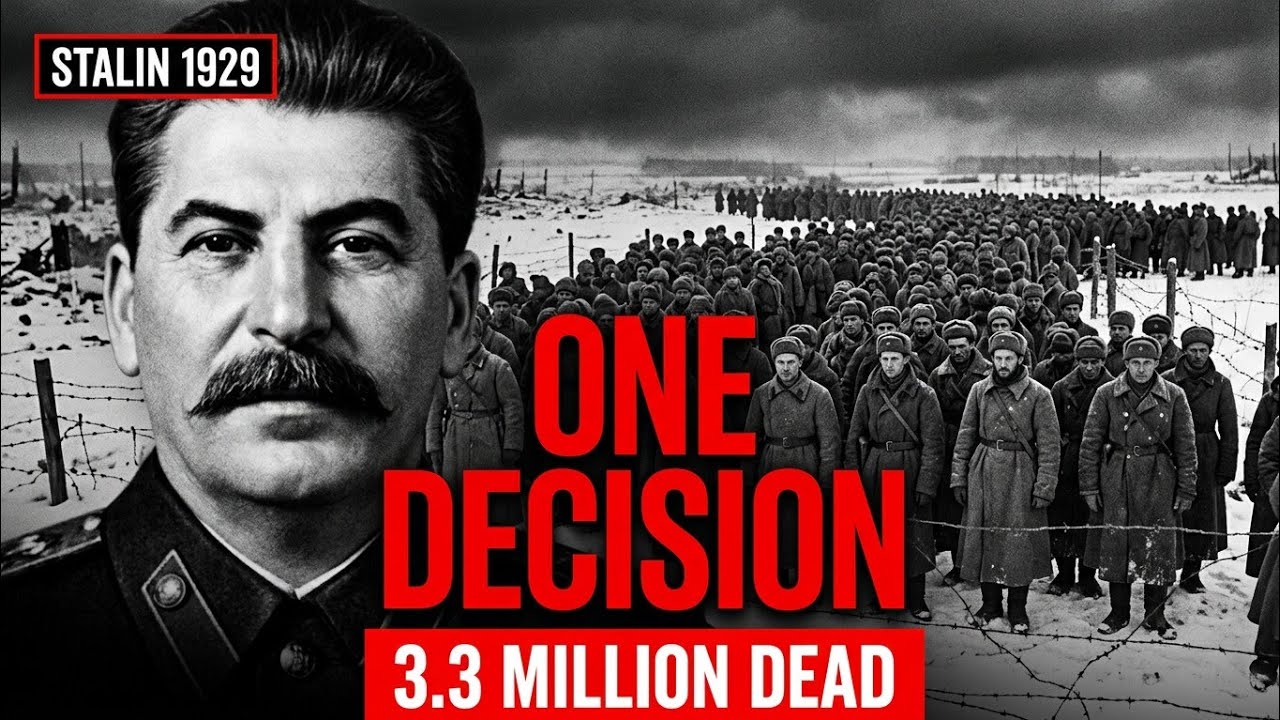
The numbers are the part of this story that most people never encounter in full. Of the approximately 5.7 million Soviet soldiers captured by Germany during the Second World War, 3.3 million died in captivity. That is a death rate of 57 percent.
To understand what that number means, it requires a comparison. Of the Western Allied prisoners, British, American, Canadian, and French, held in German captivity during the same war, the death rate was approximately 4 percent.
Those men were protected by the Geneva Convention. They received Red Cross packages. Their names were reported to international bodies. They were housed in conditions that were often brutal, but were legally constrained from being lethal by design.
The difference between 57 percent and 4 percent is not explained by the difference in how much Germany hated its enemies. Germany hated Britain. Germany hated the United States. The difference is explained in significant part by the presence or absence of a legal framework that created accountability for how prisoners were treated.
Many of the 3.3 million died in the first winter of the war. The German military had not prepared adequate housing or food for the volume of prisoners that Barbarossa encirclements produced. Soviet prisoners were held in open fields surrounded by wire as winter arrived. They froze. They starved. They died of typhus and dysentery in camps that had no medical infrastructure because the convention that would have required medical infrastructure did not apply to them.
This was not a secret inside Germany. The scale of Soviet prisoner deaths was visible and documented within the German military administration. Reports went up the chain of command. The response was not to improve conditions. The response was to note that the Soviet Union had not signed and therefore the conditions were not a legal violation.
The absence of the signature was not the cause of the deaths, but it was the legal language that made the deaths administratively permissible.
There is a layer of this story that is darker than the German treatment of Soviet prisoners. It is what the Soviet government did to its own captured men.
On August 16, 1941, Stalin issued Order 270. The order declared that any Soviet soldier who allowed himself to be captured by the enemy was a traitor to the Soviet state. Officers who were captured were to be considered deserters and enemies of the people. Their families would lose their state benefits and their rations. Soldiers who were captured were subject to being shot upon return to Soviet lines.
Men who survived German captivity, who endured the open fields and the starvation and the forced labor and the systematic killing, returned to Soviet lines and faced arrest. Some were shot. Some were sent to Soviet labor camps. Some were sent back to penal battalions to fight in conditions designed to get them killed in combat as punishment for having been captured.
The Soviet Union refused to sign a convention designed to protect its captured soldiers, then declared those same soldiers to be traitors for having been captured, then punished the ones who survived captivity for surviving.
The men who paid for every one of those decisions were the men in the fields, the men in the encirclements, the men who raised their hands not because they had given up, but because the tactical situation had collapsed around them and there was no other option.
They were abandoned by international law because their government had not signed the document that created it. And then they were abandoned by their own government for having needed that protection in the first place.
The question this history leaves behind does not have a clean answer. It has two sides that cannot be fully reconciled.
Side one, the Soviet arguments against signing were not entirely wrong. The convention was a Western document written for Western warfare. Its assumptions about the nature of combat and capture did not fully account for what the Eastern Front would become. A more comprehensive and universally applicable convention might have produced a different Soviet calculation in 1929.
Side two, none of the legitimate criticisms of the convention's limitations justify what happened to 3.3 million men. Whatever the flaws of the document, whatever the ideological objections, whatever the structural arguments, the absence of the signature produced a legal vacuum that was filled with death. A flawed document offering partial protection is not equivalent to no document offering none.
The question underneath both sides is this: When a government makes a political calculation that it believes serves the state, and that calculation costs millions of its own people their lives, at what point does the calculation become a crime against the people it was supposed to serve?
Stalin made the calculation in 1929. The men who paid for it died between 1941 and 1945 in fields and camps across Germany and occupied Europe. They never knew the calculation had been made. They never knew that in a clean Swiss city in the summer of 1929, their government had looked at a document designed to protect them and decided it was not worth signing.
The document sat in Geneva with 47 signatures. The 48th line was blank. That blank line has 3.3 million names written in it. None of them chose to be there.