On March 5, 1953, Joseph Stalin died at his dacha outside Moscow. He was 74. The stroke that killed him went undiagnosed in time because his doctors were afraid to examine him thoroughly. Stalin was in the middle of an anti-Semitic purge that had targeted the Soviet medical establishment, and the doctors who might have saved him were under arrest.
The man who had ruled the Soviet Union for 29 years was gone. He had collectivized agriculture, murdered the kulaks, purged the Red Army on the eve of the war it needed to fight, signed a pact with Hitler, survived Hitler's invasion, driven the Wehrmacht back to Berlin, imposed Soviet power on half of Europe, blockaded Berlin, watched his scientists test the Soviet atomic bomb, and watched his North Korean clients cross the 38th parallel.
The news reached Washington in the early hours of March 5. It reached the CIA before it reached the State Department. It reached Allen Dulles, the agency's new director, before it reached most of the people who would need to decide what to do about it.
Dulles understood immediately what it meant and what it might mean. The gap between those two things was the gap that the next several weeks of American foreign policy would be spent trying to navigate.
What it meant was that the Soviet Union was without its dictator for the first time in 29 years. What it might mean was almost everything else. It might mean a succession crisis that paralyzed Soviet decision-making. It might mean a power struggle that produced a more moderate leadership willing to negotiate Cold War tensions. It might mean an opening in the structure of the post-war world that did not appear often.
The CIA told Eisenhower it was the chance of a century. What Eisenhower did with that assessment became one of the most consequential and most debated decisions of his presidency. Historians have been arguing about it since the documents were declassified.
To understand what Stalin's death meant, you have to understand the world Eisenhower occupied in March 1953. He had been president for exactly 43 days when the news arrived.
He had inherited a set of problems whose accumulated weight would be daunting for any administration. They were particularly complicated for an administration whose campaign promises included a more aggressive prosecution of the Cold War than Truman's containment strategy had delivered.
Korea was the most immediate problem. The Korean War was in its third year and had settled into a grinding stalemate. The armistice negotiations at Panmunjom had been ongoing since July 1951 and had produced nothing except a detailed map of the disagreements between the two sides.
The disagreements about the repatriation of prisoners of war had proven more intractable than the military questions. Eisenhower had campaigned on ending the Korean War. He was now the president, and the war was not ended, and the men were still dying on a line that had not moved significantly in 18 months.
The nuclear question was the second major problem. The Soviet Union tested its first atomic bomb in August 1949 and had been developing its nuclear capability since. By March 1953, the Soviets were developing thermonuclear weapons.
The window of American nuclear superiority that shaped Truman's foreign policy was closing. The closing of it changed the strategic calculation in ways that neither the military nor the State Department had fully processed.
Eastern Europe was the third problem. Truman's containment policy had accepted Soviet domination of Eastern Europe as a fait accompli that American policy could limit at the margins but could not reverse without a military confrontation nobody was willing to risk.
The Republican campaign of 1952 had attacked this acceptance. It used the language of rollback and liberation and promised that an Eisenhower administration would do more for the captive nations of Eastern Europe than containment had done.
Into this landscape, on March 5, 1953, Stalin died.
The CIA's assessment of the opportunity was not wrong as an assessment. The Soviet succession was genuinely uncertain. Stalin had not designated a successor in any formal sense.
His system of governance was built on the principle that no subordinate could be secure enough to develop an independent power base. It had systematically destroyed the kind of institutional succession planning that would allow for an orderly transfer of power.
The men now competing for control of the Soviet state were doing so without a clear hierarchy, without a clear ideology, and without a clear policy agenda beyond the immediate imperative of surviving each other's competition.
Lavrentiy Beria was the most immediately powerful of the competitors. He controlled the secret police, the instrument of state terror that was the foundation of Soviet domestic control. He moved within hours of Stalin's death to position himself as the dominant figure in the collective leadership the Politburo announced.
Beria's power was real, but his position was also dangerous. Every other figure in the Soviet leadership understood that the man who controls the secret police is the man most capable of eliminating all competitors, and that eliminating all competitors was precisely what they needed to prevent.
Georgy Malenkov was the second major figure. He was Stalin's designated heir in the limited sense that Stalin ever designated anyone for anything. He controlled the party apparatus, and the announcement of the collective leadership elevated him to the nominal premiership.
Malenkov's position at the top of the nominal hierarchy concealed how much his actual power depended on the fragile balance of the collective leadership rather than on any independent base of authority.
Vyacheslav Molotov, the foreign minister, represented the old guard. These were the men who had been with Stalin since the beginning and who had survived by the specific combination of usefulness and submissiveness that Stalin rewarded.
Nikita Khrushchev was the least obviously powerful of the major figures in March 1953. He was the party secretary, and his institutional position gave him control over the party apparatus that nobody was fully tracking as the decisive source of power in the succession struggle.
The CIA was watching all of this with focused attention. It was generating assessments for Eisenhower with the urgency of people who believed the window of opportunity was short.
The specific opportunity the CIA identified was this. The Soviet leadership in the weeks after Stalin's death was signaling a possible willingness to reduce Cold War tensions in ways that Stalin's rigidity had made impossible.
Malenkov gave a speech suggesting that all outstanding international questions could be resolved through negotiation. The Soviet press shifted its tone on several issues. Most significantly, the armistice negotiations in Korea began showing movement that had been absent for months.
The CIA assessed that this movement reflected a Soviet decision to allow the Korean War to end rather than to continue it as an instrument of American exhaustion.
The question for Eisenhower was what to do with these signals. The CIA's answer was aggressive. The chance of a century implied a major American initiative that exploited the Soviet leadership's uncertainty and the genuine possibility of a more moderate post-Stalin policy.
The specific initiatives discussed inside the administration ranged from a direct approach to the new Soviet leadership about a comprehensive negotiated settlement to more aggressive covert operations designed to exploit the instability of the succession period and support liberation movements in Eastern Europe.
The State Department's answer was more cautious. John Foster Dulles, the Secretary of State and Allen Dulles's brother, brought to the question the particular combination of ideological conviction and diplomatic caution that characterized his approach to the Soviet Union throughout the Eisenhower years.
Dulles believed the Soviet system was evil and would eventually collapse under the weight of its own contradictions. That belief produced a foreign policy of patience rather than initiative, of waiting for the Soviet system to fail rather than taking risks to accelerate its failure.
His assessment of the post-Stalin signals was skeptical. He did not believe the Soviet leopard had changed its spots. He did not believe the succession uncertainty represented a genuine opportunity for a negotiated reduction in Cold War tensions. He believed it represented a tactical adjustment by a system whose fundamental character had not changed.
Eisenhower was between these two positions. The place he occupied between them was not the midpoint but something more specifically his own, shaped by the military experience and strategic temperament that were different from anything either the CIA or the State Department brought to the question.
He had commanded armies. He had managed alliances. He had sat across tables from people whose interests were not his interests and found ways to produce outcomes that neither side could have produced alone. He was not naive about the Soviet Union and he was not ideologically rigid about it.
He was a practical man looking at a practical question: whether the death of Stalin had created a genuine opportunity for a reduction in Cold War tensions that served American interests, and if so, what the right instrument for exploiting that opportunity was.

He decided to give a speech. But the decision to give a speech rather than pursue the aggressive covert and diplomatic initiatives the CIA was recommending did not come easily. The process by which Eisenhower arrived at it reveals more about his strategic thinking than the speech itself does.
The internal debate inside the Eisenhower administration in the weeks between Stalin's death and the April 16 speech was one of the most consequential policy arguments of the entire Cold War. It was conducted at the highest levels of the American government with the urgency of people who understood that the window they were discussing was closing with each passing week.
The NSC meetings in March and April 1953 were where the argument was most fully developed. The National Security Council under Eisenhower was a different institution from the NSC under Truman, more formal and more structured and more systematically used as the primary instrument of foreign policy deliberation.
Eisenhower had redesigned the NSC process to ensure that the president received genuinely contested analysis rather than the bureaucratically smooth consensus that institutional processes tend to produce. The redesign was working in the spring of 1953 in the sense that the NSC meetings generated real argument rather than managed agreement.
The CIA's position in those meetings was consistently and specifically that the succession crisis was producing a Soviet leadership vulnerable in ways American policy had not previously encountered, and that the vulnerability should be exploited through initiatives going beyond a public speech.
The specific initiatives being advocated involved direct communication with individual Soviet leaders, the use of intermediaries in European capitals to signal American willingness to negotiate comprehensive settlements, and the exploitation of uncertainty in Eastern Europe to support political movements.
Eisenhower listened to all of this with the attention of a man taking it seriously and the skepticism of a man whose military experience had taught him the difference between an opportunity that looks large from Washington and an opportunity that is actually executable on the ground.
His skepticism had several specific components. The first was about the Soviet leadership's actual intentions. The CIA's assessment that the succession signals represented genuine moderation was an assessment, not a certainty, and Eisenhower was acutely aware of the difference.
The Soviet leaders sending the moderation signals were the same Soviet leaders who had been Stalin's lieutenants for decades, who survived in that position by being sufficiently ruthless and sufficiently ideologically committed to satisfy the most demanding employer in the history of totalitarian governance.
The possibility that their moderation was tactical rather than genuine, that it reflected the immediate requirements of the succession struggle rather than a fundamental change in Soviet policy, was one Eisenhower could not dismiss and that the CIA's assessment did not fully resolve.
The second component of his skepticism was about American capacity to exploit the opportunity even if it was real. The aggressive initiatives the CIA recommended required American credibility in Eastern Europe and in Moscow that Eisenhower was not confident the United States actually had.
The Truman administration's containment policy had established a pattern of American behavior that the Soviet leadership had been reading for four years. That pattern said the United States would resist Soviet expansion at the borders of the Western alliance but would not take offensive action inside the Soviet sphere.
Changing that pattern required establishing new credibility that took time to build and could not be built through a single initiative, however well designed.
The third component was the most personal and the most strategic simultaneously. Eisenhower was thinking about what happens if the aggressive initiatives are tried and they fail.
If the United States made a direct approach to the Soviet leadership and the approach was rejected, or exploited for propaganda purposes, or used by hardliners within the Soviet succession struggle to discredit the moderates whose position the approach was intended to strengthen, the United States would have spent credibility and received nothing.
Worse, it would have potentially strengthened the Soviet hardliners by giving them evidence that the American approach was an attempt to exploit Soviet weakness rather than a genuine offer of reduced tension.
Eisenhower decided that the risk of the aggressive initiatives failing was higher than the CIA's assessment of the opportunity justified. The right instrument for the moment was not a covert approach whose failure could not be acknowledged but a public statement whose terms were so clear and so reasonable that the Soviet leadership's response to it would itself be informative.
The speech would be the test. If the Soviet leadership responded to a public American offer of negotiated tension reduction with genuine movement, the opportunity was real and further initiatives were warranted. If the Soviet leadership ignored it or dismissed it, the CIA's chance of a century was a misreading of a tactical adjustment.
Eisenhower delivered the speech on April 16, 1953, six weeks after Stalin's death. It was called "The Chance for Peace." It was addressed formally to the American Society of Newspaper Editors but written for a global audience and intended to be received in Moscow as much as in Washington.
The speech is one of the most remarkable documents of the Cold War. It speaks with directness and specificity about the cost of the arms race, the opportunity Stalin's death might represent, and the specific terms on which the United States was willing to negotiate a reduction in Cold War tensions.
Eisenhower said that every gun that is made, every warship launched, every rocket fired signifies in the final sense a theft from those who hunger and are not fed, those who are cold and are not clothed.
He said the world in arms was not spending money alone but the sweat of its laborers, the genius of its scientists, the hopes of its children. He said a bomber cost a certain number of modern brick schools, a single fighter plane cost a certain number of miles of concrete highway, and a destroyer cost new homes that could have housed 8,000 people.
This was not the language of containment. It was not the language of rollback. It was the language of a former Supreme Allied Commander who understood what military spending costs in human terms and who was using Stalin's death as an occasion to say publicly what he believed privately.
The speech produced an immediate and significant reaction. The response from Moscow was not what the hardliners in the American foreign policy establishment expected. The Soviet leadership engaged with it.
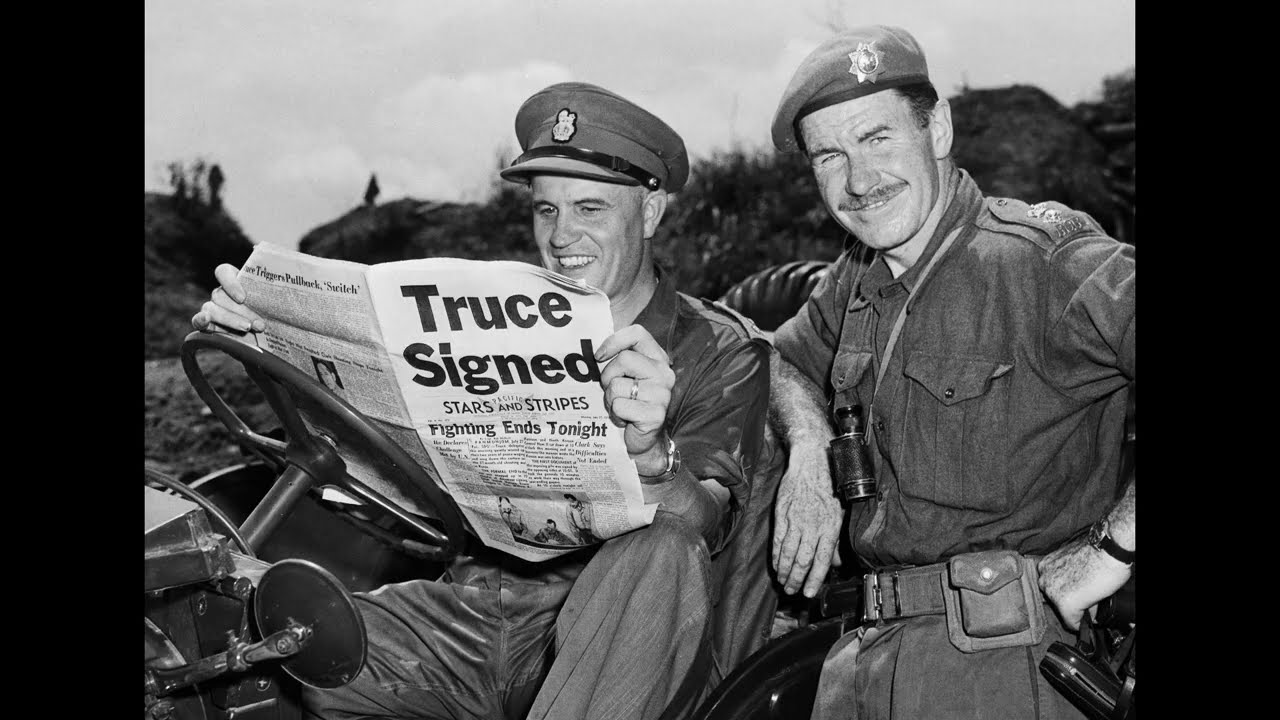
The signals the CIA had been reading as genuine turned out to be, in several respects, genuine. The Korean armistice, stalled for months, was signed in July 1953. The prisoner repatriation issue that had been the central obstacle was resolved through a formula that neither side could claim as a complete victory but that both sides could accept. The Korean War ended.
Beria was arrested by his colleagues in June 1953 in a plot organized by Khrushchev and Malenkov and the military leadership. It reflected the collective determination of the Soviet leadership that the man who controlled the secret police could not be allowed to consolidate his position.
His arrest and subsequent execution removed the most immediately dangerous figure from the succession struggle and began the process of de-Stalinization that Khrushchev would formalize in his secret speech to the 20th Party Congress in 1956.
The comprehensive settlement of Cold War tensions that the CIA's chance of a century language implied did not materialize. The Geneva Summit of 1955, the first meeting between American and Soviet leaders since Potsdam, produced an atmosphere of relative goodwill that contemporaries called the spirit of Geneva and that did not survive long enough to produce any specific agreements.
The Cold War continued. The arms race continued. The division of Europe continued. What changed was the character of the competition.
The post-Stalinist Soviet Union under Khrushchev was a different adversary than the Soviet Union under Stalin. Not less dangerous in every dimension, but dangerous differently. More willing to engage in the kind of diplomatic competition Eisenhower's chance for peace speech was designed to invite. Less rigidly committed to the ideological confrontation that Stalin's personal paranoia and ideological certainty had made unavoidable.
The historians who argue that Eisenhower missed the chance of a century point to the specific initiatives that were not taken in the spring of 1953. The direct approach to the Soviet leadership that the CIA recommended and that Eisenhower did not make. The aggressive exploitation of the succession uncertainty that might have produced different outcomes in Eastern Europe or in the broader Cold War competition.
They argue that the window was real and that a more aggressive American response might have produced a more comprehensive reduction in Cold War tensions than the chance for peace speech and the Korean armistice actually delivered.
The historians who defend Eisenhower's approach point to what the approach actually produced. The Korean War ended. The armistice held. The Soviet leadership that emerged from the succession struggle was more moderate than Stalin and more willing to manage the Cold War competition at a level that did not risk the nuclear war both sides were now capable of fighting.
The chance for peace speech established a rhetorical and diplomatic framework for the competition that influenced how it was conducted for the remainder of the decade.
Eisenhower himself, in the private documents and diary entries and letters that the presidential library has made available, is clear about the calculation he was making. He did not believe the succession crisis represented an opportunity to end the Cold War through aggressive exploitation of Soviet weakness. He believed it represented an opportunity to begin a conversation about managing the Cold War at a lower cost.
He used the chance for peace speech to open that conversation in the most public and unambiguous way available to him.
Whether that was the right use of the chance of a century is a question that depends on what you think the century's chance actually was. Stalin was dead. The Soviet Union was uncertain. The arms race was consuming the world's resources at a rate Eisenhower found genuinely alarming.
And the man who had commanded the armies that defeated Hitler stood up and said that every gun made is a theft from those who are hungry. That was his answer to the chance of a century.