When people think of the marijuana trade in late 20th-century America, they usually picture Colombian and Mexican cartels smuggling drugs across the border. Fewer know that, at the same time, an organization inside the United States was producing as much marijuana as the cartels imported — perhaps more.
Operating largely unnoticed, this network harvested hundreds of tons of cannabis from fields spread across much of the Southeast. It had its own strain, its own code of silence, and eventually a name coined by journalists: the Cornbread Mafia.
The story begins in Kentucky, a state founded in the 18th century by persecuted Catholics from Maryland. Two hundred years later, distilling had become the economic backbone of places like Marion County, where hundreds of Catholic families made their living working in distilleries.
That changed with Prohibition and the Great Depression. The new rules left Marion County's Catholic and Protestant minorities without work, and no decent alternatives were offered. Residents decided that the only law that could dictate their rules was God's law.
Since the Bible did not prohibit the sale of alcohol, congressional instructions could be disregarded. Bootlegging flourished, bringing with it wars with inspectors, shootouts between police and gangsters trying to free bourbon from distillery warehouses, and moonshine stills larger than the legal distilleries of the pre-Prohibition era.
Marion County became a well-known center for illegal alcohol production, attracting both criminals and law enforcement. Moonshiners thrived across the country, especially between the Mississippi and Ohio rivers, but Kentucky had advantages: proximity to northern cities such as Detroit, Chicago, and Cleveland, and knowledge of commercial distillation.
While most moonshiners used inefficient stills producing about 190 liters a day, Marion County used steam stills capable of producing far more. According to local lore, Al Capone himself visited local moonshine distilleries during trips to Louisville to establish cooperation.
When Capone passed through Marion County in May 1932 on his way to federal prison in Atlanta, local moonshiners lined the railroad tracks to say goodbye, raising their jugs of whiskey in salute. A year later, John Dillinger, recently released from prison, used the county as a base for bank robberies in Indiana and Ohio.
Marion County became an attractive refuge for criminals because locals kept their mouths shut. After numerous raids on farms, they realized that concealing the truth was their only protection from Prohibition inspectors, which led to an unspoken code of silence passed down from generation to generation.
After Prohibition was repealed in 1933, Marion County did not stop producing illegal alcohol, even during World War II when the government rationed sugar, a key moonshine ingredient. During the war, farmers in various parts of America grew hemp for military purposes at the federal government's request.
Hemp and marijuana for consumption had been banned since 1937, but the U.S. Navy needed ropes made from hemp fibers, and its main supplier, the Philippines, was lost in 1941. Of the nine states that grew hemp, only Kentucky supplied seeds, which were then planted in tropical regions with longer growing seasons, such as Brazil and Hawaii.
In 1942, Marion County was supposed to produce seeds for 200,000 hectares of hemp. Young men from the county who had not been drafted worked in the fields tending acres of hemp, though they had never seen the crop grown before. After the fall harvest, they ran the hemp through a threshing machine that separated seeds from husks.
Since the government only wanted the seeds, the farmers burned everything else. They quickly realized that burning the crop made them feel strange — the first step toward local residents producing marijuana on a massive scale. Knowledgeable people note that industrial hemp does not contain enough THC to produce a narcotic effect, so here we can only take the word of the people who worked there.
To understand what followed, two things matter. First, since the days of bootlegging, Marion County residents had been accustomed to placing family ties and mutual assistance above the law. Second, they already had experience growing marijuana, but the variety they produced was of too low quality to be consumed as a drug.
The problem of Kentucky marijuana would be solved by the central character of this story: Johnny Boone.
Johnny Boone spent his childhood on a farm on Bloomfield Road in Washington County that belonged to his mother's family. His father, Daniel Boone, was a domestic tyrant and alcoholic. A good day for Johnny and his siblings was when their father fell asleep before they returned from school.
Otherwise, the children had to hide under their beds or jump out of windows to avoid their father's belt. Their mother also had a hard time. Johnny always remembered the time his father beat her with a fishing rod, and little Johnny took his mother to the doctor to have a fish hook removed from her cheek.
In search of a father figure, Johnny Boone turned to his maternal grandfather, Poss Walker, the owner of extensive family farmland. Hardened by the Prohibition era, Walker learned to supplement the family budget by moonshining, smuggling, and other means he deemed necessary to keep the farm afloat.
He included these activities in his mentorship of his grandson, teaching young Boone skills for which no awards were given. In addition to moonshining, Walker taught Boone to grow tobacco in excess of the established quota, which was also suppressed by the government.
Walker helped his 11-year-old grandson grow 1.7 acres of tobacco, for which he took seventh place in the county youth tobacco growing competition. In 1958, at age 15, Johnny Boone won the 4-H state championship in sheep farming, receiving a trip to Chicago for the National 4-H Congress as a prize.
In 1960, Boone once again conquered Kentucky with his tobacco, making him a two-time state champion. His winning tobacco project covered 2.6 acres, where he personally irrigated the land and carefully harvested the shoots and all the leaves.
Johnny Boone graduated from high school in 1961 as a talented football player and sixth in his class academically. The local newspaper predicted he would attend the University of Kentucky, but fate had other plans. Despite his intelligence and ambition, Boone started a family and remained on the farm to continue his grandfather's traditions.
After marrying and giving up on college, Boone began farming and making moonshine to support his family. Although his home and property were in Washington County, Boone was drawn to Marion County, where some people considered compliance with certain laws optional.
Starting in the 1960s, Marion County began quietly experimenting with growing marijuana for sale. The impetus was the return of Vietnam War veterans to the county. Boone himself never fought in Vietnam, but he learned about those years from veteran Bobby Joe Schumacher.
Schumacher talked about the brutality and lack of rules on the battlefield, which inevitably left their mark on the moral values and mindset of people like him. That experience prepared Schumacher and other veterans for life in a world without rules, where honesty led to poverty and lawlessness led to wealth.
Returning Vietnam veterans helped criminal elements in Marion County establish connections with a nationwide network of veterans. This underground network contributed to Marion County's boom in the cultivation and sale of marijuana, which was delivered to customers across the country.
Experienced farmers used their expertise in growing tobacco and participating in agricultural programs to grow marijuana. At some point, Boone, influenced by his surroundings, became one of them. He started growing marijuana, but simply growing it wasn't enough.
As noted, local marijuana didn't contain enough THC to compete in the rapidly growing market. A new strain was needed — one suitable for consumption and adapted to the Kentucky climate. For Boone, this was a real challenge, and he accepted it.
Boone began experimenting with cannabis genetics, but not alone. His partner was a man who traveled the world collecting high-quality marijuana strains. We still don't know who this mysterious assistant was, nor his origin or age. In sources about the Cornbread Mafia, he is often referred to simply as Mr. X.
Boone had two tasks: adapt the seeds to Kentucky conditions and increase the THC content in the marijuana. Mr. X supplied seeds from different parts of the world — first Mexican and Colombian varieties, then seeds from India, Pakistan, the Middle East, Kabul, and Afghanistan. At some point, he even obtained a supposedly Russian variety.
With Mr. X's support, Boone crossed different varieties with the variety most often referred to as indica, trying to obtain a plant that could grow fully in Kentucky and would not be inferior to imported goods. Indica and sativa were used as the basis for the new variety, but it is not known what else was added during selection.
In the end, Johnny Boone achieved what he had been striving for. After about seven years of experimentation, he developed his own flawless strain of marijuana called Kentucky Bluegrass, which quickly spread among local farmers.
After farmers grew and harvested the marijuana, the product had to undergo processing known as manicuring. Boone himself described this lengthy and tedious task: pulling a couple of hundred pounds of weed out of the field and sitting on buckets and chairs to pull all the sticks and debris out of it. Sitting, sitting, and sitting.
The work was much more effective in a large group. Manicuring, which involved prolonged sitting and trimming buds by hand, was performed only by trusted people who knew how to keep quiet. This monotonous work forced people who would not normally spend much time together to tolerate each other longer than many thought possible.
The more time you spend with someone, the more you begin to trust them. While trimming buds from stems in a barn, a group of men became the team that would form the backbone of the future Cornbread Mafia.
Among them were the sons of former bootlegger Squire Bickett, Joe and Jimmy, who had been involved in various criminal adventures since childhood. Bobby Joe Schumacher and Garland Russell also joined the team.
Garland Russell was not a local, and little is known about his life before he arrived in Marion. He was an experienced criminal who had already been to prison. A very tough guy, he was accepted into the group — which at that time had no name at all — purely on the principle that since this psychopath is here, he'd better be with us than against us.
Although Russell's reputation helped in business, his rage and propensity for violence often caused problems. Once, when the young men discovered that someone was stealing plants from their plot near the Rolling Fork River, Russell gathered the team and they crossed the river armed with shotguns to punish the family they suspected.
They opened fire on the house, smashed windows, damaged a car, and killed a dog. Not satisfied, Russell broke down the door and wanted to kill everyone, including children and the elderly, but his own people stopped him.
In the late 1970s, Russell got involved in another shootout and disappeared. Neither police nor his relatives could find him, and his daughters, hoping to inherit his fortune, were unable to prove his death. No one knows what happened to Garland Russell, and if anyone does know, they are keeping quiet.
There is a theory that he was the first to coin the term Cornbread Mafia. The name was not meant to be taken seriously — like a group of boys who steal candy from a kiosk for fun calling themselves mafiosi. It stuck because one of the most popular methods of disguising marijuana was to plant it among cornfields.
Apart from characters like Garland Russell, the so-called Cornbread Mafia mainly consisted of ordinary farmers and former bootleggers doing business under conditions of terrible unemployment. On Christmas Eve 1980, Lebanon Enterprise reporter Nini Glascock surveyed a group of at least 40 people gathered at the county courthouse to file for unemployment benefits.
The information she gathered was grim. One man said he had four small children, hadn't worked since July, had looked everywhere for work, and no one was hiring while the bills had to be paid. A mother of seven who had lost her job a week before the holiday admitted they would not have a Christmas tree that year, but added that they were luckier than some, because many had nothing at all.
For many, growing or transporting marijuana was their last chance to feed their families, and people were willing to do it. They became part of a community later portrayed as a hierarchical and dangerous organization, but in fact a simple association of men producing and exporting a product.
There was no division into bosses, capos, and consiglieri. No rituals and no clear distribution of tasks. Imagine several houses in a village deciding to grow potatoes for a restaurant chain, dividing into teams and planting huge fields. Those who know how to dig and loosen soil do so. Those with a truck and connections deliver the final product. Those who can do both do both in turn.
Only in this case, it was necessary to keep quiet about the fields, and better to transport the product along back roads, the ones bootleggers had chosen years before.
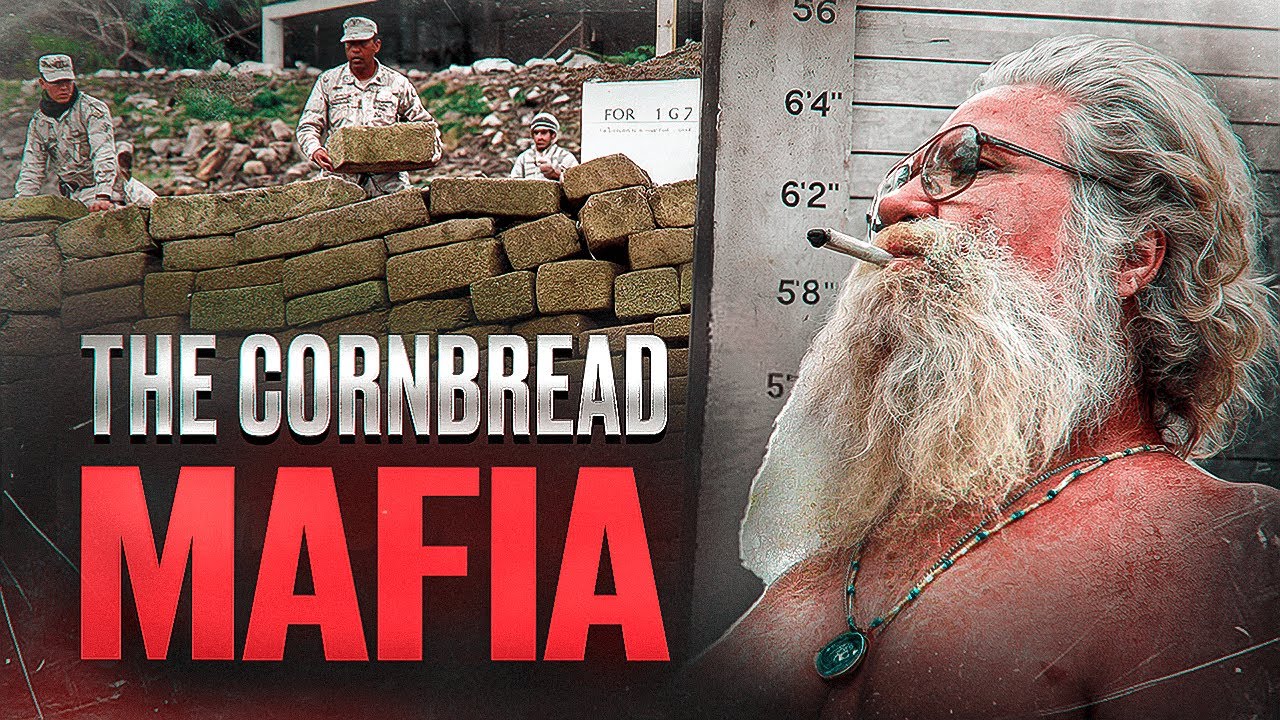
The idea of the Cornbread Mafia as a tough organization was developed by the press, generously fed by the Drug Enforcement Administration. Johnny Boone, one of the most famous members, really did look like a serious mafia boss and fit the public's supposed physical description of a man heading a criminal organization.
His friend Joe Bickett, however, noted that Boone was more like Santa Claus. According to Bickett, Boone was honest in his dealings, and if you were his friend, he had your back.
If the farmers from Marion and the mafiosi we are familiar with had anything in common, it was omertà — staying silent. The Italian mafia demanded that its members never cooperate with the law or reveal the organization's secrets. The men of the Cornbread Mafia observed this code so diligently that even the Sicilian Mafia would have been jealous.
The Cornbread Mafia was largely based on mutual assistance. One group might have a harvest in Tennessee, another in West Virginia, and a third in Indiana. Members agreed that one group would give a certain percentage of its harvest for a certain percentage of another's.
Thus, if one harvest failed in Tennessee, the group still had a percentage of the harvest from another state to fall back on. It was a kind of insurance policy that prevented the complete loss of a crop.
As Boone's genetic experiments began to yield results, the status of Kentucky marijuana rose from only good for livestock to no worse than California's and half the price. The only drawback was buyers' prejudice, as many had considered Marion's product unsuitable hay.
To combat this, Marion County producers changed the appearance of their product and sold it under different names, imitating the characteristics of Jamaican and Colombian weed. As Kentucky producers improved their skills and word of the Bluegrass variety spread, they stopped disguising their product. Kentucky marijuana began to sell itself.
Some distributors processed a ton of Kentucky marijuana per week. Large buyers pre-ordered the harvest, financing seeds, fertilizers, and cultivation. Business was booming.
Of course, it is difficult to remain undetected for long when the result of your activities occupies huge fields scattered across different parts of a county. Police first suspected that secret grass was being grown in Marion County on July 10, 1973, when an officer in Lebanon, Kentucky, stopped a car containing 60 brown paper bags of a product with a distinctive smell.
The officer estimated that each bag contained enough marijuana to make 100 joints valued at a dollar each, resulting in a total seizure of $6,000. In 1976, police first became acquainted with Johnny Boone's cannabis business.
One day, Boone discovered that a thief had visited his farm in Washington County and stolen a whole new row of marijuana from his field. Boone decided to ambush the thief and spent the night watching the property with his most trusted partner, his 10-year-old son, Jeffrey.
Meanwhile, a few miles away, a state trooper pulled over a car for speeding, and the driver turned out to be the same man who had stolen from Boone's plantation. The driver bargained his way out of the ticket in exchange for the location of the best marijuana plantation he had ever seen.

The patrolman drove to Johnny Boone's farm and pulled up right at his cattle gate, 100 feet from where Boone was hiding in the dark with his rifle and his son. At first, Boone thought he had found his thief, but fortunately for everyone, the patrolman identified himself before Johnny used his rifle.
It wasn't Boone's first run-in with the law. In the late 1960s, he had already been arrested along with a Marion County farmer when they were caught making whiskey without paying taxes on the business. This time, however, his activities were much more impressive.
In the fall of 1976, when police approached his valuable plot of land with grass, Johnny Boone didn't panic or try to deny anything. He simply surrendered, and state police stumbled upon one of the first farms where the increasingly popular Kentucky Bluegrass was grown. This time, Boone somehow managed to avoid arrest.
In the 1970s, the Cornbread Mafia managed to form an alliance of farmers, bring a competitive product to market, and attract the attention of police. Some of the men already ended up behind bars.
The 1980s were no less eventful. The cat-and-mouse game with police, federal agents, and the Drug Enforcement Administration continued. Despite the fact that the ranks of the Cornbread Mafia were noticeably thinning, production in Kentucky continued.
In response to the specific threat to law and order emanating from Marion County, the Kentucky State Police was one of the first in the country to use helicopters to detect illegal crops. In 1980, in just one week, state police with the support of a helicopter from Jefferson County discovered and destroyed more than 45 acres of marijuana in Marion County and another 20 acres in neighboring Washington County.
Sometimes no special technology was needed to catch offenders — just the connections that held the entire Cornbread Mafia together. In 1983, five farms were discovered at once in the Hart County area.
It started when a man from Raywick named Chip introduced a group of men from Marion County to some people from Hart County. His team included Governor Louie Nunn's nephew, Donnie Nunn, who showed his friends some of the places where marijuana was grown.
These friends turned out to be law enforcement officers, who arrested the farmers who had planted more than 22,000 plants in five fields. The U.S. attorney's office in Bowling Green tried to get several of the arrested men to turn in the rest of the team, but without success. No one wanted to talk.
They even offered immunity to one man and called him before a grand jury, but he still refused to turn in the others.
Not all Kentucky farmers saw their fortunes decline, at least not immediately. In 1980, while many members of the Cornbread Mafia were desperately evading federal raids, Bobby Joe Schumacher was looking for opportunities to expand.
Law enforcement was able to detect the large crops he was overseeing. Instead of selling weed on the local market, he established connections in South Florida, where he shipped his entire harvest. Buyers in Florida mixed Kentucky marijuana with imported weed and shipped it across the country.
Although the 1980 raids slowed local weed production in Kentucky, demand remained. Bobby Joe and his partners seized the opportunity and also organized shipments of weed from Central and South America through their connections in Florida.
Around the same time, there was a mass immigration of Cubans to the United States through the port of Mariel. Cuban President Fidel Castro allowed anyone who wanted to immigrate to do so after thousands of Cubans tried to seek refuge in the Peruvian embassy.
The arrival of the refugees created a problem for President Jimmy Carter, especially after it became known that there were convicted criminals among them. Shipping from Mariel was suspended in October 1980, but more than 100,000 Cubans had already arrived in Florida, placing a huge burden on the U.S. Coast Guard.
Bobby Joe and other smugglers seized the opportunity to transport marijuana into the U.S. Knowing the Coast Guard was busy with Cuban refugees, he established connections with smugglers who delivered boats with Colombian marijuana to the Key West area.
To transport the marijuana to the mainland, Bobby Joe devised a cunning plan. In Kentucky, he purchased used pickup trucks equipped with toolboxes and construction equipment. To pass off the transporters as ordinary work trucks, they were deliberately dirtied and splattered with diesel fuel, oil, and grease.
Dummy fuel tanks were bolted to the body of each truck to conceal wooden boxes of marijuana, and the drivers wore dirty work clothes. Under this clever guise, the trucks loaded with marijuana left their hiding places and headed for Kentucky. The Coast Guard, focused on Cuban refugees, let the dirty construction trucks pass through checkpoints without asking questions.
Bobby Joe soon realized he could make more money from smuggling than from growing marijuana. He strengthened his ties with smugglers in Florida, who supplied him with as much weed as he could distribute.
Bobby Joe and his new partner, whose name we do not know, purchased two vessels for transporting cigarettes and established ties with smugglers who delivered marijuana to the Gulf of Mexico. There, the two boats transported 4,000 pounds of marijuana each to Everglades City, from where semi-trailers carried the loads north to Atlanta and Kentucky.
During this operation, Bobby Joe and his team brought about 50,000 pounds of weed to the United States. In St. Augustine, Florida, Bobby Joe organized another smuggling operation using shrimp boats to deliver marijuana from a floating base ship. He was less fortunate there.
In 1985, 30 witnesses from Florida and Georgia turned him and his accomplices in to federal agents, saying that Bobby Joe Schumacher had taken over 1,000 pounds of marijuana from the ship and transported it by truck to Kentucky. When he was found guilty, Schumacher paid his $250,000 bail and went on the run.
Even while in hiding, Schumacher continued to run a network of marijuana farms in several states until May 1989, when police arrested him in a resort town in Canada.
On October 23, 1987, the small world of the Cornbread Mafia was shaken by an event that significantly dampened its fighting spirit. That day, Minnesota law enforcement officers obtained a search warrant for a farm in Otter Tail County.
A sophisticated system for growing, processing, and packaging marijuana was discovered on the farm. The weed was growing in a corn field, and the buildings and grain silos were filled to capacity. The barn housed a processing center, including equipment for drying, cutting, sorting, and packaging marijuana.
Packaged bags of marijuana were found, with the total volume estimated at no less than 45 tons. The second floor of the barn housed a work area with radios, cigarettes, and drinks. Sleeping bags were also found in the barn, and the house served as something of a dormitory for the workers.
As a result of the raid, 62 dump trucks were taken away with marijuana and 17 Kentucky residents were arrested, including Johnny Boone. While Boone and his workers sat in their cells in Minnesota, federal investigators began to understand the scale of the Cornbread Mafia's operations.
Although the seizure of 45 tons in Minnesota was the largest in the state's history, it turned out not to be the only one. Investigators began to see connections to a network of farms in different states.
In 1987, the Drug Enforcement Administration was confident that the vast majority of marijuana sold in America was smuggled in from across the southern border. But Johnny Boone's farm opened the agents' eyes to a threat they had overlooked: a huge marijuana growing empire right under their noses.

Investigators bombarded Kentucky residents who couldn't have been unaware of the Cornbread Mafia with questions, but got nowhere. Although the Kentuckians were polite and friendly to the agents, they all remained silent.
After all the arrests had been made, the 17 arrested in Minnesota and Wisconsin joined 53 others, and none of them agreed to talk to investigators in exchange for a reduced sentence. That fact impressed even the prosecutors.
Boone hired a lawyer from Louisville who performed his assigned task almost flawlessly. After a brief stay in local jails and correctional facilities, the entire Minnesota crew was released on bail — all except Johnny Boone, because in his case it was not only illegal marijuana cultivation but also a violation of his parole.
It was not Boone's first prison term. In March 1982, he had already received five years when law enforcement discovered his large-scale farm in Breckinridge County. He was released early in the fall of 1984.
One of the rules of his 1984 parole was that he was not allowed to leave Kentucky, but Boone violated this rule three years later. He had big plans to grow marijuana in Minnesota.
Boone did not want to plead guilty, but his lawyer convinced him that otherwise he could face life imprisonment. In the end, Boone agreed and was sentenced to 20 years in federal prison.
Some clarification is needed here. During the period described, U.S. policy toward drug traffickers underwent changes. In 1986, President Ronald Reagan signed the Anti-Drug Abuse Act, a powerful addition to his 1984 package.
The law was the federal government's way of saying no. As Reagan put it, it added $1.7 billion in taxpayer money to the $2.2 billion already spent each year on the war on drugs to improve law enforcement programs, toughen penalties for people who break drug laws, and increase the federal payroll to maintain several thousand drug enforcement agents.
These changes set off a time bomb. On November 1, 1987, all drug offenders received sentences of 10 years or more. The only relief for Johnny Boone after his arrest was that it happened in the last week of October rather than the first week of November.
Because he was arrested before November 1, the effective date of the mandatory provisions of the 1988 Crime Control Act, Boone only had to serve 66 percent of his sentence. On April 29, 1988, Boone faced his sentencing, which began at 10:30 a.m.
When the judge asked if Boone had anything to say, he delivered a monologue that could have been a key scene in a movie about the Cornbread Mafia. The gist was that he and his colleagues had chosen their path simply to make money in the face of unemployment.
He said he was not making excuses, but that because of the situation in their neighborhood, marijuana was one of the things that sometimes helped people make a living. He said they were not criminals, not the kind of people who go out and hurt others, and that they even tried to feed families that weren't their own. Some even fed small children who had no breadwinners at home.
He said he personally was very sorry about what happened, that it had caused a lot of problems for families and a lot of grief, and that he hoped the court would treat the group with mercy. After listening, the judge said, "Thank you." The hearing came to an end.
Although Johnny Boone was not the boss and the entire economy of the Cornbread Mafia did not depend on him, his arrest was still a significant event. A psychological factor played a role.
Members of the Cornbread Mafia still at large thought that since Johnny Boone — one of the founders of the organization, the inventor of Kentucky Bluegrass, and just a cool guy — had been arrested, it didn't look good for them either.
Did the farmers give up their marijuana business? No. They still had families to feed, and they still hoped they would be luckier than Boone. As Joe Bickett said, if you keep rolling dice, sooner or later you're going to get knocked out of the game. They all knew the odds, but they kept playing.
It was getting harder and harder to play. First, the FBI and police had turned their attention to the Marion County farmers and were conducting a targeted crackdown using helicopters to scan fields from the air. Second, cocaine was flooding the market, which was not conducive to business.
Cocaine competed with marijuana and demand for weed declined, but that was only one side of the coin. Even worse for the farmers was that members of the Cornbread Mafia did not deny themselves cocaine, which made them less capable and focused workers.
In 1985, cocaine even caused a fundamental split in the once friendly Cornbread Mafia. At one point, two leading forces emerged: Johnny Boone and Schumacher. Schumacher and his people were based in Kansas, while Boone led his crews in Minnesota.
Before the network was broken up and they were all caught, the Kansas and Minnesota branches were almost in a state of cold war. The Kansas group's cocaine use led to a major rift with Johnny Boone, who wanted them to stop.
The final blow to the Cornbread Mafia came at a 1989 conference in Louisville, after which the media began to portray the farmers' organization as a real mafia. That increased the number of raids and the funding for those raids. The Cornbread Mafia was slowly falling apart.
Johnny Boone ended up in the United States Penitentiary in Terre Haute, Indiana, a prison with a reputation as the worst in the federal correctional system, where the government sent prisoners it would rather see dead. Terre Haute was unofficially a death sentence for most of those who arrived there, either dying of natural causes before the end of their long sentences or being killed by the violent prison population.
Johnny Boone was not a gangster, but he was a tough guy with a menacing appearance who knew how to command respect, which is why he managed to settle in there. He made friends, including some men from Cosa Nostra.
After talking with them, Boone learned that all these years the members of his Cornbread Mafia had been observing a code of silence called omertà. Better late than never. Impressed by this discovery, Boone even asked a tattoo artist to tattoo the word omertà on his back.
In April 1993, Boone was transferred to a facility in Manchester, Kentucky, where he was met by the Bickett brothers and a whole group of men from Kentucky incarcerated for the same reason as him. It was like a reunion of friends.
Then, in the late 1990s, when Johnny Boone was nearing his release, the Bureau of Prisons transferred him to a facility in Lexington, Kentucky, just 60 miles from home. Shortly after, Jimmy Bickett was also transferred there, so he wasn't lonely. Johnny was finally released sometime in 1999.
In 2008, however, he was again charged with growing marijuana. At that point, Johnny disappeared and his whereabouts remained unknown until his capture in Montreal, Canada, in December 2016. He was sentenced to 57 months at the Elkton Federal Correctional Institution in Ohio, but was released in June 2020 due to the COVID outbreak.
Boone died in Lebanon, Kentucky, on June 14, 2024. He was 80 years old.
The Cornbread Mafia gradually disappeared completely. Some were arrested. Others eventually gave up the risky business. But this did not help spread the secrets of the ambiguous organization. The silence of the Kentuckians continued to live on even after the arrest of key leaders.
And the most interesting part of this story? Since 1996, various states have gradually begun to legalize marijuana for medical purposes. In Kentucky, this happened in 2023. And since 2012, following Colorado and Washington, some states have also allowed cultivation for recreational purposes.
One can almost picture Johnny Boone high in the clouds, contemplating the fields of cannabis that have suddenly become legal.