On a wet December morning in 1942, a chambermaid at the Dorchester Hotel found a beautiful woman half-conscious in her suite with an empty bottle of sleeping tablets beside the bed. Within a day, the woman was dead. Within a week, Britain’s most powerful press baron arrived at her door, sorted her papers, and quietly removed two unsigned oil paintings—both painted by Winston Churchill. Her name was Doris, Viscountess Castlerosse.
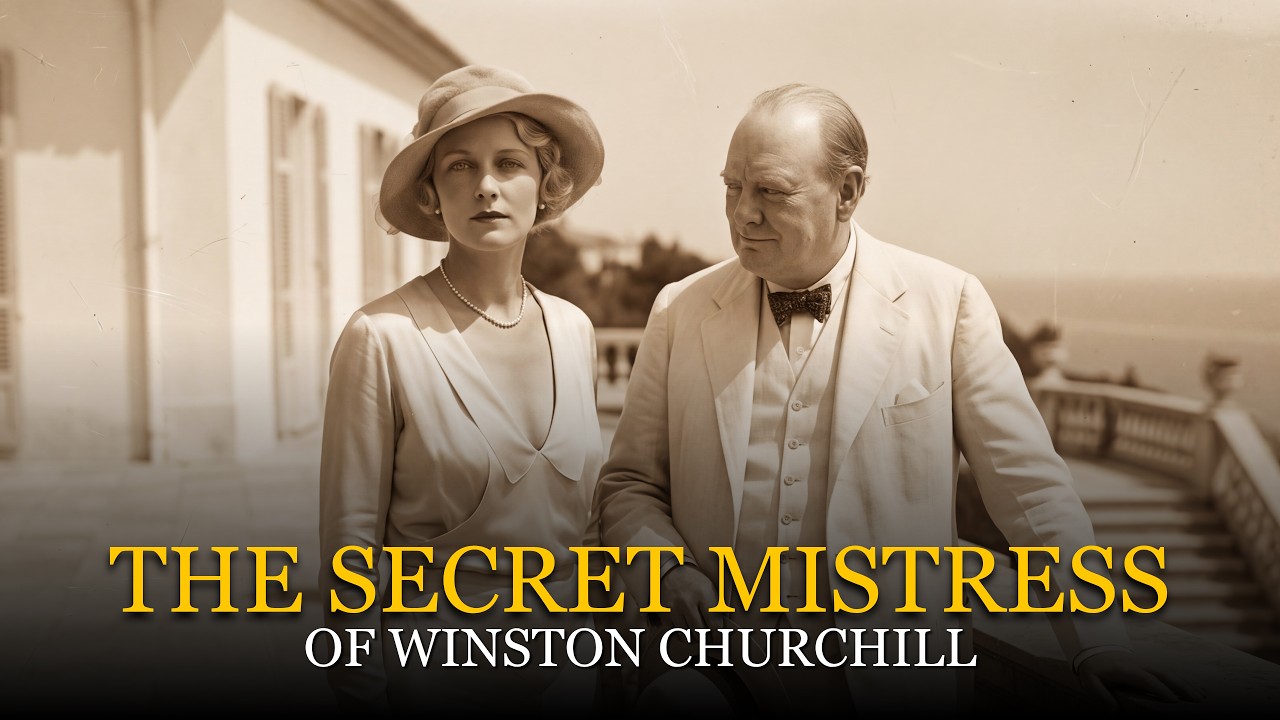
For the next 30 years, the Churchill family worked slowly and patiently to erase her from his life. Born in 1900 above a lace shop on Streatham Hill, Doris Delevingne was the eldest daughter of a haberdasher of French extraction. Her family expected her to marry decently and disappear. Instead, by 16, she was blonde, slim, and determined, practicing away her South London vowels in front of a mirror.
In 1919, she took a job selling second-hand evening dresses to West End actresses. Within months, she had moved out of her parents’ house into rented rooms off the Edgware Road. In a letter to a girlfriend in 1921, she described her plan almost coolly: she had no education, no family money, and only what she called her bank—her face, her figure, and her wit—which she meant to spend carefully on the right men until something more permanent could be arranged. By the spring of 1924, she had a house in Deanery Street in Mayfair, with three powerful men competing to pay for it.
Sir Robert Throckmorton, a South African gold heir, covered the rent. Stephen Sanford, heir to the American carpet fortune, paid for her jewelry and dresses. Tom Mitford came and went. The arrangement was understood by everyone in her circle: the man who paid the rent had use of the upper floors; the others were entertained in the drawing room downstairs.
She was, by her early 20s, a famous face in London society. Cecil Beaton described meeting her in 1925 as the most beautiful English woman he had ever seen, standing at the edge of a room like a tall white candle in a draft. In the late autumn of 1925, she met Valentine Browne, Viscount Castlerosse, heir to the Earldom of Kenmare and the most read columnist in the British press. He was 6 feet 3 inches, weighed close to 20 stone, and carried a limp from a wound at the Somme.
They married at the Brompton Oratory on May 16, 1928, in a society wedding that filled the front pages. Castlerosse had made his name as a columnist for Lord Beaverbrook’s Sunday Express. His column, Londoner’s Diary, sold a million and a half copies every Sunday. He had title and platform; she had the most photographed face in the country.
It was, by both sides’ admission, an honest bargain. In private, the marriage went wrong within months. Castlerosse drank heavily and had sudden terrorsome temper. By Christmas 1928, she dreaded their evenings at home.
By spring 1929, at a house party in Wiltshire, he shook her until her head struck a wardrobe; the bruises took two weeks to fade. She had her own affairs—with Randolph Churchill, then a 17-year-old schoolboy at Eton, and later with Cecil Beaton. There was also a secret arrangement. Lord Beaverbrook had paid the deposit on a flat she kept before her marriage and gave her a small retainer in exchange for gossip collected from her new social position.
By 1930, that retainer had grown to the equivalent of roughly £50,000 a year in modern money, paid in cash in unmarked envelopes. The details she gathered appeared, beautifully veiled, in her husband’s column. Castlerosse came to know the source by 1931 but continued to use the material because it kept his column at the top of the British press. It was in the summer of 1930, on a yacht off Cap Ferrat, that Doris met Winston Churchill for the first time.
He was 55, out of office, out of money, and increasingly out of patience with his own party. He was painting in the garden of Beaverbrook’s villa when she arrived; he set down his brush. Beaverbrook, watching from the terrace, had just introduced his most famous columnist’s wife to the man he most wanted to bring back into power. Churchill spent the early 1930s painting every weekend at Chartwell and on holidays abroad.
He had a studio in a converted barn, where he worked in a smock with a cigar in his teeth. Between 1933 and 1935, he made four trips to the south of France. On each trip, Doris was present at the same villas and yachts. Photographs from the period show them together again and again—on the terrace, by the pool, on the deck—talking to each other, not posing.
He painted her at Chartwell on three separate visits between 1934 and 1935. There were at least two finished oil portraits. The first, which hangs at Chartwell today, shows her in a green dress with a low neckline, seated at a three-quarter angle. It bears a small white label: “Lady Castlerosse by Sir Winston Churchill, circa 1934.
” It says nothing else. The second portrait has a more unsettled history. According to the recorded statement of John Colville, Churchill’s private secretary, made in 1985 and released to scholars in 2018, the painting was a partial nude. Colville saw it once at Chartwell in 1937, leaning against the wall of the studio block with its face turned to the wall.
It was, he said, the kind of painting a sensible wife would prefer to be removed. It was, in time, removed. In the summer of 1934, Churchill wrote Doris a letter in his own hand. It opened: “My darling, you are a ray of sunshine across an old man’s gloomy autumn.
” It was signed, “Ever your loving W. ” The letter survives, held privately by the Delevingne family. The defenders of the Churchill marriage have long argued that the relationship was no more than a friendly flirtation. After the letter’s appearance in 2018, the question changed from whether Churchill had feelings for her to how far those feelings had gone and what they had cost to set aside.
By the autumn of 1935, the affair was over. Clementine Churchill had begun writing to her husband almost daily, not jealous letters, but the letters of an intelligent and tired woman making it impossible for him to forget she was waiting in London. What was not over was the question of what Doris still had in her keeping. There were 42 letters, the photographs from the yacht, and the second painting—materials that would become a serious risk for a man whose political career was about to enter its most important phase.
In 1938, Doris obtained her divorce from Castlerosse. The decree nisi was granted on February 3, 1938, and the decree absolute followed in August. The financial settlement was small: a single lump sum of £500. The second piece of business was more private.
According to Colville’s testimony, Churchill, through Brendan Bracken, paid £1,000—roughly £70,000 today—to recover his correspondence. On a Tuesday afternoon in the early summer of 1938, Bracken arrived at Deanery Street with a banker’s draft. Doris unlocked a small leather case and handed him a bundle of 42 letters tied with pale green ribbon. Bracken counted them, accepted the draft, and left.
The transaction took 20 minutes. The letters were burned in the open fireplace at Chartwell within 48 hours. The “Ray of Sunshine” letter survived, misfiled for 50 years and rediscovered in 2017. Doris took the draft, paid her bills, and wrote to her brother that she had had a good year.
She never wrote to Churchill again. In the summer of 1936, she leased a half-finished palace on the Grand Canal in Venice—the Palazzo Venier dei Leoni—and turned it into the most photographed party venue in Europe. She gave 53 dinner parties, four large receptions, and one masked ball that Town & Country called the most beautiful party held in Europe since the war. She installed a black marble bathroom with silver taps and a white Carrara marble bath, paid for by Beaverbrook.
Her guests included Cecil Beaton, Lloyd George, Noel Coward, and, on one September afternoon, the 15-year-old Prince Philip of Greece. Underneath the parties, the structure was cracking. The marriage was in lawyers’ hands. Churchill visited her at the palace twice in October 1936 and never returned.
By 1940, she sailed for New York to find a rich American husband. The work did not go as planned. The old New York families were not interested in a divorced English viscountess of doubtful resources. She made a serious attempt on a wealthy widower named Charles Dilkusha de Rohan, who gave her a diamond bracelet but told her gently that he had no intention of marrying again.
By Christmas 1941, she was nearly destitute. In the autumn of 1942, she wrote to Brendan Bracken at the Ministry of Information, asking him to secure her a seat on a Lisbon flying boat. Bracken’s reply, signed off by Churchill himself, granted her a seat on a flight leaving October 2, 1942. She arrived back in London with two trunks, the leather case, a green leather scrapbook, and almost no money.
Churchill had brought her home. He did not, in the 74 days she had left to live, visit her once. She took a small suite at the Dorchester Hotel, which extended her credit on a weekly basis. Most of the men she had known were dead, in uniform, or in office.
She began selling the last of her jewelry quietly through a Bond Street dealer. The diamonds had been brought into England from New York without declaration—a serious criminal offense during wartime. By mid-November, a Customs and Excise officer had visited her twice, telling her the matter would go to the magistrate’s court before the year’s end. By the last week of November, she refused to come down to the public rooms.
On the evening of December 10, 1942, she rang down for a glass of warm milk, then a fresh bottle of soda water. She did not ring again. On the morning of December 11, the chambermaid Annie Sharp found her lying on her back in bed with an empty brown glass bottle of barbiturate on the bedside table. No note.
She was carried across Park Lane to St. Mary’s Hospital in Paddington. She died without waking at 12:01 in the morning on December 12, 1942. She was 42 years old.
The coroner returned an open verdict—death by barbiturate poisoning with an open question as to intent. In the language of the people who had known her, it was understood as suicide. Neither Churchill nor Castlerosse attended the inquest. Castlerosse, who had been told the news the morning after, sat by his fire for two hours before he could speak.
He would be dead himself within nine months. Lord Beaverbrook arrived at the Dorchester at noon on the day of her death. He spent an hour in the sitting room and 40 minutes in the bedroom. He left with a small leather case, the green scrapbook, three velvet jewelry boxes, and two flat brown paper parcels.
The parcels contained the two oil paintings by Winston Churchill. They were placed in the strong room at Stornoway House and remained there for the duration of the war. The funeral was held on December 17 at Golders Green Crematorium. The mourners numbered 14.
There was no Churchill, no Castlerosse. The Times carried three lines noting her death, without a photograph. There was no obituary. At Chartwell today, the first painting hangs in the studio block with a label that gives her name and nothing more.
The second painting—the partial nude—was returned, according to Beaverbrook’s private secretary, to Clementine Churchill in a sealed parcel in the late summer of 1946. Its present whereabouts are not known. The most likely explanation is that Clementine, who later burned the Graham Sutherland portrait of her husband on a bonfire, gave instructions to destroy it as well. There is no document naming the destruction, and no witness saw it burned.
The painting simply vanished from every subsequent inventory. The question of the affair itself was finally settled by a tape recording John Colville made for Churchill’s daughter Mary Soames in 1985. Colville had been told by Churchill himself in 1953 that the affair with Lady Castlerosse had taken place in the south of France between 1933 and 1935, and that the buyback of the letters in 1938 had been at his own personal cost. The tape was sealed in the Churchill Archives Centre and opened by historians in 2017.
Their findings were published in March 2018. Doris Delevingne—the haberdasher’s daughter from Streatham, the most photographed English woman of her generation, the secret lover of the most consequential British politician of the 20th century—died alone in a small suite at the Dorchester. The slow work of family loyalty has taken her down to one painting and a label. The label says her name.
The label says nothing else.