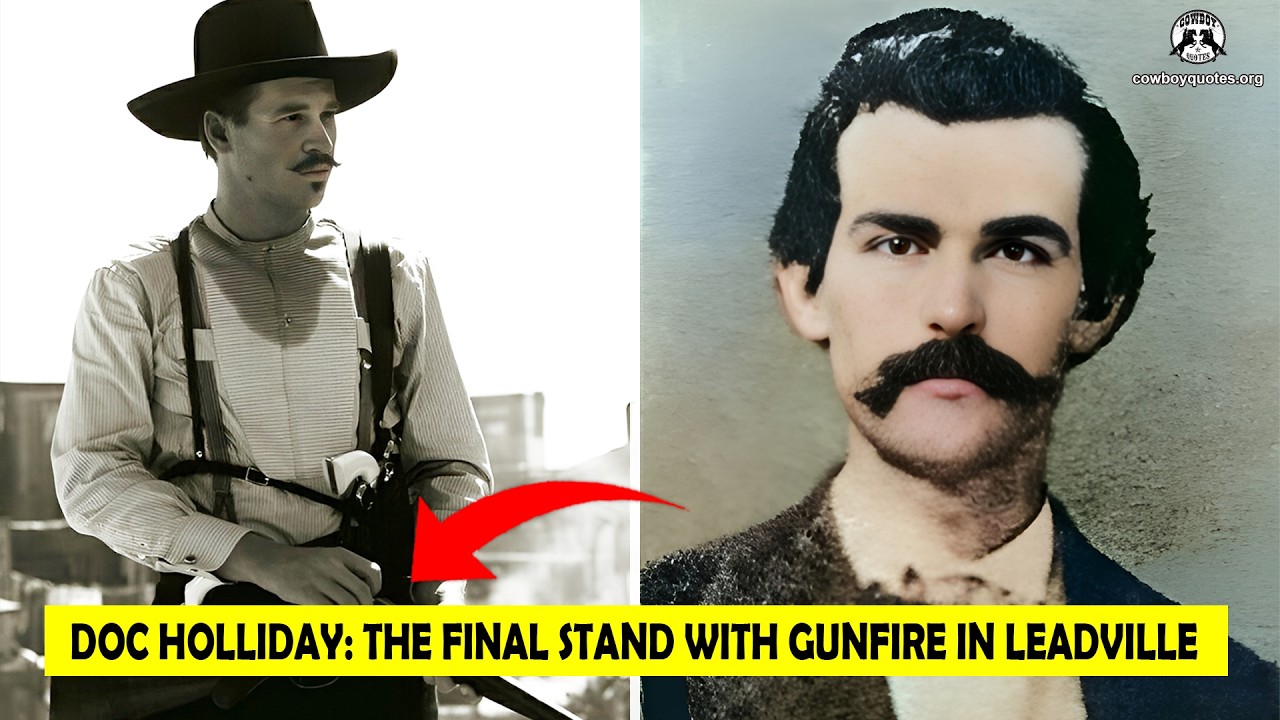
Doc Holliday was in visible decline by the summer of 1884 in Leadville, Colorado, yet the dying gambler still had one final violent confrontation in him. Tuberculosis had hollowed him out, but his reputation as a dangerous man remained. After leaving Tombstone and the Earps, Holliday had drifted to the Colorado boomtown, hoping the mountain air and steady faro tables would sustain him. Instead, he found a city teeming with former rivals from Arizona, and a mounting feud that would end in gunfire.
The tension centered on rival gambling factions. In Tombstone, Holliday had aligned with the Easterners, while a group known as the Slopers opposed them. A leading Sloper figure, John Tyler, had relocated to Leadville before Holliday’s arrival, and by 1884, Tyler had taken over Holliday’s former position as a faro dealer at the Monarch saloon. Tyler’s associate, Tom Duncan, worked as a bartender there.
Another member of that circle was Billy Allen, a former Leadville policeman working as a special officer at the Monarch. On August 15, 1884, Allen confronted Holliday over a $5 debt. He demanded repayment by noon on August 19 and reportedly threatened serious consequences if the money was not paid. Holliday, who had already pawned personal belongings and was financially strained, saw the debt as a pretext.
He believed Allen was an instrument of a broader group that opposed him, and he suspected the deadline was a trap. On August 19, Holliday, keeping gambler’s hours, woke only after the noon deadline had passed. Shortly after 3:00 p. m.
, he stepped out of his room in the Star Block building on Harrison Avenue. A fellow gambler, Pat Sweeney, warned him that Allen had been seen armed and on the hunt. Holliday briefly returned to his room, and accounts differ on whether he concealed a revolver on his person or asked a friend to carry it for him. Holliday then sought out Marshal Harvey Fawcett.
He asked whether Allen, as a special policeman at the Monarch, was legally allowed to carry a firearm in town. Fawcett clarified that Allen’s authority was limited to the Monarch’s premises. At that point, Holliday allegedly remarked that he would obtain a shotgun and shoot Allen on sight, a striking statement made directly to the town marshal. Fawcett immediately went looking for Allen, but at the Monarch he learned that Allen had just left.
Meanwhile, Holliday entered Hyman’s Saloon and placed a revolver behind the bar within easy reach. Sources conflict on the weapon’s exact model and caliber, with some describing a . 41 Colt single-action and others a . 44.
That afternoon, Allen walked down Harrison Avenue, stopping at the Tabor Grand Opera House for theater tickets and a shoe shine before entering the Monarch. One of the Monarch’s proprietors, Cy Allen, cautioned him against seeking out Holliday. Billy Allen dismissed the concern and headed toward Hyman’s. Just before 5:00 p.
m. , Holliday saw Allen approaching through the front window. As Allen opened the door and stepped inside, pausing when someone outside called to him, Holliday raised the revolver and fired. The first shot missed, shattering a pane of glass and lodging in the doorframe.
As Allen stumbled, Holliday fired again, striking him in the right arm. The bullet severed a major artery, causing severe bleeding. Allen made it outside before collapsing into the arms of bystanders. A bartender restrained Holliday’s gun hand to prevent another shot.
Captain Ed Bradbury of the Leadville Police entered, took possession of the revolver, and escorted Holliday to the county jail at Holliday’s request for his own protection. Allen was taken home, where Dr. F. F.
D’Avignon found no detectable pulse in the injured arm. The doctor performed emergency surgery, locating and suturing the damaged artery, a delicate procedure for the 19th century that prevented a fatal outcome. From jail, Holliday spoke with a reporter. He insisted the confrontation was not about the $5 debt, describing it as merely a pretext.
He claimed the conflict stemmed from earlier rivalries and that Allen had been selected to carry out an attack against him. He emphasized his history in Arizona, noting he had lived there openly and had even served in a law enforcement capacity. He maintained that previous accusations against him had ended in acquittals and suggested that certain individuals wanted to target him for the publicity it would bring. The strategy appeared to shape public opinion.
Newspaper coverage suggested that many in Leadville viewed Holliday as a sick man who had been mistreated. When Judge William W. Old ordered him to stand trial, the Leadville Daily Democrat observed that public sentiment leaned in his favor, with some residents believing Holliday had reason to think he faced an imminent attack. The next day, Captain Bradbury filed a formal complaint charging Holliday with assault with intent to kill.
Bail was set at $5,000, and two prominent Leadville figures, John G. Morgan and Colonel Sam Houston, agreed to act as sureties. Five days later, however, bail was increased by an additional $3,000. Newspaper commentary expressed concern that extended confinement could endanger Holliday’s fragile health.
One likely reason for the higher bond was Allen’s uncertain recovery. His arm was severely swollen, and large doses of morphine reportedly failed to relieve his pain and instead caused delirium. Despite early pessimism, Allen recovered quickly and was seen back on the streets within days. The court then reduced bail back to $5,000, but for reasons not fully explained, the sureties did not immediately post the renewed bond.
Holliday remained jailed for more than a week. At the preliminary hearing, most testimony suggested Allen was unarmed at the time of the shooting. A prominent witness, Pat Sweeney, testified that earlier that day he had observed what looked like the butt of a revolver in Allen’s hand at Hyman’s. He stated that he had hurried to warn Holliday that Allen was armed and looking for him.
The defense relied on the Western principle of no duty to retreat, arguing that a person who had not initiated a confrontation was not required to withdraw before defending himself. The physical disparity was also noted: Holliday, weakened by tuberculosis, weighed roughly 122 pounds, while Allen was about 170 pounds and in robust condition. Cy Allen testified that he had advised Billy Allen against going to Hyman’s because Holliday was there. Captain Bradbury had also urged caution, but Allen proceeded anyway.
The trial convened on March 27, 1885. The first day was consumed by procedural arguments. When testimony began, Billy Allen testified that he was unarmed and denied ever threatening Holliday’s life. The defense countered with witnesses who asserted Allen had made hostile remarks about Holliday in the days before the incident and had actively sought him out.
On March 28, 1885, the jury returned a verdict of acquittal. The courtroom had been cleared during deliberations, and after a brief interval, the jury found Holliday not guilty. The ruling effectively ended the violent conflict between the Holliday and Tyler factions in Leadville. Reports of renewed confrontations surfaced in late October 1885, but stricter enforcement against concealed weapons under Marshal Patrick A.
Kelly prevented further bloodshed. By winter 1885, Holliday left Leadville. The high altitude and harsh climate posed serious risks to a man repeatedly afflicted with pneumonia and advanced tuberculosis. He relocated to Denver, where he is believed to have had his final meeting with Wyatt Earp, likely in the lobby of the Windsor Hotel during the winter of 1885-86 or the following spring.
Earp’s companion, Sadie Marcus, later recalled observing the conversation and described Holliday as gaunt, coughing, and physically weakened. By May 1887, Holliday made his way to Glenwood Springs, traveling by stagecoach from Leadville. The town’s hot springs were widely promoted as beneficial for respiratory ailments. He registered at the elegant Hotel Glenwood.
How he financed his stay remains uncertain, though he likely continued occasional gambling work when able and received help from friends. Despite the era’s optimism about altitude therapy, tuberculosis was a progressive and often fatal disease. On the morning of November 8, 1887, Doc Holliday died in his hotel room at the age of 36. Billy Allen’s life followed a different path.
Research places him in Garfield County, Colorado in 1887, where he reportedly served as an army scout during tensions involving the Ute people. He later worked as a fireman in Pueblo and eventually became fire chief. By 1900, he had joined the Klondike Gold Rush and was appointed a deputy U. S.
Marshal. He died on March 21, 1941, at age 82, at the Old Soldiers’ Home in Orting, Washington. John Tyler faded from Leadville’s records after 1886.
Some accounts speculate that he left the region entirely, possibly traveling overseas and later settling in Honolulu, though documentation is limited.