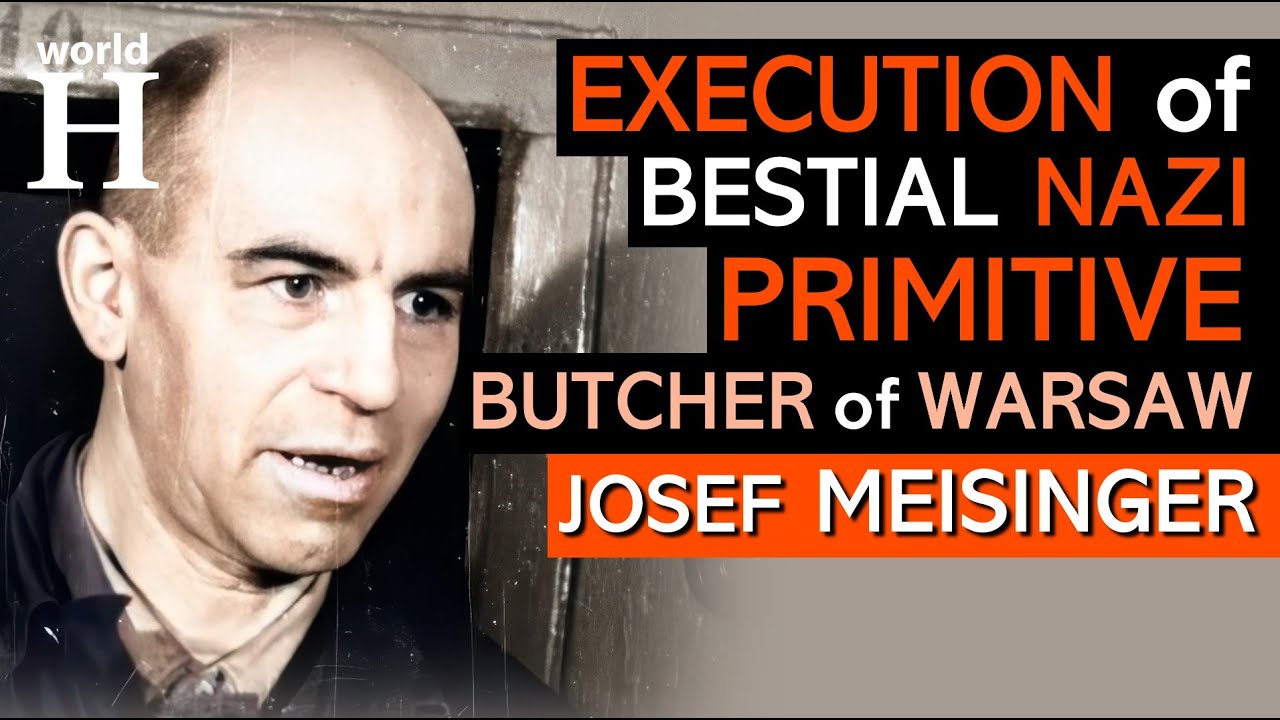
Josef Meisinger earned the nickname "Butcher of Warsaw" for atrocities so brutal that they appalled even his Nazi superiors. Born on September 14, 1899, in Munich, he was just 14 when World War I began. He volunteered for the army in 1916 and was seriously wounded on the Western Front the following year, receiving the Iron Cross Second Class for his service.
After the war, Meisinger built a career in law enforcement. He became an inspector at the Munich Regional Court in October 1920 and joined the Munich police headquarters two years later. In November 1923, he took part in the Beer Hall Putsch, the failed Nazi attempt to overthrow the German government. The insurrection collapsed when Munich police clashed with Nazi Stormtroopers, leaving 16 Nazi Party members and four police officers dead. Hitler was convicted of high treason and sentenced to five years, though he served only eight months.
Hitler was appointed chancellor of Germany on January 30, 1933. That same year, Meisinger joined the SS and the Nazi Party, and he entered the Bavarian political police, then headed by Heinrich Himmler. His colleagues included Heinrich Müller, Franz Josef Huber, and Reinhard Heydrich. When Heydrich was appointed chief of the Gestapo in April 1934, he transferred to Berlin and took Meisinger with him.
Meisinger reached the rank of SS-Untersturmführer in May 1934 and was assigned to uncover opponents of Hitler within the Nazi Party, prosecute abortion cases, prosecute intimate relations between Jews and non-Jews, and especially prosecute homosexuals. The Nazis viewed homosexuality as a threat to the Aryan birth rate and their ideal of family life. From 1936 to 1938, Meisinger oversaw the Reich Central Office for the Combating of Homosexuality and Abortion, which Himmler had established within the criminal police.
In 1938, Meisinger became entangled in the Blomberg-Fritsch Affair. Hitler, Hermann Göring, and Himmler wanted to remove Field Marshal Werner von Blomberg, the defense minister, and Colonel General Werner von Fritsch, the army commander-in-chief, both of whom had been hesitant about war preparations. Meisinger's investigation revealed that Blomberg's wife, Anna Gruhn, had been a prostitute and had posed for pornographic photos. Facing pressure from Göring, Blomberg resigned.
Meisinger was then asked to find dirt on the unmarried von Fritsch. He produced a file alleging homosexual activity, even though Heydrich had already passed similar information to Hitler in 1936 and been ordered to destroy it. Von Fritsch was forced to resign on February 4, 1938, but the charges were soon shown to be false. A witness had confused him with another man, and von Fritsch was acquitted on March 18. The damage to his name was done, however, and high-ranking officials were outraged. Werner Best, describing the incident, called Meisinger a primitive man with clumsy methods for providing fabricated evidence. As a result, Meisinger and others were replaced, transferred for disciplinary reasons, or dismissed.
World War II began on September 1, 1939, when Nazi Germany invaded Poland after a false accusation that Poles had attacked a German radio station. Poland soon found itself fighting a two-front war when the Soviet Union invaded from the east on September 17. Poland officially surrendered on September 28, and one day later, under a secret protocol to their non-aggression pact, Germany and the Soviet Union partitioned the country. The western third was annexed by Germany, the eastern third by the Soviet Union, and the middle became the General Government, run by German authorities and divided into four districts, including the Warsaw District.
The German Army was followed by the Einsatzgruppen, mobile death squads sent to kill civilians, mostly the Polish intelligentsia such as teachers, priests, and physicians. Meisinger was appointed deputy commander of Einsatzgruppe IV in Poland, and on January 1, 1940, he became commander of the State Police in the Warsaw District. He applied brutal force against Poles, especially those of Jewish descent. On November 22, 1939, as a reprisal for the murder of a Polish policeman, he ordered the execution of 55 Jewish residents. On December 20, he ordered the execution of 107 Poles as a reprisal for the murder of two Germans.

As part of the AB Action, which aimed to eliminate the Polish intelligentsia, Meisinger authorized the Palmiry Massacre, the shooting of 1,700 people in a forest near the village of Palmiry, 23 kilometers northwest of Warsaw. Prisoners, including community leaders, professors, teachers, priests, and Jews, were put on trucks and taken to the Kampinos forest near Palmiry. There they were stripped of their luggage, and some were blindfolded and had their hands tied. They were led to the edge of a pit and shot with long firearms so that their limp bodies slid into the grave. Those still alive were shot in the head with short firearms, and in some cases the SS burned the wounded alive.
Meisinger became so notorious that he was called the "Butcher of Warsaw." After the war, Walter Schellenberg, former head of the foreign intelligence section of the SD, wrote in his memoirs that Meisinger's atrocities in Warsaw had appalled even his superiors. Schellenberg said he had collected a huge file proving Meisinger to be so utterly bestial and corrupt as to be practically inhuman, and he sent information about the deeds to Gestapo headquarters in Berlin. According to Schellenberg, Himmler ultimately decided to try Meisinger before a court martial and shoot him. Meisinger was saved by Heydrich, who sent him to Japan.
From April 1, 1941, to May 1945, Meisinger served as Gestapo liaison to leaders in Tokyo, in particular agents of the SD at the German Embassy. His duties included seeking out enemies of the Third Reich within the German community using informants, and serving as SD liaison officer to the Japanese secret intelligence service. One of his tasks was observing the Soviet agent Richard Sorge. In May 1941, one month after Meisinger arrived in Japan, Sorge reported to Moscow that the German attack on the Soviet Union would begin in late June. Instead of investigating Sorge, Meisinger became his constant drinking companion and one of his best sources of information.
In 1941, Meisinger tried to influence the Japanese to exterminate approximately 23,000 Jews who had escaped from Austria, Germany, Poland, and Russia and were living in Japanese-occupied Shanghai. He proposed gassing them, setting them on ships that would then be sunk, or isolating them on nearby islands to starve. The Japanese were repulsed by these suggestions and did not yield to his pressure. Meisinger then took advantage of Japanese fears of espionage. In the fall of 1942, Berlin instructed him to report to the Japanese authorities the names of all anti-Nazis among the Germans, explaining that these anti-Nazis were also anti-Japanese. His list contained, among other things, the names of all Jews with German passports in Japan.

It became clear to the Japanese that those who had fled to Shanghai since the November pogroms of 1938 represented the highest potential danger. The proclamation of a ghetto was the logical consequence of Meisinger's interventions. The ghetto covered about one square mile and was strictly isolated by Japanese soldiers, with Jews allowed to leave only with special permission. Limited movement and wartime deprivations made life difficult, though the Japanese treatment of Jews in Shanghai was comparatively benign compared with the daily terrors endured by ghetto Jews in Europe. Some 2,000 of them died in the Shanghai ghetto during the wartime period.
On August 6, 1945, the United States dropped an atomic bomb code-named Little Boy on Hiroshima, and three days later dropped a second, code-named Fat Man, on Nagasaki. On August 15, Emperor Hirohito announced Japan's unconditional surrender, and the formal surrender was signed on September 2 aboard the USS Missouri in Tokyo Bay. On September 6, 1945, Meisinger surrendered to two U.S. war correspondents at the Fujiya Hotel in Hakone, 80 kilometers south of Tokyo. The reporters drove him to the Yokohama headquarters of the Counter Intelligence Corps, where he turned himself in. He was held at Yokohama prison and underwent intensive questioning.
In 1946, Meisinger was extradited to Poland to face justice. His trial began on December 17, 1946, alongside three other members of the Nazi authorities of occupied Warsaw: Ludwig Fischer, governor of the Warsaw District; Ludwig Leist, mayor of Warsaw; and Max Daume, acting commander of the Order Police in Warsaw, who was responsible for the Wawer massacre of December 27, 1939, in which 107 of 114 people sentenced to death were killed, the rest surviving by simulating their own deaths.
On March 3, 1947, the Polish Supreme National Tribunal found Meisinger guilty and sentenced him to death by hanging. He was 47 years old when he was hanged in Warsaw's Mokotów prison on March 7, 1947. Schellenberg later described him as a frightening individual, a large, coarse-faced man with a bald head and an incredibly ugly face, one of the most evil creatures among Heydrich's bunch of thugs, who carried out the vilest of his orders. No tears were shed for Josef Meisinger.