Robert Newton Ford was just 20 years old when he pulled the trigger that ended the life of Jesse James, the most notorious outlaw of the American West. On April 3, 1882, in St. Joseph, Missouri, Ford shot the man he had once idolized, a single act that would define the rest of his short life and ignite a debate that still continues more than a century later. To some, Ford was a coward who murdered a friend in cold blood.
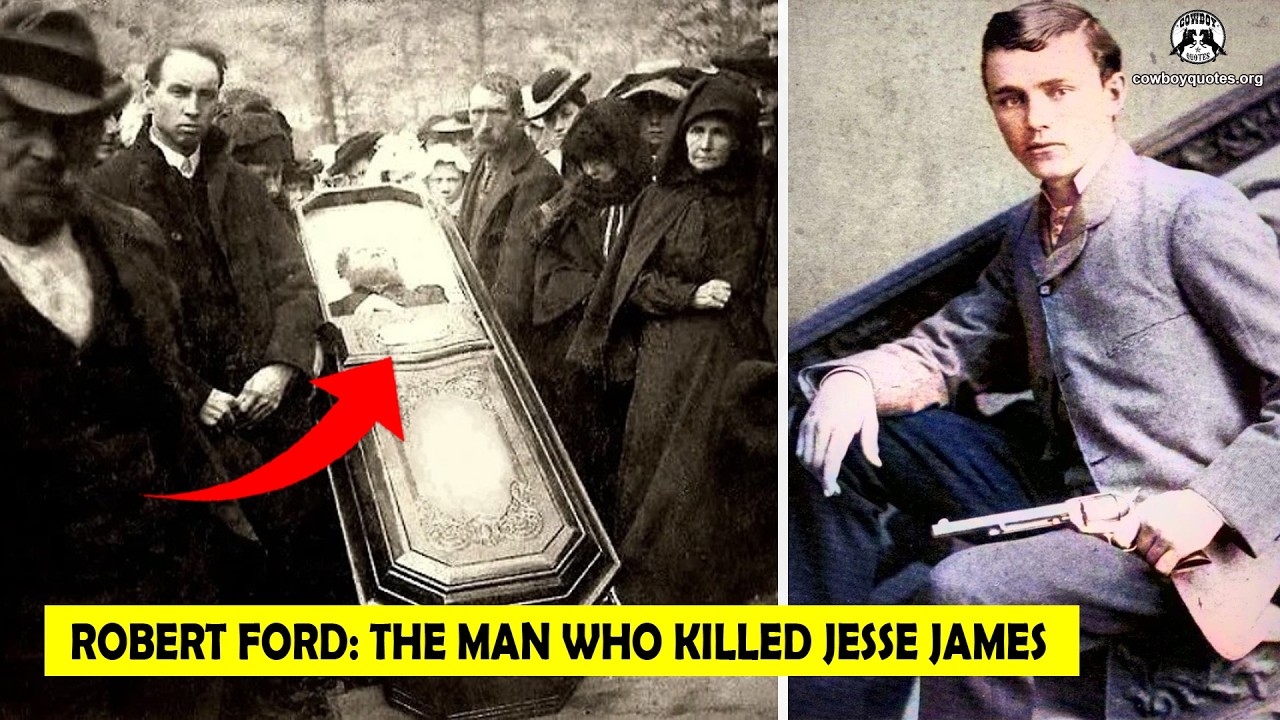
To others, he was a young man desperate to escape a fading outlaw empire and the constant threat of prosecution. Whatever the interpretation, his name became permanently linked to betrayal in a frontier culture that prized loyalty above all else. Ford was born in 1861 in Ray County, Missouri, the youngest of seven children. Growing up in the aftermath of the Civil War, he developed a strong admiration for Jesse James, whose service with Confederate guerrillas and later criminal exploits had made him a regional legend in certain southern-leaning communities.
At around 18 years old, Ford finally met the man he had long looked up to. His older brother, Charley Ford, had become directly involved with the James-Younger Gang and is believed to have participated in the group’s train robbery at Blue Cut in Jackson County, Missouri, on September 7, 1881. Robert Ford soon joined the shrinking circle of associates around James. By the early 1880s, the once-formidable gang had been significantly diminished.
Several members had left out of fear of prosecution, while others were imprisoned or dead after the failed 1876 bank raid in Northfield, Minnesota. Jesse James’s brother, Frank, had withdrawn from outlaw life and settled in Virginia. The organization was under intense pressure from law enforcement and private detectives. In November 1881, Jesse James relocated his wife and children to St.
Joseph, Missouri, reportedly intending to step away from criminal activity. Living under the alias Thomas Howard, he sought domestic stability while remaining one of the most wanted fugitives in the country. The Ford brothers lived alongside the James family, sharing meals and daily routines while quietly weighing a dangerous decision. James proposed another bank robbery targeting Platte City Bank, but the Ford brothers had already chosen a different path.
Rather than join the raid, they intended to claim the $10,000 reward offered for James by Missouri Governor Thomas T. Crittenden. In January 1882, Robert Ford and fellow gang associate Dick Liddil surrendered to Sheriff James Timberlake at the Ray County home of their sister, Martha Bolton. Authorities questioned them in connection with the earlier death of Wood Hite, a cousin of Jesse James.
Soon afterward, they were brought into discussions with Governor Crittenden, who had made capturing the James brothers a central objective of his administration. Crittenden faced legal limits preventing him from offering an unusually large state reward directly. To work around this, he encouraged railroad and express companies, frequent targets of outlaw activity, to contribute funds. A combined reward of $5,000 for the capture of each James brother, plus an additional $5,000 upon conviction, created powerful financial incentives.
According to later accounts, Crittenden assured Ford that he would receive a full pardon if he eliminated James. Whether Ford viewed the arrangement as a calculated opportunity or a desperate gamble remains debated by historians. On the morning of April 3, 1882, after breakfast, James and the Ford brothers gathered in the living room of the St. Joseph home.
They were preparing to travel to Platte City. That same morning, James read a newspaper report describing Dick Liddil’s confession regarding his involvement in the death of Wood Hite. The news appears to have deepened James’s suspicions toward the Ford brothers, who had not informed him of these developments. According to later testimony from Robert Ford, he sensed that James had begun to understand their intentions.
The atmosphere in the room reportedly grew tense. Rather than confronting them, however, James removed his revolvers and placed them aside. Noticing a dusty picture above the mantel, he stepped onto a chair to clean it. At that moment, Robert Ford fired a single shot, ending James’s life.
The circumstances of the killing made it one of the most controversial episodes in Old West history. The Ford brothers soon sent a telegram to Governor Crittenden seeking the reward. They surrendered to authorities expecting recognition for ending the career of a nationally known outlaw. Instead, they were formally charged with first-degree murder.
In a highly unusual legal proceeding, both brothers were indicted, entered guilty pleas, and were sentenced to death, all within a single day. Just hours later, Governor Crittenden issued them a full pardon. Historians have long noted that the rapid sequence of conviction and clemency strongly suggests the outcome had been arranged in advance. Public sentiment shifted sharply against the Ford brothers after the killing.
Although many Americans believed James’s criminal career needed to end, the manner in which it happened unsettled the public imagination. Society wanted Jesse James stopped, yet it judged harshly the man who accomplished it. For a time, Robert Ford attempted to capitalize on the notoriety. He posed for photographs in dime museums and performed in touring stage productions that reenacted the infamous scene alongside his brother.
These performances reflected a broader trend in late 19th century America: the commercialization of frontier legends. Outlaws and lawmen alike became characters in popular entertainment, blurring the line between history and spectacle. The stage show brought income but not widespread respect. Charley Ford’s health declined rapidly, and suffering from tuberculosis and morphine dependency, he died in 1884 at the age of 24.
His death left Robert to navigate his increasingly complicated reputation alone. Seeking distance from Missouri, Robert Ford moved west. Along with former associate Dick Liddil, he relocated to Las Vegas, New Mexico, where they opened a saloon. According to local legend, he participated in a shooting contest with Jose Chavez y Chavez, a former associate of Billy the Kid during the Lincoln County War.
While details remain debated, the story illustrates how interconnected and mythologized frontier figures had become. In December 1889, Ford survived an attempt on his life while in Kansas City, Kansas, an indication that resentment toward him had not faded. By the late 1880s and early 1890s, he had settled in Colorado, opening saloons and gambling establishments in towns shaped by mining booms. On May 29, 1892, he opened Ford’s Exchange in Creede, reportedly operating as a dance hall and saloon.
Only days later, a major fire swept through the town’s business district, destroying Ford’s establishment along with many others. Demonstrating the resilience common in frontier communities, he quickly erected a temporary tent saloon while awaiting reconstruction. Three days after the fire, on June 8, 1892, Edward O’Kelly walked into Ford’s temporary tent saloon while the town was still rebuilding. According to contemporary witness accounts, Robert Ford was standing inside with his back turned when O’Kelly entered.
O’Kelly reportedly greeted him with the words, “Hello, Bob. ” As Ford turned to respond, O’Kelly raised a double-barrel shotgun and fired at close range. Ford died almost instantly at the age of 30. With that single act, O’Kelly became known as the man who killed the man who killed Jesse James.
Unlike Ford, whose action had been entangled with political arrangements and reward money, O’Kelly never clearly explained his motive. Historians continue to debate whether his actions were driven by personal resentment, a desire for notoriety, sympathy for Jesse James, or the volatile culture of frontier reputation where fame, good or bad, carried its own currency. O’Kelly was arrested, tried, and initially sentenced to life imprisonment. Public opinion again played a role in shaping the outcome.
His sentence was reduced to 18 years, and after serving approximately 9 years, he was released in 1902. A reported petition bearing around 7,000 signatures supported his early release, and health concerns were also cited. The episode reflects how divided public sentiment remained regarding Robert Ford. O’Kelly’s life after prison was brief.
In January 1904, he died during an attempted confrontation with a police officer, bringing another turbulent frontier life to an abrupt close. Robert Ford was buried in Creede, Colorado shortly after his death. Later, his remains were moved to Richmond Cemetery in his hometown of Richmond, Ray County, Missouri. His gravestone bore the inscription “The man who shot Jesse James.
” The wording itself reveals how completely that single event defined him. Despite years spent attempting to reinvent himself as an entertainer and businessman, history reduced his identity to one controversial act. In the end, Robert Ford never escaped the shadow of the man he brought down. History remembers Jesse James as a legend whose name still echoes across books, ballads, and Hollywood screens.
Ford’s story remains far more complicated, a tale shaped by ambition, loyalty, fear, politics, and myth at the crossroads of the American frontier.