On May 8, 1963, in the Court of Session in Edinburgh, a judge named John Wheatley began reading aloud from a document so long that reporters in the press gallery had brought spare notebooks. Wheatley was a Lord Ordinary of the Scottish bench, a Catholic, a former Lord Advocate, and a man trained to say difficult things in careful language. What he had written ran to nearly 50,000 words, longer than most novels, and it concerned the private life of one woman.
She was not in the room. She had stopped coming.
The case was a divorce action. In Scotland at that time, a divorce required a finding of fault, the fault had to be proved, and the proving of it was a public act. The pursuer was Ian Douglas Campbell, the 11th Duke of Argyll, chief of Clan Campbell and hereditary master of the royal household of Scotland. The defender was his third wife, born Margaret Whigham.
Wheatley read for hours in the flat, unhurried voice of a man who had decided that the only defense against a sensational subject was a boring delivery. Then he arrived at his assessment of the woman herself, and the sentence that came out of his mouth would follow her to her grave.
He described her as a completely promiscuous woman whose sexual appetite could only be satisfied by a number of men. Her attitude to marriage, he said, was debased. The material produced in evidence he called disgusting.
Judges do not usually talk like that. The whole architecture of a written judgment is designed to keep the personal opinion of the man wearing the wig out of the reasoning. Here was a senior Scottish judge telling the country what he thought of a private woman's character as a human being.
That is the moment the phrase was born. Not the exact words, but the verdict underneath them. A nasty piece of work. Everyone knew.
The newspapers took the judgment apart and printed the worst of it in type large enough to read across a railway carriage. Within a week, there was not a household in Britain that had not heard some version of what the Duchess of Argyll was supposed to be.
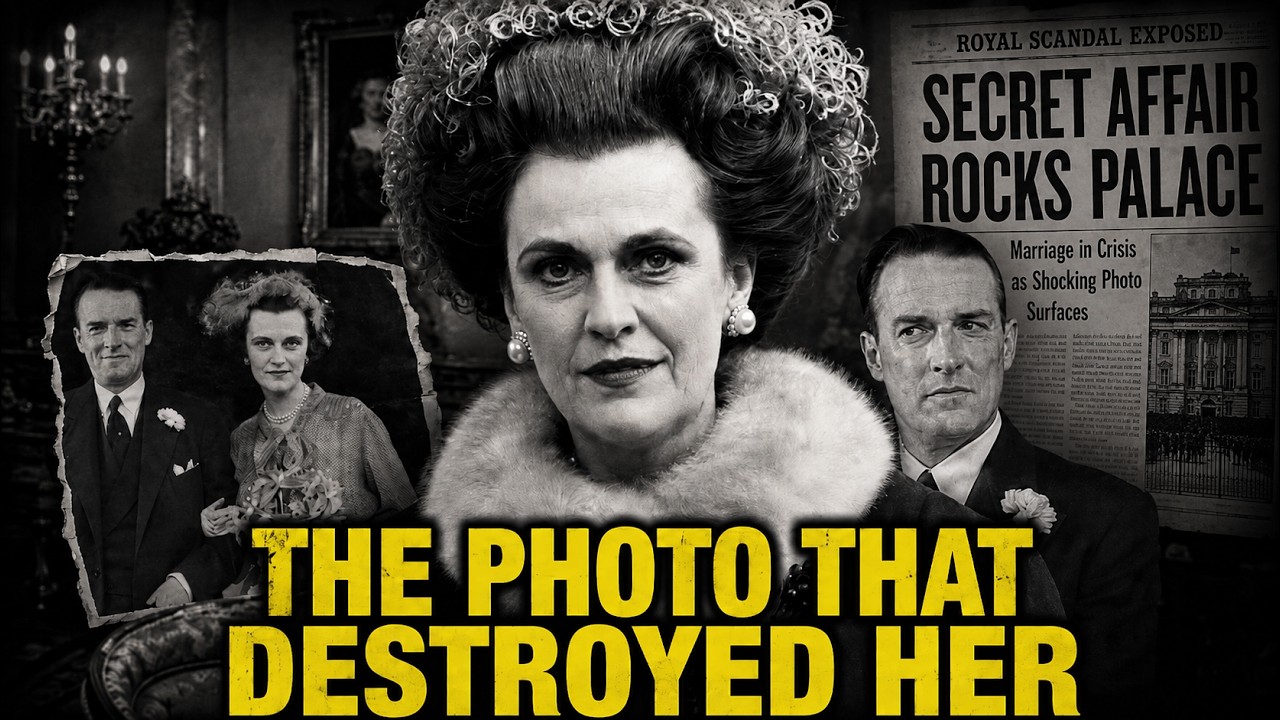
The material Wheatley called disgusting was not testimony. It was not letters. It was two small square photographs.
They had been taken with a Polaroid camera, which in the late 1950s was an expensive novelty and the only camera in the world that let you take a picture nobody else would ever have to develop. No chemist, no assistant holding your negatives up to the light. You pressed the button, you waited a minute, and the photograph existed only in your hand.
In the photographs, a woman is naked except for a three-strand pearl necklace. She is engaged in a sexual act with a man. The man's head is not in the frame. It is not artfully cropped. It is simply not there, because whoever was holding the camera was standing close and was not thinking about posterity.
Those photographs had been locked in a cupboard in a house in Upper Grosvenor Street in Mayfair. They were private in the most literal sense the word has ever had. They ended up in a courtroom in Edinburgh, and from there in the mouths of every gossip columnist in Britain, because her husband had gone into that house while she was out of the country and taken them.
To understand what happened in that courtroom, you have to understand what the woman at the center of it had been 30 years earlier. The drop is the whole point.
In 1930, a girl of 17 came out into London society and was named debutante of the year. She was the only child of George Hay Whigham, a Scot from Renfrew who had made himself into one of the more effective industrialists of his generation, a director of the Celanese Corporation. He moved his family between Scotland, New York, and London according to where the business was, and he had money of the modern kind, made rather than inherited.
His daughter was extraordinarily good-looking in a way that photographs of the period still transmit. Very dark hair, very pale skin, an unusual stillness in front of a camera at a time when most well-born young women were photographed looking as though they had just been startled. She had a slight stammer as a child, which was treated, and which left her with a manner of speaking that people described as deliberate.
For roughly three years she was the most photographed unmarried woman in Britain. That is not a figure of speech about her. It is close to a plain description of the newspaper record. She was engaged more than once, including to the seventh Earl of Warwick, and the engagement was broken, and the breaking of it was news.
Then in February 1933, at the Brompton Oratory, she married an American called Charles Sweeney. Norman Hartnell made the dress, and Hartnell later said it was the making of him, which coming from the man who would eventually dress a queen for her coronation is worth something. The crowd outside was reported in the thousands. Traffic in Knightsbridge stopped for hours. Police were brought in to hold a line at the doors of a church for a private wedding between two people who held no title and no office of any kind.
She was a name, not a duchess, not an actress, not a politician's wife. A name in the modern sense, produced by photographs and columns and by a public that had recently discovered it enjoyed looking at rich young women.
Now put that image beside the other one. A courtroom in Edinburgh 30 years later, a judge with a document the length of a novel, two small photographs on a table, and a sentence about a debased attitude to marriage being read into the permanent record of Scots law.
Between those two rooms there is a marriage that produced two children and eight miscarriages. A fall down a lift shaft in Bond Street that nearly killed her. A divorce, a second marriage into one of the oldest titles in Scotland, a castle she paid to keep standing, a husband who took amphetamines and drank, a burglary committed by that husband against his own wife, a stolen diary, a slander case, an accusation of forgery aimed at two boys who were not hers, and 11 days of evidence in open court.
So the question has to be dealt with honestly. Was she a nasty piece of work?
There are things in the record that are difficult to argue away. She pursued a campaign over several years to establish that her two stepsons, the Duke's sons by his previous wife, were not legitimate and therefore could not inherit the dukedom. There were letters involved whose authenticity was disputed. She was accused in effect of manufacturing evidence to disinherit two young men who had done nothing to her except be born.
Whatever the exact truth of that episode, and it is murkier than either side ever admitted, the intent behind it is not a kind intent. She sued people. She fell out with her own daughter for years. By the account of people who liked her as well as people who did not, she could be imperious, careless with other people's dignity, and unable to let go of a grievance long after any advantage in holding it had gone.
And there are things on the other side of the ledger that the phrase cannot hold.
Her husband put a private detective on her. He took a key or had one made and entered a house that was legally hers while she was abroad. He removed her diaries, her private papers, and the photographs from a locked cabinet. He then used all of it in open court in a jurisdiction where the reporting would be unrestricted, and afterwards he sold his account of the marriage to a Sunday newspaper for money.
If a private individual did that today, the conversation would not be about the woman's character. It would be about the crime.
The judge who called her promiscuous had in front of him the products of that burglary, and he treated them as evidence rather than as stolen goods. Nobody in the courtroom, so far as the record shows, spent much time on how they had come to be there.
And the men, there were said to be 88 of them, a number that comes from lists found among her papers. That number went round the world and is still the first thing most people can tell you about her. Not one of those men was named in a judgment. Not one of them was described as debased. Their careers continued. Several of them were public figures who went on to hold office, receive honors, and die respectable.
The entire cost of what had been by definition a mutual activity was loaded onto one person, and she carried it for 30 years. She was still carrying it in a nursing home in Pimlico in the summer of 1993 when she died at the age of 80.
Both of those things are true at once. She was capable of genuine cruelty, and she was subjected to something that the law of the time had no proper name for. The second of those things is the reason the first is all anyone remembers.
Ian Campbell was three years dead when his own account of himself was first read, and it is a peculiar document, because he was not stupid and he was not without charm and he seems to have had very little idea how he came across.
He was born in 1903 into a branch of the family that was not expected to inherit, and he inherited anyway in 1949 when the 10th Duke died. He had been a prisoner of the Germans after Saint-Valery in 1940, an experience that left marks he never really discussed and that he also, according to several people who knew him, used as an all-purpose explanation for behavior that predated it.
By the time he met Margaret, he was on his third marriage. The first had been to Janet Aitken, daughter of Lord Beaverbrook, and it had gone badly enough that Beaverbrook, who owned newspapers and was not a forgiving man, had opinions about Ian Campbell for the rest of his life. The second was to an American, Louise Clews, and produced the two sons whose legitimacy would later be attacked.
He drank. That is not gossip. It is in his own writing and in the evidence. He also took the amphetamine preparations that were prescribed with alarming freedom in Britain in the 1950s. The combination of the two is not a combination that improves a man's judgment or his temper.
And he had an obsession. In Tobermory Bay off the island of Mull, a ship from the Spanish Armada is supposed to have gone down in 1588, and it is supposed to have been carrying gold. The Dukes of Argyll had held rights to salvage in that bay for centuries. Generation after generation had dived, dredged, formed syndicates, and found almost nothing. Ian Campbell believed he would be the one. He spent money he did not have chasing it. Some of that money was hers.
Because here is the arrangement that sat underneath the marriage from the beginning, and that nobody involved was ever willing to describe out loud. He had a castle and a title. She had a fortune from a Scottish industrialist father.
Inveraray Castle in 1951 was in a genuinely dangerous state, with rot, failing roofs, and a heating system that belonged to another century. She poured money into it. Her father poured money into it. The restoration of one of the great houses of Scotland was substantially paid for by the daughter of a man from Newton Mearns who had made his money in synthetic fibers.
When the marriage failed, what she wanted back was some acknowledgement of that. What she got was Lord Wheatley.
The break came somewhere around 1958 and 1959. There had been separations before. This time he went to her house in Upper Grosvenor Street in her absence and opened the cupboard.
What he found there was better than anything a private detective could have produced. There were diaries going back years. There were lists, and there were the photographs.
The lists are where the number 88 comes from. They were not, as the legend later had it, a tally kept for sport. They were the sort of thing found in the papers of a woman who had lived 30 years in the center of London society and who wrote things down. But a list of 88 men's names in the private papers of a woman in a divorce action was in 1963 the end of any argument she might have wanted to make.
The photographs were worse, because the photographs could not be explained.
The Duke went to work on them like a man doing a puzzle. There were annotations on the back of some of the material in handwriting. There were dates he compared, cross-referenced, and eliminated, and he produced a short list. The number he arrived at, and that went to the prime minister's attention, was five. And one of the five was in the cabinet.
Duncan Sandys was Secretary of State for Commonwealth Relations. He had been Minister of Defence. Until 1960 he had been married to Winston Churchill's daughter, Diana. He was a serious politician in a serious job. And in the spring of 1963 he offered Harold Macmillan his resignation on the grounds that he might be the man in the photograph.
You have to place that in the year to feel it properly. 1963 in Britain is the Profumo year. John Profumo, Secretary of State for War, had lied to the House of Commons in March about his relationship with Christine Keeler, and by June he had resigned, and by the autumn the government was in a condition that no amount of grouse shooting could disguise. Macmillan would be gone by October.
The establishment, a word that had only recently come into general use, was being taken apart in public by a press that had discovered it could. Into the middle of that walked the Argyll divorce, with its photographs and its 88 names and its cabinet minister who could not be certain of his own innocence.
Macmillan did not accept the resignation. He asked Lord Denning, who was already conducting the inquiry into Profumo, to find out. The method Denning is reported to have used has a quality that a novelist would risk. Handwriting samples were obtained from the men on the short list and compared with the annotations. On that basis, Sandys was cleared and stayed in office.
The man in the photograph was never publicly identified. The most persuasive later work, including a documentary made 50 years afterwards, points towards Douglas Fairbanks Jr., the actor who was in London through those years, who was on every relevant guest list, and whose handwriting has been argued to match. He denied it while he lived. It has never been established beyond argument.
She never said. That is the detail that ought to be more famous than it is. She was destroyed in public over a period of years by a photograph in which she was the only identifiable person, and she went to her grave without naming the man in it. Whatever else she was, she was not a talker.
What happened afterwards was slow. The Duke got his divorce and the costs, then sold his side of the story to a newspaper, married again, and died in 1973 at the age of 70. Inveraray Castle, which her money had saved, passed to the elder of the two sons whose legitimacy she had tried to destroy.
She kept going. She wrote a memoir in the 1970s called Forget Not, in which the tone is bright and the omissions are enormous. There were interviews, parties, photographs. A small number of people stayed close to her for the rest of her life and never wavered about it, which tells you something the judgment does not.
But the money went. It went the way inherited money goes when the person holding it has been trained since 1930 to live at a level and has never once been asked to earn anything. Legal costs. The house in Upper Grosvenor Street sold. She moved into a suite at the Grosvenor House Hotel in Park Lane and lived there for years, and in the end could not pay for that either, and was asked to leave. She finished in a nursing home in Pimlico and died there in July 1993 after a fall, at 80 years old.
The obituaries were mostly about 1963. Then slowly the thing turned over.
By the 21st century, a generation was looking at that story with completely different equipment. A woman's private sexual photographs, stolen from her home by her husband and published to humiliate her, is not to a modern reader a story about the woman's morals. Channel 4 made a documentary. The BBC made a drama with Claire Foy playing her and Paul Bettany playing the Duke, and it did not go down well with everyone. Part of why it did not is that a fair number of people had built their idea of the 20th century on the older version.
The rehabilitation has gone slightly too far in places. That happens. The woman who tried to bastardize her stepsons does not become a saint because her husband was worse. The modern habit of sorting historical people into victims and villains breaks down completely on a case like this one, where the same person is both inside the same decade.
She was born on December 1, 1912, at Newton Mearns, a few miles south of Glasgow, and she was named Ethel Margaret Whigham. She dropped the Ethel as soon as she was old enough to have an opinion about it.
Her father was the story of the household. George Hay Whigham was a Scot of the type that Scotland produced in industrial quantities in the late 19th century and then exported to run things. He was clever, cold in the way that competent men were often trained to be, and very good at business. His association with Celanese, the artificial fiber company, took him to Canada and then to New York, and it made him rich on a scale his own father would have found difficult to imagine.
It is worth being precise about where the money came from, because the whole story rests on it and it is usually waved through in a phrase about a rich father. Two Swiss brothers, Camille and Henri Dreyfus, had worked out a usable process for cellulose acetate, first as a dope for aircraft wings during the First World War and then, once the war ended and the aircraft orders stopped, as a textile fiber. The company that came out of it was one of the growth industries of the 1920s. It put a fabric with the drape and shine of silk within reach of women who could not afford silk at exactly the moment when hemlines were rising and dress fashions were changing faster than they ever had.
Whigham was involved on the British and North American side, and he did well out of it, and by the middle of the 1920s his family was living at a level his own upbringing near Glasgow would not have predicted.
Two things follow from that, and both of them matter. The first is that the money was new, and everybody in the world she entered knew it was new. British society in 1930 was perfectly happy to accept industrial money and had been doing so for a century, but it accepted it on terms, and the terms included a certain distance from the person holding it. The Whighams had money made from synthetic fabric in a decade when the people at the top of the season had money made from land in the 14th century. That gap never closed, and it was still being used against her in the 1960s by women who could not have told you where their own family's income came from.
The second is that the money was finite and it was not entailed. Landed fortunes of the old kind were built into legal structures designed to keep them from being spent, with trusts and settlements and life interests. A fortune made in artificial fiber in the 1920s had none of that. It was cash and shares and property, and it could be spent, and it was. She was not a rich woman who could not go broke. She was a rich woman who could, and the mechanism that would eventually put her in a nursing home was built into the source of the money before she was born.
Her father died in 1948, three years before the Argyll marriage. That timing is important. Everything that went into Inveraray after 1951 came out of a fixed inheritance with nobody adding to it, and every legal bill after 1959 came out of the same pot.
Her mother, Helen Mann Hann, was a different proposition. Almost everyone who has written about the family has described her as difficult, and Margaret herself in later life described her in terms that were unusually unguarded for a woman of her generation. Helen drank. She was jealous of her daughter in a way that started when the daughter was a child and got worse as the child got better looking. She could be violent, Margaret said.
So there was one child, and she was it. That combination, an absent successful father and a hostile intelligent mother in a house with money and no siblings, produces a recognizable type. The child learns to perform for the parent who might reward it and to armor herself against the parent who will not. She becomes precocious with adults and awkward with children. She develops an early and permanent understanding that approval is transactional and that beauty is a currency you can spend.
They moved to New York when she was small, and she was educated there for a period in a world of Manhattan private schools where the children of new industrial money were being trained to mix with the children of old industrial money. She had a stammer. It was treated in the American manner by a specialist, and she lost it. Later she would attribute a great deal of her nerve to that treatment and to the American habit of assuming that a personal defect was a problem to be solved rather than a fate to be endured.
She also learned in New York the thing that would define her operating style for 60 years. Publicity was not a misfortune that happened to you. It was a resource. American society girls in the 1920s were already being covered like minor celebrities, and the machinery for it was more developed there than in London. She watched it work. She understood it before almost anybody in her English social class did.
When the Whighams came back to Britain at the end of the 1920s, she arrived into the London season carrying an American toolkit into a Victorian institution, and she took it apart.
By 1930, she was out, and the London season took her the way a stock exchange takes a rumor. The season in that period was a marriage market, with a calendar: presentation at court, then the round of dances from May to July, then Ascot, Henley, Goodwood, then Scotland for the shooting, then the winter. Several hundred girls came out each year. Perhaps a dozen were noticed. One was debutante of the year, which was not an official title, more a consensus arrived at by society columnists and dowagers and the photographers who worked the doors, and in 1930 the consensus was unanimous.
What made her different from the other pretty girls was that she understood the photographers were not an inconvenience. They were the distribution system. She learned their names. She learned which entrance to use and when to pause. She gave them something to print, and in return she got a level of visibility that no amount of family lineage could have bought.
Her English contemporaries found this vulgar and said so, and some of them were still saying so 50 years later. That reaction is worth noticing, because it is the first appearance of a note that runs through her entire life. A woman who is admired for her looks is acceptable. A woman who has worked out how the admiration is manufactured and operates the machinery herself is a different order of problem.
She was resented in 1930 for exactly the quality that made her survive 1963, which was that she never once mistook publicity for something that happened to her by accident.
Her Americanness deserves attention, because it was used against her for 60 years and almost nobody says so directly. She was not American. She was born in Renfrew to two Scottish parents, but she had spent formative years in New York. She had been educated there for a period. Her manner had been shaped there, and her mother had acquired American habits, and the whole family carried a transatlantic quality that the English upper class detected instantly and never forgot.
British society between the wars had a complicated relationship with American women. On one side there was the practical fact that American money had been rescuing English estates since the 1870s. Consuelo Vanderbilt had gone to Blenheim. Mary Leiter had gone to the Curzons. There were something over a hundred such marriages in the 50 years before the First World War, and the arithmetic behind them was completely transparent to everybody involved. An English title needed capital. American industrial families wanted rank. The transaction worked and it was repeated until it became a category.
On the other side there was contempt, and the contempt was in direct proportion to the dependence. American women in English society were held to be loud, forward, overdressed, overfamiliar with servants, insufficiently interested in the correct forms, and sexually unmysterious in a way that the English found both attractive and disreputable. All of that was said openly. It was in the novels. It was in the letters.
Margaret was not American and she was treated as though she were, because she had the manner. She was direct. She spoke to the press and she was frank about wanting things. Her clothes were chosen to be looked at rather than to be correct. There were none of the small ritual self-deprecations that an English woman of her age and position was supposed to perform.
Then in 1936 the country got Wallis Simpson, and the whole apparatus of anti-American feeling in British society acquired a face and a national crisis to attach itself to. After the abdication, an English social world that had spent 40 years taking American money decided that the American woman was a specific and identifiable danger. Twice married, sexually experienced, manipulative, ambitious, foreign, not one of us. That template was constructed in 1936, and it was available off the shelf for the next several decades.
When the Argyll case broke in 1963, there was an audience already trained to recognize the type. Twice married, sexually experienced, ambitious, and married into an ancient Scottish title with money made in synthetics. In the eyes of a certain kind of English person, she had done exactly what Wallis Simpson had done, only to a duke instead of a king, and had been caught at it.
None of that appears in Wheatley's judgment, because it could not, and all of it is in the atmosphere the judgment was received into. The irony that nobody bothered with at the time is that she was a Scot married to the chief of Clan Campbell, being tried in a Scottish court, and the thing that made her intolerable to the English was that she seemed foreign.
There were engagements. The most public was to Charles Greville, Earl of Warwick, a young man of impeccable family and by most accounts limited weather. It was announced, it was reported, it was broken off, and the breaking was reported too, and she came out of it with her position enhanced rather than damaged, which in 1932 was not the usual arithmetic for a young woman in a broken engagement.
What is established is that in 1932 she met an American. Charles Sweeney was the son of an Irish-American family from Pennsylvania, educated in England, an amateur golfer good enough to matter, and later a founder of the Eagle Squadron, the unit of American volunteers who flew for the Royal Air Force before the United States entered the war. That last detail is worth holding, because it means the man she married was not a lounger. He was in most respects an unusually substantial person.
Her father did not want it. George Whigham had made his money the hard way and had a Scot's suspicion of charm, and he seems to have thought Sweeney was after the money, which was the standard fatherly diagnosis and in this case appears to have been wrong. Margaret wanted it, and she generally got what she wanted from her father, and the engagement was announced.
The wedding in February 1933 is the high watermark of her life as a public figure in the good sense. Norman Hartnell was 32 years old and running a business that was doing well without being famous. He was given the commission and he treated it as the opportunity it was. The dress was white satin cut close, with a train that ran to something in the region of nine meters, covered in a pattern of small pearl and crystal embroidery that took his workroom weeks. Photographs of it survive, and it still looks like a good dress, which is not true of most 1930s couture.
The crowd is the part people remember. Estimates run to several thousand outside the Brompton Oratory, packed along the pavements in Knightsbridge, with police brought in to hold a corridor to the doors. Traffic on the Brompton Road stopped. Women fainted. A window was broken. Inside, the church was full of people who mattered, and outside it was full of people who had read about her in a newspaper and wanted to see if she looked the same in daylight.
This was not a royal wedding. Neither party held a title. It was in the strictest sense two private individuals getting married, and the country stopped to watch, and that had not happened before in quite that way. What was on display in Knightsbridge that February was the arrival of celebrity as a category separate from rank, and she was standing at the front of it in nine meters of white satin.
The marriage lasted 14 years, and it was not for most of that time unhappy. This is the part that gets skipped, because it does not fit either the glamour story or the scandal story. They lived in London in a house in Upper Grosvenor Street that her father bought for them, the same house that would be burgled by her second husband 25 years later. Sweeney golfed and worked. She ran a household and appeared in magazines. There were two children who survived: Frances, born in 1937, and Brian, born in 1940.
The 1930s in the world she lived in were a decade of continuous, organized, exhausting pleasure conducted by people who mostly did not have jobs. The year had a shape, and everybody in it followed the same shape. London from spring into July, with a dinner and a dance most nights of the week during the season proper. Ascot in June, Henley and Goodwood in July, then the exodus. Scotland from the 12th of August for the grouse. House parties running one into the next for six or seven weeks with the same 80 people moving between the same 15 houses. Then the south of France or the Riviera or a cure somewhere, then London again and the cycle restarting.
Inside that circuit, the currency was not money, since everybody had it, and it was not rank alone, since rank was fixed. The currency was being wanted, being asked, being the person whose absence from a weekend would be remarked on. Margaret Sweeney was for the whole of that decade one of perhaps two dozen people in Britain who could be certain of an invitation to anything. She had achieved it by 20 and she held it for 25 years, and it was the only measurable achievement available to a woman in her position.
That is not a small thing to notice, because it explains what she did after 1963 better than any theory about head injuries. She had spent her entire adult life in an economy where the sole unit of value was social visibility, and she had been very good at it, on one reading the best of her generation, and then in a single week that economy was closed to her. Everything she had accumulated over three decades was denominated in a currency that had been abolished overnight, and there was no exchange rate.
A woman who had built a career or run a business or done anything with an existence outside that world would have had somewhere to go. She had nowhere, because there had never been anywhere, and there was never going to be anywhere, because she had been 18 in 1930 and nobody had suggested there might be.
The other thing that decade gave her was the network that later produced the 88. Consider the mechanics without any moralizing. The same two or 300 people meeting each other constantly over 25 years, in country houses with long corridors and no supervision, in a class that had already largely abandoned any expectation of sexual fidelity within marriage, at a period when contraception had become reliable enough to be usable and divorce was still difficult enough to be worth avoiding. That combination produced exactly the behavior you would predict.
Everybody knew. That is the part that has to be held on to. The men who sat in judgment on her in 1963, in parliament, in the clubs, in the newspaper offices, in the courts, had spent the previous 30 years in precisely the same houses at precisely the same weekends. The affairs were not secret from the participants, only from the public. What she did was not a deviation from the standards of her world. It was the standard of her world. What she did that was genuinely different was that she got caught with a photograph.
And there is a specific point about war that has to go in here, because the 1940s changed the sexual conduct of that generation and nobody has ever wanted to say so plainly. London between 1940 and 1945 was a city where a very large number of people conducted themselves on the assumption that they might be dead by Friday. Husbands were abroad for years at a stretch. Marriages were suspended rather than maintained. The blackout removed the last practical constraint. Every social historian who has worked on that period has found the same thing, which is a substantial and general loosening that everybody understood at the time and nobody discussed afterwards.
She lived through that in her late 20s and early 30s as a married woman with a husband away, in the middle of the city, and so did a very large number of the women who cut her 20 years later.
And there were, by her own account, eight miscarriages. That number should stop you. Eight over roughly a decade, in an era with no reliable understanding of recurrent pregnancy loss, no useful treatment, no language for it, and no permission to grieve it publicly. The medical response available to a rich woman in 1938 was bed rest and sympathy. She lost pregnancies at various stages, some of them late. She wrote about it later with a flatness that reads to a modern eye like something other than composure.
What people said about her in the 1950s was that she was hard. What almost nobody said was that she had been through eight miscarriages, two difficult births, and a decade of the kind of repeated physical and emotional damage that in any other context would be described as trauma. Her nerves were commented on. Her temper was commented on. The obvious source of both went unmentioned, because in her class and her decade a woman's reproductive history was not a thing you discussed, even when it was the central fact of her adult life.
The war interrupted everything. Sweeney went into the effort to raise American volunteer pilots and then into the Royal Air Force. The children were sent out of London. She stayed and worked in the way well-connected women worked in wartime London, and there is a genuine record of it: canteen and hospital work, fundraising, the organizing of things.
And then in 1943 she nearly died, and the manner of it is so strange that it has been distorted in almost every retelling. She was going to see a chiropodist in Bond Street. The building had a lift. She stepped through the doors of the lift shaft on an upper floor and the lift was not there. She fell roughly 40 feet down the shaft and landed at the bottom.
By any reasonable expectation, that should have killed her. It did not. The injuries were very bad. There was concussion, and she was taken to hospital, and she recovered over a period of months. The permanent damage that is beyond dispute is that she lost her sense of taste and her sense of smell and never got them back. She said afterwards that food was pointless to her for the remaining 50 years of her life.
What has been added to this, mostly by later writers looking for a tidy explanation, is a personality change. The theory in its usual form holds that the head injury damaged something, and that the woman who came out of that lift shaft was more impulsive, more sexually reckless, and less able to weigh consequences than the woman who had gone into it, and that everything that followed can be traced to a moment of inattention in a Bond Street doorway.
It is a seductive theory, and it should not be sold as fact. Nobody examined her brain. There is no contemporary medical record making that finding. A serious head injury can produce changes of that kind, and it is fair to note that as a possibility rather than a conclusion, but the theory does a particular job that ought to make you suspicious of it, which is that it removes her agency entirely and makes the rest of her life a symptom. The same writers who describe her as calculating are often the ones reaching for the lift shaft, and both cannot be right.
What can be said is that the marriage did not survive the war. Sweeney had been away. She had not. They divorced in 1947, and it was not contested, and Sweeney remained on terms with her for decades afterwards, and spoke well of her in public long after it had stopped being convenient. That is a small detail, and it is one of the few unambiguously good pieces of evidence in her file. The man who knew her best in her 20s and 30s never joined the pile-on.
It is worth stopping on the machinery of the press, because the machinery is what made her and what killed her, and most accounts of the Argyll case treat the press as weather rather than as an industry with owners and interests.
Britain in the 1930s had newspapers of a size and reach that are difficult to imagine now. The Daily Express under Beaverbrook was selling in the region of two million copies a day and would go higher. The Daily Mail, the Daily Herald, and the News of the World were selling incomparable quantities. A single front page reached, on a good day, something close to a quarter of the adult population of the country.
Those papers had discovered something in the 1920s that changed what they printed. Photographs reproduced well now. Halftone printing had improved. The equipment had got faster. A picture of a pretty woman at a party sold copies more reliably than a column of political reporting. The society page stopped being a list of names in small type and became a picture desk.
What that created was a demand for a specific product: young women of good family who photographed well and would be seen in public regularly. There were not many of them, because the class they came from regarded appearing in newspapers as an embarrassment. The old aristocratic rule was that a lady's name appeared in print three times, at her birth, her marriage, and her death, and anything else was a failure of discretion.
Margaret Whigham broke that rule at 18 and never observed it again. She was, in the language of a later century, an early adopter. She grasped that a woman with no title and no political power could acquire a form of standing by being reliably photographable, and that the newspapers would supply the standing free of charge because they needed the picture more than she needed the coverage. Photographers found her accessible. She told them things and she turned up, and by 1933, when the crowd stopped the traffic in Knightsbridge, the crowd was there because the newspapers had spent three years manufacturing her.
That bargain has a term in it that nobody explains to an 18-year-old. The same machinery that raises on demand also destroys on demand, and it does not require a change of heart to switch modes. It requires only that destruction becomes the better story.
There is a useful comparison available three years after her wedding. In 1936, Wallis Simpson, an American of no particular family, was the subject of the most complete press management operation in modern British history. Every newspaper editor in the country knew about the King and Mrs. Simpson for months. Not one of them printed it. The American and Continental press covered it in detail, and copies of Time magazine came into Britain with pages cut out of them. The silence held until the beginning of December, and then it broke, and within nine days there was an abdication.
That episode tells you the British press of the period was perfectly capable of restraint when the people who owned it decided restraint was appropriate. Beaverbrook was personally involved in the suppression. The proprietors could and did switch the machine off when it suited them. Nobody switched it off for Margaret in 1963. There was no reason to. She was not the king. She had no institutional protector. She had in Beaverbrook an active enemy with newsprint, and Scottish reporting rules meant there was not even a legal argument for restraint.
The comparison runs the other way too, and it is not flattering to her. Wallis Simpson was subjected to a level of national hatred that makes the Argyll coverage look mild, and she was hated for marrying a man rather than for sleeping with several. There is a category of woman that Britain in the middle of the 20th century reserved a particular venom for, and both of them were in it: foreign or half foreign, twice married, sexually knowing, socially ambitious, and in possession of a man that the country felt some ownership of.
The other thing the press economy explains is why the story would not die. An ordinary scandal has a life of perhaps three weeks. This one ran in one form or another for 30 years, and the reason is that it was renewable. There was a permanent unanswered question sitting inside it, which was the identity of the man, and an unanswered question is an asset to a newspaper. Every few years somebody could publish a new theory or an interview or a claim from a deathbed, and the whole thing would go round again. And each time it went round, her name went round with it.
If she had named him in 1963, the story would have had an ending, and endings are where stories go to stop. By refusing, she guaranteed that it would follow her for the rest of her life. Whether she understood that at the time is not knowable. What is clear is that she never changed her mind about it, not once in three decades of being asked.
Between 1947 and 1951, she was a rich, single, 35-year-old woman in a bombed and rationed London, and she enjoyed herself. It is important to be accurate about what that means and what it did not mean. It did not mean she was doing anything unusual for her set. Postwar upper-class London was by any measure a permissive environment. Marriages were arrangements. Affairs were conducted with a discretion that was about form rather than restraint.
The men she moved among had been at war, had come back, and had in many cases decided that the rules they had been raised on were not worth much. Nobody in that world was scandalized by adultery. What that world required was that you did not get caught in a way that made other people deal with it.
She had money, a house in Mayfair, a name, and no husband. She traveled. She was seen. Some of the names that would appear in her private papers a decade later were acquired in exactly these years, in a city where the same 200 people met each other constantly and nobody wrote anything down except her.
And in 1949, at a house party or a dinner depending on which account you take, she met Ian Campbell. He was not yet the Duke. He became the Duke that same year when his cousin, the 10th Duke, died. The transformation of Ian Campbell from a man with a complicated history into the chief of Clan Campbell happened while he was in the middle of courting her.
She always denied that the title was the attraction. Nobody who knew her believed the denial, and there is no particular reason we should either. She had spent 19 years being Mrs. Sweeney, and Mrs. Sweeney had been an excellent thing to be in 1933 and was a diminishing thing to be in 1949. A dukedom is not a diminishing thing. It is one of about two dozen in Scotland and England combined.
She was also, and this is the part the cynical reading misses, in love with the idea of a project. Inveraray was a project.
What she got in the bargain was a man who has been in most tellings reduced to a villain and who was more interesting and more damaged than that. Ian Campbell was born in 1903. He had an unstable childhood, moved between countries, and grew up without much money in a family that had a great deal of past. He went into the army in June 1940 at Saint-Valery-en-Caux on the Normandy coast. The 51st Highland Division was cut off and forced to surrender, and something like 10,000 men went into German captivity for five years. Campbell was one of them.
Five years is a long time. Men came out of those camps changed in ways that nobody in 1945 had the vocabulary to describe and nobody in 1950 had the inclination to treat. He came out drinking. He came out with a fixed conviction that the world owed him restitution. And at some point in the late 1940s or early 1950s he was prescribed amphetamines, which British doctors in that period handed out for tiredness, low mood, weight, and general vagueness, with no understanding whatsoever of what long-term use does to a person's judgment, sleep, or temper.
Put the drink and the pills together in a man who was already grandiose and already carrying five years of captivity, and you have the person she married at Caxton Hall in March 1951.
His first wife had been Janet Aitken, daughter of Max Aitken, Lord Beaverbrook, the most powerful newspaper proprietor in Britain. That marriage had ended badly. Beaverbrook owned the Daily Express, the Sunday Express, and the Evening Standard, and Beaverbrook did not forget. Anyone doing the arithmetic in 1951 might have noticed that Margaret was marrying into a permanent adverse relationship with a man who controlled a substantial share of the British press, and that when things went wrong, there would be no help from that quarter.
The second wife was Louise Clews, an American, and that marriage produced two sons, Ian and Colin. The elder, Ian, was the heir to the dukedom. Both boys were alive, and neither of them had any idea in 1951 that their father's third wife would one day try to have them declared illegitimate.
Inveraray Castle sits on the west shore of Loch Fyne in Argyll. Built in the middle of the 18th century in a gray-green stone, with four round towers and a great deal of pointed Gothic decoration, it is one of the more beautiful large houses in Scotland. In 1951 it was also in serious trouble. There had been a fire in the previous century and a partial rebuild. There was rot. The roof leaked in multiple places. The heating, such as it was, belonged to a period when the answer to cold was more servants and more coal, and by 1951 there were neither.
The estate did not generate enough to fix it. Scottish landed estates in the 1950s were in large numbers running at a loss, hollowed out by two wars, by death duties that had risen sharply, and by the collapse of the agricultural and domestic labor arrangements the whole system had been built on. The 11th Duke inherited a great name attached to a liability.
What he did about it was two things. The first was to open the castle to the public, which was a genuinely forward-looking decision for the early 1950s, and which is why Inveraray is still standing and still visitable today. The second was to marry a woman whose father had made a fortune in synthetic fiber.
She paid. Precisely how much has never been established, and the figures quoted in the divorce and afterwards were disputed by both sides. What is not disputed is the shape of it. Money came from Margaret and money came from George Whigham. It went into the fabric of the castle, the roof, the heating, the rewiring, the decoration, and into the establishment of the place as a house that could receive paying visitors. Her father also at various points propped up the Duke's finances directly.
For a few years, it worked in the way these arrangements sometimes do. She had a castle to restore, a title, a project, and a husband. He had solvency. There are photographs of them at Inveraray in the early 1950s in which they look, if not happy, then at least engaged in the same enterprise.
A house of that size in 1951 operated on a staff that no longer existed. The Edwardian model, the one the building had been designed around, assumed something in the order of 20 or 30 indoor servants, with a hierarchy running down from a house steward through butler, footman, housekeeper, cook, kitchen maids, housemaids, and the rest, and a separate outdoor establishment for the gardens, the stables, and the estate. That system had been destroyed by two wars and by the simple fact that domestic service had stopped being the default employment for working-class women. A girl in Argyll in 1951 who would have gone into a great house in 1911 now had a choice, and the choice included offices, shops, factories, nursing, and immigration, all of which paid better and none of which involved being called by your surname.
So the house had rooms that required a staff that could not be hired, in a country that was still rationing food, with a roof that leaked.
What she brought to that was not only money. It was an American assumption that a large building is a business problem with a solution rather than an inheritance to be endured. The paying visitor operation at Inveraray was in the early 1950s close to the front edge of what became a standard survival model for the British country house. Longleat opened to the public in 1949. Beaulieu followed. Within 20 years, the stately home open to visitors was an established industry with car parks and gift shops, and in one famous case, lions. Inveraray was in that first wave, and the reason it was in that first wave is that the 11th Duke had a wife with capital, energy, and no reverence at all for the idea that the family should be too proud to charge for admission.
There is a photograph of the two of them from those years standing in front of the castle, and it is worth describing because of what it is doing. He is in tweed. She is dressed for London. They are both looking directly at the camera. It is a publicity photograph taken for the visitor operation, and it tells you the whole arrangement in one frame. He supplied the castle and the tweed and the name. She supplied the money and the audience.
The marriage worked exactly as long as both halves of that were needed. Once the roof was on and the visitors were coming and the immediate crisis had passed, the capital had done its job, and what was left was two people who had very little in common and a great deal of information about each other.
There is a version of this in which she should have seen it coming. That is not entirely fair. She had spent her whole life being wanted for what she was rather than what she brought, or at least believing that. The discovery in her 40s that she had been useful was not one she had been prepared for by anything in her upbringing.
It came apart for the reasons these things come apart, which is that the money ran in one direction only and gratitude does not survive dependence. He drank more. The amphetamines continued. He developed an obsession, which is the only accurate word, with the wreck in Tobermory Bay.
The story is that in 1588, after the defeat of the Armada, a Spanish ship put into Tobermory on the island of Mull and blew up in the harbor, and that she was carrying treasure. The Dukes of Argyll had held salvage rights over that bay since the 17th century. For 300 years, successive dukes and various syndicates had dived, dredged, blasted, and speculated, and what had come up was some timber, some cannon, some coins of no great value, and an enormous quantity of mud.
Ian Campbell believed the gold was there. He raised money for expeditions and gave interviews about it. Arrangements were made with salvage operators. He spent over a period of years sums he did not have, chasing a Spanish galleon that had been picked over by his own ancestors for three centuries. Some of what he spent was hers or her father's, and the arguments about it were part of the corrosion.
By the middle of the 1950s they were fighting constantly, and the fights were not the ordinary marital kind. Both of them were combatants of a high order. He had a temper that could turn physical. She had a tongue and a memory and an instinct for the sentence that would do the most damage. There were separations, reconciliations, and a period in which they were living substantially apart while remaining married for reasons that had a good deal to do with money and appearances.
Somewhere in the second half of that decade, each of them independently decided to start gathering evidence against the other. From that point, the marriage stopped being a marriage and became a case.
The house at 48 Upper Grosvenor Street was hers. It had been bought by her father. It was not a marital home in any Scottish or English legal sense that would have given him rights over its contents. She kept her private papers there. In 1959, while she was out of the country, he went in.
The accounts differ on the mechanics. He had access, or he obtained access, and there was at least one other person involved, and a locked cabinet or cupboard was opened. What came out of it was a haul of a kind that no private detective in London could have assembled in a year of work. Her personal diaries covering a long period, correspondence, private papers, lists of names, and the Polaroid photographs.
She discovered the theft when she returned. She knew who had done it.
And here we arrive at the fact that ought to be the center of every account of this case and almost never is. Nothing happened to him. There was no prosecution. There was no serious police interest. A man had entered a house that was not his, opened a locked container that was not his, and removed the private property of another person, and the legal system of the United Kingdom treated it as a domestic matter between husband and wife.
Four years later, the same legal system, in the person of Lord Wheatley, would take the products of that entry, admit them as evidence, and use them to deliver a moral verdict on the woman they had been stolen from.
He also, and this is documented in the subsequent proceedings, hired private detectives and had her followed and gathered material on her movements. She did some of the same in return. Both of them were, by the end of the 1950s, running surveillance operations against a person they were legally married to.
And she made the mistake that would cost her more than any of the rest of it. In 1959, there was a legal action involving Yvonne MacPherson, who had worked for her. The details are tangled and the reporting of the time is not always reliable, but the substance is that Margaret pursued a claim over things that had been said about her, and that the action went badly, and that in the course of it a picture emerged of a woman prepared to use the courts aggressively against people who had far fewer resources than she had. She lost, and it was expensive, and it damaged her.
That case matters because of what it established before the divorce ever came to court. By 1960, in the small world of London lawyers and London journalists, the Duchess of Argyll already had a reputation as a litigant. When the big case arrived, she came into it as a woman who had already been seen going after a former employee, and the sympathy she might otherwise have attracted had been spent in advance.
The other thing she did in these years is the single hardest thing in her file to defend. The Duke had two sons by Louise Clews. If they were legitimate, the elder would inherit the dukedom, Inveraray, and everything attached to it. Margaret had no son by the Duke and never would.
A campaign began to establish that they were not legitimate. The argument turned on the timing and validity of the Duke's marriage to their mother and on questions of paternity, and the material that surfaced in support of it included letters. The authenticity of some of that material was disputed at the time and has been disputed ever since. The allegation made in court and repeated afterwards was that documents had been fabricated. Whether she personally forged anything has never been proved.
What is beyond argument is that she was the driving force behind an effort to have two young men publicly declared bastards in order to alter the succession to a title, and that those two young men had done nothing to her whatsoever. That is the case for the prosecution, and it is a strong one. When people say she was a nasty piece of work, this is the thing they should be pointing at, and it is not the thing they usually point at. What they point at is the photograph, which is to say they point at the one part of the story where she is not the aggressor.

To understand what kind of year 1963 was in Britain, you have to understand that this case did not land in a calm country. It landed in a country that was in the middle of losing its temper with its own governing class, and the timing is a large part of why it went off the way it did.
In 1960, Penguin Books had been prosecuted for publishing Lady Chatterley's Lover, and prosecuting counsel had asked the jury whether it was a book they would wish their wife or their servants to read. The jury acquitted. That question, and the laughter it produced, did more damage to the authority of the English establishment than the verdict did. A prosecutor had stood up in the Old Bailey and revealed without meaning to exactly what world he thought he was living in, and the country had looked at him and decided he was a relic.
In 1961, Beyond the Fringe opened in the West End with four young men doing impressions of the prime minister. In 1962, Private Eye was two years old, and That Was The Week That Was went out on the BBC on Saturday nights and did to politicians what nobody had previously done to politicians on British television. The word satire acquired a new meaning in about 18 months.
In 1962, Macmillan sacked a third of his cabinet in a single day in an episode that became known as the Night of the Long Knives, and the effect was not to demonstrate his authority but to reveal his panic. In January 1963, Hugh Gaitskell died and Harold Wilson took over the Labour Party. Britain's application to join the European Economic Community was vetoed by de Gaulle. The winter was the coldest in more than 200 years, and the country spent three months frozen. And in March, John Profumo lied to the House of Commons.
The Profumo affair had everything. A Secretary of State for War. A young woman, Christine Keeler, who had also been involved with a Soviet naval attaché. An osteopath, Stephen Ward, who moved between the aristocracy and Soho, and who would be prosecuted and would kill himself before the verdict. A country house at Cliveden, owned by the Astors, with a swimming pool. Lord Astor was a name that carried its own weight, and Cliveden had a reputation going back to the 1930s.
What the country took from it, correctly, was that the people running Britain had been conducting themselves in a manner they would have imprisoned anybody else for, had assumed as a matter of course that it would never come out, and had lied to Parliament when it started to.
The Argyll judgment came down between Profumo's lie and Profumo's confession. It arrived in the middle of the eruption and it was read as part of the same story, which is to say as more evidence from inside the houses. There is a phrase that got a great deal of use in those months: the establishment, which had been coined in its modern sense by the journalist Henry Fairlie only a few years earlier. 1963 is the year it became a household word and the year it became an accusation.
So here is the position the Duchess of Argyll occupied in the public imagination in May of that year, and it is worse than simple disapproval. She was not merely a woman who had committed adultery. She was for a few months a piece of evidence in a national argument about whether the upper classes were fit to run anything.
The photographs were not being consumed as pornography, or not only as pornography. They were being consumed as proof. That is why the coverage was so enormous and so relentless. A newspaper printing the details of the Argyll judgment in May 1963 was not doing gossip. It was, in its own account of itself, doing public interest journalism about the moral condition of the ruling class, and the fact that this involved describing a naked woman in some detail was, everyone agreed, regrettable and necessary.
The convenient thing about using her as proof was that it required no examination of anybody else. Look at the men in the story of that year and count the outcomes.
Profumo resigned and then spent 40 years doing genuine charitable work at Toynbee Hall in the East End, and was rehabilitated so completely that he was given a CBE and was seated near the Queen at Margaret Thatcher's 80th birthday party. Stephen Ward, who was not a member of the establishment and was the most convenient available scapegoat, was prosecuted for living on immoral earnings and died. Lord Astor kept Cliveden. Duncan Sandys stayed in the cabinet and got a peerage. The 11th Duke of Argyll kept his castle and his title.
Christine Keeler was 19 when it started. She went to prison for perjury in an unrelated matter, spent the rest of her life in poverty and under various assumed names, and died in 2017 in a flat in Farnborough. Mandy Rice-Davies got the best line of the decade in the witness box when told that Lord Astor denied her allegation, and she said: "Well, he would, wouldn't he?"
Margaret Argyll was 50 and died in a nursing home.
The pattern is not subtle, and it is not a coincidence. The men in these episodes were treated as men who had made an error. The women were treated as what the episode was about. The machinery that produced that outcome was not a conspiracy. There was no meeting. It was simply the accumulated operating assumption of every newspaper editor, every judge, every barrister, and a substantial majority of the reading public that a man's sexual conduct was a private lapse and a woman's sexual conduct was her character.
Lord Wheatley's judgment is the purest surviving statement of that assumption, which is why it is still quoted. It says out loud, in the official language of a superior court, the thing that everybody in the country was operating on and nobody had previously been required to write down.
The action came to the Court of Session in Edinburgh and ran for 11 days. A word about why Edinburgh, because it explains a great deal of what followed. He was Scottish. The title was Scottish. The marriage had a Scottish domicile, and so the case was heard under Scots law, which in 1963 differed from English law in ways that mattered enormously to her.
In England, divorce proceedings were subject to reporting restrictions that limited what newspapers could print about the evidence. In Scotland, they were not. A divorce heard in Edinburgh could be reported in detail. Every allegation, every document described, every exchange between counsel and witness was available to any newspaper that could get a reporter into the building.
She was in effect tried in the one jurisdiction in the United Kingdom where the entire proceeding could be printed, and it was printed. English newspapers that could not have reported an identical case in London reported this one in full, day after day, because it was happening in Scotland.
The Duke's case was that she had committed adultery, and he named men. She counterclaimed. Both sides produced material. The evidence included her diaries, her lists, correspondence, the testimony of servants and detectives, and the photographs.
What went on in that courtroom over those 11 days was, by the standards of any period, extraordinary. A woman's private written record of her own life was read out by opposing counsel. Her domestic staff gave evidence about her movements and her visitors. Hotel registers were produced, and the photographs were entered, examined, and discussed.
The men were not named in the judgment. Some had been named in the pleadings, but the judgment, the document that the country read, named her, and described her, and did not do the same to anybody else.
Consider the asymmetry of that as a piece of machinery. A sexual act, by definition, involves more than one person. The court in Edinburgh had before it evidence of a woman's sexual conduct with a number of men. It produced a 50,000-word document assessing the moral character of exactly one participant.
That was not Lord Wheatley being unusual. That was the law working as designed. Adultery was the fault. The fault had to be attached to the defender, and the defender was her. But the effect in the country outside the courtroom was that a great many men who had done precisely what she had done went home to their dinners with their names intact, and one woman absorbed the entire moral weight of a decade of shared behavior.
To see what the divorce actually cost her, you have to understand what a Scottish divorce action of that period involved for the person defending it, because the machinery itself was punitive in ways that had nothing to do with the outcome.
It began with pleadings, which in Scots practice meant a written record in which each side set out its allegations in detail and the other side answered them line by line. That document, the closed record, existed months before anybody stood up in court. It named men. It described occasions, dates, hotels, addresses. It was seen by solicitors, advocates, clerks, and typists, and material of that kind does not stay in a drawer in a city the size of Edinburgh.
Then came the proof, the hearing of evidence, which is where the 11 days went. Witnesses were called and examined and cross-examined. Some of them were servants who had worked in her houses, and there is a particular quality to that which is difficult to convey now. A woman sat in a courtroom while people who had made her breakfast described who had come to the house and when they had left and what state the rooms had been in. Domestic staff in that period had no protection of any kind. They could be compelled, and they were. And afterwards they had to go and find other work in a city where the people who employed staff had all read the coverage.
Detectives gave evidence. Hotel staff gave evidence. Registers were produced. And there was the documentary material, which is the part that has no modern equivalent, and which is genuinely the cruellest thing in the whole case.
Her diaries were read. A diary is not a record of events. It is a record of a person talking to herself. It contains the things you write down because there is nobody to say them to, in the shorthand you use with yourself, without context or defense or the softening you apply when another human being is going to hear it. Every unkind observation, every complaint, every piece of vanity, every low moment, in her own handwriting, produced in open court by a barrister acting for her husband and read aloud to a room containing journalists.
She had written those words in a house in Mayfair, believing that the only person who would ever read them was herself. That belief was correct until her husband opened the cupboard. There is no penalty at law for what he did, and there was no remedy for what it did to her.
Take away the burglary and there is no short list, no photographs, no 88, no 50,000-word judgment. There is a divorce between two unpleasant people that would have been settled in a fortnight and forgotten in a year.
She attended for part of it and then stopped attending, and the stopping was reported as arrogance. A simpler explanation is available. The costs, when they came, were enormous. Eleven days of a fully contested proof in the Court of Session, with senior counsel on both sides, expert evidence, months of preparation, and a mountain of documents, is one of the more expensive things a private individual can buy. She lost, and in the ordinary way she was liable for a substantial part of both sides of it. That single bill is a large part of why a woman who had started with an industrial fortune behind her ended up in a nursing home.
The public version of her decline is that she spent it on parties. Some of it went on parties. A great deal of it went on lawyers. And the largest share of that went on defending an action that had been built out of her own stolen property.
There is a detail from the aftermath that stays. She kept for years, in her house and later in her hotel suite, the scrapbooks: volumes of press cuttings covering her entire public life from 1930 onwards, kept up and pasted in and ordered. Which means that a woman who was subjected to the worst press coverage of any private individual in Britain in her lifetime sat down at some point and cut those pages out and pasted them into a book and kept the book.
You can read that as vanity, and people have. It is closer to the truth to say that she had understood herself as a person in newspapers since she was 17, and that the newspapers were the only continuous record of her life that existed, and that she was not able to separate the coverage that had made her from the coverage that had destroyed her, because to her they were the same substance. She had never known any other way of being real.
Wheatley delivered the judgment on May 8, 1963. It is a long, careful, and in most respects competent piece of legal writing. He works through the evidence in order. He makes findings. He explains why he accepts some testimony and rejects other testimony. Most of it is dry. And then there are the passages about her character.
He describes her as a completely promiscuous woman whose sexual appetite could only be satisfied by a number of men, and whose attitude to the sanctity of marriage was what he called wholly immoral. He says she had become what he described as a highly sexed woman who had ceased to be satisfied with normal relations and had started to indulge in what he called disgusting sexual activities.
Read that again slowly and notice what a judge is doing there. He is not finding facts about conduct. He is diagnosing a woman. The language moves from the legal register into something closer to a moral pathology report, and it does so in a document that will be published and quoted and that she has no means of answering.
Wheatley was not, by the standards of 1963, a monster. He was a serious lawyer who went on to become Lord Justice Clerk, one of the most senior judicial offices in Scotland. What he was doing was expressing, with the authority of the bench behind it, the settled view of respectable British opinion in the early 1960s about a woman who had behaved sexually in the way that men of his own class had behaved for centuries without attracting a single adverse sentence in any law report.
There is one more thing in that judgment that deserves attention. He accepted that the photographs were what they appeared to be, and he treated them as evidence of her conduct, and nowhere in the 50,000 words is there any serious grappling with how they had come into her husband's possession. The burglary is a fact in the background. It is not a problem.
Why did she have the photographs at all? She had them because she had taken part in making them in private with a man and had kept them in a locked cupboard in her own house. There is no other explanation and she never offered one.
That fact was treated in 1963 as the aggravating feature. A woman had not merely committed adultery. She had permitted it to be photographed and had kept the photographs. And that was the thing that made Wheatley reach for the word disgusting and made the country reach for something stronger.
Turn it over and it is the opposite of an aggravation. It is the proof that she believed she was safe. Nobody photographs themselves doing anything in a place they think is exposed. The existence of those pictures is direct evidence of a woman operating on the assumption that her own locked cupboard in her own house was private, which is not a naive assumption. It is the assumption that all property law and all social convention and every decent instinct entitled her to make.
She was wrong about it in one respect only. She was married to a man who would open the cupboard. The country then took the evidence of her belief in her own privacy and used it as evidence of her depravity, which is an inversion so complete that once you have seen it, you cannot see the case any other way.
For those photographs never to have harmed her, she would have needed to live in 1958 according to a rule that nobody had ever articulated: assume that anything you write, photograph, or keep in your own home may one day be read aloud in a courtroom by a barrister acting for your husband. That rule is now something close to common sense. Every person under 40 in a western country now operates more or less consciously on the assumption that private material may become public and that the consequences of that will fall on the person in it.
That is a genuinely new condition of life, and it did not exist when she locked that cupboard. She was in the most exact sense living in the last generation that could believe in the privacy of a locked drawer, and she was one of the first people to discover in public what happens when the belief turns out to be unenforceable.
The verdict went to the Duke. He got his divorce, and then the country got the photographs, or rather got a description of them repeated endlessly, which in some ways was worse. The image of the woman in the pearls became a fixed national possession. It was on every front page in outline and innuendo. It was in the jokes. It was in the language. For the rest of her life she could not walk into an English room without a proportion of the people in it thinking about a photograph they had never seen.
The British press in 1963 could not print the photographs and could not print an explicit description of what was in them. The obscenity law of the period made that impossible, and no editor attempted it. What they could do, and did, was report the court proceedings, which meant reporting counsel's questions and the judge's language, which meant that the country received the substance of the material in the form of legal euphemism repeated daily over and over in every paper.
Euphemism of that kind is more inflammatory than description, not less. A phrase like disgusting sexual activities, printed in a headline with no elaboration permitted, invites every reader in the country to supply their own content, and several million readers duly did. The blank was filled in in pubs and offices and on buses for weeks, and each version was worse than the last, and none of them could be corrected because the original could not be printed.
By the end of it, what the public believed about the Duchess of Argyll had detached almost entirely from the two photographs that actually existed. The rumors ran to numbers, to practices, to a film rather than photographs, to a list of names she was supposed to have kept as a scoreboard. Very little of that had any basis. All of it was permanent.
She spent 30 years being publicly identified with a version of events that had been generated in the imagination of the reading public, and she could not challenge it, because to challenge it she would have had to specify what had actually been in the photographs in public herself. That trap is worth understanding, because it recurs. A person is accused in terms vague enough that denial requires them to make the accusation concrete themselves, and so denial is impossible and silence is read as admission. She was in that position from May 1963 until her death.
The Scottish press on the whole handled it with more restraint than the London press did. Some of that is proximity, since the Campbells were a Scottish family and Argyll was a real place with real people in it rather than an item. Some of it is that Scottish papers had been reporting Court of Session divorces without restriction for a very long time and had developed a house style for it that was drier and less excited than Fleet Street's. The heaviest coverage, the coverage that fixed her in the national mind, came out of London, from newspapers that were legally forbidden from reporting an identical case in an English court and had discovered a loophole 300 miles north.
And of course, the question that consumed the country was not what had been done to her. It was who the man was.
The hunt for the headless man is the part of this story that has generated the most writing and the least certainty. The Duke, working from the material he had taken, arrived at a short list. Five is the number generally given. The candidates named over the years by various researchers include Duncan Sandys, the cabinet minister; Douglas Fairbanks Jr., the American actor who lived in London and moved in exactly those circles; Peter Combe, who had worked at the Savoy; John Cohane, an American businessman; and Sigismund von Braun, a German diplomat and the brother of the rocket scientist.
Duncan Sandys went to the prime minister. That is documented. He was Secretary of State for Commonwealth Relations. He had been Minister of Defence. He had been married to Winston Churchill's daughter. And he told Harold Macmillan that he might be the man in the photograph, and offered to resign.
You have to hold the calendar in your head to feel what that meant. On March 22, 1963, John Profumo had stood up in the House of Commons and told it that there had been no impropriety in his relationship with Christine Keeler. In April, the Argyll evidence was being heard in Edinburgh. On May 8, Wheatley delivered the judgment with the disgusting sexual activities in it. On June 5, Profumo admitted he had lied and resigned. In the same weeks, the cabinet was dealing with a second minister who could not swear he was not the anonymous man in a stolen photograph of a duchess.
Macmillan asked Lord Denning, who was already running the Profumo inquiry, to establish the matter. The method that has been reported, and that has never been convincingly denied, is that handwriting was compared. There were annotations on the material. Samples were obtained from the candidates. On that basis, Sandys was excluded, and he stayed in the cabinet, and he died in 1987 as Baron Duncan-Sandys, with an obituary that mentioned Zimbabwe and the Commonwealth rather more prominently than it mentioned any of this.
The case for Fairbanks was made most fully 50 years later in a documentary that went back to the handwriting and to the movements of the various candidates and concluded that the actor was the most probable answer. Fairbanks denied it in his lifetime. He was a man with a reputation and a wife and a great deal to lose, and his denial is worth precisely what any such denial is worth. The argument for him is circumstantial and reasonably strong. It is not proof.
The appetite of the British public in that autumn is documented in a way that most public appetites are not, because there is a sales figure. Lord Denning's report into the Profumo affair was published on September 26, 1963, by Her Majesty's Stationery Office, priced at a few shillings. People queued through the night outside the Stationery Office in Kingsway to buy it. The first printing sold out within hours. It went on to sell something in the region of 100,000 copies within days, which made a government report into one of the bestselling documents in the country that year.
Nothing like that had happened before, and nothing like it has happened since. A crowd of ordinary Londoners stood in the street in the dark, waiting for a judge's report on the sexual conduct of a cabinet minister, and the newspapers photographed them doing it and printed the photographs, and the whole country agreed that this was a matter of the highest public importance.
The Argyll material sat inside that same climate, and the two stories cross-fertilized for months. The country had been given permission by the highest authorities in the land, in the interests of national security, to read about sex in detail. Once that permission is granted, it does not confine itself to the case that granted it.
There is a point about the security dimension that is usually skipped and that deserves a hearing, because it is the strongest available argument for the way the Sandys question was handled. A secretary of state who appears in a photograph of that kind, whose identity is unknown to the state but potentially known to persons unknown, is a genuine counterintelligence problem. It is the textbook precondition for blackmail. Everybody in Whitehall in 1963 had just spent a year being told, in relation to Christine Keeler and Yevgeny Ivanov, that a minister's private life could become a national security question.
When Sandys went to Macmillan, he was doing the correct thing, and Macmillan asking Denning to settle it was also the correct thing, which makes the contrast sharper rather than softer. The machinery of the British state moved efficiently and discreetly to establish whether a man in the cabinet was in the photograph, resolved the question, protected him, and told nobody. The same photograph, in the same weeks, was being used in open court to establish that the woman in it was disgusting. Discretion existed. It was available. It was applied with speed and skill to the man and not at all to the woman. And the decision about who got it was made by people who would have been genuinely baffled to be told they had made a decision.
She never said. Not in 1963, not in the memoir, not in any interview across 30 years, not on her deathbed as far as anyone has ever reported. People asked her constantly. She talked around it or refused or changed the subject.
That silence has usually been read as a woman protecting a lover. It might equally have been the last piece of control she had. The one thing the country wanted from her was the name, and it was the one thing she still owned, and she kept it for three decades while everything else was taken.
There is a version of this story in which the man behaves well. He steps forward, or he supports her, or at minimum he says something. That did not happen. Whoever he was, he watched a woman be publicly dismantled over a photograph in which he was the other participant, and he said nothing, and he kept his name, and by every indication he lived out a comfortable life.
The Duke did not come out of it as well as he expected. He had his divorce and his costs and his vindication, and then he sold his story. There were articles in a Sunday newspaper in which the 11th Duke of Argyll, chief of Clan Campbell, gave the reading public his account of his marriage in exchange for money. That transaction did him real damage in the world whose opinion he actually cared about. Scottish society could accommodate a duke who divorced his wife in a spectacular case. It was considerably less comfortable with a duke who then went into print about it for a fee. The class that had closed ranks behind him against her did not close ranks behind him against Fleet Street.
He married again, a fourth time, to Mathilda Coster Mortimer, and lived on at Inveraray and continued to chase the Tobermory gold and never found it, and died in 1973 at the age of 70. Everything that Margaret's money had preserved passed to his elder son by Louise Clews, who became the 12th Duke, the same young man whose legitimacy she had tried to destroy. He held it until his death in the early 1990s. And the castle is still there, still open to visitors, still standing on its roof and its rewiring, a substantial part of which was paid for by a woman whose name is not on anything in the building.
Something should be said about the two boys, since they have been furniture in this story so far and they were people. Ian Campbell, born in 1937, and Colin Campbell, born in 1946, were the sons of the 11th Duke and his second wife, Louise Clews. They were children when their father married Margaret. They were young men when the campaign against their legitimacy was running.
Consider what that means in practice for the elder one. From his teens into his 20s, the woman married to his father was working to establish, in public and in law, that he was not entitled to the name he had been born with, that his mother's marriage had been defective, and that the inheritance he had been raised to expect belonged to somebody else. The allegations were not made privately. They surfaced in litigation and in the press.
He became the 12th Duke on his father's death in 1973, at 36, and inherited a castle that needed permanent expensive attention and an estate that could not comfortably pay for it. In 1975, two years into his tenure, Inveraray caught fire and a large part of the interior was badly damaged, including rooms that had been restored 20 years earlier with money from the woman who had tried to disinherit him. He spent the rest of his life on the repair and the running of it. He died in 1993, the same year as Margaret, at 56.
The younger son, Lord Colin Campbell, has had his own turbulent public existence, including a brief marriage in the 1970s to a woman who has been a fixture of British broadcasting ever since under the name Lady Colin Campbell, which is one of the more improbable footnotes attached to this family.
They are raised here because the modern reassessment of Margaret has a tendency to treat the stepsons as an abstraction, a legal maneuver, a bad thing she did. They were an actual 17-year-old boy and an actual 8-year-old boy in a household with a father who drank and a stepmother who was preparing to declare them bastards. Whatever was done to Margaret in 1963 does not run backwards and undo that.
The other person in this who deserves a paragraph is her daughter. Frances Sweeney was born in 1937 and married the 10th Duke of Rutland at 21, in 1958, which put her at Belvoir Castle with a title of her own, five years before her mother's name became a national joke. She was 26 in 1963. She had small children. There is no version of that year that was survivable for her. She was a young duchess in a conservative aristocratic house, and her mother was the most notorious woman in Britain, and every person she met had read the coverage and was choosing not to mention it. Her own marriage ended in 1974.
The estrangement between mother and daughter has usually been reported as Margaret's fault, and Margaret's general record makes that plausible. It is also true that Frances had been handed at 26, and through no act of her own, a burden that would have strained any relationship past repair. They came back together to some degree in the later years. Frances was among those involved in arranging her mother's care at the end. That is the kind of ending most families get, which is to say partial and late and better than nothing.
The number 88 is the most repeated fact about her and one of the least examined. Where does it come from? It comes from her own private papers, taken from her own cupboard, and it was not, so far as anyone has been able to establish, a list she had made of men she had slept with. That framing was applied later in the press and in the retelling, and it stuck because it was a better story.

What the papers contained were lists of names in the ordinary way that a woman who ran a social life on that scale kept lists of names: guests, contacts, people to write to. And within that material, according to the case that was constructed against her, there was a smaller group whose names recurred in ways that could be argued to mean something. The Duke's side did the arguing. They had every reason to argue it aggressively, because in a Scottish divorce action the whole thing turned on proving adultery, and a woman with a list of 88 men in her desk is a much easier proposition to put to a court than a woman with a list of 12.
She was not chased, and she never claimed to be. And the fact that the number is unreliable does not mean the underlying conduct was invented. There were affairs. There were a good many of them over a long period, in a social world where affairs were the normal furniture of a marriage. What is being said is that a figure produced by an opposing party in litigation, from stolen documents, for the purpose of establishing a legal fault, has been repeated for 60 years as though it were an audited account. It is on Wikipedia. It is in the first paragraph of most obituaries. It is the single thing that most people who have heard of her can tell you, and its provenance is a man who broke into her house.
As for the men themselves, nobody has ever made a list of them, which is interesting in itself. Sixty years of journalists have chased the identity of one man in one photograph. In all that time, nobody has been able to assemble a documented list of the actual relationships. There have been claims. There have been the usual memoirs in which somebody's uncle is supposed to have said something at a dinner. The verifiable record of who the 88 were, or the 12, or however many there truly were, does not exist.
That absence is not an accident. It is the shape of a system working. The men in this story had wives, positions, clubs, regiments, boards, and children, and the apparatus of British discretion existed precisely to protect them, and it protected them successfully, and it is still protecting them now. There are men in that group who received honors. There are men in that group whose grandchildren are alive and who would be very surprised.
The one who has been publicly proposed is Douglas Fairbanks Jr., and it is worth spending a moment on him because he makes the asymmetry concrete. Fairbanks was the son of the biggest star of the silent era and had become a star himself, then had a genuinely distinguished war in the United States Navy, where he worked on deception operations and came out with decorations from several countries. He settled in London, was given an honorary knighthood in 1949, and was on every list worth being on. He moved in court circles and stayed married to Mary Lee Hartford for more than 40 years.
He was, in short, exactly the kind of man the system was built to shelter, and it sheltered him. There was a denial of any involvement, no naming in any judgment, and no interruption at all to being received everywhere. Death came in 1993, four months before Margaret, in New York, with obituaries that ran through the films and the Navy Cross and did not in the main mention Edinburgh.
If the identification is correct, and it is not proven, then two people were in the same photograph, and one of them died a knight and the other died in a nursing home with her bills paid by friends. That is not a moral judgment about him. He may well have wanted to say something and been advised correctly that saying it would achieve nothing except adding his family to the pile. It is a statement about how the machinery allocated cost.
There is one more thing about the photographs that has been almost entirely lost in the retelling, and it goes to the question of who took them. A Polaroid camera of that period required somebody to hold it. In a photograph showing two people engaged in a sexual act, with one of them cropped at the neck, the framing tells you something about where the camera was and who was operating it. This has been argued over. It has been suggested that a third person was present. It has been suggested that the man held the camera himself, which would explain both the framing and, more to the point, why his own head is out of shot in every single one of them.
That second possibility deserves more attention than it has ever received. If the man took the pictures, then the man made an image of a woman in which he could not be identified and she could not be anything else. And he left that image with her, and it was that image which was later used to destroy her. Whether or not it was designed that way, that is what it did.
What she did with them is the strangest part of the story, and depending on how you look at it, either the most admirable or the most deluded. She did not go abroad. She did not change her name. She did not withdraw. A great many women in her position in 1963 would have gone to the south of France and stayed there, and the world would have let them, and after 15 years the whole thing would have softened into a footnote.
She stayed in London, in the house in Upper Grosvenor Street, and she went out. She kept the title, under the practice of the time a divorced duchess retained the style, and she used it, and she signed herself Margaret Argyll for 30 years, and it drove a certain kind of person to distraction that the woman in the photograph was still walking into the Ritz as a duchess.
She gave parties. There were committees for charities that would still have her, and there were some photographers who got her. Over the years she appeared on television and did it well, because she had a manner that translated to a camera. She wrote the memoir Forget Not in 1975, which is charming and readable and which handles the entire central catastrophe of her life with an evasiveness so complete that it becomes, in its own way, a document about her.
And she was cut, not by everybody and not consistently, but the cutting was real and it went on for years. There were houses she was not asked to. There were women who had known her since 1930 who stopped acknowledging her. There were events where she was placed at a table that told her exactly what her position was. She did not appear to notice, or she did an extremely good impression of not noticing. The second is more likely, and it took an enormous amount out of her.
The relationship with her daughter did not recover for a long time. Frances had married Charles Manners, the 10th Duke of Rutland, in 1958, which made her a duchess in her own right at 21, and the mother and daughter fell into an estrangement that lasted in various forms for much of the rest of Margaret's life. The reasons were mixed and personal and involved money as well as the scandal. They were partially reconciled later. It was never easy. Her son Brian went to live in the United States.
There is a chapter of her life that gets almost no attention, because it does not fit either version of her, and it may be the one that tells you most about what she actually was. Between roughly 1951 and 1958, the Duchess of Argyll did a great deal of unglamorous work.
Inveraray in 1951 was not a stately home in the modern sense. There was no visitor operation, no tea room, no car park, no shop, no trained guides, no signage, none of the apparatus that a house of that size needs if it is going to earn money from the public. Somebody had to build all of that from nothing, in a village on Loch Fyne, in a Scotland that had almost no experience of it. She did a substantial part of it. Contractors were dealt with. Inventories were gone through. Interiors were worked on room by room, and the standard of that work has been acknowledged by people who have no reason to be kind to her, because it survives and it can be inspected. She learned about 18th-century Scottish decoration in the way an intelligent amateur learns about a thing when she has to.
She also worked the village. Argyll in the 1950s was a place where the castle and the community were tied together by employment and by 300 years of habit, and a duchess who arrived from Mayfair and treated the arrangement as beneath her would have been noticed instantly. By the accounts that exist, she was not that. She turned up. She opened things. She remembered names. Some of the people in that village were still speaking well of her long after the rest of the country had settled its opinion, and that is not nothing.
And in London she did committee work, real committee work of the kind that involves sitting in rooms with people you would not choose and going through accounts. She was involved with the British Red Cross. She raised money for hospitals. She was for a period a serious fundraiser for causes connected with the deaf, which she came to through her own family and which she stayed with for years.
None of this makes her a good woman. Rich women of her generation did charitable work as a matter of course, and a proportion of it was social and a proportion of it was genuine, and separating the two at this distance is not possible. But it does complicate the picture, and the picture has been left uncomplicated for 60 years because complication is not what the story is for.
The same goes for the friendships. She kept a small number of people around her for 50 years, and they were not all useful to her, and several of them stayed when staying cost them something. When the money ran out at the end, it was those people who paid for the nursing home. A woman who is nothing but calculation does not usually finish with friends who will do that.
The charitable committees and the village and the loyal friends sit alongside the campaign against the two stepsons, not instead of it. Both are hers. What they suggest together is a person who was capable of considerable warmth and considerable savagery, and who applied them according to whether she felt secure. When she was secure at Inveraray in 1953, with a project and a title and a husband who still needed her, she was by most accounts good company and reasonably decent to the people around her. When she was threatened, which after 1957 she permanently was, she went for the throat and did not much care whose it was. That is not a rare psychology. It is a very common one among people who were raised by someone like Helen Whigham. What is unusual is the scale of the setting she got to display it in.
Her memoir is worth looking at directly, because it is the only long document she left and it is a peculiar object. Forget Not came out in 1975, 12 years after the judgment, and it was written with a collaborator, as such books were. It is a pleasant read. It is full of names and houses and dresses and travel, and she is a good anecdotalist, and the prose has an ease to it that suggests she was enjoying herself. And it does not deal with anything.
The central catastrophe of her life is present, because it could not be omitted, but it is handled at arm's length, in the tone of a woman describing an unpleasant business matter. The photographs are barely there. The judge's language is barely there. Her mother appears and is criticized, and it is the one place in the book where something real comes through the surface. The stepsons episode is not confronted. The men are not discussed.
You can read that as evasion, and mostly it is. But read it another way and it is consistent with everything else she did after 1963. She had decided, apparently within weeks of the judgment, on a single strategy for the rest of her life, and the strategy was to behave as though it had not happened. She used the title. She went out. There was a book about parties and there were photographs to sit for.
Somebody who has been humiliated on that scale has broadly three available routes: leave, confess, or carry on as though the world is mistaken. She took the third, and she took it with a consistency that lasted 30 years, and did not waver in public even once.
It is a strategy with an obvious cost, which is that it made her look shameless, and shamelessness was read as confirmation. A woman who had retired in disgrace would have been forgiven eventually. Britain likes penitence. A woman who kept the title and kept turning up was continuously reaffirming, in the eyes of the people who disapproved of her, simply by continuing to exist in public. She must have known that. She did it anyway for 30 years. That is not stupidity. It was the only form of resistance available to her, and she used it until the money ran out.
And the money drained away in the manner that inherited money drains away from someone who has never in 60 years been required to consider the relationship between income and expenditure. The legal costs of the divorce and of the various other actions were very large. Her father's fortune, which had been the foundation of everything, was not infinite, and George Whigham died in 1948, before the Argyll marriage, so the Inveraray money had come out of a finite pot. She had given a great deal of it to a castle she did not end up owning any part of. She kept living at the rate she had lived at since 1933, because it did not occur to her to do otherwise. And there was staff, and there were clothes, and there was entertaining, and the arithmetic went where that arithmetic always goes.
In 1978 she had to give up the house in Upper Grosvenor Street. Number 48, the house her father had bought her as a young married woman in the 1930s, the house her second husband had burgled, went. She moved into the Grosvenor House Hotel on Park Lane and lived in a suite there. That is a very particular form of decline, and anyone who knows London will recognize it. She had not moved to a flat in a cheaper postcode. She had moved to a hotel on Park Lane, which is more expensive than a flat, and which allowed her to go on receiving people in a way that looked like continuity.
She stayed there for something over a decade. The bills were not paid. In 1990, after a long period of accumulating debt, she was asked to leave. And when she did not, she was removed. A woman of 77 was evicted from a hotel suite in Park Lane over unpaid bills, and it was in the papers, because everything about her was always in the papers.
She spent her last years in a nursing home in Pimlico. Friends paid. A small number of people who had stayed with her the whole way, and who do not get named often enough in accounts of her life, arranged and funded her care. She fell at some point in the summer of 1993, and she died on July 25, aged 80. The funeral was small. The obituaries were about 1963. All of them, every single one, 30 years on. The first line of most of them contained the word scandal. Somewhere below it came the photograph and the judge's sentence. A woman had lived for 80 years, and the summary of her in the newspapers of her own country was 11 days in Edinburgh.
And then slowly opinion turned, and it turned because the world acquired a category that did not exist in 1963. In the 1990s and 2000s, and then very fast in the 2010s, the private sexual image became a public problem. Cameras got into telephones. Images could be copied infinitely and distributed instantly, and a pattern emerged everywhere, in every country, of intimate photographs taken in private being released without consent, almost always by a former partner, almost always against a woman, almost always with the intention of destroying her standing. Laws were written. The behavior got a name. And once the behavior had a name, the Argyll case looked completely different.
What happened to her in 1963 is in every structural particular the thing those laws were written to prevent. Private images, made in private, of an act she had consented to be photographed doing, held in her own locked cupboard in her own house, taken without her consent by a former partner, distributed for the express purpose of destroying her reputation, used against her in a public forum, amplified by a press that treated the images as evidence about her rather than evidence about him.
The only difference between the Duchess of Argyll and a woman whose ex-boyfriend uploads photographs of her today is that the Duchess of Argyll had it done to her by a duke in a court of law, with the assistance of a high court judge and the entire national press, and there was no offense he could have been charged with.
Two smaller pieces of the record belong here, because both of them get repeated wrongly. The first concerns her title after the divorce. Under the practice governing courtesy styles, a woman who has been divorced from a peer keeps the style but loses the definite article. So she became Margaret, Duchess of Argyll, rather than the Duchess of Argyll. It is a distinction of one word, and it did a great deal of work. Every time her name appeared in print, the punctuation announced her status. This is a woman who was a duchess and is no longer the Duchess. She used the style anyway, everywhere, for 30 years. A certain kind of commentator has treated that as pathetic clinging. It was not clinging. It was the only asset she had that could not be repossessed, and she used it exactly as she had used everything else since 1930, which is to say deliberately and in public.
The second concerns what became of the photographs. They were produced in court, and they were productions in a Scottish civil action, which means they went into the process and were in the ordinary way dealt with at the conclusion of it. What happened to them after that has been the subject of 60 years of claim and counterclaim. There have been reports of copies circulating privately. There have been auctions of Argyll material over the years, including papers and effects sold after her death, and each of those events produced another round of coverage.
The one thing that can be said with confidence is that she never controlled them again after 1959, and that the question of who held them and what they might do with them was a live one for the whole of the rest of her life. A woman in her 70s in a hotel suite on Park Lane knew that somewhere there existed images of her at 46 that could reappear at any time, and that she had no legal means of preventing it. That is a particular kind of confinement, and it is the one thing in this story that translates most directly into the present.
Every person who has had private material taken and distributed describes the same feature, which is not the initial exposure but the permanence of it. The knowledge that the thing is out there and is not retrievable and may surface at any point for the rest of your life. She lived with that from the age of 46 to the age of 80. Thirty-four years. And the man in the photograph, whoever he was, went to his grave with his face out of frame.
In 2021, the BBC broadcast a drama, A Very British Scandal, with Claire Foy as Margaret and Paul Bettany as the Duke, written by Sarah Phelps. It took the position that the case was an atrocity committed against a woman by a man and a legal system, and it was watched by millions of people who had never heard her name. The reaction to that was not universally warm, and the objections are worth taking seriously rather than dismissing. Some of them came from people who felt the drama had sanded the edges off her. Some came from descendants of the various people involved, who took the view that a woman who tried to have two boys declared illegitimate is not a straightforward heroine. Some came from historians who thought the modern framing had flattened a genuinely complicated woman into an emblem. They have a point. The correction has in places gone past correct.
The 11th Duke has been handled far too gently by history. There is a habit in accounts of this case of describing him as a wronged husband who went too far, or as a drunk who lost control, or as a product of his time. Look at the sequence of what he actually did, and none of those descriptions survive.
He married a woman substantially for her money, and there is no serious argument about that. He took the money. He took her father's money as well. It went into his castle, his roof, his heating, and into a treasure hunt he had been told by three centuries of family history was hopeless. He conducted his own affairs throughout, which is documented, and which he did not much bother to deny. When the marriage began to fail, he did not seek a separation. He began building a case and hired professionals to follow his own wife. Then he entered a house that was legally hers, in her absence, and opened a locked cabinet and took her diaries, her letters, and her private photographs.
He then spent a period of time analyzing that stolen material, comparing handwriting, cross-referencing dates, and constructing from it a short list of men. That is not the behavior of a man in the grip of jealous rage. That is patient, sustained, methodical work carried out over months.
He took the material to a court in a jurisdiction where the proceedings could be reported without restriction, in circumstances where he knew, because everybody knew, that the reporting would be total. And when it was over and he had his decree and his costs and the country had its photograph, he took his account of his marriage to a Sunday newspaper and was paid for it.
Every one of those steps is a choice, and each choice was available to be made differently, and he made all of them the same way.
Set beside that the case against her. She was unfaithful in a milieu where infidelity was standard. She was vindictive towards his sons, which is genuinely bad. She was litigious and could be cruel. The two ledgers are not equivalent. And the reason we have spent 60 years discussing hers is that his was never entered.
There is a further point about him that should be said directly. The legitimacy campaign against his sons was hers, and it was contemptible, and it was also aimed at the succession to his dukedom. He had a direct interest in defeating it, and the material he took from her cupboard was extremely useful in doing so. The burglary was not only about the marriage. It was about the title and the estate and who would end up owning Inveraray. Follow the property. She put money into the castle. The castle passed to his son. She died in a nursing home. Whatever else the 11th Duke was, he was not a man who came out of the transaction badly.
The other thing worth saying about him is that the sympathy he received at the time was structural rather than personal. He was Scottish, titled, a former prisoner of war, and a man. She was half American, twice married, a public figure by her own effort, and a woman who had been photographed. Before either of them opened their mouth, the court of British opinion had allocated roles, and the allocation had almost nothing to do with the specific conduct of the specific individuals.
If the evidence had been reversed, if it had been his diaries in her cupboard and his photographs on the bench, nobody believes for a moment that Lord Wheatley would have written 50,000 words diagnosing a duke as a highly sexed man who had ceased to be satisfied with normal relations. There would have been a divorce, granted without fuss, and the newspapers would have covered it in six paragraphs on page nine.
The pattern she was caught in did not stop with her. Christine Keeler was 19 years old when it started, from a converted railway carriage in Berkshire, with no money and no connections. What was done to her was done more brutally than what was done to Margaret, because she had none of the protections that money and a title supply. She was photographed, prosecuted, disbelieved, and then spent five decades being the punchline of a national story she had been a child in. She lived in council housing. She used other names to get work. When she died in 2017, the obituaries printed the same photograph they had printed in 1963.
Then take Diana, Princess of Wales, 29 years later. The mechanics are recognizable immediately. Private communications recorded without consent and published. Photographs obtained by intrusion. A marriage disintegrating in public, with both parties briefing and the press treating the woman's conduct as evidence about her character and the man's conduct as an unfortunate situation he had found himself in. The Squidgygate tape was published in 1992, four years before the divorce, and the country listened to a private telephone call between a woman and a man who was not her husband and formed views about her.
The differences are real. Diana had at various points the sympathy of a very large part of the public in a way Margaret never did, and she was considerably better at using the press than her mother-in-law's generation had been. But the underlying transaction is the same. A woman's private material is obtained without her consent and published, and the resulting national conversation is about her.
What connects these cases is not the technology, which changed completely across the 60 years. It is the assumption underneath, which did not change at all until very recently and has not entirely changed now: that a sexual image of a woman is information about that woman rather than information about the person who chose to release it.
Margaret is the earliest case in the modern British record where all the elements are present and documented. It happened in a courtroom, so there is a transcript. It happened in the press, so there is an archive. The perpetrator was identifiable, boasted about it in print afterwards, and faced no consequence of any kind.
There is one more feature of the pattern that her case shows more clearly than any of the later ones, and it concerns respectability. She was not a young woman without resources. She was a duchess, 50 years old, with a house in Mayfair, a title, a place in society, and access to the best lawyers in Britain. She had every protection the system was capable of offering to a woman. It made no difference whatsoever.
The full weight of British respectability, which had been extended to her without question from 1930 to 1959, was withdrawn in a matter of weeks, and once it was gone, none of the assets she had accumulated could buy it back. Not the title, which she kept and which people sneered at. Not the money, which she spent trying. Not the friends, most of whom left, which suggests that the protection had never been hers. It had been lent to her on the condition that she remained the sort of woman it was extended to. And the moment the photographs existed, she was reclassified, and the reclassification was permanent and irreversible and could not be appealed to anybody.
Look at what happened to the law after her, because that is the one place where this story produces something other than damage. Nothing changed in 1963. That has to be said first. There was no reform, no inquiry into how the evidence had been obtained, no judicial comment about the burglary, no question in Parliament about a cabinet minister's handwriting being compared with annotations on a stolen photograph. The case produced enormous public excitement and no legislative consequence whatsoever.
Divorce law in Britain did change, and quickly, but not because of her. The Divorce Reform Act of 1969 in England and Wales introduced irretrievable breakdown and made it possible to end a marriage without a courtroom contest over which party had committed which sexual act with whom. Scotland followed with its own reform in 1976. Within 13 years of the Argyll judgment, the entire legal apparatus that had produced it had been dismantled, and for reasons of practicality rather than justice, because the old system was clogging the courts and humiliating everybody who came near it.
What that means is that the Duchess of Argyll was one of the last people in Britain to be put through the full 19th-century procedure. If the marriage had failed 10 years later, there would have been no proof, no 11 days, no diaries read aloud, no judgment about her character. She was caught by a machine that was about to be scrapped.
The other legal development took much longer. The distribution of private sexual images without consent became a criminal offense in England and Wales in 2015 under the Criminal Justice and Courts Act, with a similar provision in Scotland the following year, and the law has been extended since. Fifty-two years after Lord Wheatley called her disgusting, Parliament decided that doing to a woman what her husband had done to her was a crime.
Nobody named her in those debates. The campaigners who got that law passed were arguing about telephones and websites and teenagers, which is correct, because that is where the harm is happening now. But the case is the same case. A person in a position of intimacy obtains images that exist because of that intimacy and releases them to destroy the subject's standing, and the subject is then held responsible for their existence.
Everything that is now understood about that pattern, that the release is an act of control rather than an act of passion, that the public reliably blames the person in the image rather than the person who released it, that the damage is not to reputation but to the ability to exist in public at all, was on display in Edinburgh in 1963 in front of a full press gallery, and nobody could see it because the vocabulary did not exist.
A society can watch a wrong being done in public, in a courtroom, with the whole apparatus of the state involved, and can report it in every newspaper for a fortnight, and can be unable to perceive it because it has no word for what it is looking at. The word arrives 50 years later, and the wrong becomes visible retrospectively, and everyone agrees it was always obvious. It was not obvious. Not one person of consequence in Britain in 1963 said out loud that the photograph should not have been in that courtroom. No editorial said it, no judge said it, and nobody said it in the House of Commons. The country was in the middle of a full-scale revolt against the hypocrisy of its ruling class. Satire was everywhere. Deference was collapsing. And every single one of the people doing the revolting looked at a woman being destroyed with her own stolen property and saw a woman being caught.
One honest word about the sources, because a story this old and this contaminated deserves it. Almost everything anyone knows about the private conduct of Margaret Argyll comes from one of four places, and all four are compromised.
There is the divorce evidence, which came out of a burglary, was assembled by an opposing party for the purpose of winning litigation, and was tested only to the standard required to prove a civil case in 1963. There is her own memoir and her own interviews, the account of a woman who had spent 60 years managing her public image and had no intention of stopping, and which contained demonstrable omissions and some probable improvements. Then the press of the period, with a direct commercial interest in the most sensational available version and almost no verification or right of reply. And underneath all of it, the memoir literature of her social world, written mostly by people settling scores decades after the fact, from memory, about parties they had been drinking at.
There is no neutral source. There is no archive of her side. There is no dispassionate contemporary who wrote it all down for posterity. Which means that everything here sits on a foundation that is at best partial. Anyone who tells you they know exactly what that woman did and why is telling you more than the records.
The number 88, the David Niven story, the Cole Porter lyric, the identity of the man, the handwriting method, and the personality change after the fall are all in the disputed column, and they are also, not coincidentally, six of the ten things most people can tell you about her.
What is solid is short, and it is enough. Born rich, famous at 18. She married twice, had two children, and lost eight pregnancies. A fall down a lift shaft took her senses of taste and smell. Her money restored a castle she never owned. Her husband entered her house and took her private papers and photographs. A Scottish judge used them to grant a divorce and to describe her in terms no British court had ever used about a woman before. She never named the man. She lost her money over the following 20 years and died in a nursing home at 80, with her bills paid by friends. Everything else is argument.
So here is the verdict, both sides of it, as honestly as possible.
The case that she was a nasty piece of work is real, and it does not depend on the photographs at all. She attempted to destroy the legitimacy of two young men who had done nothing to her in order to redirect a hereditary title, and the material used in that attempt was of disputed authenticity. The most charitable reading available is that she pursued it recklessly, without caring much whether it was true. She used the law as a weapon against people with less money than her, and did it more than once, and did it against a former employee. By the accounts of people who spent time with her, she was capable of a coldness that had nothing to do with self-defense. She dropped people. Her viciousness about other women was habitual rather than provoked. Grievances were held for decades and worked at. She was estranged from her own daughter for years, and while an estrangement always has two authors, the pattern of Margaret's other relationships suggests where the weight lies. And she was throughout a snob of a particular kind, one who had bought into a system of rank that was already dying and who assessed people by where they stood in it.
Now the other side. She did not do anything sexually that a hundred men in her own social circle were not doing in the same decade with no consequence whatsoever. Not one of them was described in a law report as debased. She was burgled by her husband, and the state did nothing about it. She was tried in the one jurisdiction where the whole thing could be printed, and it was printed, and she was the only person in the case whose name was made public property. She was subjected to a form of abuse that the law did not recognize for another 50 years, and she was blamed for it. And the blame stuck so hard that it was still the first line of her obituary in 1993. And she never named him. Under 30 years of pressure, with money running out and the world telling her she was disgusting, she never gave the country the one thing it wanted from her. Whatever you think of her, that took something.
There is a last comparison worth making, with a woman who was in the same courtroom system a generation earlier and got the opposite result, because it shows that the outcome was not inevitable. British divorce before 1937 required proof of adultery, and for a wife to divorce a husband it required adultery plus something else, cruelty or desertion, because a man's infidelity alone was not considered sufficient grounds while a woman's was. That double standard was written into the statute in those words, and it stood from 1857 until 1923.
For 66 years, the law of England said explicitly that the same act was a graver matter when a woman did it. When that was finally equalized, the equalization was on paper. The attitudes that had produced it stayed exactly where they were, and 40 years later they came out of the mouth of a Scottish judge in a court that had by then been formally requiring equal treatment for four decades.
That is the useful lesson about how these things actually change. The statute goes first, sometimes by a long way, and the operating assumptions of the people applying it go later. And in the gap between the two, you get cases like this one, where the law is neutral on its face and the outcome is not neutral at all. She was in that sense sentenced under a statute that had been repealed and a custom that had not.
And there is one more piece of context that ought to be uncomfortable for anyone inclined to feel superior about 1963. The reason the Argyll judgment is quotable is that Wheatley wrote it down. He put the assumption into words in a formal document under his own name, and it survives, and we can all read it and be appalled. The assumptions currently operating in our own arrangements are not being written down in that form. They are in the way stories get chosen, and how comment sections behave, and which participant in a leaked image gets identified in a headline. In 60 years, somebody will be able to point at all of it and ask how nobody noticed. It will look completely obvious to them. It did not look obvious to a country in 1963 that thought of itself as being in the middle of a revolution against exactly this kind of hypocrisy, and was, and still could not see the woman in front of it.
That is what makes her worth more than a paragraph. Not the photographs, which are the least interesting thing about her, and not the 88, which is probably a fiction. What makes her worth it is that she is one of the clearest cases on record of a society doing something in full public view, with the assistance of its courts and its press and its own considerable moral confidence, and being completely unable to perceive what it was doing while it did it.
The phrase in the title is true, and it is also the wrong instrument. She was at various points and to various people a nasty piece of work. So was her husband, considerably more so, and with fewer excuses. So was the system that turned a private cruelty into a national entertainment and then handed the bill to the woman.
What was actually going on in 1963 was not a country discovering that a duchess had a private life. Every person in that courtroom knew what went on in the houses they went to at weekends. What the country discovered was that it could look in detail at a woman's sexual life, in print, with a judge's permission, and enjoy it, and call the enjoyment moral disapproval. She gave them a face to attach it to. She had been giving them a face since 1930. That was the deal she made as an 18-year-old girl who had worked out that photographers were a distribution system, and it made her for 20 years and it destroyed her over 11 days. And she never once in 80 years looked for a different arrangement.
She died in a nursing home in Pimlico with the bills paid by friends, and the men are all in their family plots with clean obituaries, and the castle her money saved is open to visitors from Easter to October. That is the story.