In February 1950, a low-level mobster named Vincent Romano walked into the Seavoy Ballroom in Harlem and insulted the wife of Ellsworth "Bumpy" Johnson in front of a crowd of killers. Three days later, his body was pulled from the East River. No one was ever charged. No one ever would be.
The story begins at dawn on Pier 15, where a docker named Jimmy Reeves spotted something gray floating face down in the current. The body bumped against the pilings like driftwood. Reeves, who had seen bodies before, did not call out or wave for help. He simply watched.
The corpse was taken to the city morgue, where a coroner named Brennan rolled it face up. Vincent Romano, 28, waterlogged skin the color of old newspaper, eyes still open and frozen mid-scream. Brennan searched for bullet holes and stab wounds and found nothing. The lungs were heavy with river water, but there was something else in the tissue. Something that did not belong. Terror.
Detective Frank Mulligan caught the case at nine that morning. Third-generation Irish, Queens born, he drove uptown slowly. Harlem in daylight looked quieter and more honest than Harlem at night. He parked outside a barber shop on Lenox Avenue. The sign said Curtis and Sons, but everyone knew it was Bumpy's real office, the place where business happened without paperwork.
Inside, four men sat waiting for haircuts they did not need. The barber, Curtis, did not look up. Mulligan asked about Romano. Curtis kept cutting, the snip of the scissors sharp in the silence. He said he could not say he knew the man. When Mulligan mentioned the Seavoy Ballroom, Curtis set the scissors down and wiped his hands on a towel slowly enough to make a point.
"Detective, let me tell you something, and this is just advice off the record," Curtis said, looking at Mulligan in the mirror. "In Harlem, we don't ask who killed a man. We ask what he did to deserve it."
The shop went cemetery quiet. Mulligan left empty-handed. No witnesses, no names, just a knot in his gut. Back at the precinct, he typed his report. Cause of death, drowning. Manner undetermined. He did not write what he knew in his bones, that Romano had drowned somewhere dry, somewhere his screams did not echo. The file was buried, unsolved, forgotten.
Three nights earlier, the Seavoy Ballroom had been breathing like a living thing. The band played hot, all brass and swing. Cigarette smoke hung thick enough to taste, sweet tobacco mixed with gin. Bumpy Johnson sat in his corner booth, back to the wall, eyes scanning the room. He was 43 but looked 50. Scars on his knuckles. A calmness that came from watching men die and learning not to care.
Beside him sat his wife, May. Elegant in a green dress she had made herself. Harlem loved her, not because she married power, but because she earned respect. Church every Sunday. Cash slipped to widows who could not pay rent. Kindness given without cameras watching.
Then Vincent Romano walked in. He did not knock or wait. He cut through the crowd with two men flanking him. Genovese, low-level, hungry. The kind of hunger that makes men stupid and dead in equal measure. He wore a suit too expensive for his rank and a gold watch too shiny.
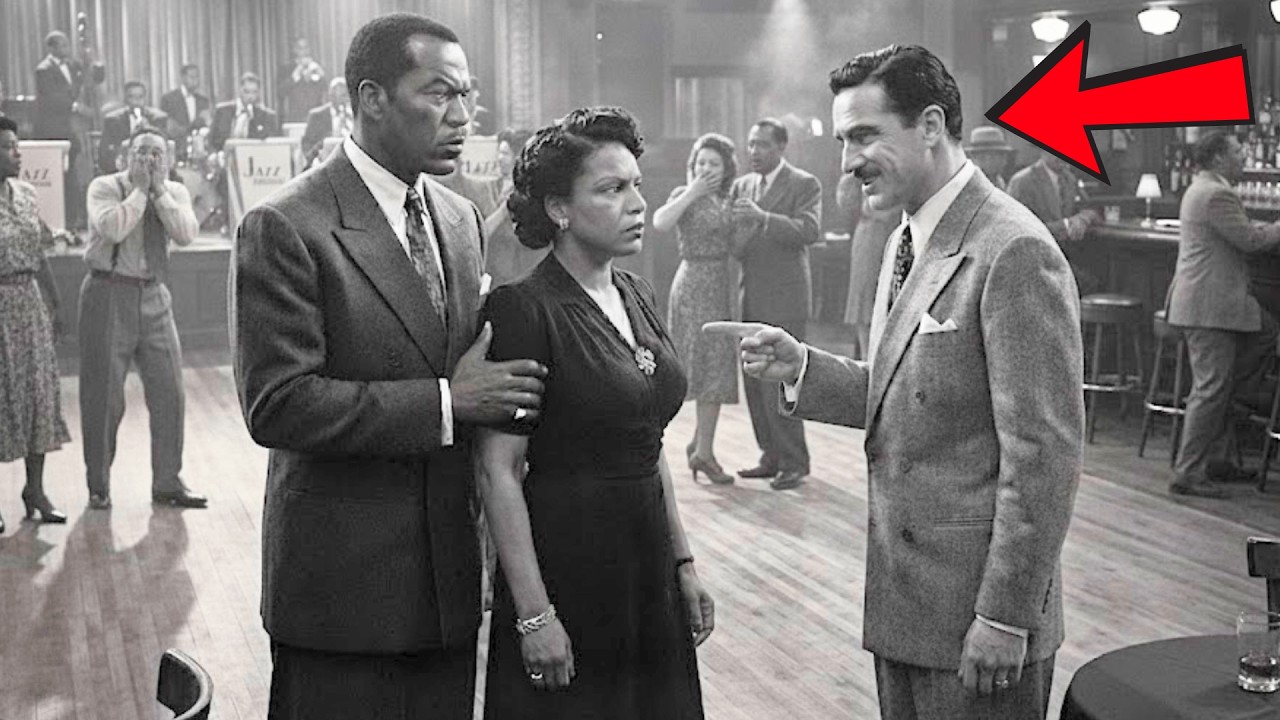
Romano planted both hands on Bumpy's table and demanded fifty percent of the numbers and policy operations. Bumpy said no. Romano laughed too loud and told the older man he was yesterday's news. The tables around them went quiet one by one, the silence spreading like oil on water.
Bumpy asked if he was done. Romano's smile cracked. He wanted anger, shouting, violence. Instead he got stone. So he pivoted to the insult he had been rehearsing. He looked at May, then back at Bumpy.
"I got to be honest, Bumpy, I don't get it," Romano said. "A man with your reputation, your power, and this is what you settle for." He gestured at May like she was furniture. "No offense, sweetheart, but you're not much to look at. Kind of ugly, if we're calling it straight."
The room stopped. May's hand froze on her drink. Her face did not change, but her eyes went somewhere far away. Bumpy stood, slow enough to hear fabric rustle. He was not tall, five foot nine on a good day, but when he rose, the room shrank. He buttoned his jacket, one button then the other, every movement precise. He looked at Romano without speaking, then took May's hand and walked out.
No words. No violence. No reaction. Just silence.
Romano watched them leave and turned to the crowd with his arms spread wide. Nobody cheered. Nobody agreed. They just stared. Some in shock, some in pity, some already counting the hours Romano had left. In Harlem, there was an old rule nobody wrote down. A man who loses his temper loses his throne. But a man who walks away in silence is a man who has already decided how you die.
Harlem did not sleep. It waited. No gunfire cracked through the night. No bodies slumped in alleys come morning. Just silence, thick and heavy, the kind that makes people double-check their locks and kiss their children twice.
Romano kept breathing, kept walking, kept telling anyone who would listen how he made Bumpy Johnson tuck tail and run. But the smart ones, the ones who had lived long enough to see empires rise and fall over a handshake or a bullet, were not laughing. They were counting days like rosary beads.
Over those three days, Bumpy received visitors in his office above the barber shop on 135th Street. A white lawyer named Bradley warned that open conflict would bring police raids and pressure from the mayor. He recommended giving the city a ghost story instead of a war. A Russian information merchant named Polyoff confirmed that Romano was freelancing, that the Genovese family had not greenlighted the move, and that Costello did not even know it happened.
Reverend Henderson, 80 years old and one of the few people alive who used Bumpy's real name, warned that the community was watching. "Nothing, they'll think you're weak," he said. "Too much, they'll think you're reckless. You're walking a razor blade here." His advice was to remind people why they respected Bumpy. Not because he was violent, but because he was just, and justice does not need an audience.
Dorothy Mitchell, who ran a boarding house on 125th Street and knew every woman in Harlem and half their secrets, delivered the message from the women. If Bumpy let the insult pass, it would be hunting season, not just on May but on all of them. But they also trusted him to handle it right. Because Bumpy Johnson did not just protect himself. He protected all of them.
By day three, the decision was made. Not revenge. Correction. Not war. Surgery.
Romano was a creature of habit, and that is what killed him. Espresso at the same cafe every Monday. Card game at the same social club every Tuesday. Lunch with his mother every Wednesday. Dinner at the same restaurant every Friday. He had stopped going to Harlem after the Seavoy, not out of fear but out of victory. He thought he had proven his point.
Bumpy did not need to follow him. He had people who had been watching Romano for years. Waiters, deliverymen, the woman who cleaned the social club and emptied ashtrays full of secrets. They did not report formally. They just mentioned things over coffee. Romano was a creature of habit. You could set your watch by him.
On Tuesday night, February 14, 1950, three days after the Seavoy incident, Romano left his card game early with his pockets full. He told his two enforcers to go home. It was two blocks. He would be fine. They hesitated, but he was the boss that night, flushed with cash and confidence. So they left.
The streets were quiet, too quiet even for a Tuesday. Halfway home, Romano noticed the silence. No cars, no voices from open windows, no cats in alleys. Just his footsteps echoing off brick. Then he heard the engine, smooth and expensive. A black Cadillac turned the corner, headlights off, prowling. It pulled up beside him and stopped. The back door opened.
A voice from inside, calm, almost polite. "Get in, Vincent."
Romano did not run. He did not scream. Deep down, he had known since he walked out of the Seavoy three nights earlier. He got in. The door closed with a soft click, final as a casket lid. The car drove away, slow, no rush. Just another Tuesday night in Little Italy.
Inside, Romano shook and sweated and tried to bargain. The man beside him did not look at him. He raised one hand to stop him. "You disrespected his wife in public. You made him look weak. You think that's just business."
The car drove for three more hours. Three hours of questions, of explanations, of Romano realizing too late that some mistakes cannot be apologized for. By dawn, he was not Vincent Romano anymore. He was just evidence. Just a message. The East River would deliver when the tide was right.
The body surfaced at dawn at Pier 15, the same place the story started. The coroner's report was clinical. Cause of death, drowning. Bruising on the wrists and ankles consistent with restraints. Time of death approximately 48 hours before discovery. Manner of death undetermined. But Mulligan knew. Everyone knew. They just could not prove it.
The newspapers ran it on page six. A small story. Local man found dead in East River. No theories, no investigation promises. Nothing about the Seavoy, nothing about Bumpy Johnson, nothing that connected dots the city did not want connected. Some deaths do not need solving. They just need filing.
In Little Italy, the Genovese family held a quiet meeting above a butcher shop on Mulberry Street. Frank Costello, now the boss with Luciano in exile, listened as his consigliere Gianelli laid out the facts. Romano had gone to Harlem without permission, tried to shake down Bumpy Johnson, insulted his wife in public, and made it personal and visible. Now he was dead.
"We can go to war over a soldier who disrespected our arrangement with Harlem," Costello said. "Or we can accept that he got what he deserved and move on." If they retaliated, they would break an agreement that had made them rich for fifteen years. Bumpy did not start this. Romano did. Bumpy just finished it. Clean, quiet, no war, no publicity, no heat on any of them.
As far as the organization was concerned, Vincent Romano never worked for them. He was a freelancer, a nobody. And nobody cries over nobodies.
In Harlem, the response was different. More subtle. More powerful. There was no celebration, no victory party, no speeches about justice being served. Just a collective exhale, a release of tension nobody realized they were holding. Women at the market nodded to each other. Men at the barber shop went back to arguing about baseball and boxing. The world was back in order.
Reverend Henderson mentioned it in his Sunday sermon without naming names. "There are rules in this world that don't get written down," he said. "Rules that exist because we agree they should. And when those rules get broken, the world has a way of correcting itself. Not through revenge, through balance, through the understanding that respect isn't optional. It's the foundation of everything."
That afternoon, Bumpy sat in his office. Polyoff entered and delivered the message. Costello's people had reached out through an unofficial channel. The agreement stood. No retaliation, no heat. Business as usual. Romano was never authorized. What he did at the Seavoy was a personal matter, handled privately.
Bumpy took a drag of his cigarette and let the smoke out slow. "So, we're clear." They were clear.
That night, the Seavoy Ballroom opened again. Music playing, dancers spinning, life returning to normal. Bumpy and May walked in to the same table, the same corner, the same routine. But everything was different now. The room watched them enter, not with fear, with respect. The kind that does not need to be demanded. The kind earned through silence and patience and knowing when to act and when to let the river do the talking.
Romano's name was never mentioned again. In Harlem, the dead only matter when their deaths teach lessons. And Vincent Romano's lesson was simple. Some men talk about power. Others just have it. The difference between the two is measured in days. Specifically, the three days between disrespect and consequence.
The story did not stay in Harlem. It spread through kitchen windows where coffee boiled and truth got served without sugar. At Dorothy Mitchell's boarding house, six women sat around a table shelling peas while Billie Holiday sang low on the radio. Pearl, the youngest, brought the news that Romano had been found in the river. Dorothy did not look up from her work.
"What happens to foolish men isn't our concern," she said. But she set down the pod and looked at Pearl with eyes that had witnessed forty years of Harlem funerals. "People say a lot of things. Child, doesn't make them true. Doesn't make them safe to repeat either."
Then she said what was their business. What that dead man said about May Johnson before he got dead. Called her ugly, loud enough for two hundred people to hear, like she was livestock he could grade and dismiss. Loretta, 56, who cleaned houses downtown, nodded slowly. She was used to disrespect from white folks. But if that poison started in Harlem, from men who looked like their sons and brothers, then they had lost everything that mattered.
"Family isn't a bargaining chip," Dorothy said. "Never was. Any man who thinks he can use someone's wife to score points in his dirty little games needs to learn different. Needs to learn permanent."
She explained the difference between violence that destroys and violence that protects. Romano's violence tried to destroy May's dignity, tried to make her less than human in front of her community. That was the kind that spreads like cancer. What happened to Romano was the kind that cuts out the cancer before it kills the patient. If Bumpy had swallowed the insult, every two-bit thug from Harlem to Brooklyn would have known they could disrespect their women without consequence.
By Sunday, every woman in Harlem knew the story. Not because preachers told it, but because mothers whispered it while braiding daughters' hair and grandmothers spoke it while rocking babies to sleep. The message traveled on voices that never rose above conversation but carried weight like iron. Bumpy Johnson protected his wife, which meant he protected all of them.
Meanwhile, the Italians were learning new vocabulary. Words like respect and boundaries and consequences. The Monday after Romano became river debris, two Genovese representatives parked outside Curtis's barber shop. They climbed the narrow stairs to Bumpy's office. Duca, gray-templed and expensive, entered first, with a younger man named Moretti behind him, watching and learning.

Duca extended his hand. Bumpy shook it, firm and professional, no warmth, no hostility. They sat in the wooden chairs, which creaked different notes of discomfort. Duca confirmed that the arrangement continued without alteration. The numbers operation remained under Bumpy's management, his territory, his rules. They collected their percentage as agreed fifteen years earlier when Luciano and Bumpy established terms.
Then Duca addressed the incident. What Romano said about May Johnson was unacceptable, unprofessional, unauthorized. He acted alone. "How the situation resolved itself, we have no objections, no complaints, no desire for retaliation or escalation," Duca said. "As far as we're concerned, Romano created a problem and the problem solved itself."
Bumpy tapped ash into a glass tray. "Anything else?"
Duca leaned forward. "Just this assurance. The men we send to Harlem from this day forward will be respectful, professional. They will conduct business and nothing more. No provocations, no insults, no attempts to test boundaries or renegotiate terms. We understand the rules now clearly."
Bumpy studied him for a long moment, then nodded once. "Good. Because I don't believe in warnings. I don't believe in second chances. I believe in clarity. And what happened to Romano provided clarity for everyone. You understand what I'm saying?"
Duca nodded. As they moved toward the door, Bumpy's voice stopped them. "Your boy Romano, he thought talking loud made him powerful. Thought disrespecting my wife would make him look strong to his friends. You know what it actually did? It proved he didn't understand power at all. Real power doesn't announce itself. Doesn't need an audience. It just is. Like gravity. Like winter. You don't negotiate with it. You just accept it and adjust accordingly."
He stubbed out his cigarette. "Make sure your people understand that. Because the next man who forgets won't get three days to reconsider his choices. He'll just stop making choices entirely."
Duca and Moretti left. The stairs creaked their descent. The shop door opened and closed. The Chrysler started and drove away. Curtis appeared in the doorway with his broom, always sweeping, always listening. "They learn," he said.
Bumpy lit another cigarette. "They remembered. Different thing. Learning means discovering something new. Remembering means you forgot something important and paid for the education."
That afternoon, word spread through Little Italy like fire through dry kindling. New directive from Costello himself. Anyone conducting business in Harlem shows complete respect. No exceptions, no excuses. Break this rule and the organization will not protect you, will not avenge you, will not even claim you existed. The young punks grumbled into their beers. The old-timers nodded into their espressos. They remembered the early days before the agreement, when every street corner was a battlefield and every handshake might precede a bullet. Peace is profitable. War is expensive. And Romano's body floating in the East River was a receipt everyone could read.
By week's end, the change was visible. Italian runners collecting policy money knocked before entering. They said sir and ma'am. They counted money quickly and left immediately. No lingering, no small talk. Just business. Not fear. Something better. Respect. The kind built on understanding that some lines exist for good reason, and crossing them has consequences that make headlines in the obituary section.
Three months later, in May 1950, the story had become gospel in a pool hall on 145th Street. Three young men huddled in the back corner, early twenties, sharp suits bought on credit. Marcus, with a scar over his left eye, held court. He told the story the way old women recite scripture.
"I'm telling you straight, Bumpy didn't touch Romano for three whole days," Marcus said. "Just sat there, took the insult, let that Italian bastard walk around bragging about how he made the king of Harlem back down like a whipped dog."
Tommy, shorter and skeptical, shook his head. "That makes zero sense. You let a man disrespect you in public like that, call your wife ugly in front of two hundred witnesses, you lose everything."
Marcus grinned. "That's exactly what Romano thought. That's why his corpse floated up bloated and purple with river water in his lungs and terror frozen on his face. See, Bumpy understood something fundamental that most of these young fools running around here will never comprehend."
Jerome, the quietest of the three, who read books when nobody was watching, leaned in. "What did he understand?"
"He understood that when you react immediately, when you let rage drive the engine, you're playing their game," Marcus said. "But when you wait, when you take time to think and plan and prepare every single detail, that's when you control everything. That's when you're conducting the orchestra and everyone else is just playing notes you already wrote."
Tommy frowned. "Waiting makes you look weak."
"To stupid people, yeah. To people who confuse volume with power and violence with strength. But to people who actually survive long enough to go gray, patience looks like the most terrifying thing in the world. Because patient men don't fight battles. They win wars."
Jerome nodded slowly. "So the three days wasn't hesitation. It was calculation."
"Exactly right," Marcus said. "Bumpy used those three days to gather intelligence, talk to lawyers about legal exposure, confirm Romano was freelancing without Genovese approval, understand the political landscape, make absolutely certain that when he moved, it wouldn't ignite a war. It would simply solve a problem that needed solving."
And most importantly, he used those three days to let Romano get comfortable. Let him establish predictable routines. Let him walk the same streets, eat at the same cafes, play cards the same Tuesday nights like clockwork. Like a man who did not understand he was already dead, just had not kept the appointment yet.
The story spread from that pool hall like fever through packed tenements. It traveled through Harlem, changing shape slightly with each telling, gaining details, losing others. But the core remained solid as bedrock. Three days. That is the space between disrespect and reckoning. That is how long patience wears the disguise of weakness before revealing itself as the sharpest blade nobody saw coming.
Mothers told it to sons over breakfast. Don't be like Romano. Don't think running your mouth makes you powerful. Real power sits quiet, watches, waits, then moves so completely that nobody needs explanations because everybody already understands. Fathers told it to daughters walking them home from school. Find yourself a man like Bumpy Johnson. Not the loudest man demanding attention. Find the one who does not need to prove anything because everyone already knows.

Reverend Henderson referenced it on Sunday morning, careful, never naming names, but every soul in those pews knew exactly what he meant. "There's a time for turning the other cheek," he said. "But there's also a time, and scripture is abundantly clear on this, for driving the money changers from the temple, for standing against those who would defile what's sacred. Wisdom isn't about always choosing peace. It's about knowing when peace serves justice and when justice requires righteous action that others might call violent, but God calls necessary."
By summer, "three days" had become code shorthand. Everyone understood without explanation. A man causes trouble at a club, grabs women wrong, says things that should not leave sewers, much less mouths. The bouncer does not throw him out, just watches, remembers the face. Three days later, that man discovers he is unwelcome everywhere. Banned, blacklisted, no violence, no confrontation. Just consequences arriving like mail. Nobody ordered it, but everyone expected it.
Eight months after Romano's body surfaced, in October 1950, Harlem settled into a rhythm it had not felt since before the war. Autumn arrived cold, leaves turning colors that reminded old folks of blood and gold and beautiful things dying. The numbers operation ran smooth as aged bourbon. Runners collected bets from shoe shine stands and barber shops. Money flowed uptown and downtown. The Genovese took their percentage. Nobody complained. Nobody renegotiated. Nobody forgot the lesson written in river water and three days of silence.
On a Thursday night at the Seavoy Ballroom, eight months after Romano's mouth signed a check his life could not cover, the place was packed. The band played fire. Italian representatives still came for business, but they arrived changed, like men who had visited church and actually heard the sermon instead of just sitting through it.
That night, Duca brought fresh meat. A kid named Rizzo, 25, first time uptown, wearing a suit too expensive for his rank and a watch too shiny for his status. They took a back table, not Bumpy's corner, which was sacred ground, but close enough to see it. Close enough to learn through proximity what words cannot teach.
Duca ordered whiskey, neat, and leaned close to Rizzo. "See that corner booth? That's Bumpy Johnson's table. Has been fifteen years. You don't approach uninvited. You don't stare too long. You definitely don't make eye contact unless he initiates. You understanding me crystal clear?"
Rizzo nodded, cocky, young, stupid in ways that used to be fatal before Duca started teaching caution. "I heard about Romano. But that was almost a year ago. Things change. People forget."
Duca's face went granite. He grabbed Rizzo's wrist under the table, gripped tight enough to bruise. "Listen very carefully because I'm only saying this once. Things don't change in Harlem unless Bumpy Johnson decides they change. Romano thought things changed. Romano thought youth and ambition rewrote rules written in blood and memory. You know where Vincent Romano is right now?"
Rizzo swallowed hard. "Dead."
"Dead. Floating in the East River with water in his lungs. And nobody, not his mother, not his friends, not the organization, is asking questions. Because when you disrespect Bumpy Johnson, you're not disrespecting one man. You're disrespecting an agreement that's kept peace and made everyone rich for fifteen years."
Duca released his wrist and drank, letting the whiskey burn away anger before it became action. "Here's how this works. We come to Harlem. We conduct business. We're polite, professional, respectful. We don't raise voices. We don't make threats. We don't comment on anyone's family. We collect what's owed, pay what we owe, and leave clean. Simple. Can you handle basic human decency, or do I need someone smarter?"
Rizzo nodded, cockiness evaporated, replaced by wisdom purchased with someone else's life. "Yes, sir. I understand completely."
Across the room, Bumpy watched the exchange. He could not hear the words and did not need to. Body language spoke volumes. Duca teaching a new generation, passing down rules like sacred scripture, making sure lessons outlive teachers. May noticed her husband watching and followed his gaze. "They're learning," she said.
Bumpy sipped his bourbon. "They're remembering. Different thing. Learning means discovering something new. Remembering means forgetting something critical and paying tuition in blood."
"Will it last?"
Bumpy considered, taking time for an honest answer instead of an easy one. "Nothing lasts forever. Eventually, someone new arrives who didn't witness Romano. Someone who thinks he's smarter, faster, more dangerous, and he'll test boundaries again because humans forget lessons they didn't learn personally."
"What will you do?"
Bumpy was quiet, then turned to her, eyes sad, a weary man who had taught the same lesson too many times and knew he would teach it again. "Same thing I did to Romano. Because the lesson doesn't change. Only the students do."
The music shifted to a slower ballad. Couples drifted to the floor. Bumpy stood and extended his hand. "Dance with me." They moved to the floor, not performing, just a man and wife dancing where eight months earlier someone had made a fatal miscalculation. People watched, not staring, just noticing the way you notice landmarks that define geography and memory. That is Bumpy Johnson. That is the line you do not cross. Not written in law. Not spoken in court. Just understood. The way gravity is understood. The way consequences are understood.
Later, after midnight, Bumpy stood on his balcony looking over Harlem, windows glowing, leaves continuing to fall. His territory. His responsibility. He thought about Romano, not with satisfaction or regret, just recognition that some things are necessary. That maintaining order sometimes requires demonstrating what happens when order breaks.
Tomorrow runners would collect bets again. Money would flow again. Business as usual. But underneath, something was different, permanent. The old order said Harlem could be tested. The new order said test it once. There would not be twice.
Power does not need signatures, just understanding. And after Romano, there were no more questions. Just answers written in water and remembered in whispers. The East River still flows. The Seavoy still plays music every Thursday night. But after February 1950, nobody ever called Bumpy Johnson's wife ugly again. Not in public, not in private, not even in whispered thoughts.
This story is not about revenge. It is about choice. When challenged in front of witnesses, you can react immediately, swing fists, raise your voice, win the moment, but lose the war. Or you can do what Bumpy did. Walk away. Wait three days. Teach a lesson so complete it gets passed down like scripture.
Romano chose volume. Bumpy chose silence. Romano has been dead for decades. Bumpy's name still commands respect. That is the difference between men who talk about power and men who have it.